Month: February 2023
Sentences to ponder
Importantly, we find that bans or restrictions that specifically target “assault weapons” increase demand for handguns, which are associated with the vast majority of firearm-related violence.
That is from a new NBER working paper by Sarah Moshary, Bradley Shapiro, and Sara Drango.
Monday assorted links
1. Jeffrey Flier on the diversity of institutions supporting biomedical research.
2. When do bureaucrats die prematurely?
3. LLMs can teach themselves to use tools.
4. Where Rihanna’s wealth comes from.
5. Japanese trade and stalled racial progress.
6. You will be able to stream the Chinese Three-Body Problem TV show (NYT).
7. Smart essay on why this guy chose a job at OpenAI instead of academia.
Cheating Teachers
Chalkbeat: New York City schools will once again grade their own students’ Regents exams, a policy that officials scrapped a decade ago amid concerns that educators were systematically nudging scores over the passing cutoff.
New York’s Regency exam is a statewide system of standardized, exit exams for secondary school students. Traditionally, the exam was graded by teachers from the same school as the student, i.e. the student’s teachers. The exam had two cutoffs, 55 for a “local diploma” and 65 for the higher-level “Regent’s diploma.” The distribution of grades during the home-school grading period shows clear spikes in the number of students just passing the 55 and 65 point cutoffs (and consequent dips in the number of students just failing). From an excellent paper by Dee, Dobbie, Jakob and Rockoff.
Is this altruism on the part of the teachers? Maybe. But the teachers are also graded on the number of their students who pass the exam.
The home-school grading system was dropped around 2011 due to bad publicity about the rampant cheating. It’s quite amazing that not a single good reason has been given for returning to the home-school grading system but the teacher’s union has been pressuring to return to the easier to manipulate system.
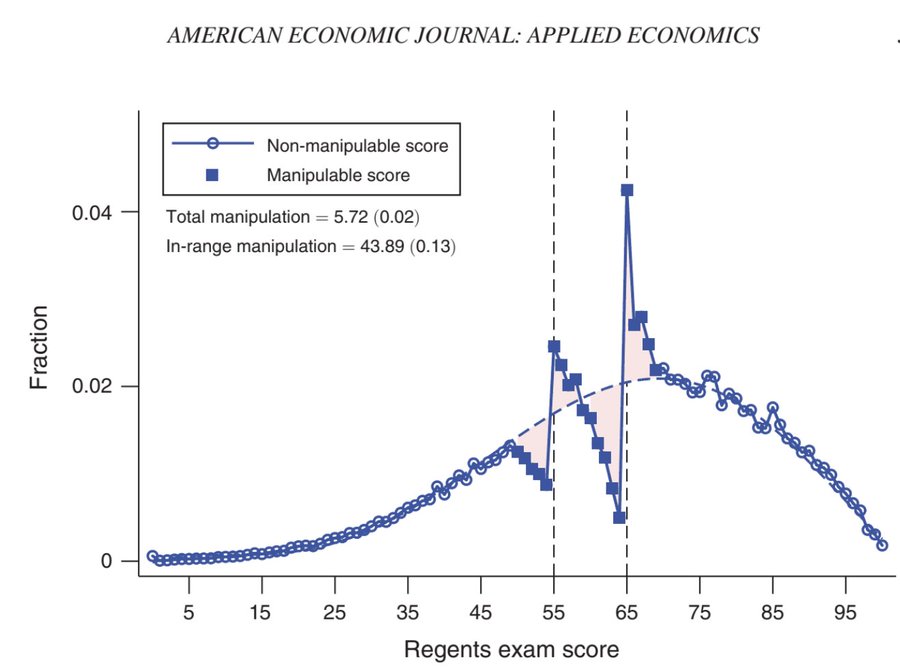
Hat tip: Thomas Dee.
The underrated story of 2023
A fresh round of IMF bailouts is underway, and some of the world’s most indebted nations will have to sacrifice their currencies to get them.
The year has already seen three debt-laden countries — Egypt, Pakistan and Lebanon — drop their exchange rates to unlock International Monetary Fund assistance. That may be just the beginning. With at least two dozen nations queuing up before the Fund for rescue packages, currency traders are bracing for a potential fresh wave of devaluations in the developing world…
“Currency devaluation makes a number of equity markets in the smaller emerging and frontier universe untouchable,” Malik said, naming Argentina, Egypt, Ghana, Lebanon, Nigeria, Pakistan, Sri Lanka and Zimbabwe.
Here is more from Bloomberg.
*The Guest Lecture*
The author is Martin Riker, and this is a story about a jobless economics professor about to give a lecture. She is nervous, and her thoughts rapidly turn to Keynes, including his “Economic Possibilities for Our Grandchildren” essay. She ponders the problems of the world, her husband and daughter, and Keynes, Keynes, Keynes, chatting with him throughout. On pp.54-55 Deirdre McCloskey surfaces and plays a role in the story, which shifts to the scene of a trial.
I don’t want to spoil anything, but suffice to say there are some non-literal meanings of what is happening in these pages. Overall, this is one of the more significant modern examples of a very direct overlap of economics and fiction.
You can buy it here. Here are various reviews.
Okie-dokie
BREAKING: Pentagon says they don’t know how the shot down "objects" stayed afloat, says they don’t have reason to believe they’re from China.
What is your theory?
— Collin Rugg (@CollinRugg) February 13, 2023
The trajectory of ESG
ESG was kind of a fad pic.twitter.com/k4pLSGdvgb
— Noah Smith 🐇🇺🇸🇺🇦 (@Noahpinion) February 12, 2023
Sunday assorted links
2. Against Hersh on Nord Stream.
3. Claims about filter updates.
4. Claims from the Yale economics department about Japan (NYT).
5. Knock at the Cabin is quite a good movie.
6. Alireza to the fashion world!? And Stockfish vs. ChatGPT.
All “wacky” links today!
Shooting down intruders?
What are your comments and rigorous analyses (notice the prompt) on the recent shoot downs? And no, I do not mean the Chinese balloons. Comments are open…
Tap the Yellowstone Super-volcano!
I applaud this kind of big think!
The USA is confronted with three epic-size problems: (1) the need for production of energy on a scale that meets the current and future needs of the nation, (2) the need to confront the climate crisis head-on by only producing renewable, green energy, that is 100% emission-free, and (3) the need to forever forestall the eruption of the Yellowstone Supervolcano. This paper offers both a provable practical, novel solution, and a thought experiment, to simultaneously solve all of the above stated problems. Through a new copper-based engineering approach on an unprecedented scale, this paper proposes a safe means to draw up the mighty energy reserve of the Yellowstone Supervolcano from within the Earth, to superheat steam for spinning turbines at sufficient speed and on a sufficient scale, in order to power the entire USA. The proposed, single, multi-redundant facility utilizes the star topology in a grid array pattern to accomplish this. Over time, bleed-off of sufficient energy could potentially forestall this Supervolcano from ever erupting again. With obvious importance to our planet and the research community alike, COMSOL simulation demonstrates and proves the solution proposed herein, to bring vast amounts of green, emission-free energy to the planet’s surface for utilization. Well over 11 Quadrillion Watt hours of electrical energy generated over the course of one full year, to meet the current and future needs of the USA is shown to be practical. Going beyond other current and past research efforts, this methodology offers tremendous benefits, potentially on a planetary scale.
From Yellowstone Caldera Volcanic Power Generation Facility: A new engineering approach for harvesting emission-free green volcanic energy on a national scale by Arciuolo and Faezipour.
Hat tip: nvo.
What I’ve been reading
1. Trevor Latimer, Small Isn’t Beautiful: The Case Against Localism. I say the correct answer here is culturally specific. Nonetheless this is a good and useful book marshaling arguments against localism and in favor of centralization, including with respect to the value of liberty.
2. Mario Vargas Llosa, The Call of the Tribe. On the thinkers who have influenced him, including Adam Smith, Hayek, Berlin, Popper, and Ortega y Gasset, among others. All of the chapters I quite liked. The story of the meeting of Berlin and Akhmatova I had not known. Not consummated, but intensely erotic and unforgettable for both of them.
3. Philip K. Howard, Not Accountable: Rethinking the Constitutionality of Public Employee Unions. I am not sure about the “unconstitutionality” point, but the rest of this critique is right on target. Is this the next frontier for supply-side progressives?
4. Philip Bowring, The Making of the Modern Philippines: Pieces of a Jigsaw State is a good overview and in general I favor explanatory, country-specific books. Once again, low productivity in agriculture is a big problem.
5. Aidan Cottrell-Boyce, The End of Nightwork is a Northern Irish speculative fiction tale about a group of people who stay a physical age for a long period of time, and then suddenly age many years at once. Uneven, but mostly interesting (I finished it).
There is Daniel Akst, War by Other Means: The Pacifists of the Greatest Generation Who Revolutionized Resistance.
Bill Hammack, The Things We Make: The Unknown History of Invention from Cathedrals to Soda Cans. From an engineering perspective.
There is also Bent Flyvbjerg and Dan Gardner, How Big Things Get Done: The Surprising Factors that Determine the Fate of Every Project, from Home Renovations to Space Exploration, and Everything in Between.
Useful is The Loss of Hindustan: The Invention of India, by Manan Ahmed Asif.
Russia fact of the day
Turkish Airlines plans to run daily flights from Istanbul to Buenos Aires from September, up from four times a week in 2022. Weekly flights to São Paulo will increase from seven to 11 times this year, the company said. While the airline explained that demand for these routes was “quite balanced” between the countries, travel agencies in Argentina indicated that it was primarily due to flights from Turkey.
Turkey is less hospitable to Russian migrants than before, and thus it comes to this:
So many Russian babies are being born in the Brazilian city of Florianópolis that parents are banding together to hire an Orthodox priest to baptise the newest members of their families.
Here is the full FT story by Lucinda Elliott. I also would point your attention to this excellent FT long read on the decline of Barcelona. Remember the Catalonian independent movement? Well, here is what that actually brought about — a shrinking of maintenance and investment.
Saturday assorted links
1. My “return of inflation” idea seems to be occurring.
2. New film about the new British science agency ARIA, a kind of British Darpa. Brought to you by Works in Progress.
3. Okie-dokie: “Smoking cannabis on the street in Amsterdam’s red light district will soon be illegal, the city council has announced, as part of a range of bylaws designed to deter tourist excesses and make life more bearable for despairing local people.” And: “The city is still investigating a possible ban on stag and hen parties and the mayor wants to bar tourists from its cannabis coffeeshops.”
4. Tax system of the Faroe Islands.
5. Carlos Saura has passed away, RIP.
6. Good, longish article on how to think about GPTs. The best parts are extremely insightful.
Trapped in Anti-Racist Hell
Then all nine remaining students entered, each carrying a piece of paper. One by one they read a paragraph….I had used racist language. I had misgendered Brittney Griner. I had repeatedly confused the names of two black students. My body language harmed them. I hadn’t corrected facts that were harmful to hear when the (now-purged) students introduced them in class. I invited them to think about the reasoning of both sides of an argument, when only one side was correct….
One might be tempted to dismiss this as another old, white male complaining about the kids but the speaker is Vincent Lloyd, highly-regarded director of Africana Studies at Villanova and the author of Black Dignity, “a radical work by one of the leading young scholars of Black thought…an effort to describe the philosophy underlying the Black Lives Matter movement.”
I have no doubt that I would disagree with much of what he has to say but Lloyd has a calling, he believes in his students, in the virtue of teaching and in the power of the humanities to make us better:
…a seminar requires patience. Day by day, one intervention builds on another, as one student notices what another student overlooked, and as the professor guides the discussion toward the most important questions. All of this is grounded in a text: Specific words, phrases, arguments, and images from a text offer essential friction for conversation, holding seminar participants accountable to something concrete. The instructor gently—ideally, almost invisibly—guides discussion toward what matters.
The seminar assumes that each student has innate intelligence, even as we come from different backgrounds, have different amounts and sorts of knowledge, and different skills. We can each be formed best if we take advantage of our differing insights to push each other, over time, again and again. When this practice is occasioned by carefully curated texts—not exclusively “great books,” but texts that challenge each other and us as they probe issues of essential importance—a seminar succeeds.
A seminar takes time. The first day, you will be frustrated. The second and the third day, you will be frustrated. Even on the last day, you will be frustrated, though ideally now in a different way. Each intervention in a seminar is incomplete, and gets things wrong. Each subsequent intervention is also incomplete, and also gets things wrong. But there are plenty of insights and surprises, for each participant looks at a text with different eyes.
It is tempting to add: Such is life. Such is democratic life. We each have different, partial knowledge. We each get things wrong, over and over. At our best, we enter the fray by listening to each other and complementing and challenging the insights of our fellows. In the process, over years, decades, we are oriented toward justice and truth.
You can feel Lloyd’s pain when his students reject this gift.
Read the whole thing.
My science remarks at the AEI metascience forum
Jim Pethokoukis has transcribed some of them, here is one bit:
There’s a commonly noted productivity slowdown in the Western world starting in 1973 that I and some other people here have written about. I think one neglected factor behind this slowdown is just the destruction of the German-language speaking and central European scientific world, which starts in the 1930s and culminates in World War II. On top of that, you have the Holocaust. The fruits of science take a long time. So if you’re entranced with AI, that is ultimately the result of someone earlier having come up with electricity — Tesla, Edison, others. So before the 1930s, central Europe and Germany is by far the world’s most productive scientific area. And which factors organizationally were behind those successes? To me, that feels dramatically understudied. But you have a 10-, 15-year period where essentially all of that goes poof. Some of it comes over here to the US, a bit to Great Britain, but that’s really a central event in the 20th century. You can’t understand 20th century science without thinking very hard and long about that event.
But in terms of more approximately and more recently, here’s how I would put the importance of metascience or how science is done. It’s how science is done better that will get us out of the Great Stagnation. I don’t think that doing it worse is what got us into the Great Stagnation. So when it comes to what got us into the Great Stagnation, I think the number one culprit is simply we exhausted a lot of low-hanging fruit from combining fossil fuels with powerful machines. At some point, enough people have cars and you get the side airbag. Your CD player has better sound, now you hook in your smartphone or whatever. Those are nice advances, but they’re not really fundamental to the act of driving. So there’s just an exhaustion that happens.
There are other factors, there’s an increase in the level of regulation in a number of ways, some good, some bad, but it’s still going to slow down some amount of progress. And then the energy price shock in 1973 combined with our unwillingness to really go large with nuclear power, right? So all that happening more or less at the same time. And then a few decades earlier, the world took this huge, you know, wrenching gut blow. Now this all means actually, you should be quite optimistic about the future. Here’s the trick to the whole hypothesis, the counterintuitive part. So let’s say the Great Stagnation is not caused by science being done worse. As we’re probably now coming out of the Great Stagnation, we have mRNA vaccines, right? We have ChatGPT, a lot of advances in green energy. Maybe they’re not all sure things yet. Other areas like quantum computing, not a sure thing yet, but you can see that a lot might be coming all based in this new fundamental technology. You could call it computing.
So the hurdle that science has to clear to get us out of those accumulated institutional and low-hanging fruit barriers, that’s a higher hurdle than it used to be. So if the current scientific advances are clearing that higher hurdle, you should actually be quite optimistic about them because they’ve passed through these filters. So you have these other developments. Oh, ‘90s internet becomes more of a thing. Well, that was nice for a few years, you know, Walmart managed its inventory better. 1995 to 1998 productivity goes up, wonderful. That dwindles away. It’s then all worse again. If we really are now clearing all the hurdles, you should be especially optimistic. But it also means science policy, how science is done, how it’s organized, how it’s funded is way more important than during all those years. Those years when we were stuck, you were reshuffling the deck chairs. Not on the Titanic, but what’s like a mediocre company that just keeps on going. I don’t want any name names, but there’s a bunch of them. You were reshuffling the deck chairs there, and now we’re reshuffling the hall enterprise. It’s a very exciting time, but science matters more than ever.
There is more at the link, good throughout.