The Capital Strike
Roosevelt went on in later weeks to speculate that the slowdown in investment was not economically explicable but was, rather, part of a political conspiracy against him, a "capital strike" designed to dislodge him from office and destroy the New Deal…In a reprise of his tactics in the "wealth tax" battle of 1935 and the electoral campaign of 1936, Roosevelt loosed Assistant Attorney General Robert Jackson, along with Ickes, to give a series of blistering speeches in December 1937. Ickes inveighed against Henry Ford, Tom Girdler and the "Sixty Families,"…Left unchecked, Ickes thundered, they would create "big-business Fascist America – an enslaved America." For his part, Jackson decried the slump in private investment as "a general strike – the first general strike in America – a strike against the government – a strike to coerce political action." Roosevelt even ordered an FBI investigation of possible criminal conspiracy in the alleged capitalist strike, but it revealed nothing of substance.
(From David M. Kennedy’s Freedom from Fear (p. 352) in The Oxford History of the United States.)
A group of capitalists go on strike to protest a government that is confiscating their wealth. The government vows to force them back to work and sets agents on their trail. Hmmm…..seems like there could be a novel in that.
Leave your comments here on Keynes and money wages
This is Tyler, not Alex, but typepad is again not accepting comments on my posts for technical reasons. Typepad, please clear up this problem!
In the meantime, you can leave your comments here.
The Next Crisis
It’s not just Social Security and Medicare which are underfunded. State governments have vastly underfunded public pensions. Here is the abstract to a new NBER paper, The Intergenerational Transfer of Public Pension Promises by Novy-Marx and Rauh.
The value of pension promises already made by US state governments will
grow to approximately $7.9 trillion in 15 years. We study investment
strategies of state pension plans and estimate the distribution of
future funding outcomes. We conservatively predict a 50% chance of
aggregate underfunding greater than $750 billion and a 25% chance of at
least $1.75 trillion (in 2005 dollars). Adjusting for risk, the true
intergenerational transfer is substantially larger. Insuring both
taxpayers against funding deficits and plan participants against
benefit reductions would cost almost $2 trillion today, even though
governments portray state pensions as almost fully funded.
It’s official.
It began (pdf) in December 2007.
Interpreting the Monetary Base Under the New Monetary Regime
The monetary regime has changed and, as a result, many people are misinterpreting the recent increase in the monetary base. Paul Krugman, for example, posts the picture  at right. His interpretation is that the tremendous increase in the base shows that the Fed is trying to expand the money supply like crazy but nothing is happening, i.e. a massive liquidity trap. (Krugman is not alone in this interpretation, see e.g. this post by Bob Higgs). Thus, Krugman concludes, Friedman was wrong both about monetary history and monetary theory.
Krugman’s interpretation, however, neglects the fact that the monetary regime changed when the Fed began to pay interest on reserves. Previously, holding reserves was costly to banks so they held as few as possible. Since Oct 9, 2008, however, the Fed has paid interest on reserves so there is no longer an opportunity cost to holding reserves. The jump in reserves occurred primarily at this time and is entirely under the Fed’s control. The jump in reserves does not represent a massive attempt to increase the broader money supply.
Here’s a bit more background. When no interest was paid on reserves banks tried to hold as few as possible. But during the day the banks needed reserves – of which there were only $40 billion or so – to fund trillions of dollars worth of intraday payments. As
a result, there was typically a daily shortage of reserves which the Fed made up for by extending hundreds of billions of dollars worth of daylight credit. Thus, in essence, the banks used to inhale credit during the day – puffing up like a bullfrog – only to exhale at night. (But note that our stats on the monetary base only measured the bullfrog at night.)
Today, the banks are no longer in bullfrog mode. The Fed is paying interest on reserves and they are paying at a rate which is high enough so that the banks have plenty of reserves on hand during the day and they keep those reserves at night. Thus, all that has really happened – as far as the monetary base statistic is concerned – is that we have replaced daylight credit with excess reserves held around the clock. The change does not represent a massive injection of liquidity and the increase in reserves should not be interpreted as evidence of a liquidity trap.
Addendum: (For the truly wonkish.) If you want more, see my earlier post on excess reserves, posts by Jim Hamilton, and David Altig, and especially two very useful Fed articles, Keister, Martin, and McAndrews (n.b. the last section) and Ennis and Weinberg.
Comments on Prebisch and other matters of the day
This is Tyler here, not Alex. For some reason Typepad denies the comments function to my posts only. If you would like to leave comments on the Prebisch post, or other matters of the day, please use the comments section to this entry. I do hope the problems are resolved soon and like Alex I wish you all a happy Thanksgiving. You should be grateful for what you have received in life but also think what you might do in the year to come to assist others.
Happy Thanksgiving
I have a great many things to be thankful for and will be reflecting on them today. I wish all our readers the very best.
Atlas Shrugged – Updated
"Damn it, Dagny! I need the government to get out of the way and let me do my job!"
She sat across the desk from him. She appeared casual but confident, a slim body with rounded shoulders like an exquisitely engineered truss. How he hated his debased need for her, he who loathed self-sacrifice but would give up everything he valued to get in her pants … Did she know?
"I heard the thugs in Washington were trying to take your Rearden metal at the point of a gun," she said. "Don’t let them, Hank. With your advanced alloy and my high-tech railroad, we’ll revitalize our country’s failing infrastructure and make big, virtuous profits."
"Oh, no, I got out of that suckers’ game. I now run my own hedge-fund firm, Rearden Capital Management."
"What?"
The story, which is awesome, continues here. A big hat tip to Phil Izzo at WSJ’s Real Time Economics.
Wind Farming
President-elect Obama has called for the creation of more "wind farms." Before jumping on that bandwagon, however, we ought to take a look at West Texas where wind farmers are farming subsidies almost as well as their agricultural cousins and, as a result, they are paying distributors to take their power. Mike Giberson has the story:
In the first half of 2008, [electricity] prices were below zero nearly 20 percent
of the time…During these negative price periods, suppliers are paying ERCOT to take their power….the negative prices appear to be the result of the large installed capacity of wind generation.
Wind generators face very small costs of shutting down and starting
back up, but they do face another cost when shutting down: loss of the
Production Tax Credit and state Renewable Energy Credit revenue which
depend upon generator output. It is economically rational for wind
power producers to operate as long as the subsidy exceeds their
operating costs plus the negative price they have to pay the market. Even
if the market value of the power is zero or negative, the subsidies
encourage wind power producers to keep churning the megawatts out….You could, as a correspondent put it to me, build a giant toaster in West Texas and be paid by generators to operate it.
If President-Obama is serious about green energy it’s not wind he needs to look at but nuclear. Nuclear is clean and green and we can build power stations where we need power, instead of having to invest in costly and inefficient transport networks.
The Price of Everything
Our colleague, Russ Roberts, will be speaking about his novel novel, The Price of Everything: A Parable of Possibility and Prosperity on Monday at noon at Cato in Washington, D.C. More info here – note that the event is free, which seems peculiar!
A frightening figure
Paul Krugman presents a frightening figure.
The figure [below] shows the real interest rates on corporate bonds, with
the expected rate of inflation from the spread between 20-year TIPS and
20-year Treasury rates. All data monthly, from St. Louis Fed.

I’ve been saying for some time that one of the signs of a credit crunch has got to be rapidly rising real rates – in very recent weeks, that appears to be happening. The timing suggests to me that this is more of a deflation problem than a banking-credit problem per se but at this point who cares – we can probably all agree it’s more bad news.
Addendum: Greg Mankiw is also troubled by what this figure means.
Singapore to Pay Organ Donors
Big news on the effort to alleviate the shortage of human organs:
Singapore is to allow compensation for kidney transplants and for eggs.
A government proposal has been approved by a bioethics committee and
legislation will be introduced early next year.…According
to the BMJ, a sum of S$10,000 was mentioned. According to the Straits
Times, the health minister, Mr Khaw Boon Wan, mentioned "at least a
five-figure sum, possibly even six-figure" as appropriate
reimbursement. This would include expenses, such as transport and
medical costs, as well as loss of earnings. Also, the donor should be
covered for follow-up medical costs and higher insurance premiums as a
result of losing a kidney.
In other big news the National Kidney Foundation (NKF) is reconsidering their long-held opposition to compensation for organ donors. The NKF is surveying people on financial compensation. Marginal Revolution readers can raise the level of discussion and perhaps help save some lives by answering the survey here (it’s very short).
Thanks to Lloyd Cohen and Richard Darling for the pointers.
Now is the Time for the Buffalo Commons
The Federal Government owns more than half of Oregon, Utah, Nevada, Idaho and Alaska and it owns nearly half of California, Arizona, New Mexico and Wyoming. See the map for more. It is time for a sale. Selling even some western land could raise hundreds of billions of dollars – perhaps trillions of dollars – for the Federal government at a time when the funds are badly needed and no one want to raise taxes. At the same time, a sale of western land would improve the efficiency of land allocation.
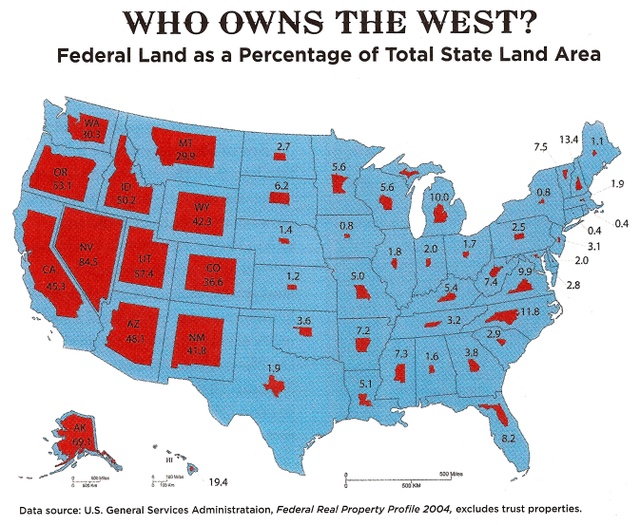
Does a sale of western lands mean reducing national parkland? No, first much of the land isn’t parkland. Second, I propose a deal. The government should sell some of its most valuable land in the west and use some of the proceeds to buy low-price land in the Great Plains.
The western Great Plains are emptying of people. Some 322 of the 443 Plains counties have lost population since 1930 and a majority have lost population since 1990.
Now is the time for the Federal government to sell high-priced land in the West, use some of the proceeds to deal with current problems and use some of the proceeds to buy low-priced land in the Plains creating the world’s largest nature park, The Buffalo Commons.
Hat tip to Carl Close for the pointer to the map.
Credit Card Crunch?
Frankly, I am tired of this topic but every time I try to check the data – as best as I can – it doesn’t seem to support the rhetoric we are hearing from people at the top [despite real problems blah, blah, blah]. Here’s Paulson today:
At least some of the remainder [of the bailout money], Paulson said, should be used to
reinvigorate the market for credit cards, student and auto loans —
which combined account for some 40 percent of consumer credit."This market, which is vital for lending and growth, has for all practical purposes ground to a halt," Paulson said. (emphasis added)
I’ll focus on credit cards. It is true that credit card offers, i.e. junk mail, is down:
…one billion fewer offers mailed during the course of the year.
Households with incomes under $50,000 will receive about 700,000 fewer
offers in 2008 compared to 2007. These households account for the
majority of the cutback and clearly indicate a major change in strategy
by card issuers."The souring economy and industry consolidation have driven volumes
down to levels not seen since 2003 [Crisis! AT]" said Andrew Davidson, Vice
President of Competitive Tracking Services for Synovate’s Financial
Services Group. "Card issuers are taking a more cautious approach, with
lower income and high risk households receiving fewer offers or no
offers at all."
But even so:
Despite the decline in offers for new cards, US consumers still
have access to an increasing amount of credit. Household credit lines
across all cards edged up to an average of $27,626 per household (YTD
3Q 2008) from $26,902 in 2007 despite evidence that issuers are cutting
credit lines on certain customers.…"Much has been reported about issuers reducing credit lines for
certain customers but this is not the case for the majority of people.
Across the industry as a whole, we continue to see credit access and
usage at record high levels" said Davidson.
By the way, after listening to Tyler and me debate this topic Bob Murphy and Megan McArdle decided to run some tests. So if you prefer your data by anecdote you can read Bob’s results here and Megan’s here. I am partial to Megan’s hypothesis #5.
Understanding Fiscal Policy During the Great Depression
My little spat with with Rauchway regarding unemployment during the Great Depression draws in Paul Krugman. Krugman doesn’t respond to any of my arguments but he does give us the old line that fiscal policy didn’t fail during the Great Depression it wasn’t tried.
Now, you might say that the incomplete recovery shows that “pump-priming”, Keynesian fiscal policy doesn’t work. Except that the New Deal didn’t pursue Keynesian policies. Properly measured, that is, by using the cyclically adjusted deficit, fiscal policy was only modestly expansionary, at least compared with the depth of the slump. Here’s the Cary Brown estimates, from Brad DeLong…Net stimulus of around 3 percent of GDP – not much, when you’ve got a 42 percent output gap.
Now there is actually a lot of truth to this but the way in which Krugman, Rauchway, DeLong and others present this point is esoteric and likely to mislead even many economists. What Krugman seems to be saying is that the government didn’t spend enough during the thirties (Rauchway, who also cites Cary Brown, says directly "there was never enough spending to achieve the desired effect.") Yet federal spending during this time increased tremendously. So what is really going on? The answer is actually quite simple.
During the Great Depression federal expenditures increased tremendously but so did taxes. Thus, the reason spending was not stimulative was not that spending wasn’t tried it’s that taxes were also raised to prohibitive levels. But don’t take my word for it. Read Cary Brown (JSTOR) whom Krugman, Rauchway, DeLong all cite but none of whom quote at length. Here is Brown:
The primary failure of fiscal policy to be expansive in this period is attributable to the sharp increases in tax structures enacted at all levels of government. Total government purchases of goods and services expanded virtually every year, with federal expansion especially marked in 1933 and 1934. [But] the federal Revenue Act of 1932 virtually doubled full employment tax yields…
…the highly deflationary impact of this tax law has not been fully appreciated…The Revenue Act of 1932 pushed up rates virtually across the board, but notably on the lower and middle income groups….Personal income tax exemptions were slashed, the normal-tax as well as surtax rates were sharply raised, and the earned-income credit equal to 25 percent of taxes on low income was repealed. Less drastic changes were made in the corporate income tax, but its rate was raised slightly and a $3000 exemption eliminated. Estates tax rates were pushed up, exemptions sharply reduced, and a gift tax was provided. Congress toyed with a manufacturers’ sales tax, but finally rejected it in favor of a broad new list of excise taxes and substantially higher rates for old ones….
The Revenue Act of 1932 was followed by many further tax increases (e.g. Brown notes "…social security taxes began in 1937 to exert a pronounced effect…") many of them, under pressure from the Huey Long wing, designed to "Share our Wealth." Here is a graph of the highest marginal income tax rate which went from 25% to 79% between 1929 and 1940 and here is a graph of the lowest marginal income tax rate which (from a low base) increased by a factor of 10. (Hat tip to Carpe Diem).


Thus, an accurate portrayal of fiscal policy during the Great Depression – entirely consistent with Krugman – is that we had much greater spending, much greater taxes and not much economic stimulus. And if supporters of the New Deal argue that fiscal policy was only "modestly expansionary" then it’s quite reasonable to think that once we take into account the supply side effect of taxes and the increase in regime uncertainty then the net effect might even have been contractionary.