Bankrupt Data
Paul Krugman is plugging a new study suggesting that a majority of bankruptcies are due to medical expenses. HedgeFundGuy tears it up. Nice. See also Todd Zywicki’s comments.
More Transhumanism
In his excellent post yesterday on identity and transhumanism Tyler asked:
Now let’s say
your children could be one percent happier throughout their lives, but
this would mean they were totally unlike you, the parent… How many of us would choose this option?
I think the answer is more than Tyler imagines. Many poor immigrants have made exactly this choice. They come from the old country for a better life for their children and in the process their children become something strange and different from themselves, namely American. The tension between the immigrant parents, never quite learning to speak English properly or to adopt the new ways and mores, and their American children can be hearbreaking.
Transhumanism will never make as large a difference between a single generation as does immigration.
Tyler also writes "Isn’t there a collective action problem here? Everyone wants a more competitive kid but at the end humanity is very different."
True, but I think the collective action problem is actually a solution to the externality problem. Consider a slight modification of Tyler’s example.
Suppose that your children could be much happier throughout
their lives, but this would mean they were totally unlike you, the
parent.
Why would parents say no to this offer? Only because they discount the happiness of their children relative to their own – even if the children gain much more than the parents, the parents lose and they say no. And yet isn’t this monstrous?
Fortunately, change across a single generation is likely to be small so parents will say yes even though 5 or 6 or 10 generations down the line the changes will be dramatic. It’s because of this wedge effect that Fukuyama is so worried about relatively small changes today and it’s precisely for this reason that his opposition has no hope of success in a free society.
Bring on the velociraptors.

My Unconscious is Clear
The Implicit Association Test is revolutionizing the study of prejudice and bias. The basic idea is simple, the test taker is asked to categorize a series of faces, hitting a right hand key for a white face and a left hand key for a black face. Then the taker must similarly categorize a series of words as good or bad, words like wonderful, nasty, peace, hate etc.
Now here is where it gets interesting. The next list contains both faces and words and the test taker is asked to hit a right hand key if the word is either good or the face is white or to hit a left hand key if the word is either bad or the face black. Finally, the same task is performed but now the test taker must categorize together good words and black faces and bad words and white faces. The test taker is asked to do the test as fast as possible.
Bias is revealed, so the argument goes, if response time is faster when good words must be paired with white faces and bad words paired with black faces than the reverse. Call it the Blink, Blink, Bias test.
Now before you object, it has been shown that the biases revealed by the test do correlate
well with policy preferences and a wide variety of conscious and
unconscious actions. Also the order of the two important tests, whether you hit the right or left hand keys etc. can all be varied with no change in results.
But what I find most interesting about these tests is that they do not always correlate the way one might expect. This article from the Washington Post, for example, discusses a number of liberals who took the test and were shocked and appalled to find that they were unconsciously biased.
And now for my confession. I am well aware of the differences in crime rates, IQ scores, welfare dependency and other factors across races. I have sometimes been called a racist for mentioning these things. I would be lying if I said I had a lot of black friends. Thus, I was prepared to be told the worst about myself and adjust my conscious beliefs accordingly.
But according to the IAT, I showed no signs of bias! Frankly, I am surprised but my unconscious is clear.
You can take the test here. Hat tip to Mahalanobis.
DOJ to break-up Marginal Revolution?
Steve Kirchner at Institutional Economics is worried about a bubble in economics blogs. But he has a solution:
Clearly government intervention is required to bring order to this sector of
the blogosphere and prevent a blog boom-bust cycle from developing. As a
solution, I propose the nationalisation of blogs, starting with John Quiggin, who can
then educate us all on the merits of public ownership of the means of blogging.Marginal Revolution will be broken
up by the Justice Department into two separate blogs, one for Tyler and one for
Alex, to end its market dominance.
Ah, antitrust protectionism, it is the sincerest form of flattery!
Addendum: What’s good for farmers is surely good for writers too. So says Dan Akst in his own solution to the flooding of the market.
Dutch Treat
Holland’s Health Minister has proposed a system for organ donation similar to what I have called (in Entrepreneurial Economics) "no-give, no-take." Under the proposed system people who sign their organ donor cards would receive points which would raise them on the waiting list should they one day need an organ.
My main argument for no-give, no-take has always been efficiency, it would increase the incentives to donate. It’s fairness, however, especially as it intersects with the politics of immigration that is driving the change in Holland.
The Liberal VVD minister defended his proposal by pointing out that
Muslims often refuse to donate organs based on religious beliefs. This
is despite the fact they are willing to receive an organ if they are
ill. "That creates a bad feeling," he said."If you say: ‘I refuse to donate an organ because of my religion,
but I don’t want to receive one either’, than I will respect it. But I
won’t respect a one-sided attitude of receiving and not giving. I find
that problematic," Hoogervorst said.
Thanks to Dave Undis for the pointer.
The Big Bang
Compared to say quantum physics or relativity the big bang seems straightforward – there was a big bang, right? In fact, the idea of an expanding universe is as strange and intuition-defying as any in physics.
The strangeness of the big bang model first become clear to me when I quizzed Robin Hanson along the following lines. How can the universe be infinite (as some cosmologists think) when we know that the universe is some 14 billion years old and it is expanding? Doesn’t this mean that it must be finite?
Robin, who continues to publish papers in quantum physics as well as economics, explained that the universe is infinite and was already infinitely large when the big bang began, it’s space that has expanded. The big bang was not an expansion in space but an expansion of space. (My interpretation – think of the infinite number of points between 0 and 1 being mapped to the infinite number of points between 1 and 10.)
If that’s not clear, and I don’t suppose that it is, this month’s Scientific American has the best introduction to the big bang that I have ever read. I’ve also found this FAQ useful (see especially the answer to my question here).
Choice: The Best of Reason
I’ve been enjoying Choice: The Best of Reason. Reason magazine’s byline has always been Free Minds and Free Markets but perhaps it ought to be Free Minds, Free Markets and Fun. Here’s Drew Carey (from long before Janet Jackson’s wardrobe malfunction):
The government is really into ‘protecting people’. The Federal Communications Commission (FCC) says you can’t broadcast certain words and certain pictures. It says it’s protecting citizens. But I’m sitting in my home with DirecTC and can watch whatever I want. I can afford the best pornography – laser-disc porn! The government’s not protecting me from anything.
All the government’s doing is discriminating against poor people. It thinks poor people are like cows, that poor people can’t think straight: If we let them hear dirty words or see dirty pictures, there’s going to be madness! If you’re poor and all you can afford is a 12-inch black-and-white TV and can’t pay for cable – you’re so protected. You’d probably be happier if you could see some pornography, a pair of titties, once in a while on free TV. But a pair of titties on free TV? The government figures if you saw that, you’d just explode!
Mansfield on Economists
Here is Harvard’s Harvey Mansfield on economists (in relation to the Summers affair).
Summers is an economist, and there is almost no such thing as a suave
economist. The great Joseph Schumpeter, a Harvard economist of long ago, claimed
to be the world’s greatest lover as well as the world’s greatest economist (it
is said), but he was a singular marvel. The reason why economists are blunt is
that words of honey seem to them mere diversion from reason and self-interest,
which are the only sure guides in life.
Aids, Condoms and Africa
Regarding my post, The African Cliff, a number of readers wrote to me about the Catholic Church’s anti-condom teachings (and apparently in some cases mis/disinformation campaigns).
I have three reasons for thinking that Catholic teaching on condoms, whatever you might think of the substantive issue, is not a major factor in the African Aids crisis. First, Catholics in the US don’t seem to find it difficult to ignore the Church’s teachings when these are costly. Second, many African countries with high Aids rates have few Catholics. (Compare the countries in yesterday’s graph with this map of Catholic membership in Africa.) Third, couples who do not use condoms but follow Catholic teaching in regards to monogamous marriage are unlikely to contribute much to the Aids problem. It seems inconsistent, moreover, to assume that religion is strong enough to prevent men from using condoms but not strong enough to stop them from sleeping with multiple partners. Does the man having sex with a prostitute feel less guilty because he isn’t wearing a condom? (Admittedly, I don’t know enough about venial versus mortal sins to be sure about the latter.)
We hope that Marginal Revolution can be enjoyed by the whole family so I am somewhat reluctant to discuss a second hypothesis brought to my attention by Steve Sailor. Nevertheless intellectual honesty compels me to mention dry sex.
Epidemiologists are also finding that multiple concurrent sex partners are an important transmission route. Halperin and Epstein writing in the Lancet (subs. required) note:
Of increasing interest to epidemiologists is the observation that
in Africa men and women often have more than one–typically two or
perhaps three–concurrent partnerships that can overlap for months or
years. This pattern differs from that of the serial monogamy more common in
the west, or the one-off casual and commercial sexual encounters that
occur everywhere.
Morris and Kretzschmar
used mathematical modeling to compare the spread of HIV in two
populations, one in which serial monogamy was the norm and one in which
long-term concurrency was common. Although the total number of sexual
relationships was similar in both populations, HIV transmission was
much more rapid with long-term concurrency–and the resulting epidemic
was ten times greater.
It is important to understand that multiple concurrent partners does not mean more partners in a lifetime. What differs in parts of sub-Saharan Africa is the pattern and timing of sexual relations not the number of lifetime partners. (See also Sailor for a tendentious but interesting take on the why the pattern might be different in parts of Africa.)
The African Cliff
Even though I know about AIDS in Africa this figure shocked me.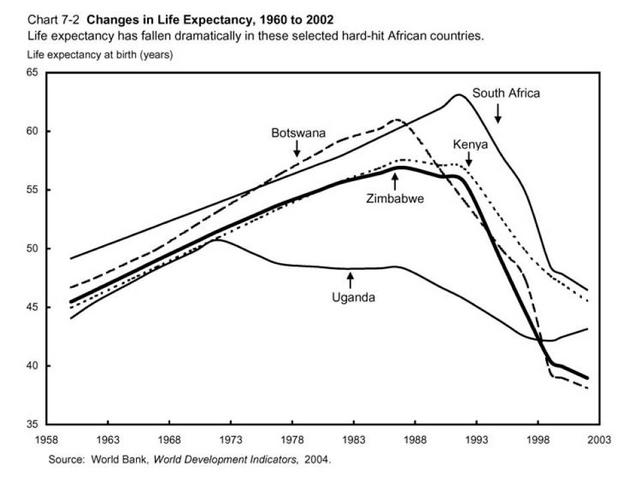
What I don’t understand is why the discussion of solutions focuses so heavily on AIDS drugs when condoms are cheaper and more effective in preventing spread of the disease. And why isn’t condom use in Africa skyrocketing? (A notable exception is Uganda where AIDS rates have begun to level off due to condom use– see graph). Condoms are cheap – even if not to every African they can be easily subsidized by donor groups or governments but there is still a large condom-gap in Africa.
Note that in theory condom use could increase transmission of AIDS if it increases sex. Evidence from the US and elsewhere indicates this is unlikely in practice. Moreoever, it doesn’t explain why more condoms are not being used.
Figure from the Economic Report of the President (2005) via Ben Muse.
Copyrighting Storms
Writing in the Financial Times, James Boyle makes an interesting comparison between how Europe and the U.S. treat government produced data, everything from "ordnance survey maps and weather data, to state-produced texts,
traffic studies and scientific information."
On
one side of the Atlantic, state produced data flows are frequently
viewed as potential revenue sources. They are copyrighted or protected
by database rights. The departments which produce the data often
attempt to make a profit from user-fees, or at least recover their
entire operating costs….The other side of the Atlantic practices a benign form of
information socialism. By law, any text produced by the central
government is free from copyright and passes immediately into the
public domain.
Surprisingly, it’s the US which practices the "benign form of socialism."
Take weather data. The United States makes complete weather data
available to anyone at the cost of reproduction. If the superb
government websites and data feeds aren’t enough, for the price of a
box of blank DVD’s you can have the entire history of weather records
across the continental US. European countries, by contrast, typically
claim government copyright over weather data and often require the
payment of substantial fees. Which approach is better? If I had to
suggest one article on this subject it would be the magisterial study
by Peter Weiss called “Borders in Cyberspace,” published by the
National Academies of Science. Weiss suggests that the US approach
generates far more social wealth. True, the information is initially
provided for free, but a thriving private weather industry has sprung
up which takes the publicly funded data as its raw material and then
adds value to it. The US weather risk management industry, for example,
is ten times bigger than the European one, employing more people,
producing more valuable products, generating more social wealth.
Another study estimates that Europe invests €9.5bn in weather data and
gets approximately €68bn back in economic value – in everything from
more efficient farming and construction decisions, to better holiday
planning – a 7-fold multiplier. The United States, by contrast invests
twice as much – €19bn – but gets back a return of €750bn, a 39-fold
multiplier. Other studies suggest similar patterns in areas ranging
from geo-spatial data to traffic patterns and agriculture. “Free”
information flow is better at priming the pump of economic activity.
Link addded. Thanks to Paul van Hoek for the pointer.
Weather Incentives Work?
The Russians will soon find out.
Moscow Mayor Juri Luschkov said: "Weather forecasters in our city and
the surrounding area will be held responsible for financial losses that
the city incurs through their incorrect prognoses."….He did not elaborate on how much the fines would be or if the cash
would be taken from the weathermen, or the companies they worked for.The
fines come after the head of the Romanian National Meteorology Agency,
Ion Poiana, was fired after he predicted warm weather fronts on days
when temperatures plunged to a record minus 36 degrees centigrade.
Thanks to Carl Close for the pointer.
Brad is wrong, so is Brad
Brad DeLong quotes Brad Plummer:
[I]t really doesn’t make a difference whether you pay 40 percent of your income for private health care, or 40 percent of your income in taxes that then go to government-administered health care. I mean, yes, in one sense it makes a difference: If you think the free market is a better way of delivering health care, you’ll endorse option 1; otherwise, you’ll endorse option 2. But in the end, you’re still paying 40 percent of your income….it’s disingenuous to say, "Oh no! America’s doomed! We’re going to have
to raise taxes massively in the future in order to afford things we’d
be spending a good chunk of our income on anyway!"
Brad DeLong writes "Brad is absolutely right. (I like the way
that sentence sounds: I wish *I* heard it more often from others.)"
Sorry Brad (and Brad), I’d like to oblige but there is a big difference between spending 40 percent of your own income on health and having 40 percent of your income taken in taxes and spent on health even if we assume that the spending is on exactly the same thing. The 40 percent of your income spent on health is a benefit of work, a reason to work harder, but the 40 percent taken in taxes is a cost of work that creates a dead weight loss. Moreover, at 40 percent plus the dead weight loss is going to be big.
To make the problem with Brad P.’s thought experiment clear suppose that we documented exactly how everyone spent their yearly income. Now we tax everyone 100 percent and provide them with exactly what they were buying before. Nothing changes, right? Wrong. At 100 percent tax there is no longer any incentive to work – thus no one works and nothing is provided. Everything changes.
Brain Drained
Two weeks ago I posted on the brain drain at the NIH brought about by new draconian rules on so-called "conflicts of interest" between NIH workers and outside interests. I suggested that the policy was a mistake but we now learn from the Washington Post that it is a stupid mistake.
The unexpected finding that as much as 80 percent of the seeming
improprieties were actually the result of errors by government
investigators has undermined the rationale behind NIH Director Elias A.
Zerhouni’s recent decision to impose severe restrictions on the
personal activities and finances of all of the agency’s more than 5,000
employees…
The story is simple. The government asked the pharmaceutical companies for the names of all NIH scientists with whom they had consulting operations and they asked the NIH for a similar list. Comparing the two lists they found about 100 names on the pharmaceutical list which were not on the NIH list and then jumped to the conclusion that these 100 people were lying. After months of investigation during which many people’s lives have been turned upside down it turns out that one list included 2004 but the other did not, some of the "John Smiths" on the pharmaceutical list were incorrectly identified with "John Smiths" at the NIH, the pharmaceutical companies didn’t use the same definition of consulting as the NIH etc. Keystone cops.
And here is an example of the new law in practice.
One scientist who, under the new rules, was informed he could not
accept an unpaid adjunct professorship at Johns Hopkins University was
told he might be unduly influenced in favor of the university because
the appointment came with free campus parking…
Harvey Rosen to Head CEA
Harvey Rosen has been promoted to chairman of the Council of Economic Advisors. Rosen is a respected professor of public finance and expert on tax policy from Princeton. Speaking personally, I find his work accomplished but boring. He can, however, surprise at times. I like this paper quite a bit, especially the title (fortunately CEA chairman need not pass through a Congressional gauntlet 🙂 ).
The Self-Employed are Less Likely to Have Health Insurance Than Wage Earners. So What?