Schelling is owed an apology (Lomborg too)
John Quiggin writes that "The wheels are coming off Bjorn Lomborg’s attempt to undermine the Kyoto Protocol," citing an Economist article for indicating that some members are dissenting and reiterating his claim that the Copenhagen Consensus was rigged against climate change. Methinks it is Quiggin who has prejudged the issue.
In his earlier article Quiggin complained that the panel and the climate change opponents were rigged. In particular he noted:
[T]he members of the Copenhagen panel were generally towards the right and, to the extent that they had stated views, to be opponents of Kyoto. Indeed, Lomborg’s argument that spending to mitigate climate change would be better directed to aid projects was first put forward by Thomas Schelling, one of the Copenhagen panellists.
Now consider what the Economist article has to say. True, it notes, "Now, some members of the Consensus are dissenting." Who you might ask? Why it’s…Thomas Schelling!
Again from the earlier article, Quiggin attacked the opponents of the climate change paper writing:
The same lack of balance was evident in the selection of ‘opponents’. For Robert Cline’s paper on climate change, Lomborg picked vigorous opponents of Kyoto, Robert Mendelsohn and Alan Manne, and the result was an acrimonious debate.
But who does Quiggin have the temerity to cite as another dissenter? Why it’s… Robert Mendelsohn!
Quiggin doesn’t explain why Mendelsohn and Schelling are offering their (mild) dissent – it’s not because they are in favor of spending lots of money on global warming. Rather, it’s because they think that the author of the climate change chapter, William Cline, exagerates the costs of global warming and proposes far too costly solutions.
Thus, believe it or not, the new theory of how Lomborg rigged the climate change study is that he chose someone to write the global climate change chapter who was too strong an proponent of its importance! Give me a break.
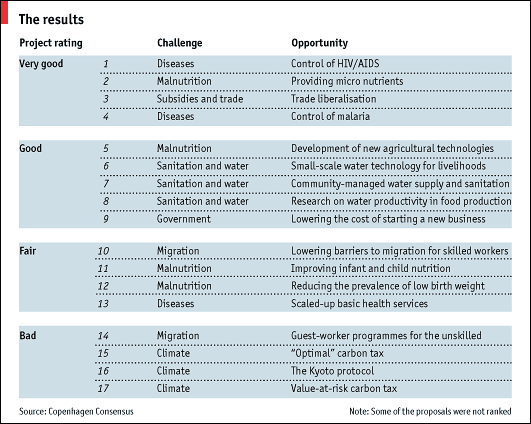
Bottom line is that the the so-called dissent reinforces the Copenhagen Consensus which is that modest steps to combat global warming may be justified (Mendelsohn proposes an initial carbon tax of $2 to Cline’s $150) but that there are many other more worthwhile development goals.
Budget Asymmetry
The Bush budget looks pretty good but lets keep things in perspective. My prediction is that it will be easier to add $540 billion in Medicare spending than it will be to cut $5 billion in farm subsidies.
Brain Drain at the NIH?
Last week the NIH announced drastic new rules restricting employees, and their spouses and dependents, from stock holdings in drug, biotech and other companies with significant medical divisions. Consulting, lecturing and other outside income is also severely restricted. Even most prizes and awards with money are now forbidden (the Nobel is an exception). NIH employees are furious.
Word on the street is that universities, including GMU, are receiving a flood of applications from talented scientists. (Perhaps the NIH should have consulted with some economists who might have explained the concepts of opportunity costs and compensating differentials).
No doubt there were some conflicts of interest and some abuses but there were also virtues in the old system. The free flow of scientists to and from commercial and government research is a key part of what made Washington and Maryland’s biotech sector succesful. Moreover, as Steve Pearlstein notes, it wasn’t that long ago that this free flow of people, ideas and money was encouraged, precisely in order to get the scientists out of their ivory tower and into the real world of medical need. Expect less from the NIH in the future.
Is HOPE a virtue?
In response to middle-class anxiety about college costs, states have dramatically increased funding for "merit-based" scholarships. Georgia’s HOPE program (Helping Outstanding Pupils Educationally), begun in 1993, is the model. HOPE covers tuition, fees and book expenses for any high-school graduate earning a B average.
David Mustard, who spoke here last week, and co-authors have written a series of papers asking in effect, Is HOPE a virtue? Predictably, high-school GPAs increased markedly after 1993 with a pronounced spike at B. SAT scores, however, did not increase so grade inflation, not academic improvement, appears to be the cause. Once in college students must maintain a B average to keep their scholarship – the program is rather lax on how many or what courses must be taken however. The result is that scholarship students take fewer classes, take easier classes and when the going gets tough they withdraw more often. Apparently HOPE comes at the expense of fortitude.
HOPE increases the number of students enrolled in GA colleges only modestly and the bulk of the increase comes from students who are induced by the cash to stay in GA, instead of going to school in another state, rather than from students who, without HOPE, would never have gone to college. What do the students do with the cash they save on tuition? Cornwell and Mustard (2002) find that car registrations increase significantly with county scholarships!
Bottom line: HOPE is neither charitable nor prudent. The bullk of the money is a simple transfer to students and their parents. To the extent that HOPE has incentive effects these appear to reduce not increase educational effort and achievement.
Tyler and the Global Cultural War
Tyler is in Paris again, a major player in what the NYTimes calls a global cultural war.
The idea of promoting cultural diversity around the world seems reasonable enough. It recognizes that everyone profits from the free flow of ideas, words and images. It encourages preservation of, say, indigenous traditions and minority languages. It treats the cultures of rich and poor countries as equal. And most topically, it offers an antidote to cultural homogeneity.
Try turning this seemingly straightforward idea into an international treaty, though, and things soon become complicated. Since October 2003, Unesco’s 190 members have been working on what is provisionally called the Convention on the Protection of the Diversity of Cultural Contents and Artistic Expression. It is intended to be approved by consensus this fall, but don’t count on it. There is still no agreement on its final name.
But that is a minor issue compared with more fundamental differences. Led by France and Canada, a majority of countries are asserting the right of governments to safeguard, promote and even protect their cultures from outside competition. Opposing them, a smaller group led by the United States argues that cultural diversity can best flourish in the freedom of the globalized economy.
A bid to break the deadlock is now under way at the Paris headquarters of Unesco…
Tyler will continue to blog from Paris but we are also pleased to be joined this week by our returning guest, Fabio Rojas.
I am not a number!
The libertarian in me thinks this amusing advert portrays a dystopia, but the economist in me sees the efficiency advantages. In the end I come down on the side of "screw efficiency, give me liberty!" But I am torn and fail to see the principles which will resolve my unease.
Modeling Intellectual Property
For over half a century, kits have been sold that enable military history
buffs to assemble scale models of military ships, aircraft and vehicles. But
that era is coming to an end, as the manufacturers of the original equipment,
especially aircraft, are demanding high royalties (up to $40 per kit) from the
kit makers….Models of a company’s products are considered the
intellectual property of the owner of a vehicle design. Some intellectual
property lawyers have pointed out that many of these demands are on weak legal
ground, but the kit manufacturers are often small companies that cannot afford
years of litigation to settle this contention.
That’s from James Dunnigan. Dunnigan points to an ironic unintended consequence of this use of intellectual property law. To avoid the levies kit manufacturers are turning to items for which there is no royalty – items like aircraft from Nazi Germany.
Thanks to Cory Doctorow at BoingBoing for the pointer.
The Fountainhead
If ethics is about the virtuous man then politics is about the social requirements for the virtuous man to exist (the modern literature lags behind Rand in connecting ethics and politics). One can understand Rand’s novels as an extended disquisition on virtue ethics and the political and social requirements necessary to practice such an ethics. In particular, she argued that rights, a legal concept creating a protected sphere for independent action, were a necessary condition to live a life of virtue.
One need not buy Rand’s deductive argument that laissez-faire capitalism is the sine-qua-non of ethical action to appreciate her insights connecting the good man and good woman with the good society. Ayn Rand was absolutely right to say that capitalism requires a moral defense. Moreover, the only plausible defense must involve the virtue of selfishness. It is all too obvious that capitalism promotes and rewards self-interest and, Mandeville nothwithstanding, no defense which simply excuses this fact will succeed.
Rand’s language hasn’t done much to advance her case and indeed it has obscured areas where her insights are now widely accepted. Today, for example, you can find many books
attacking the evil of altruism. Surprised? Of course, the books don’t use those terms, instead they call it the problem of codependency (or some other such). Relatedly, it’s no accident that Hillary Clinton was once an avid Randian (recall her political career started with Barry Goldwater) because Rand is an important feminist. Rand’s portrayal of strong, independent, intelligent women is coming to be recognized as a landmark in fiction but in addition Rand’s attacks on self-sacrifice have special meaning in a culture that has long used the “caring ethic” to bind women to the service of others.
Of weaknesses there are many, most of which flow from the combination of Rand as philosopher, novelist and powerful personality. John Galt, for example, is but one instantiation of the Randian/Aristotelian virtue ethic, an instantiation which was created for a particular aesthetic purpose by a particular person. To often both Rand and her detractors have taken the instantiation for the class thereby limiting the vision.
Slippery Slopes
Ah winter, time to take the kids out sledding at the local park. Not in many communities where sledding has been banned because of liability concerns.
Rules of Just Conduct versus Social Justice
Elizabeth Anderson and other commentators misunderstand Hayek and in the process they fail to understand the sense in which market outcomes may be said to be just (Tyler comments also).
Hayek argued that the concept of social or distributive justice was "empty and meaningless." Anderson tries to use this argument, which she explains well, to suggest that any idea of libertarian or free market justice must also be empty and meaningless. Hayek, however, did not argue against rules of just conduct, "those end-independent rules which serve the formation of a spontaneous order." Among such rules may be Nozickian or Lockean rules of voluntary exchange.
It’s quite possible, for example, to be a good Hayekian and also to say that I deserve my income because it was acquired by just conduct, e.g. by production and trade.
True, it is an accidental fact that I live in a time and place where my skills are highly prized. In this sense, I do not deserve my income (i.e. my income is in part a function of things beyond my control). But I do deserve my income in the sense that it was acquired justly and to take justly acquired earnings may be an injustice.
The ol’ dollar, it’s gonna go down
Bill Gates and Warren Buffett are short the dollar.
“I’m short the dollar,” Gates, chairman of Microsoft Corp., told
Charlie Rose in an interview late yesterday at the World Economic
Forum in Davos, Switzerland. “The ol’ dollar, it’s gonna go down.”Gates’s concern that widening U.S. budget and trade deficits are
undermining the dollar was echoed in Davos by policymakers including
European Central Bank President Jean-Claude Trichet and German
Chancellor Gerhard Schroeder.The dollar fell 21 percent against a basket of six major currencies
from the start of 2002 to the end of last year. The trade deficit
swelled to a record $609.3 billion last year and total U.S.
government debt rose 8.7 percent to $7.62 trillion in the past 12
months.“It is a bit scary,” Gates said. “We’re in uncharted territory
when the world’s reserve currency has so much outstanding debt.’…Gates reflected the views of his friend Warren Buffett, the
billionaire investor who has bet against the dollar since 2002.
Buffett said last week that the U.S. trade gap will probably further
weaken the currency.“Unless we have a major change in trade policies, I don’t see how
the dollar avoids going down,” Buffett said in an interview with
CNBC Jan. 19.
Thanks to David Theroux for the pointer.
More ‘Little Black Lies’
Black life expectancy is lower than white life expectancy. On this basis, President Bush argues that social security is a worse deal for blacks than whites. Paul Krugman says this is a lie but his primary counter-argument is shockingly weak:
Mr. Bush’s remarks on African-Americans perpetuate a crude misunderstanding about what life expectancy means. It’s true that the
current life expectancy for black males at birth is only 68.8 years –
but that doesn’t mean that a black man who has worked all his life can
expect to die after collecting only a few years’ worth of Social
Security benefits. Blacks’ low life expectancy is largely due to high
death rates in childhood and young adulthood. African-American men who
make it to age 65 can expect to live, and collect benefits, for an
additional 14.6 years – not that far short of the 16.6-year figure for
white men.
True, life expectancy at birth isn’t the right statistic but neither is life-expectancy at 65. Consider the following simple example: suppose that 95 percent of blacks die before the age of 65 but that the 5% who survive to 65 have the same life expectancy as whites. Krugman would then claim that social security isn’t discriminatory, but that would be absurd – 95 percent of blacks would be paying payroll taxes for all of their working lives and in return they would receive nothing.
As HedgeFundGuy points out a more relevant measure of life expectancy for social security is life expectancy at 20, when working-life begins, and at this age black life-expectancy is still a significant 6 years less than that of whites.
Life expectancy isn’t the only thing that affects social security redistribution, however, marriage rates, number of dependents, disability, income and even the time pattern of income matter also. It may be that when all of these considerations are taken into account that on average social security is no worse a deal for blacks than for whites but this will be true only because social security is a hash of redistributionist tendencies few of which are well understood let alone well justified.
Addendum: See also Heritage’s rebuttal which makes a number of other good points especially the fact that lumping in the disability program with social security is not appropriate. Although the programs are connected historically they can, are, and should be treated as independent for purposes of reform and analysis.
Shiller on Housing Prices
Robert Shiller has a new edition of Irrational Exuberance coming out, this one will feature a chapter on real estate. Shiller, of course, predicted the stock market collapse and now believes that we are near the peak of housing prices. He is also involved in establishing a futures market that would allow people to hedge against movements in housing prices (see also my post on The New Financial Order). Here is a short interview with him on these subjects.
I too think that housing prices are inflated. It is certain that prices cannot continue to rise as they have in recent years and when interest rates increase, as they surely will as budget deficits continue to balloon and Asian central banks grow weary of taking losses on their portfolios, prices will fall both because of the rise in interest rates per se and because the increase will prick the bubble. Yes, Tyler has outed me as well as Brad De Long and Brad Setser.
Vioxx and Tort
We have two systems of drug regulation in the United States, the FDA and tort law. Unfortunately, neither system works well. FDA incentives push for excess delay and excess cost and the tort system appears random if not perverse in its operation with good claims receiving nothing and bad claims receiving billions.
Writing in the New Yorker, James Surowiecki discusses some relevant research from Kip Viscusi:
Merck would seem to have one big thing in its favor: the company
voluntarily withdrew Vioxx from the market. But while Merck executives
may have hoped to persuade people that they were acting responsibly,
plaintiffs’ attorneys have taken the withdrawal as an admission of
guilt…internal
company documents show that Merck employees were debating the safety of
the drug for years before the recall.From a scientific perspective, this is hardly damning. The internal
debates about the drug’s safety were just that–debates, with different
scientists arguing for and against the drug….While that kind of weighing of risk and benefit may be medically
rational, in the legal arena it’s poison. Nothing infuriates juries
like finding out that companies knew about dangers and then “balanced”
them away. In fact, any kind of risk-benefit analysis, honest or not,
is likely to get you in trouble with juries….Viscusi has shown that
people are inclined to award heftier punitive damages against a company
that had performed a risk analysis before selling a product than a
company that didn’t bother to. Even if the company puts a very high
value on each life, the fact that it has weighed costs against benefits
is, in itself, reprehensible. “We’re just numbers, I feel, to them” is
how a juror in the G.M. case put it. “Statistics. That’s something that
is wrong.”…Before a jury, then, a firm is better off being
ignorant than informed.
A Swiss Miss Doesn’t Miss Much
Switzerland continues to have more guns and less crime. Here is a charming portrait by Stephen Halbrook of a Swiss shooting competition for boys and girls.
The greatest shooting festival in the world
for youngsters takes place every year in Zurich, Switzerland. Imagine
thousands of boys and girls shooting military service rifle over three
days amid an enormous fair with ferris wheels and wild rides of all
kinds. You’re at the Knabenschiessen (boys’ shooting contest).
This girl, one of 1,585 who competed, being coached in sharpshooting with the Assault Rifle 90, the Swiss service rifle.Held since the year 1657, the competition traditionally has been both a
sport and a way of encouraging marksmanship in a country where every
male serves in the militia army. Today, girls compete along side the
boys. In fact, girls are now winning the competition.It’s
September 13, 2004. In the U.S. on this date, the Clinton fake “assault
weapon” ban sunsets. In Zurich, some 5,631 teens – 4,046 boys and 1,585
girls, aged 13-17 – have finished firing the Swiss service rifle, and
it’s time for the shootoff.That
rifle is the SIG Strumgeweher (assault rifle) model 1990 (Stgw 90), a
selective fire, 5.6 mm rifle with folding skeleton stock, bayonet lug,
bipod, and grenade launcher. The Stgw 90 is a real assault rifle in
that it is fully automatic, although that feature is disabled during
the competition. Every Swiss man, on reaching age 20, is issued one to
keep at home. Imagine all those teenagers firing this real assault
rifle while their moms and dads look on with approval, anxiously
awaiting the scores.