Assorted links
1. Photos of robots.
2. Royal wedding betting markets in everything, which color for the Queen’s hat?
3. Earl B. Hunt, Human Intelligence, a good introduction to current debates.
4. China’s investments in the Caribbean; sign of bubble or not? (e.g., “A 2011 commitment by Beijing to build a $600 million deep-sea harbor, highway and port in Suriname that will link the country to its natural resource rich southern neighbor, Brazil.”)
5. The Canadians do fiscal stimulus the right way.
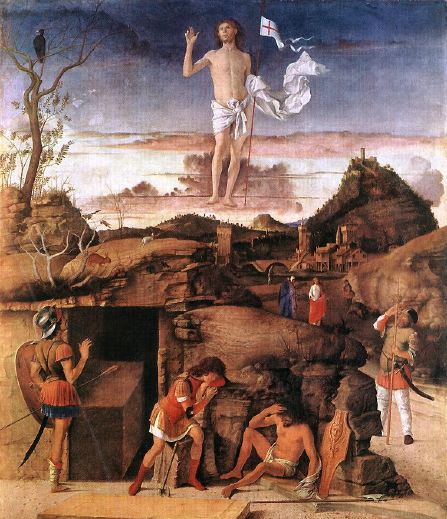
Happy Easter
Scott Sumner, from the comments
This is on “The People’s Budget“:
Matt Yglesias has a much better solution for progressives; a progressive consumption tax.
This capital gains proposal is especially silly. I’m 99% sure they won’t allow unlimited write-offs of capital losses, which means the effective cap gains rate would be even higher, and risk-taking would be discouraged. And why even have a corporate income tax system? Even from a progressive perspective it makes no sense at all.
This proposal taxes rich guys who live a hedonistic lifestyle at a much lower rates than equally rich guys who are thrifty, and leave something for others. That’s progressive?
A progressive consumption tax system composed of a mixture of modestly progressive VAT and steeply progressive payroll taxes and carbon taxes and land taxes. That’s all you need. K.I.S.S.
Assorted links
1. “…the studio audience gave the Pope a hearty round of applause.”
2. The economics of The Jetsons.
3. $23 million book on flies, it must be really good.
4. The science behind college football helmet stickers.
5. Vibrators.
*How To Live*
The author is Sarah Bakewell and the subtitle is Or a Life of Montaigne in One Question and Twenty Attempts at an Answer. This book truly brings Montaigne to life — a task I would have thought impossible in a popular publication. I view Montaigne as one of the most important writers and thinkers and perhaps the single most important for anyone in the blogosphere. I had not known, by the way, that Montaigne was mayor of Bordeaux for four years.
Here is Tim Harford on why we are all too sure of ourselves.
For the pointer to the book I thank the excellent Christopher Weber, Citizen of the World.
“The People’s Budget”
It is endorsed by Paul Krugman and also Jeffrey Sachs, so I thought I would give it a look. It is from the Congressional Progressive Caucus. One simple question is to ask how the rich are taxed:
1. There are separate rates in the mid- to high forties for millionaires, with strict limits on itemized deductions.
2. “Raise the taxable maximum on the employee side to 90% of earnings and eliminate the taxable maximum on the employer side.” With volatile incomes, it’s tricky to translate that into an expected marginal rate or to figure out how much is infra-marginal. See the technical appendix, p.8, for more details, though I find the entire proposal here poorly explicated. In any case, it’s a big tax increase.
3. Tax capital gains and dividends at the normal income rates. (I am not sure how loss offsets are to be treated, though it could make a big difference and significantly boost the demand for volatile stocks.)
4. I’m not sure what happens with state-level income tax rates but there’s certainly, in the proposal, no talk of them going down. And since they’re probably not free market deregulators at the state and local level, I suppose I expect those taxes to go up, given Medicaid burdens, pension problems, ailing educational systems, and so on.
5. Estate taxes would be raised significantly (sock it to Boy Mankiw!), as would corporate income taxes, there would be new financial transactions taxes, there would be a new bank tax, and tax enforcement would be stiffer.
6. There are, by the way, no proposed cuts in benefits.
What is the final net income and also capital gains rate for wealthy taxpayers? It’s hard to say exactly, but north of seventy percent for income rates (including state and local rates), and near fifty percent for capital gains rates, is not hard to believe.
Quick quiz #1: What are the capital gains tax rates in the European social democracies?
Quick quiz #2: From the climate change debates we learn the value of scientific consensus; what percentage of Democratic public finance economists would favor top income and capital gains rates in the neighborhood of seventy and fifty percent? Some of them have read and digested, for instance, this paper by the impressive Raj Chetty.
Quick quiz #3: Does the technical report offer estimated labor supply and investment elasticities in response to these higher tax rates? (p.s. the answer is “no.”)
I can tell you this: in the technical appendix; the assumption is that the net effect on growth, from investment changes, after all the new public sector investment is called into place, is a positive [sic] 0.3%.
There have been some good criticisms of the funny assumptions behind the Ryan plan, but actually this budget isn’t better, either in terms of its final conclusions, its adherence to best scientific practices, or its transparency in getting to its results. Should we not apply equally high standards to both the Ryan budget and this? There are plenty of good arguments that taxes have to go up, but this particular proposal isn’t one of them. INSERT SNARKY CLOSING OF YOUR CHOICE I WON’T DO IT FOR YOU.
Why are so many Russian Jews Republicans?
I wouldn’t exactly describe my family this way, but here are some data (do read the whole article):
The most recent data, from the 2004 election, show that Russian Jews preferred Bush to Kerry by a margin of 3 to 1. Israel, national security, and the economy topped the list of concerns among Russian Jews, but there was also a cultural component to their preference; they were among the so-called Values Voters who voted Republican based on cultural wedge issues. A month before the election, 81 percent of Russian Jews supported a constitutional amendment banning same-sex marriages—nearly the inverse number of Jews nationally. They also expressed heavy opposition to affirmative action and showed less support for on-demand abortion, according to numbers compiled by the Research Institute for New Americans, which tracks the Russian-speaking community.
And here is more evidence. Why might this be? The stronger record of Republicans, in particular Reagan, as anti-communists is one obvious reason, but that doesn’t explain the broader conservative tendency. The Russian Jews are not anti-gay marriage because the U.S. Republicans are. The more hawkish stance of Republicans on Israel is another reason, but again that doesn’t seem to explain why the connection is such a fundamental one. It doesn’t sound as if these Russian Jews are yearning to become Democrats, if only for the Israel issue.
I would suggest that many Russian Jews, compared to American Jews, are much less hesitant to affiliate with the American brand of Christianity found in the Republican Party. Related strains of thought have been prevalent in Russia for a long time, yet for a long while their Christian nature was covered up by communist rule. Furthermore attachment to Israel, rather than a lifelong felt contrast with American Christians, or strict Judaic observance, is the source of Jewish identity for many Russian Jews. So affiliation with a fairly Christian party is not jarring for the Russian Jews and indeed it may be welcomed, especially if it dovetails with pro-Israel attitudes.
The implied prediction is that Russian Jews who assimilate more in American life, and who marry Americans, are less likely to be Republicans.
I found this part of the article interesting:
Theirs is no country-club Republicanism. Russian Jews in New York, the nation’s largest Russian-Jewish community, numbering 350,000, are largely under-employed; a majority earns less than $30,000. (These numbers do not reflect under-education. The average Russian Jewish immigrant has more higher education that his average American Jewish counterpart.)
On related questions, here is Ilya Somin. Here is another opinion:
“Russians respect power,” says Gary Shteyngart, a novelist who emigrated to New York from Leningrad at age 7. “Many immigrants give lip service to democracy but in the end they want some patriarchal white guy to run things with a strong hand. Feelings of oppression that began within the anti-Semitic confines of the Soviet Union are turned from a defensive to an offensive stance under the false perception that the Democratic Party is indistinguishable from the Communist Party of the USSR.”
I thank Natasha, a loyal MR reader, for the pointer.
Assorted links
1. Maundy money coincides with Queen’s birthday!
3. Bureaucratics (photo show, excellent, recommended, I am glad I went through them all).
4. “Imagining the button” – worth a reread.
Are “green” products declining?
The number of household cleaners with green claims introduced in 2008 was 144, up from 29 in 2007. By 2009 that had dropped to 105, according to Mintel, a research firm. Green dishwashing liquid followed a similar pattern, with 14 introductions in 2007, 85 in 2008, then 58 in 2009.
The story (1/20) is here, and it is adequate to stick with that quotation above (not worth one of your twenty). Some of this switch is due to the recession, but I wouldn’t assume that green products will make a big comeback with better times (there is related comment here). Consumer brand stickiness is legendary, altruistic trends need a big oomph to get off the ground and they need to be seen as cool and up-and-coming, and consequently there is no reason to favor a Whig interpretation of history in this matter. Possibly the bubble has been burst.
Religious conversion as an anti-poverty strategy
Adam writes to me:
Hypothetical for you: would a massive conversion of low-income people to Mormonism reduce poverty? Utah looks to have some good demographics, which must be somewhat due to to the fact that 60% belong to the LDS church: http://www.adherents.com/largecom/lds_dem.html
They have the lowest child poverty rate in the country, the highest birth rate but the lowest out-of-wedlock birthrate.
Is Mormon conversion a viable development policy?
A viable *policy*, no, but a viable solution *yes*. Many of the costs of poverty are sociological rather than narrowly economic per se. In other words, many of the poor do not have what could be called Mormon lifestyles. This point holds all the more strongly in Latin America, where alcoholism is arguably a larger economic problem than in the United States. It is not uncommon for a rural village to have a male alcoholism rate of up to fifty percent.
A political conservative is more likely to make this point than to simply focus on the lack of money earned by the poor. A political liberal is more likely to assume that the rate of strict religiosity can rise only so high, and take that as a background constraint. Furthermore, under the exogenous thought experiment of many more poor people converting to Mormonism, positive selection bias diminishes and perhaps the religion as a whole becomes less strict.
The truth of the Mormonism insight doesn’t necessarily have strong implications for cash-based social aid policies in the meantime. Mormonism, as a variable, is difficult for political agents to manipulate, although they (possibly) can squash it. Raising this point, however, makes the poor look less like victims and more like a group partially complicit in their own fate. That framing does have “marketing” implications for the politics of how many resources the poor will receive. For this reason, liberals sometimes underrate the conservative point, because they do not like its political implications, and this leads liberals to misunderstand poverty. The conservatives end up misunderstanding poverty policy. Almost everyone ends up a little screwy and off-base on this issue, victims of the fallacy of mood affiliation.
Here is an article about the poorest community in the United States, in terms of measured income, it is mostly Hasidic Jews (1/20). It doesn’t have most of the problems which we usually associate with poor communities.
*Levant* (Smyrna, Alexandria, and Beirut)
That is the new and excellent book by Philip Mansel and the subtitle is Splendour and Catastrophe on the Mediterranean, excerpt:
The Beirut dilemma goes to the heart of the Levant. At certain times — Smyrna in the nineteenth century, Alexandria and Beirut for periods of the twentieth — Levantine cities could find the elixir of coexistence, putting deals before ideals, the needs of the city before the demands of nationalism. Like all cities, however, Levantine cities needed an armed force for protection. This could be provided by the Ottoman, British or French armies, but not by the cities’ own citizens, since they were unwilling to shoot co-religionists. No Levantine city produced an effective police force or national guard of its own. The very qualities that gave these cities their energy — freedom and diversity — also threatened their existence. No army, no city.
Assorted links
Game theory and the budget
Matt Yglesias writes:
…the right is big government’s best friend…You have a government set to steadily increase spending on autopilot as a result of demographic change and rising health care costs. And you have a Democratic President urging congress to enact spending cuts. But you have conservative politicians refusing to make a serious effort to reach an agreement out of some blend of taxophobia and fear of giving the President a win. The result, again, whether the right realizes it or not, is a gift to the wing of the Democratic Party that disagrees with Obama about the desirability of enacting spending cuts.
I tend to agree with this, but it’s always worth trying to solve for the case where one is wrong. The strategy of “no trade” with Obama could be rational for the Republicans if:
1. Not much will happen this time around anyway, so the Republicans are investing in credibility for a future bargain, perhaps post-2012.
2. Republicans think that prevailing economic conditions will turn public opinion in their favor, over time, and so a later bargain is preferable.
3. Republicans think that if a fiscal crisis comes, drastic spending cuts are especially easy to enact, relative to tax increases, and they are willing to risk that crisis. It’s hard to argue that this belief is true (reindexing benefits to a saner level takes a lot of time), although I would not rule out that some Republican Party politicians may hold it.
4. Wait for party leaders to move first, for political cover, and that is a dragons and ballroom dancing game (pdf).
And there is always:
5. Republican politicians are investing in the value of their non-electoral options and that implies group loyalty above other considerations.
None of us know the true model, but we all know the literature on irreversible investment and option value. If you’re not sure of the true model, wait rather than commit. Here is Jeff on deadlines. Another way to put this point is that we can’t, from current Republican inaction, infer much about the likely final outcome.
The Great Stagnation, a continuing story
The Education Department did not go nearly as far as college leaders would have liked in backing away from a new rule requiring colleges to get approval from every state in which they operate distance education programs. But in announcing Tuesday that, for the next three years, the agency would not meaningfully punish institutions that have shown “good faith” efforts to get such approval…
Do you need to read further? Abolish the DOE, I say. The full, messy, and heartbreaking story is here.
Jerry Brito defends Bitcoin
Read him here for a discussion of the revolutionary P2P properties of the system.
Here’s a way to restate my worry. Many people tell me, or write to me, about how great the transactions system is for its anonymity, invulnerability to governmental shutdown, and so on. Let’s put aside the social desirability of this and just focus on the predictions. I personally, would much rather have lots of dollars in the Cayman Islands (which is fairly anonymous already) than lots of assets in the Bitcoin system. I just don’t see why the Bitcoin assets are supposed to be so attractive compared to dollars, euros, Swiss francs, and so on. I would rather hold diamonds, for that matter, or a Picasso print. If I suddenly had a large stash of Bitcoin assets, from a heroin sale, I would work very hard to convert them into something else (p.s. I know they don’t call them “Bitcoin assets” but I wish to, to make the point).
Imagine that I can convert Bitcoin assets into other, non-Bitcoin assets quite easily. Then I will, and many other people will (there is a lot more wealth tied up in the Cayman Islands than in Bitcoin), and the velocity of Bitcoin assets accelerates. That encourages even more conversion out of Bitcoin assets. Why hold Bitcoin assets?
Alternatively, imagine that I can’t convert Bitcoin assets into other, non-Bitcoin assets easily. Then I would say the system fails as an alternative money, virtually by definition. Arguably Bitcoin is still at this stage right now, and what I am pointing out is that further development, and a move to the former scenario, isn’t going to work either.
To convince me on Bitcoin, you need to discuss the store of value function more explicitly, not just its (possible) efficiency as a transactions medium. If something is a good transactions medium — let’s grant that for the sake of argument –, but not a good store of value, its velocity will accelerate and sooner or later that spells trouble. Here are Girton and Roper on currency substitution.