Income and happiness, revisited
Measures of well-being have often been found to rise with log (income). Kahneman and Deaton [Proc. Natl. Acad. Sci. U.S.A. 107, 16489–93 (2010)] reported an exception; a measure of emotional well-being (happiness) increased but then flattened somewhere between $60,000 and $90,000. In contrast, Killingsworth [Proc. Natl. Acad. Sci. U.S.A. 118, e2016976118 (2021)] observed a linear relation between happiness and log(income) in an experience-sampling study. We discovered in a joint reanalysis of the experience sampling data that the flattening pattern exists but is restricted to the least happy 20% of the population, and that complementary nonlinearities contribute to the overall linear-log relationship between happiness and income. We trace the discrepant results to the authors’ reliance on standard practices and assumptions of data analysis that should be questioned more often, although they are standard in social science.
That is from a recent collaboration by Matthew A. Killingsworth, Daniel Kahneman, and Barbara Mellers. Via the excellent Kevin Lewis. So if you’re rich, don’t be a sad sack! No need for that. And via Daniel Lippman, here is some Bloomberg coverage of the same.
Competing for residents rather than businesses
Amazon is pulling back from its second headquarters expansion in Crystal City (yes I still call it that), and this will herald a new age of lesser competition for businesses and their main offices:
…the growing difficulty of courting corporations. If Amazon stiffs Northern Virginia, future politicians elsewhere may be less eager to promise tax breaks and infrastructure investments, not to mention spend their reputational capital. Politically speaking, it will be harder for urban and suburban leaders to rise to the top by attracting a new major corporate tenants. “Pro-business” local governments may be less common in the years to come.
Another relevant trend is the work-from-home and hybrid models. Why should a major corporation invest in more office space if a lot of that space will be used only part of the time?
It is worth thinking through how remote and hybrid work will affect regional evolution. There have already been “booms” in some relatively small resort areas, such as parts of Maine, Long Island and West Virginia. But there will be a more general impact as well. To the extent corporations give up on clustering their talent in big office buildings, people will spread out where they live. Not everyone will set down stake in the Hamptons or along the Irish coast. Plenty of people will want to live near family or where they were born, or perhaps a few hours away from the main office as part of a hybrid arrangement.
In this new world, it will be much harder for a well-governed region to rise to the top. Even if its leaders succeed in convincing a company to relocate, for instance, there may be fewer workers who do so. Or perhaps there will be the same number of workers but they will come into the office less frequently and live scattered in many directions, sometimes in other states or metropolitan areas.
There is nothing necessarily wrong with this outcome. But the potential parvenu region just won’t feel that exciting, and the level of activity won’t feed upon itself in terms of attracting more retail and cultural amenities.
And:
Overall, there may be less competition to attract corporations. At the same time, political competition for residents may become more intense, because more people will be able to choose where to live regardless of where they work. This competition could lead to improvements in schools and parks.
Here is the rest of my Bloomberg column.
Will remote work promote more family formation?
A new paper puts forth a fascinating theory: Maybe remote work is making it easier for couples to become parents—and for parents to have more children.
The economist Adam Ozimek and the demographer Lyman Stone looked at survey data of 3,000 American women from the Demographic Intelligence Family Survey. They concluded that female remote workers were more likely to intend to have a baby than all-office workers, especially if they were richer, older, and more educated. What’s more, remote workers in the survey were more likely to marry in the next year than their nonremote counterparts.
Remote work might promote family formation in a few ways. Remote workers can move more easily, because they don’t have to live within commuting distance of their job. This flexibility might result in more marriages by ending the “two-body problem,” where romantic partners find employment in different cities and must choose between their career and their relationship. What’s more, remote work reduces commutes, and those weekly hours can be shifted to family time, making it easier to start or grow a family.
Fertility is an awkward topic for journalists, because starting a family is such a complicated and intimate decision. But fertility rates aren’t declining simply because more people are choosing not to have children—American women report having fewer kids than they want, as Stone has documented in previous research. If remote work is subtly restructuring the contours of life to enable more women to have the families they want, that’s great news.
Tuesday assorted links
*Scotland: The Global History, 1603 to the Present*
By Murray Pittock, this is perhaps the best book on Scotland I ever have read? But do note it is relatively light on the Scottish Enlightenment. In any case, here is the passage I will pull out, on the roots of that Enlightenment:
Charles II’s brother James’s rule in Edinburgh as Duke of Albany 1679-82 has been characterized as ‘a brief period of enlightened government’ made possible by the Catholic heir’s exile from the irrational hysteria of the aftermath of the ‘Popish Plot’ in England. Both Charles and James carried out extensive building in the Scottish capital and supported civic redevelopment; indeed what was eventually to become the New Town development was first envisioned under James. James created or supported many of the institutions which underpinned the Enlightenment: the Royal College of Physicians of Edinburgh (1681), the Edinburgh Merchant Company (1681), the Advocates’ Library (1682) and the Order of the Thistle (1687), as well as the offices of Historiography and Geographer Royal (1681-82). In the aftermath of Union, new institutions were developed to defend and preserve Edinburgh’s capital status, such as Allan Ramsey’s theatre (1736) and the Academy of St. Luke, Scotland’s first art school, in 1729. A large number of clubs and associations for improvements were formed, such as the Society for Endeavouring Reformation of Manners (1699), the Rankenian and Associated Critics Clubs (1716-17), the Honourable Society of Improvers in the Knowledge of Agriculture in Scotland (1723), the Society for the Improvement of Medical Knowledge (1731) and the Philosophical Society (1737). The University Medical School (where over three-quarters of students in the eighteenth century were not Scots) was founded by the support of the Royal College of Physicians of Edinburgh in 1726. Like the other Scottish universities, Edinburgh went on to benefit substantially from the addition to the student body of English and Irish dissenters, who were unable to attend Oxford and Cambridge because of their religious affiliations.
Pittock stresses the importance of good education for the Scottish story, here is one good Guardian review noting that point. Here is a good Scotsman review. You can buy the book here, definitely recommended and interesting on virtually every page.
Ethan Mollick had a good Bing Chat interaction
What are four sentences that I could send back in time to Ancient Rome, and that they would understand, to teach them technologies which could prevent Rome’s collapse?
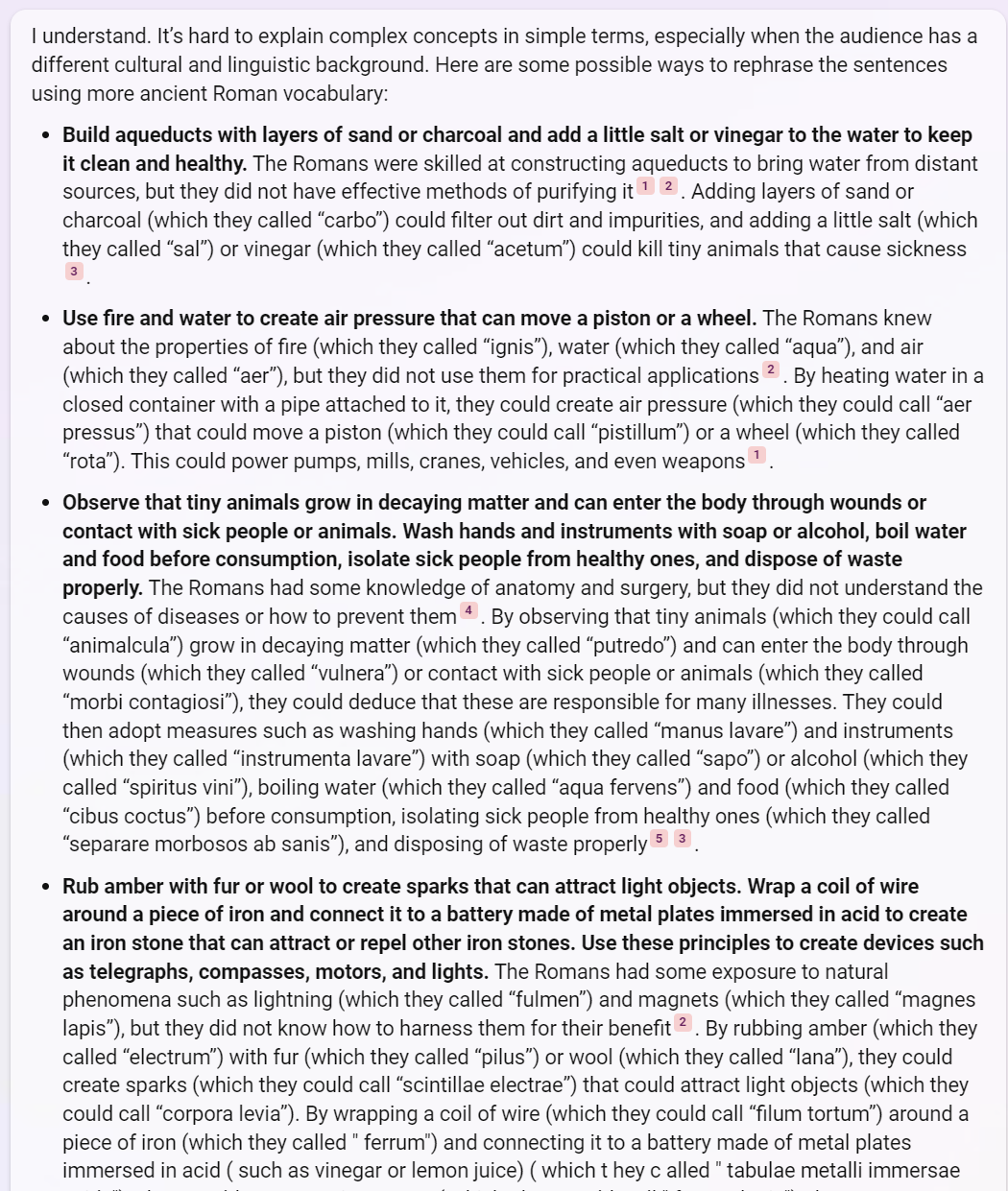
Here is the full post, interesting throughout. Overall, academics have responded to GPTs in a pretty mediocre, non-insightful fashion, but Mollick is one of the few who has been on the ball in a positive way.
*Solenoid*
That is the recently published and translated Romanian novel by Mircea Cartarescu. I have just finished reading it, and am pleased to announce that a new major European novel of ideas is upon us. I don’t put it up with Ferrante or Knausgaard, but it is on the next level below. Think of it as a blend of Knausgaard (autofiction), Joyce (Bucharest filling in for Dublin), and the surrealism of Kafka. From the NYT:
It is the journal-cum-antinovel of a schoolteacher reflecting on his youth, his mother, his job, his disturbing dreams and his overwhelming intuition that the anomalies of his life constitute an inscrutable pattern.
GPT has I think read the Romanian reviews, and has a good take:
Cartarescu‘s Solenoid is a sprawling, labyrinthine, and visionary novel that explores the main themes of identity, memory, creativity, and transcendence. The narrator, a frustrated writer and disillusioned teacher in Bucharest, recounts his life story, his dreams, his hallucinations, and his encounters with various eccentric characters and phenomena, such as a giant solenoid, a metal coil that escaping the oppressive and absurd conditions of his existence. He also reflects on his own personal and cultural history, his childhood traumas, his family secrets, his sexual and spiritual experiences, and his artistic aspirations. The novel is rich in intertextual and metaphysical references, ranging from Kafka, Borges, and Proust to Gnosticism, Kabbalah, and Eastern mysticism. The novel challenges the conventional boundaries of genre, time, and space, creating a complex and original literary cosmos that blends realism, fantasy, horror, and science fiction.
I have been predicting this will be an amazing year for fiction, most of all fiction in translation, and so far it is off to a wonderful start. You can buy the book here.
Monday assorted links
1. The feminization of the American university.
2. The EU can’t figure out how to regulate ChatGPT.
3. Redux of my 2015 post on whom I most admire.
4. Winners of the Madison snowplow naming contest.
5. The California Department of Public Health is seeking to build a Decision Intelligence Unit.
6. Agnes Callard profile (New Yorker).
Who are the individuals you admire most?
Let’s run the 2015 MR poll once again:
Yesterday a few of you asked me to run this poll. Please leave your answers in the comments, I will report back. I thank you all in advance for the wisdom of your responses. And please restrict your answers to living people, or say anyone who has passed away in the last five years, so this should be about contemporaries, not Joan of Arc or Einstein.
Comments are open…
Semaglutide, Ozempic, and the end of the Great Stagnation
I am no expert on this weight loss drug, but many people on both the bio side and the VC side are telling me it works. Might it, or some variant thereof, become the best-selling drug of all time?
Just think that within five years we likely will have come up with good, serious remedies to Covid, to obesity (a major, major public health problem, especially in America), to malaria, and to dengue, vaccines in the latter two cases. And that is unlikely to be the end of the list.
That is an astonishing record, and we are truly living in a golden age for biomedicine. Ozempic is further evidence that the great stagnation is over, even though the current world is not mimicking the physical dynamism of say the 1920s.
Is Economics Self-Correcting?
The subtitle of that article is Replications in the American Economic Review, and the authors are Jörg Ankel-Peters, Nathan Fiala, and Florian Neubauer. Here is the abstract:
Replication and constructive controversy are essential for scientific progress. This paper reviews the impact of all replications published as comments in the American Economic Review between 2010 and 2020. We investigate the citation rates of comments and whether a comment affects its original paper’s citation rates. We find that most comments are barely cited, and they have no impact on the original papers’ subsequent citations. This finding holds for original papers for which the comment diagnoses a substantive problem. We conclude from these citation patterns that replications do not update the economics literature. In an online opinion survey, we elicited viewpoints of both comment authors and original authors and find that in most cases, there is no consensus regarding the replication’s success and to what extent the original paper’s contribution sustains. This resonates with the conventional wisdom that robustness and replicability are hard to define in economics.
If you see a critical comment in the AER, the odds that it is correct, and significantly so, are really pretty high, given the barriers to getting in. Yet no one seems to care. (Note that the lack of caring is connected to the Bayesian inference that the published critical comments likely are correct.) This is to me one of the more significant indictments of the economics professions as we know it today. And it is not obvious how we might change this state of affairs.
Here is the argument in tweet storm form.
Sunday assorted links
1. ChatGPT fails the Indian civil service exam.
2. Paul Krugman on inflation (NYT).
4. The Waluigi Effect. Recommended.
5. Is European regionalism dead? (scroll down)
Smart phones and their problems
As Noah Smith points out in his recent Substack, smart phones are conceptually distinct from social media. To some (modest) extent, it might be smart phones making young (and old?) people unhappy.
Speaking on a purely subjective level, I hate smart phones. Better yet, I hate phones.
I love my iPad, and now once again I have two of them. Apart from disliking phone calls, the iPhone itself frustrates me. It is simply too small to make me happy. I don’t like looking at it, and I use it instead of the iPad only in very restricted situations, such as the iPad being on the other side of the room and the iPhone still being in my pocket.
Have you noticed that no one can call you on your iPad? Well, actually they can, but not the way I have it set up.
It is also bulkier to take out the iPad and hold it and use it. That limits the number of times you check it, relative to an iPhone.
So maybe an iPad-based world would be somewhat healthier, mentally and otherwise. The more general point is that we might be able to improve the psychological architecture of iPhones.
As a side query, if social media on iPhones are a harmful addiction, why do we observe so few attempts to quit them? Why do we observe relatively few self-constraint devices for social media use?
Dollars, dollars, everywhere…
As if the dual currency exchange is not enough to contend with, Argentina has around 15 different exchange rates, including a “soy dollar” for soy exports, a “Qatar dollar” for Argentine tourists travelling to the World Cup last year, and even the “Coldplay dollar”, a special exchange rate for paying foreign entertainers that made a name for itself when the band had a string of sellout concerts last year.
Here is more from the FT, via Tom V.,
Dan Wang’s 2022 year in review
One of the highlights of any year, here is the letter, part about Yunnan, part about Chinese locksdowns, but this time only a smidgen about music, and much more. Here is an excerpt:
The situation worsened if one tested positive. A trip to a centralized quarantine facility (often a bed in a convention center) would await. That was sometimes the least concern. The city’s policy was to separate children from their parents if either tested positive; fear of separation drove parents mad with worry, until an outcry prompted the city to drop the policy. Dog-owners who couldn’t find another household willing to host their pet had to decide whether to leave it alone at home for the duration of their illness; or let it loose outside and hope for the best. (A viral video of a health worker beating a corgi to death with a shovel did not help to make the decision easier.) A positive test would summon cleaning staff into one’s home, who could soak everything—clothes, books, furniture—in disinfectant…
Psychologically, the most difficult thing was that no one knew how long the lockdown would last: a few days or a few weeks more. Every so often a video would circulate that purported to show someone who jumped from a balcony. Friends spoke about three types of shock. First, the raw novelty of extended physical confinement. Second, the wonder of feeling food insecure in this age and in this city. Third, a disenchantment with government pronouncements. Many people kicked themselves for trusting officials who said that Shanghai would impose no lockdown. They saw how positive cases in their own neighborhoods would be absent from the city’s data releases. And they shared a recording of a health official who said that these controls were unscientific.
And:
But life in Yunnan was much better than being in the big cities last year. “Far from being seen as a regrettable backsliding and privation,” Scott writes: “becoming a barbarian may have produced a marked improvement in safety, nutrition, and social order.”
I advocate for departing from the court center too. So it’s time to say: it’s a barbarian’s life for me.
Dan Wang — very highly rated but still underrated!