Tuesday assorted links
1. Creeque Alley (that was then, this is now).
2. “We further document that the labor-market premium to action-oriented personality traits has rapidly increased over the past two decades.” And here is a new paper on Finnish extraversion (not joking).
3. Banning non-compete agreements in Austria didn’t really help worker earnings.
4. On the benefit of early promotion. Suandi is on the job market from Berkeley.
5. “We find that the introduction of potatoes led to a sizeable and permanent reduction in conflict.” Joris Mueller on the market from Northwestern.
The welfare effects of eviction policies
This paper studies the implications of rental market policies that address evictions and homelessness. Policies that make it harder to evict delinquent tenants, for example by providing tax-funded legal counsel in eviction cases (“Right-to-Counsel”) or by instating eviction moratoria, imply eviction and homelessness are less likely given default. But higher default costs to landlords lead to higher equilibrium rents and lower housing supply. I quantify these tradeoffs in a model of rental markets in a city, matched to micro data on rents and evictions as well as shocks to income and family structure. I find that “Right-to-Counsel” drives up rents so much that homelessness increases by 15% and welfare is dampened. Since defaults on rent are driven by persistent income shocks, stronger protections are ineffective in preventing evictions of delinquent tenants, and lead to a large increase in default premia. In contrast, rental assistance lowers renters’ default risk and as a result reduces homelessness by 45% and evictions by 75%, and increases welfare. Eviction moratoria can prevent a spike in evictions following a rare economic downturn, as long as they are used as a temporary measure.
Here is the paper, that is by Boaz Abramson, who is currently on the job market from Stanford.
What I’ve been reading
1. Stephen Crane, The Red Badge of Courage. I read this as a kid, and was surprised how well my reread held up. To the point, subtle, and with an economy of means. I hope the new Paul Auster biography of Crane (which I will read soon) will revive interest in this classic.
2. Frank Herbert, Dune Messiah. #2 in the Dune series, I disliked this one as a tot, but currently am marveling at its political sophistication. Somewhat uneven, but better than its reputation. The Wikipedia page for the book also indicates that Villeneuve is likely to do a Dune 3 based on this story.
3. Elisabeth Anderson (not the philosopher), Agents of Reform: Child Labor and the Origins of the Welfare State. Considers the political economy of child labor reform Germany, France, the United States, and the failed case of Belgium. Pathbreaking, a major advance on the extant literature. The explanations are messy rather than monocausal, but often focus on the success or failure of individual policy entrepreneurs.
4. Gordon Teskey, Spenserian Moments. No one seems to care about poor old Edmund Spenser, yet there seem to be quite a few good books about him.
5. Patrick McGilligan, Alfred Hitchcock: A Life in Darkness and Light. The best book on Hitchcock, John Nye recommended it to me eight years ago.
There is Howard Husock, The Poor Side of Town, And Why We Need It.
And Mary Roach, Fuzz: When Nature Breaks the Law.
Richard A. Williams, Fixing Food: An FDA Insider Unravels the Myths and Their Solutions, covers the food regulatory side of the FDA, and:
Markus K. Brunnermeier, The Resilient Society.
Monday assorted links
1. Impressions of an Indian graduate student visiting America.
2. A trucker reports on the supply chain crisis (too pessimistic?).
3. Reddit thread on what does America get right, what they leave out is more interesting than what they list.
4. Once we start talking to whales, what will they say back to us? Will we even understand it?
5. Hanania’s new theory of politics: “We once more find a Democratic bias towards the written word.” Recommended.
6. Vitalik on crypto cities, recommended.
*Apprentice to Genius*
An excellent book, the author is Robert Kanigel and the subtitle is The Making of a Scientific Dynasty. It is strongest on the role of mentors and lineages in scientific excellence, the radically inegalitarian and “unfair” nature of scientific achievement and also credit, and it offers an interesting look at the early days of the NIH. Here is one excerpt:
But Brodie simply saw no reason to become an expert in an area to launch a study of it. Rather, as Sid Udenfriend says, “he would just wander into a new field and make advances that people fifteen years in the field couldn’t.” Poring through scientific journals didn’t appeal to him; picking the brains of colleagues did. “He’d go up to you,” Jack Orloff remembers, “and say, ‘Tell me what you know about X and Y.’ Sometimes he’d already know a lot, but he could come across as almost stupid.” Indeed, he could seem downright ignorant, asking disarmingly simple, even hopelessly naive questions, like a child. But as one admirer notes, “He’d end up asking just the questions you should have asked ten years ago.”
And:
Beginning around 1955, the big stir at LCP was over serotonin. (“When the experiments were good, we called it serotonin,” Brodie would later recall…”When I heard it pronounced serotonin, I knew the experiments were bad and I stayed home.”)
And:
Martin Zatz, a veteran of Julius Axelrod’s lab and a scientist with an uncommonly broad cast of mind, was talking about mentoring and its role in science. “Are you going to talk about the disadvantage of the mentor chain?” he asked me, smiling broadly.
What’s that? “That you don’t get anywhere,” he replied, now quite serious, “unless you’re in one.”
Recommended. Why are there not more excellent conceptual books on the history of science?
Tyrone on crypto assets
Egads, what a fool this man is! Nonetheless he has grown wealthier as of late, so I thought I would give him the indulgence of another MR post. Little did I know what arrant nonsense he would come up with. Here is what he started with, the transcription from the Pig Latin being mine:
“Tyler, let’s play the envelope game. I give you an envelope with $100, and I tell you it is going to either double or half in value. (Think of it like a floating exchange rate that either will go to 2-1 or 1-2, with equal probability.) So you will end up with either $200 or $50, the expected value therefore being $125. That is a good deal for you! You started with $100, and you can expect now $125.
You would love to keep on playing this envelope game of course, except no one will play that envelope game with you even once. Until now.
In essence, by “tolerating” cryptocurrency, big-time fiat money holders have agreed to keep on playing this game. And so, if this continues, over time crypto will absorb more and more of the wealth in an economy. Just by playing the envelope game!
After all, the indirect utility function is convex in prices and the rest of the world is creating a floating exchange rate game for us for free! That is why so many different crypto assets keep proliferating!
The only joke about dogecoin is that it isn’t doing even better than it is.
What is philanthropy going to look like in five years’ time? All life extension technologies?
The envelopes game, of course, doesn’t boost the quantity of real resources, so eventually the purchasing power of non-crypto holders will shrink, shrink, shrink. That is why we will need a UBI, not because of AI.
Of course you might think that the fiat holders won’t tolerate the crypto game forever. And maybe not. But as long as there is any chance whatsoever that crypo assets turn out to have real value, at least some of those fiat money sows will be lining up at the trough to trade at some exchange rate…the envelopes game thus will continue!
At this point I had to push Tyrone down the stairs. Such fallacies! Such absurdities! I even offered him an envelope of his very own if he would shut up, but to no avail. I demanded that he write down the transversality condition for this fool game he had postulated, but all he could was recite the envelope theorem, another sign of his deep and utter confusion.
As he was falling down the stairs, he kept on insisting that Satoshi really was Satan, that all of the world’s wealth would fall into the hands of The Whales, that we all needed to reread Melville, and Johan Jensen, and ponder the Leviathan from Psalms, Jonah, and Job, and our sins, and that everyone trading with crypto holders was caught in a massive prisoner’s dilemma — collectively handing them volatile exchange rates and thus envelope games for free — and yes this was a long and deep stairwell…
Dear reader, I hope you never have to suffer under such sophistries and indignities again.
I return you now to your regularly scheduled programming, for however long it may last…at the very least writing this blog does not require much money. Yes, my cherished reader, it is my UBI…and so crypto will be allowed to proceed…

Solve for the Haitian equilibrium
…now a powerful gang is trying something new: Holding the entire country hostage.
Since Sunday, Haiti’s largest gang has blocked access to the country’s largest fuel terminal, which provides 70% of gasoline supplies across the country, causing a severe shortage of fuel in the capital and several other cities, according to union leaders, government officials and gang members.
In a radio interview late Monday, Jimmy Cherizier, a former policeman who is the head of the so-called G9 coalition of criminal groups, said his men would prevent fuel from being distributed from the terminal until the government handed over $50 million and Prime Minister Ariel Henry stepped down.
Here is more from the WSJ, via Adam Tooze. #TheGreatUnraveling
Sunday assorted links
1. Carbon emissions embedded in trade.
2. How zoos convince animals to get vaccinated.
3. How will radical on-line ideology evolve? It is important whether or not this is true.
4. Some of them are frauds. And more from the NYT, is the debate really this insipid? I think so.
5. How fast do people improve their chess? And an HN thread on same.
6. In some ways, this is a better article than it will seem to you: “Why we should talk about what Kyrsten Sinema is wearing” (NYT)
My favorite things Idaho
I used to blog “My Favorite Things…” all the time, but I ran out of new places to go for a while. Now there is Idaho! Boise in particular. Today, I can think of a few “favorite things” from Idaho, here goes and potatoes don’t count:
Artist: Matthew Barney. Filmmaker and artist, prominent in the avant-garde but much of his work is quite accessible if you don’t mind the near total absence of dialogue. Is the nine-hour Cremaster cycle his masterpiece? (I’ve only seen parts). According to the internet “Cremaster is a paired muscle of the pelvis and perineum that is fully developed only in the external genitalia of males. Being located between the internal and external layers of spermatic fascia, cremaster covers the testes and spermatic cord.” Many scenes from the movies have been turned into photos and artworks as well.
 Do people in Idaho look like that?
Composer: LaMonte Young. Is he the most underrated twentieth century avant-garde composer? The Well-Tuned Piano is one of my favorite works, though it is a tough slog for many, being about five hours in length, here is a YouTube version. He was even born in a log cabin in Idaho, and grew up LDS. His career blossomed in New York, but he attributed his interest in drone sounds to the Idaho wind and other sounds from his boyhood.
Other music: Built to Spill.
Author: Jerry Kramer, who grew up in Idaho and later played football for the Green Bay Packers. I loved Instant Replay as a kid. But is there a “real author” from Idaho? Is it better or worse to be a “real author”? Marilynne Robinson has never clicked with me.
Poet: Ezra Pound, born in Idaho. A fascist and anti-Semite, and not a true favorite of mine, but he was talented and it seems odd not to list him. Can I name a better poet from Idaho?
Explorer: Sacagewea. I hope she is cancel-proof.
Drum Battle: Idaho. Gene Krupa and Buddy Rich. For some reason, it reminded me of Benny Goodman’s Clarinade (not from Idaho).
Film, set in: My Own Private Idaho and Napoleon Dynamite might be the best known. But perhaps I will go with Smoke Signals, Superman II (the one with Gene Hackman), and Beavis and Butt-Head Do America. Superman II, if I had to say.
Here is more Matt Barney:
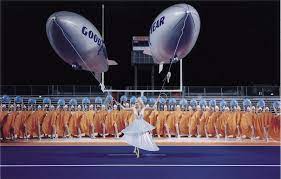 I’ll be sure to report on my visit.
Why Are Relatively Poor People Not More Supportive of Redistribution?
We test a key assumption underlying seminal theories about preferences for redistribution, which is that relatively poor people should be the most in favor of redistribution. We conduct a randomized survey experiment with over 30,000 participants across 10 countries, half of whom are informed of their position in the national income distribution. Contrary to prevailing wisdom, people who are told they are relatively poorer than they thought are less concerned about inequality and are not more supportive of redistribution. This finding is consistent with people using their own living standard as a “benchmark” for what they consider acceptable for others.
That is from a newly published paper by Christopher Hoy and Franziska Mager.
Saturday assorted links
1. I should hope so.
2. Bruce Liu plays a Chopin etude.
3. Carlsen vs. Nepo checkmate challenge competition. Chess is getting so much better at marketing. And the difference in natural ability is…manifest.
4. Which professions marry which other professions the most?
“Potential” and the gender promotion gap
We show that widely-used subjective assessments of employee “potential” contribute to gender gaps in promotion and pay. Using data on 30,000 management-track employees from a large retail chain, we find that women receive substantially lower potential ratings despite receiving higher job performance ratings. Differences in potential ratings account for 30-50% of the gender promotion gap. Women’s lower potential ratings do not appear to be based on accurate forecasts of future performance: women outperform male colleagues with the same potential ratings, both on average and on the margin of promotion. Yet, even when women outperform their previously forecasted potential, their subsequent potential ratings remain low, suggesting that firms persistently underestimate the potential of their female employees.
Here is the paper by Benson, Li, and Shue. Via the excellent Samir Varma.
Will stablecoins have fluctuating prices?
That is the topic of my latest Bloomberg column, here is one excerpt:
Even if all goes well, why should those different brands of stablecoins remain priced at $1 apiece? In most well-functioning markets, suppliers compete on innovation, quality and price. That diversity is the natural outcome of trying to figure out which coin systems — fully stable or not — are best.
If market prices do not communicate this information, how can you discover it? In my vision, higher prices will signify a coin’s quality and attract more business; the coins with strictly fixed prices will fill a niche; and the coins with lower prices will lose business, or otherwise serve as discount issues for those of lower means.
And:
On a more positive note, if you think stablecoins serve so many new and marvelous functions, you would expect many of those assets to sell for more than a dollar.
And:
For another look at why prices won’t stay fixed, consider the incentives of a stablecoin issuer. Let’s say your issue is currently one-to-one with the U.S. dollar and you are holding 100% reserves of very safe assets. Might you then be tempted to go down to 98% reserves? 95%? If the price of your coin stays at $1, fine, you come out ahead. If the price declines in proportion to the new and higher risk, you as an issuer still have broken even. So it seems that coin issuers will have an incentive to test the one-to-one exchange rates by diluting their backing.
Recommended.
Friday assorted links
1. Good Mark Zuckerberg quotation, shows “founder energy.”
2. WaPo obituary for Anthony Downs.
3. The Economist on data-driven economics.
4. California condors can have virgin births (!).
5. Squid Game cryptocurrency is rising in value rapidly.
Markets in everything
In the latest phase of the quest to turn everything into an NFT, crypto traders are now bidding to digitally own a 1,784-lb. cube of tungsten in Willowbrook, Illinois. According to the terms of the sale, which will have the receipt posted to the blockchain for posterity, the “owner” can have one supervised visit to the cube per year to touch or photograph it.
Over the past two weeks, a joke fired off by Coin Center’s Neeraj Agrawal about a nonexistent tungsten shortage thanks to crypto traders buying cubes of tungsten due to a meme actually caused one for Midwest Tungsten Service. The Illinois manufacturer actually creates small cubes of tungsten, and the tweet caused a 300 percent increase in sales that depleted the company’s stock on Amazon, Coindesk reported.
Last week, The Block reported that the company entered a partnership with crypto payment processor OpenNode to accept Bitcoin payments. One explanation as to why this is happening, which doesn’t really explain why this is happening, was offered to The Block by CMS Holdings’ Dan Matuszewski, who said “crypto just has a propensity for the density.” Tungsten is a very dense metal, comparable to uranium or gold, and its surprising weight is, apparently, pleasurable.
Midwest Tungsten told Coindesk that it primarily makes these cubes for industrial firms, and Sean Murray, the company’s director of e-commerce, suggested to Coindesk there would be a 14-inch cube next. The company offers cubes ranging from an 18-gram, 1-centimeter cube that costs $19.99 to a 41-pound, 4-inch cube that costs $2,999.99.
Well, the 14-inch cube is finally here. It weighs 1,784 poinds and is now listed on OpenSea as an NFT. Seemingly, it’s the biggest cube that Midwest Tungsten can create.
“Since we began selling the cube we have constantly asked ourselves, ‘What is the right size?’, and ‘Would anyone buy a bigger cube?’ Only recently has anyone asked us, or have we asked ourselves, ‘What is the biggest cube we can make?’
Here is the full story, via the excellent Samir Varma. You know, circa 2010 I thought MR was about to run out of startling “Markets in Everything” examples — how wrong I was!