That was then, this is now: Palantir privacy edition
Data-analytics company Palantir Technologies Inc. is in talks to provide software to governments across Europe to battle the spread of Covid-19 and make strained health-care systems more efficient, a person familiar with the matter said.
The software company is in discussions with authorities in France, Germany, Austria and Switzerland, the person said, asking not to be identified because the negotiations are private…
European Union Commissioner Thierry Breton said Monday that the bloc is collecting mobile-phone data to help predict epidemic peaks in various member states and help allocate resources.
Palantir has signed a deal with a regional government in Germany, where it already has a 14 million euro ($15 million) contract with law enforcement in North Rhine-Westphalia, the person said. Palantir is also seeking a contract at a national level, the person said, but talks have stalled, the person added.
When a nation or company buys access to Palantir, it can use the data analytics software to pull far-flung digital information into a single repository and mine it for patterns.
Here is the full story. From a distance it is difficult to evaluate these deals, but I will stick with my general claim that the anti-tech intellectuals have become irrelevant, and for the most part they know it.
How many lives is hospitalization saving in the pandemic?
Do we have evidence that hospitalization of COVID19 patients is actually saving significant numbers of lives?
I’ve now seen multiple studies suggesting that up to 80 or 90 percent of patients who end up on ventilators ultimately die. At this point, I guess there’s no way to know if the other 10 percent would have lived without the ventilators. From what I can tell, most other hospitalized patients are getting supplemental oxygen, IV fluids and antibiotics. I have not seen any evidence on the effectiveness of these treatments. Many of those patients live, but we don’t know whether they would have recovered without hospitalization. It would obviously be impossible to do a RCT on that at the moment.
Answering the question about the efficacy of hospitalization would seem to be critical, though, since, as best I can tell, the main justification for shutting down society now is to prevent our health care system from being overwhelmed – especially the supply of ventilators. If our hospitals are overwhelmed, not only COVID19 patients, but others with treatable injuries/diseases might die. But if hospitalization is not actually saving COVID19 patients in large numbers, then all the costly social interventions we are implementing now are mostly just delaying the spread of infection. Still, I recognize that it’s possible that this delay could save lives in one of two ways (or maybe there are more I’m not thinking of?).
1. We use the time to get better at testing. Then, when we lift the social distancing measures in a month or two, we have the ability to quickly test and isolate infected individuals and their close contacts. Maybe we also have anti-body tests so we can avoid quarantining immune individuals. This keeps the rate of spread relatively low until we have better treatments or a vaccine for those who haven’t been infected yet. It’s possible that “at-risk” groups will have to stay isolated during this time until we get effective treatments/vaccine. I haven’t seen any estimates of how effective this kind of strategy might be – i.e., over a course of 18 months (the time to develop/deploy a vaccine) how many infections would this prevent?
2. We could keep the social distancing policies in place until we get a vaccine/treatment. But if estimates of 18+ months to a vaccine are correct, I suspect the economic costs will be too high to bear to wait it out this way. So this is probably not in the cards.
If the number of lives we can save with #1 is relatively low (I have no idea what the number is), and if #2 is off the table, then we are really just delaying most deaths, at great social cost. It might be better to prevent our hospitals from being overwhelmed by doing better triage for admission – especially to ICU beds and ventilators (what percent of people over age 75 survive after going on a ventilator?), and working on getting people other treatments (oxygen, etc.) at home. At a minimum, it seems like the intense energy and resources focused on ventilators now might be misplaced.
For what it is worth, I’m not a skeptic of the current social distancing policies. I’m pretty sure I’d be doing all this and more if I were in charge. But I’d also be looking for evidence that what we are doing is the best course of action, given the massive costs.
That is an email from a very smart person. To that tally we also must add the negative that hospitals often become a vector for the further spread of the virus.
So what does the best evidence say here?
The fiscal multiplier during World War II
WWII is viewed as the quintessential example of fiscal stimulus and exerts an outsized influence on fiscal multiplier estimates, but the wartime economy was highly unusual. I use newly-digitized contract data to construct a state-level panel on U.S. spending in WWII. I estimate a relative fiscal multiplier of 0.25, implying an aggregate multiplier of roughly 0.3. Conversion from civilian manufacturing to war production reduced the initial shock to economic activity because war production directly displaced civilian manufacturing. Saving and taxes account for 75% of the income generated by war spending, implying that the add-on effects from increased consumption were minimal.
That is from a 2018 paper by Gillian Brunet, and you will note that it reflects the consensus of the literature as a whole. I do favor the federal government borrowing and spending a great deal of money right now on things that we need. If you think we are in a traditional Keynesian scenario, or are pulling out a traditional AS-AD model, you are going to be very badly disappointed. Most of all, we need to be spending more on public health and remedies for Covid-19. Here is my earlier Bloomberg column on analogies and disanalogies between Covid-19 and World War II. And again, see Garett Jones and Dan Rothschild on the 2009 stimulus.
How can a programmer help bleg?
I appreciate your frequent high quality work on covid 19. I’m assuming you’re more plugged into various endeavors to fight covid 19 than I am, so I wanted to ask you for some suggestions.
For someone who has strong technical and analytical skills, but little domain-specific knowledge about pandemics, virology, or any of the other manufacturing challenges the world faces right now, what are some of the projects someone could most easily start or contribute to that would have the highest impact?
The answer could be a project that one person could start on their own, or other projects which already exist but are shorthanded of technical aides, even if they don’t have the specialized knowledge to lead a project on their own.
I ask because I’m someone who programs and models a lot, but is struggling with finding the best way to contribute something of substance. I could go off and make my own dashboard for one thing or another, but I’d be weary that whatever I did might be jousting at windmills if I didn’t have the right direction.
That is an email from Jonathan Bechtel.
Thursday assorted links
1. Haircuts for airlines. And time to prepare for voting by mail.
2. David Piling (FT) wonders whether India and Africa should do full lockdown.
3. Redundancy, not reshoring, is the key to supply chain security.
4. “Our classification implies that 34 percent of U.S. jobs can plausibly be performed at home.”
5. Why was it so hard to raise the coronavirus alarm? (the yappers are one reason, btw — are you one of them?)
6. Under these calculations, an average coronavirus death in China means 11 years lost, 16 years lost in the United States.
8. Are the new testing kits going to be sent to the American South, which has fewer measured cases? Where should they be sent? A good piece.
9. Economist Eric Budish on viewing R less than 1 as a fundamental economic constraint.
10. Overnight, Magnus Carlsen just revolutionized the future organization of chess play. This will become the new normal.
11. Social distancing tips from a hermit. “Keep track of something” is a good one.
12. How are the Amish adapting to shuttered schools?
13. Marginal Revolution University landing page for economic resources on coronavirus.
America’s regulatory state is failing — we can’t even give money away
Top U.S. banks have threatened to give the federal government’s small-business rescue program a miss on concerns about taking on too much financial and legal risk, five people with direct knowledge of industry discussions told Reuters…
Their main concern is that the Treasury Department has said it expects lenders to verify borrower eligibility, and take steps to prevent fraud, money laundering and protect customer information under the Bank Secrecy Act, sources said. Banks are worried they could face regulatory penalties or legal costs down the line if things go awry in the haste to get money out the door, or get blamed for not moving funds fast enough if they perform due diligence the way they would in ordinary times, the sources said.
Here is the full story.
New issue of Econ Journal Watch
Lots of economics, remember what that is? Here is the link, check out the contents. Topics include bracero labor, lone shooters, film incentive programs, FDA liberalization, should Ed Leamer get a Nobel Prize, reviewing money and banking textbooks, and much more.
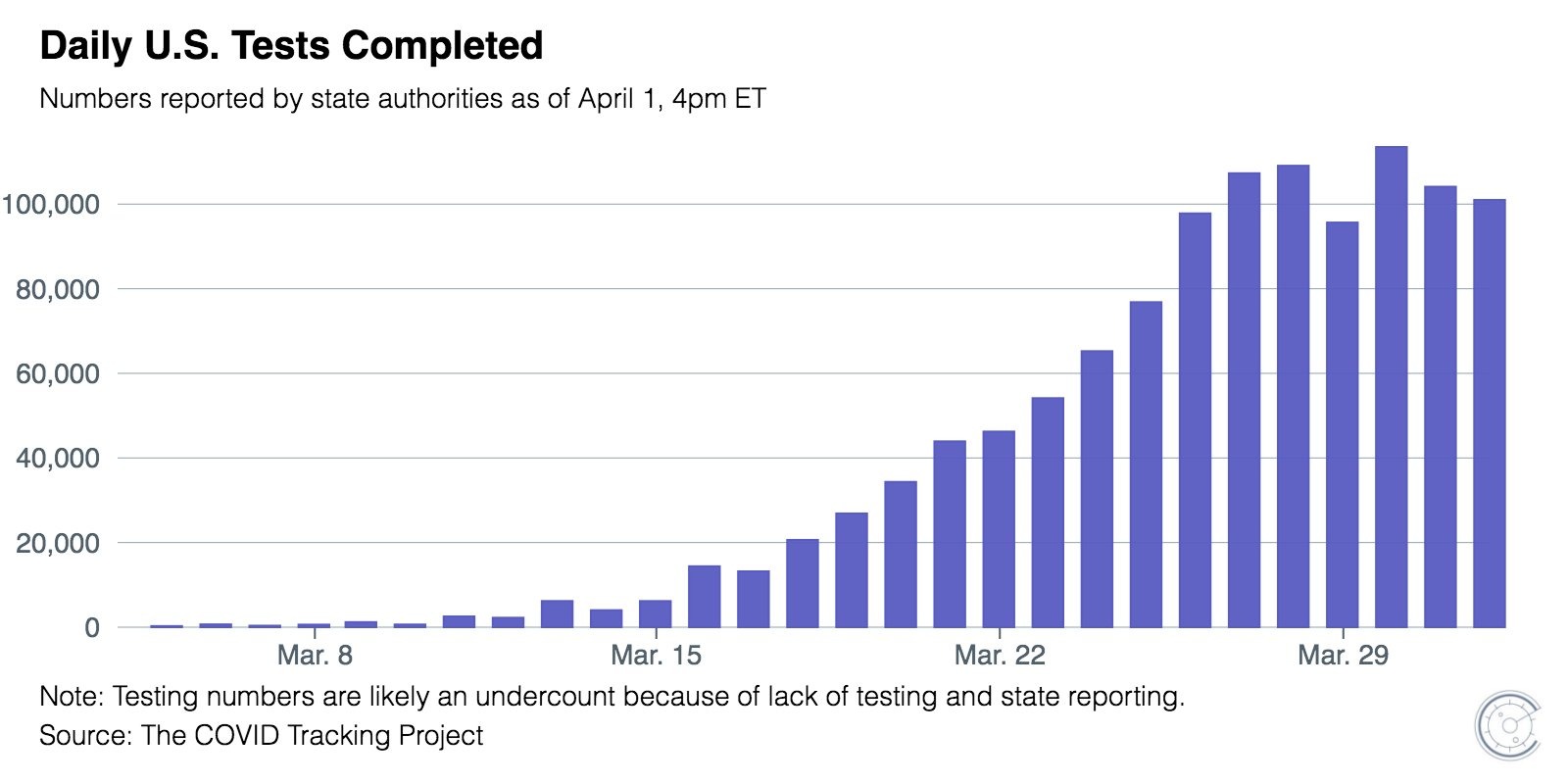
We do not yet have testing “takeoff”
Barriers to masks
I’ve been working with a generous donor to get a million PPEs (masks) to the myriad healthcare workers in NYC who constantly tell us they’re facing shortages. Yet, hurdle after hurdle of dysfunction is severely inhibiting us from getting donated masks to those in need.
Here’s a catalog of all the ways various forces conspire against this effort at EVERY level: – Employers threaten to fire doctors & nurses if they speak frankly about shortages so it’s hard to determine the most at-need hospitals & if everyone in the chain is doing their job
– CDC and WHO messaging about “no need for masks” provide cover for hospitals, limiting reputational damage and protects them from class-action lawsuits for not providing adequate PPE to their staff (which should be their job)
– US PPE compliance is messy and confusing (different agencies setting different rules) which limits supply – All 50 states, Federal agencies, hospitals, NGOs, and businesses bid against each other, pushing prices up
– US authorities punishes anyone for “price gouging” so importers and suppliers are reluctant to order PPEs from vendors for fear of being penalized – As a result, US importers and suppliers of N95 masks get outbid by foreign competitors so the US loses out
– Because there are no export controls, local supplies of N95 masks get purchased by foreign buyers and are exported – FDA fails to authorize KN95 masks thus choking off total mask supply as KN95s are cheaper & available in larger quantities than N95s (they have similar specs)
– As a result, US Importers are hesitant to order KN95s (mostly produced overseas) because they’re worried they’ll get held up at customs or that hospitals would refuse to accept them even as free donations as they fear legal liability if healthcare worker gets ill using them
– Healthcare workers don’t get the protection they need but they can’t complain to the press – Rinse, wash, repeat – (Chinese state propaganda uses this as proof that the US is just as bad as the CCP for silencing whistleblowers)
That is a tweet storm by Melissa Chen.
Running ahead of Pandemics: Achieving In-Advance Antiviral Drugs
From Jaspreet Pannu (an EV winner, by the way, Jassi Pannu), here is a new, short Mercatus policy brief. Excerpt:
I propose adopting innovation prizes with awards large enough to justify investments in broad-spectrum antiviral drugs developed up to phase III clinical trials in the FDA drug approval process. I also emphasize the importance of starting this effort with pathogen families of known pandemic potential, such as respiratory viruses.
…the medical community needs—and currently lacks—a class of drugs designed for emerging viruses of pandemic potential. These broad-spectrum drugs that target entire viral families can be developed as individual drugs or platform technologies.
Just before the outbreak of COVID-19, researchers at the Johns Hopkins Center for Health Security stated that “broad-spectrum [antiviral] therapeutics should be pursued given their potential value.”
There is much more at the link.
Wednesday assorted links
2. Timeline of the federal government response to coronavirus.
3. Anti-price gouging laws mean masks leave America, I wonder if Alex is preparing a whole post on this link?
4. Holman Jenkins of the WSJ goes Straussian on the Straussian bloggers.
5. The culture that is Bengali priorities: sweet shops will stay open. And a short history of coronavirus in Japan. And Ezra Klein interviews Evan Osnos on coronavirus and U.S.-China relations.
6. Self-isolation proves a boon to rainfall project.
7. Why there are lags in scaling up California testing. A very good (and depressing) piece.
8. Mossad officer describes their battle for ventilators. And is the U.S. taking ventilators from Paraguay? (speculative)
9. The singing stops in southern Italy as tensions rise.
10. “Our infectiousness model suggests that the total contribution to R0 from pre-symptomatics is 0.9 (0.2 – 1.1), almost enough to sustain an epidemic on its own. For SARS, the corresponding estimate was almost zero (9), immediately telling us that different containment strategies will be needed for COVID-19.” Link here.
11. Hospitals that won’t let their doctors wear masks (NYT).
12. Economist Peter Sinclair has died from Covid-19.
13. Should very young countries such as Nigeria opt for suppression?
15. Our system of scientific funding is broken for rapid science (recommended).
What should you read during the crisis?
Agnes Callard writes (NYT):
Like many others, I have been finding my taste in books and movies turning in an apocalyptic direction. I also find myself much less able than usual to hold these made-up stories at a safe distance from myself…
If I have something to feel guilty about, I want to feel guilty. If something frightening is happening, I want to be afraid of it. Which is to say: When things are bad, I want to suffer and would choose to suffer and even seek out suffering.
Having just rewatched Bergman’s The Seventh Seal, and then The Virgin Spring, I agree at the margin, but not altogether. I would raise the following points:
1. In times of turmoil, we may have a stronger craving for art that “feels real.” But such art is in fact often especially phony. The “special effects” have to be all the better, so to speak. None of what we are consuming is a realistic experience in the first place, so perhaps we are seeking out greater artifice and fooling ourselves about its realism even more than usual.
2. Should we be watching videos of bad events in hospitals? (originally Chinese hospitals, now NYC). Some people are indeed doing this, but as a substitute for Jane Austen? How about videos of people dying from Covid-19? Videos of other respiratory diseases as the next best fill-in?
3. What about the art vs. non-art margin as a larger choice? Don’t many people with terminal diseases (more terminal than usual that is) want to go for long walks in nature? Doesn’t fiction exercise much less of a hold on elderly minds and matter most for teenagers and people in their early 20s and perhaps also women in their 40s-50s? Perhaps the implication is, during a pandemic, to move away from art and literary fiction altogether.
4. The Guardian reports that sales of long, classic novels have gone up. What do those novels have in common? Are they a kind of comfort food? Do we value their length? That they are high status? That we read them already in earlier and perhaps happier periods of life? Are they long projects we can absorb ourselves in? Those seem like illusion-laden motives for reading them, “not that there’s anything wrong with that.”
5. Perhaps we like to read especially pessimistic dystopian novels as a kind of talisman. “Tell me the worst, let’s get dealing with the fear over with, then I will feel protected that reality will not disappoint my expectations because things won’t in fact be that bad.” That is again another kind of illusion. The aforementioned Guardian link suggests that sales of dystopian novels are up in general, even if they are not about plagues and pandemics.
6. Yiyun Li said: ““I have found that the more uncertain life is, the more solidity and structure Tolstoy’s novels provide. In these times, one does want to read an author who is so deeply moved by the world that he could appear unmoved in his writing,” she wrote.”
7. If people are bored, should they then wish to experience further boredom through their choice of fiction? Or would a diversion from boredom be acceptable and indeed preferred?
Somehow I think in terms of a portfolio approach to aesthetics. In harder times you need more tugs, pulls, distractions, and offsets than usual, but they should not all run in the same direction, or they will become predictable and cease to move you.
So when it comes to fiction, take some chances in your reading and toss in some of the older classics and horror and dystopia as well, and lots of fun and warmth and those walks in nature too.
So yes make a (marginal) turn in the apocalyptic direction, but in part it is to shore up your own sappiness.
Small business aid through Fintech?
Consumers open up Facebook, Instagram, Snap, and WhatsApp dozens of times a day. Businesses, on the other hand, are checking Square, Stripe, QuickBooks, Netsuite, Brex, FreshBooks, Xero, Gusto, DoorDash, Mindbody, Toast and other tools that show them sales, orders, customers, and expenses. Almost every one of these platforms has been granted permission to access—read and write—bank accounts, and helps run the business.
The stimulus bill is going to direct funds through the Small Business Administration, but the SBA doesn’t really make loans. It simply guarantees loans made by banks. For many banks, the way you apply for an SBA 7a loan is to prepare tons of documents, go to your local branch, and then wait as long as 90 days. Wells Fargo has a fancy website, but for SBA loans it directs you to your local branch for a process that takes dozens of hours of form collections and physical signatures followed by months of waiting. Many private lenders approve loans in hours, so the SBA process has historically been an adverse selection lending trap.
It’s March of 2020, the world is under quarantine, all financial data exists in digital form, and billions of people use the internet—we can and should do better. Here’s how this can work, and Silicon Valley is standing by to build this, open source it, and get it out in days so that these small businesses can weather this storm.
Each and every financial services company can place a button on their website or in their app that sucks in relevant data from each business—much of it unforgeable, like credit card receipts as validated by the credit card processor—and spits out an instant machine readable package for aid. If Federal assistance needs to go through an SBA-approved bank (an odd construct, since most of these loans are meant to be forgiven) then this machine readable package can go out to whatever bank out of the 3000+ active SBA lenders can authorize it the quickest. To prevent fraud, that bank can be granted permission to the same set of financials—without loan officers, in person visits, scans and faxes. And if it comes back clean, route the money to the financial service that has already performed the Know Your Customer check on that merchant. A very complex problem is reduced to several hundred lines of code, aided by tools that nearly every small merchant in the United States uses.
That is by Alex Rampell, there is more at the link. More generally, we need to be honest with ourselves about who is capable of generating rapid response and who is not. Here is a Reason piece on the successes of the tech community.
Emergent Ventures India
Thanks to a special grant, there is now a devoted tranche of Emergent Ventures India. In the last two years, EV has received excellent applications related to India, both from residents in India and entrepreneurs and academics around the world working on India-related projects. This is not surprising because India has exceptional young talent with great ideas, but its traditional educational and philanthropic institutions have not always identified and nurtured these ideas and individuals. And given the size of the opportunity in India, a successful idea can change the lives of a very large number of people. In this sense, EV India is our attempt at a moonshot.
And a given dollar goes much further there!
Those unfamiliar with Emergent Ventures can learn more here and here.
EV India will provide grants and micro grants to jump-start high-reward ideas that advance prosperity, opportunity, liberty, and the well-being of Indians. We encourage unorthodox ideas and also requests that are too small to attract interest from the traditional models of funding and philanthropy.
Shruti Rajagopalan (also an Emergent Ventures Winner) joined Mercatus in the fall of 2019 as a senior research fellow studying Indian political economy and economic development. Shruti and I (Tyler) are already working together to evaluate applications for EV India. And note we are now working on some Covid-19-related grants!
To apply for EV India, use the EV application click the “Apply Now” button and select India from the “My Project Will Affect” drop-down menu.
Here is a list of past grants and fellowships made to India related projects:
Harshita Arora (first EV cohort), an 18-year-old Indian prodigy from Saharanpur, in addition to her work in the sciences, she recently co-founded AtoB, a startup building a sustainable transportation network for intercity commuters using buses.
Neil Deshmukh, high school student in Pennsylvania, for general career support and also to support his work on smartphone apps for helping Indian farmers identify, diagnose, and recommend treatment options for crop diseases (PlantumAI) and for helping the blind and visually impaired interpret images through sound (VocalEyes).
Paul Novosad, at Dartmouth, with Sam Asher, at Johns Hopkins, to enable the construction of a scalable platform for the integration and dissemination of socioeconomic data in India, ideally to cover every town and village, toward the end of informing actionable improvements. The Socioeconomic High-resolution Rural-Urban Geographic Dataset on India (SHRUG) is available here.
Tejas Subramaniam, a high schooler from Chennai, for prospective work on disseminating information about the prevalence of sexual violence, the harm it does, and effective tools to reduce its incidence. Tejas (with his team) won the World Schools Debating Championships (WSDC) in August 2019.
Namrata Narain, Harvard Ph.D student in economics, for work on “What happens to the ability of firms to write contracts when courts are dysfunctional?”
Samarth Jajoo, a high school student in Ahmedabad, India, to assist in his purchase of study materials for math, computer science, and tutoring. He has developed a project called read.gift, which is a new book gifting project.
Himanshu Dhingra, an entrepreneurial Indian law student, to support his travel and internship at Project Arizona.
Ashish Kulkarni, an economics professor at Gokhale Institute of Politics and Economics, to support a podcast on asynchronous mentoring.
Shrirang Karandikar, to support an Indian project to get the kits to measure and understand local pollution.
If you are interested in supporting the India tranche of Emergent Ventures, please write to me or to Shruti at [email protected].
The optimal duration of lockdown
Here is a new AEI paper by Anna Scherbina. I have not read it and am not endorsing (or criticizing) its conclusions, here goes:
We investigate the optimal duration of the COVID-19 suppression policy. We find that absent extensive suppression measures, the economic cost of the virus will total over $9 trillion, which represents 43% of annual GDP. The optimal duration of the suppression policy crucially depends on the policy’s effectiveness in reducing the rate of the virus transmission. We use three different assumptions for the suppression policy effectiveness, measured by the R0 that it can achieve (R0 indicates the number of people an infected person infects on average at the start of the outbreak). Using the assumption that the suppression policy can achieve R0 = 1, we assess that it should be kept in place between 30 and 34 weeks. If suppression can achieve a lower R0 = 0.7, the policy should be in place between 11 and 12 weeks. Finally, for the most optimistic assumption that the suppression policy can achieve an even lower R0 of 0.5, we estimate that it should last between seven and eight weeks. We further show that stopping the suppression policy before six weeks does not produce any meaningful improvements in the pandemic outcome.
I hope there is a variable in the analysis for “risk of extreme societal pressures,” though I am not sure if those are higher for extreme lockdown scenarios or for extreme “let it rip” scenarios. In any case, such risks are a significant factor in how I view these questions.
And now I must teach! (on-line, of course). But I wanted to get this up for your attention before the evening closes.