Category: Books
What should I ask Ed Luce?
I’ll be interviewing Ed on June 13, 6-8 p.m., GMU Arlington campus, including about his new and very interesting book The Retreat of Western Liberalism. Ed is also “chief American commentator” for The Financial Times, and author of one of the best general introductions to India, In Spite of the Gods: The Rise of Modern India. Here is Ed’s Wikipedia page. Here are event details.
Transcript of my *Stubborn Attachments* podcast with Cardiff Garcia
It is here, excerpt:
I wrote this book so that you don’t read it…
Jill Lepore on dystopia
Dystopia used to be a fiction of resistance; it’s become a fiction of submission, the fiction of an untrusting, lonely, and sullen twenty-first century, the fiction of fake news and infowars, the fiction of helplessness and hopelessness. It cannot imagine a better future, and it doesn’t ask anyone to bother to make one. It nurses grievances and indulges resentments; it doesn’t call for courage; it finds that cowardice suffices. Its only admonition is: Despair more. It appeals to both the left and the right, because, in the end, it requires so little by way of literary, political, or moral imagination, asking only that you enjoy the company of people whose fear of the future aligns comfortably with your own. Left or right, the radical pessimism of an unremitting dystopianism has itself contributed to the unravelling of the liberal state and the weakening of a commitment to political pluralism. “This isn’t a story about war,” El Akkad writes in “American War.” “It’s about ruin.” A story about ruin can be beautiful. Wreckage is romantic. But a politics of ruin is doomed.
Here is the full article.
The book culture that is Iceland should not surprise the Coasean
For Tunglið, how you publish is as important as what you publish. Named after the Icelandic word for the moon, the tiny publisher prints its books in batches of 69 on the night of a full moon. So far, so weird. But keen readers must also buy their books that same night, as the publisher burns all unsold copies. Weirder still.
Why? While most books can survive centuries or even millennia, Tunglið – as its two employees tell me – “uses all the energy of publishing to fully charge a few hours instead of spreading it out over centuries … For one glorious evening, the book and its author are fully alive. And then, the morning after, everyone can get on with their lives.”
Here is the full story, and here is background information on durable good monopoly and the returns to rendering output less durable, as a means of precommitting to not lowering the price in later periods. Avoid remainders, in other words, so customers will buy it now. Guess who first came up with those insights?
Proust as speculator
Through a fast alternation of buying and selling, orders and counterorders, the end of 1911 marked Proust’s fastest plunge into debt exposure in his fifteen-year-long investing career. His patrimony amounted to about 1,522,000 francs, but more than 40 percent of it, precisely 640,000 francs, was tied up in forwards contracts—a crazy level of exposure for an amateur investor. In terms of American dollars, at this time Proust owned a personal fortune of $6,864,000 and had about $2,900,000 tied up in obligations to buy.
That is from Proust and His Banker: In Search of Time Squandered, by Gian Balsamo, via Ray Lopez. Ray also passes along this from the book summary:
Focusing on more than 350 letters between Proust and Hauser and drawing on records of the Rothschild Archive and financial data assembled from the twenty-one-volume Kolb edition of Proust’s letters, Balsamo reconstructs Proust’s finances and provides a fascinating window into the writer’s creative and speculative process. Balsamo carefully follows Proust’s financial activities, including investments ranging from Royal Dutch Securities to American railroads to Eastern European copper mines, his exchanges with various banks and brokerage firms, his impetuous gifts, and the changing size and composition of his portfolio. Successes and failures alike provided material for Proust’s fiction, whether from the purchase of an airplane for the object of his affections or the investigation of a deceased love’s intimate background. Proust was, Balsamo concludes, a master at turning financial indulgence into narrative craftsmanship, economic costs into artistic opportunities. Over the course of their fifteen-year collaboration, the banker saw Proust squander three-fifths of his wealth on reckless ventures and on magnificent presents for the men and women who struck his fancy. To Hauser the writer was a virtuoso in resource mismanagement. Nonetheless, Balsamo shows, we owe it to the altruism of this generous relative, who never thought twice about sacrificing his own time and resources to Proust, that In Search of Lost Time was ever completed…
What I’ve been reading
1. Harold James, The German Slump: Politics and Economics 1924-1936. Not economic history in the post-cliometrics sense, but a history of economic issues, very high quality, full of good information on just about every page.
2. William Rosen, Miracle Cure: The Creation of Antibiotics and the Birth of Modern Medicine. A good book on exactly what the title promises, my favorite sentence was this: “Before penicillin, three-quarters of all prescriptions were still compounded by pharmacists using physician-supplied recipes and instructions, with only a quarter ordered directly from a drug catalog. Twelve years later, nine-tenths of all prescribed medicines were for branded products.”
3. Justin Yifu Lin and Celestin Monga, Beating the Odds: Jump-Starting Developing Countries. An instructive look at how countries have to start growing before the right institutional framework is in place, and how they can get around that. Haven’t you wondered how China racked up so many years of stellar growth with such a bad “Doing Business” ranking from the World Bank? One of the better books on developing economies in the last few years.
4. Joan C. Williams, White Working Class: Overcoming Class Cluelessness in America. An intelligent and indeed reasonable basic approach to answering questions about class, including “Why don’t they push their kids harder to succeed?” and “Why don’t the people who benefit most from government help seem to appreciate it?” I am not the intended audience, but still this was better than I was expecting.
Rick Wartzman, The End of Loyalty: The Rise and Fall of Good Jobs in America, is a densely-written but nonetheless useful history of how America moved from paternalistic big businesses to lower-benefit jobs.
Arnold Kling, The Three Languages of Politics: Talking Across the Political Divides. This short book, revised, improved, and expanded, is so good it is wasted on almost all of you. Here are various pieces of background information.
*Face Value*
The author is Alexander Todorov, and the subtitle is The Irresistible Influence of First Impressions. Here is one short excerpt:
When Israeli and Japanese women rated these faces on trustworthiness, their impressions were predictably influenced by what they considered typical. As the face became more similar to the typical Israeli face, Israelis trusted it more and Japanese trusted it less and less. As the face became more similar to the typical Japanese face, the opposite occurred. We trust those who look like members of our own tribe.
The book has excellent photos and plates, recommended.
*Art Collecting Today*
The author is Doug Woodham, and the subtitle is Market Insights for Everyone Passionate About Art.
I liked everything in this book, note that the author is a Ph.d economist, has been a partner for McKinsey and also held a major position for Christie’s.
That said, I felt it should have done much more to explain how art is used for money laundering, and also tax arbitrage through donations at inflated prices, based on corrupt appraisals. Those are big reasons why art prices for highly liquid works have boomed so much over the last few decades. Arguably art markets are some of the most corrupt markets in the Western world today.
Measured by the number of Instagram followers, the three biggest artists in the world today are Banksy, JR, and Shepard Fairey.
For deceased artists, the Twitter hashtags game is won by Warhol, Picasso, Dali, and van Gogh, with da Vinci, Monet, and Michelangelo coming next.
Of the 25 highest priced artists in the world today, as measured by auction sales, 8 of them are Chinese. How many of them can you say you are familiar with? On that list are Cui Ruzhuo, Fan Zeng, Zhou Chunya, Zhang Xiaogang, He Jiaying, Huang Yongyu, Liu Wei, and Ju Ming.

Here is more by Zhou Chunya.
Oscar Wilde once said: “When bankers get together for dinner, they discuss art. When artists get together for dinner, they discuss money.”
I can gladly recommend this book, noting it tells only part of the story.
Most distinctive words: New York vs. Texan erotica
Texas: Ranked, Trailer, Soldiers, Sergeant, Bunk, Arena, Evidently, Altar, Alley, Captain.
New York: Subway, Popsicle, Senator, Butthole, Museum, Landlord, Sin, Jacuzzi, Thrusted, Shrugs.
That is from the new and excellent Nabokov’s Favorite Word is Mauve, by Ben Blatt. Here is my earlier post on the book.
Number of -ly adverbs per 10,000 words
Hemingway: 80
Twain: 81
Melville: 126
Austen: 128
J.K. Rowling: 140
E L James: 155
That is from the new and interesting Nabokov’s Favorite Word is Mauve, by Ben Blatt. The Hemingway book with the highest usage rate for -ly adverbs, True at First Light, was released only after his death and is considered one of his worst works. The same pattern is true for Faulkner and Steinbeck, namely that the most highly praised works have relatively low rates of -ly adverb usage. Among other notable authors surveyed, D.H. Lawrence seems to be the most obvious exception to this regularity.
In the novel The Hobbit, J.R.R. Tolkien used the word “she” only once. In The Prime of Miss Jean Brodie, however, she relative to he is used 79% of the time, the highest ratio of the classics surveyed. Female authors are very strongly represented on that side of the curve, let me tell you. And male authors do the “he” far more, in relative terms, than female authors do the “she.”
You also will learn from this book that David Brooks starts more sentences with “The” than any other word, whereas for Paul Krugman that place of honor goes to “But.” And, for better or worse, Krugman uses far less anaphora.
D.H. Lawrence leads for the number of animal similes.
What I’ve been reading
1. David Der-Wei Wang, editor. A New Literary History of Modern China. Almost one thousand pages, and aren’t edited volumes so often poison? Still, these short, collated excerpts provide one of the most useful and readable entry points into modern Chinese intellectual history; this will be making my “year’s best” list. Every year you should be reading multiple books about China, all of you. Here is a sentence from the work, from Andrea Bachner: “In a brothel in Singapore at the beginning of the twentieth century, a quaint Chinese intellectual (reminiscent of Wang) immersed in the project of writing a new Dream of the Red Chamber in oracle bone script on turtle shells inspires an English visitor to dream of creating a novel superior to Ulysses, tattooed on the backs of coolie laborers.”
2. Richard O. Prum, The Evolution of Beauty: How Darwin’s Forgotten Theory of Mate Choice Shapes the Animal World — And Us. The word “forgotten” is misleading in the title, but nonetheless an excellent look at how signaling theories work when the signal is distributed across a quality that is neither useful nor especially burdensome and costly. In other words, it’s not all about the peacock’s tail. The result is aesthetic beauty, and competition across that beauty for its own sake. This book offers an excellent and clearly written treatment of the particulars of avian evolution, signaling theory, and also aesthetics, bringing together some disparate areas very effectively.
3. Invisible Planets: An Anthology of Contemporary Chinese SF in Translation, edited and translated by Ken Liu. A strong collection, with two stories by Cixin Liu. Here is a new article on Chinese science fiction.
4. Thomas Hardy, Unexpected Elegies: “Poems of 1912-1913” and Other Poems About Emma. Some of Hardy’s best poetic work, it mixes “passion, memory, love, remorse, regret, self-awareness and self-flagellation…to serve a speech of intense emotional candor, all in celebration of his dead (and for many years estranged) wife, Emma,” by one account.
There is a new, expanded edition of Amartya Sen’s Collective Choice and Social Welfare, still the best place to go for his views on normative economics.
Robert Wright’s new book is Why Buddhism is True: The Science and Philosophy of Meditation and Enlightenment. I am not sure how amenable Buddhism is to bookish treatment, and furthermore the word “true” makes me nervous in this title (“useful”?), but still this book reaches a local maximum of sorts. If you want a book from a smart Westerner defending Buddhism, this is it.
China from the East
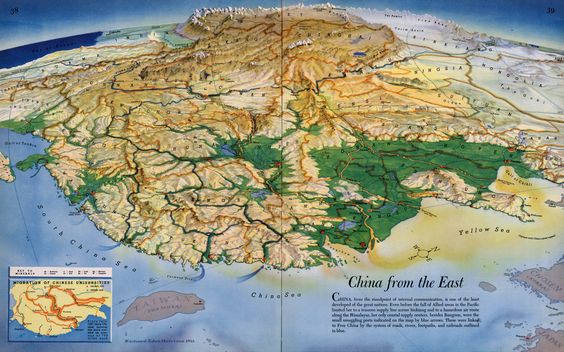
The image was sent to me by Christopher Jared. And, via Shivaji Sondhi, here is a review essay on ideology and the longevity of the Chinese empire.
What I’ve been reading
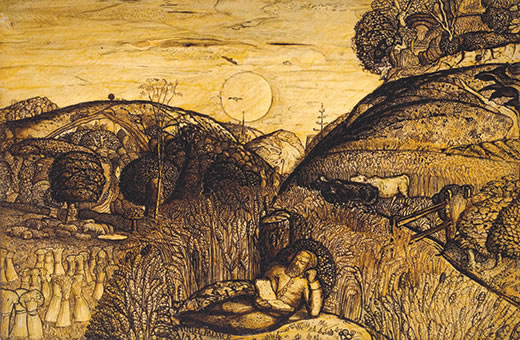
1. William Vaughan, Samuel Palmer: Shadows on the Wall. Another first-rate Yale University Press book of art plates and art history, for this they are the best. Get a hold of as many of them as you can.
2. Ge Fei, The Invisibility Cloak. This short Chinese noir novel, with a dash of Murakami, is one of my year’s favorites and also one of this year’s “cool books.” I finished it in one sitting. Set in Beijing, the protagonist sells audio equipment, and then strange things happen. Here is a good interview with the author.
3. David J. Garrow, Rising Star: The Making of Barack Obama. So far I’ve only read bits and pieces of it, but I am surprised it is not receiving more positive attention. It seems like one of the most thorough and smart and thoughtful biographies of any American president. It has plenty of detail on Obama’s life and career, and you can learn what Obama’s ex-girlfriend says about how he was in bed at age 22 (“he neither came off as experienced nor inexperienced”, [FU Aristotle!]) Yes, at 1084 pp. of text this is more than I want to know, but what’s not to like? Here is a good Brent Staples NYT review. Garrow cribs his main narrative — the artificial construction of his blackness — from Rev. Wright and Steve Sailer, and doesn’t exactly credit them, although that (the former, not the latter) may explain why the mainstream reception has been so tepid.
4. Franklin Foer, World Without Mind: The Existential Threat of Big Tech. The title says it all. I disagreed with almost everything in this book, still it is useful to see where the Zeitgeist is headed.
5. The Great Inka Road: Engineering an Empire, assorted authors and editors and photographers. One of the best and most readable introductions to Incan civilization. I’ll say it again: you all should be reading more picture books! They are one of the best ways to actually learn.
Two useful books for presenting meta-information on learning things are:
Ulrich Boser, Learn Better: Mastering the Skills for Success in Life, Business, and School, or, How to Become an Expert in Just About Anything, and
Eric Barker, Barking Up the Wrong Tree: The Surprising Science Behind Why Everything You Know About Success Is (Mostly) Wrong.
And Thomas W. Hazlett, The Political Spectrum: The Tumultuous Liberation of Wireless Technology, from Herbert Hoover to the Smartphone, is a very learned, market-oriented look at what the title promises.
Robert Sapolsky’s *Behave*
The subtitle is The Biology of Humans at Our Best and Worst. Sapolsky is tenured in biology and neuroscience at Stanford, and winner of a MacArthur genius grant. This book is a very impressive compendium of what we know about the social sciences, as might be rooted in behavioral biology and related fields. The topics include violence, altruism, cooperation, gene-environment interactions, and many more topics along the usual lines. It’s not a “here is my big idea” book, but rather “here is how we think about social phenomena.” In the conclusion, Sapolsky writes: “If you had to boil this book down to a single phrase, it would be “It’s complicated.” Nothing seems to cause anything, instead everything just modulates everything else.” Those are two very good sentences.
This is likely to be one of this year’s major social science books, and many of you should buy it, but it’s flaw is that there’s no particular claim you are forced to come to terms with.
*Indiscrete Thoughts*
That is a splendid 1996 book on mathematics and mathematical researchers, by Gian-Carlo Rota. I found philosophical, mathematical, and also managerial insights on most of the pages. It is playful and yet earnestly serious at the same time. Here is one bit:
He [Alonzo Church] looked like a cross between a panda and a large owl. He spoke in complete paragraphs which seemed to have been read out of a book, evenly and slowly enunciated, as by a talking machine. When interrupted, he would pause for an uncomfortably long period to recover the thread of the argument. He never made casual remarks: they did not belong in the baggage of formal logic. For example, he would not say “It is raining.” Such a statement, taken in isolation, makes no sense. (Whatever it is actually raining or not does not matter; what matters is consistence.) He would say instead: “I must postpone my departure for Nassau Street, inasmuch as it is raining, an act which I can verify by looking out the window.”
It is full of the sociology of everyday life, in mathematical communities that is, for instance:
How do mathematicians get to know each other? Professional psychologists do not seem to have studied this question; I will try out an amateur theory. When two mathematicians meet and feel out each other’s knowledge of mathematics, what they are really doing is finding out what each other’s bottom line is. It might be interesting to give a precise definition of a bottom line; in the absence of a definition, we will give some typical examples.
…I will shamelessly tell you what my bottom line is. It is placing balls into boxes, or as Florence Nightingale David put it with exquisite tact in her book Combinatorial Chance, it is the theory of distribution and occupancy.
The author fears the influence of philosophy on mathematics, which led to this paragraph:
Philosophical arguments are emotion-laden to a greater degree than mathematical arguments and written in a style more reminiscent of a shameful admission than of a dispassionate description. Behind every question of philosophy there lurks a gnarl of unacknowledged emotional cravings which act as a powerful motivation for conclusions in which reason plays at best a supporting role. To bring such hidden emotional cravings out into the open, as philosophers have felt it their duty to do, is to ask for trouble. Philosophical disclosures are frequently met with the anger that we reserve for the betrayal of our family secrets.
Definitely recommended, the book also has some of the best and most concrete discussions of Husserl’s philosophy I have seen, along with a meta-account of such, and also there is a discussion of the exoteric and esoteric readings of cosmology and black holes and indeed mathematics too. Here is further information on Gian-Carlo Rota the author.
For the pointer to the book I thank Patrick Collison.