Category: Data Source
What does consulting do?
It is actually pretty useful:
This paper provides the first systematic and comprehensive empirical study of management and strategy consulting. We unveil the workings of this opaque industry by drawing on universal administrative business-to-business transaction data based on value-added tax links from Belgium (2002-2023). These data permit us to document the nature of consulting engagements, take-up patterns, and the effects on client firms. We document that consulting take-up is concentrated among large, high-labor-productivity firms. For TFP and profitability, we find a U-shaped pattern: both high and low performers hire consultants. New clients spend on average 3% of payroll on consulting, typically in episodic engagements lasting less than one year. Using difference-in-differences designs exploiting these sharp consulting events, we find positive effects on labor productivity of 3.6% over five years, driven by modest employment reductions alongside stable or growing revenue. Average wages rise by 2.7% with no decline in labor’s share of value added, suggesting productivity gains do not come at workers’ expense through rent-shifting. We do observe organizational restructuring with small increases in dismissal rates, and higher services procurement but reduced labor outsourcing. Our heterogeneity analysis reveals larger productivity gains for initially less productive firms, suggesting improvements in allocative efficiency. Our findings broadly align with ex-ante predictions from surveyed academic economists and consulting professionals, validating the productivity-enhancing view of consulting endorsed by most practitioners though only half of academics, while lending less support to a rent-shifting view favored by many economists.
That is from a new NBER working paper by
The Rising Cost of Child and Pet Day Care
Everyone talks about the soaring cost of child care (e.g. here, here and here), but have you looked at the soaring cost of pet care? On a recent trip, it cost me about $82 per day to board my dog (a bit less with multi-day discounts). And no, that is not high for northern VA and that price does not include any fancy options or treats! Doggie boarding costs about about the same as staying in a Motel 6.
Many explanations have been offered for rising child care costs. The Institute for Family Studies, for example, shows that prices rise with regulations like “group sizes, child-to-staff ratios, required annual training hours, and minimum educational requirements for teachers and center directors.” I don’t deny that regulation raises prices—places with more regulation have higher costs—but I don’t think that explains the slow, steady price increase over time. As with health care and education, the better explanation is the Baumol effect, as I argued in my book (with Helland) Why Are the Prices So Damn High?
Pet care is less regulated than child care, but it too is subject to the Baumol effect. So how do price trends compare? Are they radically different or surprisingly similar? Here are the two raw price trends for pet services (CUUR0000SS62053) and for (child) Day care and preschool (CUUR0000SEEB03). Pet services covers boarding, daycare, pet sitting, walking, obedience training, grooming but veterinary care is excluded from this series so it is comparable to that for child care.
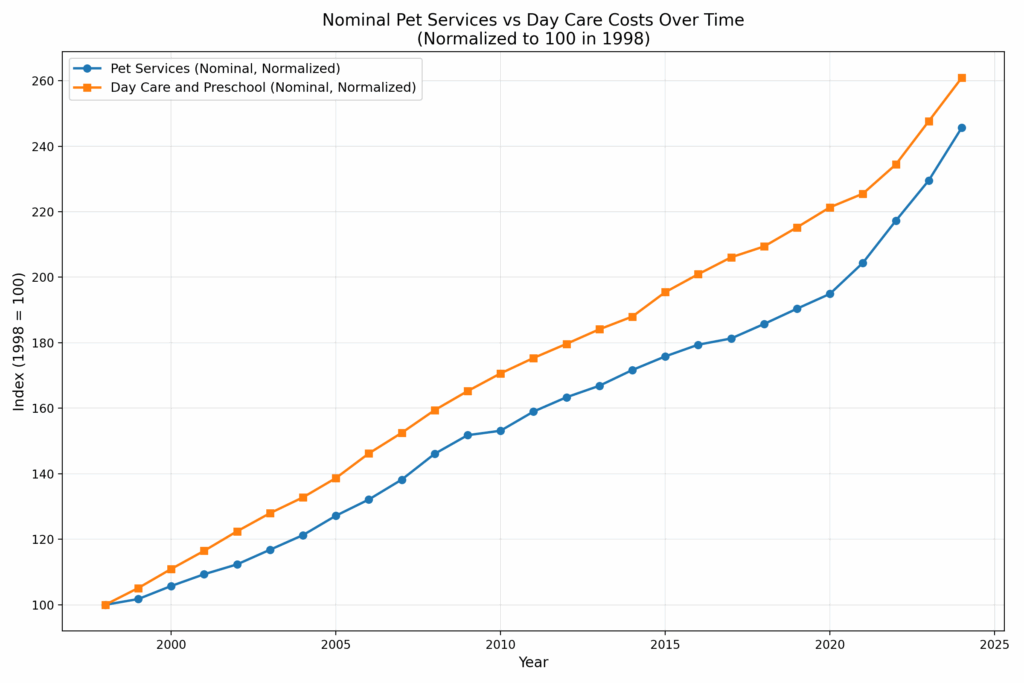
As you can see, the trends are nearly identical, with child care rising only slightly faster than pet care over the past 26 years. Of course, both trends include general inflation, which visually narrows the gap. When we normalize to the overall CPI, we get the following:
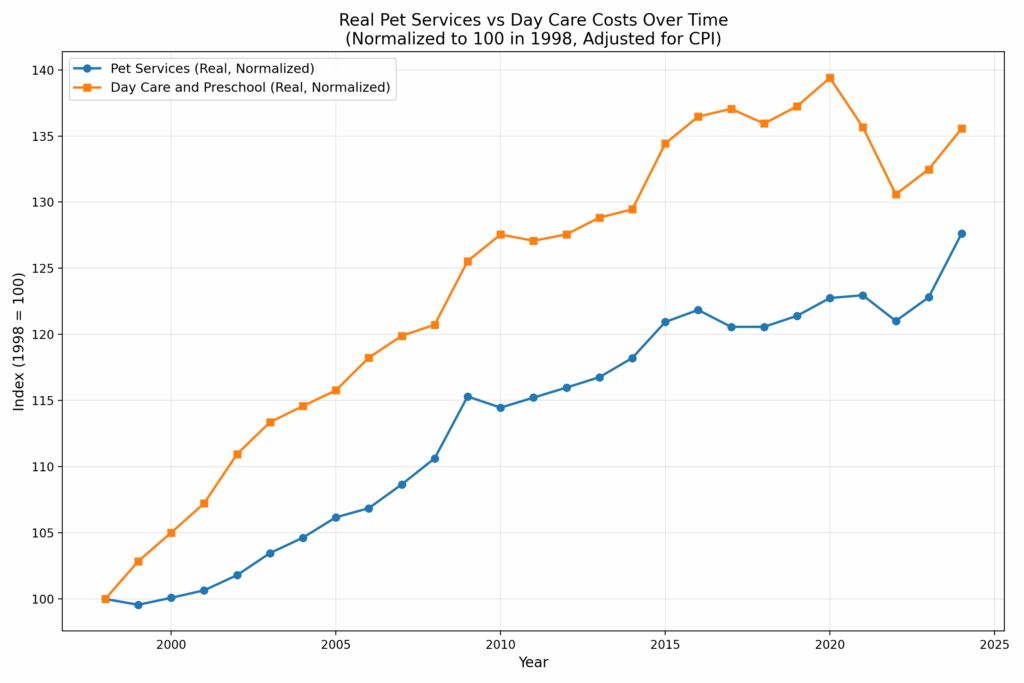
Over 26 years, the real (relative) price of Day Care and Preschool has increased 36%, while Pet Services have risen 28%. If regulation doesn’t explain the rise in pet care costs–and it probably doesn’t–then regulation probably doesn’t explain the rise in child care costs either. After all, child and pet care are very similar goods!
The similar rise in the price of child day care and pet day care/boarding is consistent with Is American Pet Health Care (Also) Uniquely Inefficient? by Einav, Finkelstein and Gupta, who find that spending on veterinary care is rising at about the same rate as spending on human health care. Since the regulatory systems of pet and human health care are very different this suggests that the fundamental reason for rising health care isn’t regulation but rising relative prices and increasing incomes (fyi this is also an important reason why Americans spend more on health care than Europeans).
Thus, my explanation for rising prices in child care and pet care is that productivity is increasing in other industries more than in the care industries which means that over time we must give up more of other goods to get child and pet care. In short, if productivity in other sectors rises while child/pet care productivity stays flat, relative prices must rise. Another way to put this is that to retain workers, wages in stagnant-productivity sectors must rise to match those in (equally labor-skilled) high-productivity sectors. That means paying more for the same level of care, simply to keep the labor force from leaving
But rising productivity in other sectors is good! Thus, I always refer to the Baumol effect rather than the “cost disease” because higher prices are not bad when they reflect changes in relative prices. As with education and health care the rising price of child and pet care isn’t a problem for society as whole. We are richer and can afford more of all goods. It can be a problem, however, for people who consume more than the average quantities of the service-sector goods and people who have lower than average wage gains. So what can we do? Redistribution is one possibility.
If we focus on the prices, the core problem is that care work is labor-intensive and labor has a high opportunity cost. One solution is to lower the opportunity cost of that labor. Low-skill immigration helps: when lower-wage workers take on support roles, higher-wage workers can focus on higher-value tasks. As I’ve put it, “The immigrant who mows the lawn of the nuclear physicist indirectly helps to unlock the secrets of the universe.” Same for the immigrant who provides boarding for the pets of the nuclear physicist.
Another solution is capital substitution—automation, AI, better tools. But care jobs resist mechanization; that’s part of why productivity growth is so slow in these sectors. Still, the basic truth remains: if we want more affordable day care—for kids or pets—we need to use less of what’s expensive: skilled labor. That means either importing more people to do the work, or investing harder in ways to do it with fewer hands.
China kindergarten fact of the day
The number of children in Chinese kindergartens has fallen by a quarter in four years, prompting the closure of tens of thousands of preschools in the country as a precipitous drop in births hits the education system.
Enrolments in China’s kindergartens have declined by 12mn children between 2020 and 2024, from a peak of 48mn, according to data from the country’s ministry of education. The number of kindergartens, serving Chinese children aged 3-5, has also fallen by 41,500 from a high of nearly 295,000 in 2021.
Here is more from the FT.
Partisan Bias in Professional Macroeconomic Forecasts
Here is a recent paper by Benjamin S. Kay, Aeimit Lakdawala, and Jane Ryngaert:
Using a novel dataset linking professional forecasters in the Wall Street Journal Economic Forecasting Survey to their political affiliations, we document a partisan bias in GDP growth forecasts. Republican-affiliated forecasters project 0.3-0.4 percentage points higher growth when Republicans hold the presidency, relative to Democratic-affiliated forecasters. Forecast accuracy shows a similar partisan pattern: Republican-affiliated forecasters are less accurate under Republican presidents, indicating that partisan optimism impairs predictive performance. This bias appears uniquely in GDP forecasts and does not extend to inflation, unemployment, or interest rates. We explain these findings with a model where forecasters combine noisy signals with politically-influenced priors: because GDP data are relatively more uncertain, priors carry more weight, letting ideology shape growth projections while leaving easier-to-forecast variables unaffected. Noisy information therefore amplifies, rather than substitutes for, heterogeneous political priors, implying that expectation models should account for both information rigidities and belief heterogeneity. Finally, we show that Republican forecasters become more optimistic when tax cuts are salient in public discourse, suggesting that partisan differences reflect divergent beliefs about the economic effects of fiscal policy.
Here is the SSRN link.
USA fact of the day
…fraction of children living with two parents is highest it’s been since 1991 (which wouldn’t be surprising with less teen/v young pregnancy)…
That is from Kevin Bryan, here is the source material.
China fact of the day
China alone accounts for almost 1000 hotels that include Vienna in their name, far more than any country, including Austria itself.
This article is more generally about what you learn when you study 25,000 hotel names and look for common patterns. Via the excellent Samir Varma.
USA fact of the day
Federal Reserve Board operating expenses have *quadrupled* from 2004 to 2023, reaching ~$1 billion in 2023, according to the Annual Reports of the Board of Governors of the Federal Reserve System.
That is from Jon Hartley. It is of course correct that the other effects of the Fed far outweigh the size of these expenditures. Nonetheless, it is worth asking, given these numbers, whether the system in place is generating good decisions. That in turn said, we do not currently have an “appropriate set of askers.”
The Benefits of Scholastic Athletics
This paper uses longitudinal data to study the benefits of participation in scholastic athletics starting with high school participation and continuing with college athletics, including the benefits of intramural athletics. We study the impact of participation on a number of important life outcomes, including graduation from high school and college and wages after schooling is completed. Controlling for rich measures of cognitive and personality skills and social background, we find substantial benefits at all levels. Participation in athletics promotes social mobility for disadvantaged and minority students.
Here is the paper, by
Labor supply is elastic!
Even in Denmark:
We investigate long-run earnings responses to taxes in the presence of dynamic returns to effort. First, we develop a theoretical model of earnings determination with dynamic returns to effort. In this model, earnings responses are delayed and mediated by job switches. Second, using administrative data from Denmark, we verify our model’s predictions about earnings and hours-worked patterns over the lifecycle. Third, we provide a quasi-experimental analysis of long-run earnings elasticities. Informed by our model, the empirical strategy exploits variation among job switchers. We find that the long-run elasticity is around 0.5, considerably larger than the short-run elasticity of roughly 0.2.
That is from a forthcoming American Economic Review piece by Henrik Kleven, Claus Kreiner, Kristian Larsen, and Jakob Søgaard. Via Alexander Berger.
Addendum: The rest of supply is elastic too.
Sentences to ponder
In a much more narrow case, a big study of the views of AI and machine learning researchers revealed high levels of trust in international organizations and low levels of trust in national militaries.
That is from Matt Yglesias.
Lookism and VC
Do subtle visual cues influence high-stakes economic decisions? Using venture capital as a laboratory, this paper shows that facial similarity between investors and entrepreneurs predicts positive funding decisions but negative investment outcomes. Analyzing early-stage deals from 2010-2020, we find that greater facial resemblance increases match probability by 3.2 percentage points even after controlling for same race, gender, and age, yet funded companies with similar-looking investor-founder pairs have 7 percent lower exit rates. However, when deal sourcing is externally curated, facial similarity effects disappear while demographic homophily persists, indicating facial resemblance primarily operates as an initial screening heuristic. These findings reveal a novel form of homophily that systematically shapes capital allocation, suggesting that interventions targeting deal sourcing may eliminate the negative influence of visual cues on investment decisions.
That is from a recent paper by Emmanuel Yimfor, via the excellent Kevin Lewis.
Britain fact of the day
As the number of Brits on sickness and disability support has rocketed in recent years, so have Motability’s sales. It uses its heft to buy new models in bulk, then leases them to claimants — usually for three years — before selling them on to traders like Samani. That has made it the UK’s leading car-fleet operator, and helped skew the market away from private buyers and sellers.
Get this:
Motability bought one of every five new cars sold in the UK last year. And yet it only exists to serve a very specific type of customer: people claiming mobility benefits.
A surge in the number of people claiming disability benefits has seen the number of Motability customers rise by about 200,000 over the past two years to 815,000.
Not good! The market for new private cars is really so anemic? Here is more from Bloomberg. Sarah Haider, telephone!
p.s. When it comes to disability: “In 2024 the DWP reported that there were 0% of fraudulent claims made.“ Whew…
Finland fact of the day
Nearly half of Finns now identify with the political right, according to a new survey by the Finnish Business and Policy Forum (EVA), marking a record high in the organisation’s annual values and attitudes research.
The 2025 survey found that 49 percent of respondents place themselves on the right of the political spectrum. The proportion identifying with the left stands at 31 percent, while only 19 percent consider themselves centrist. The centre has declined steadily with each round of the survey.
Here is the full story, via Rasheed.
The Role of Blood Plasma Donation Centers in Crime Reduction
The United States is one of the few OECD countries to pay individuals to donate blood plasma and is the most generous in terms of remuneration. The opening of a local blood plasma center represents a positive, prospective income shock for would-be donors. Using detailed data on the location of blood plasma centers in the US and two complementary difference-indifferences research designs, we study the impact of these centers on crime outcomes. Our findings indicate that the opening of a plasma center in a city leads to a 12% drop in the crime rate, an effect driven primarily by property and drug-related offenses. A within-city design confirms these findings, highlighting large crime drops in neighborhoods close to a newly opened plasma center. The crime-reducing effects of plasma donation income are particularly pronounced in less affluent areas, underscoring the financial channel as the primary mechanism behind these results. This study further posits that the perceived severity of plasma center sanctions against substance use, combined with the financial channel, significantly contributes to the observed decline in drug possession incidents.
That is from a new paper by Brendon McConnell and Mariyana Zapryanova. Via the excellent Kevin Lewis.
Why is manufacturing productivity growth so low?
We examine the recent slow growth in manufacturing productivity. We show that nearly all measured TFP growth since 1987—and its post-2000s decline—comes from a few computer-related industries. We argue conventional measures understate manufacturing productivity growth by failing to fully capture quality improvements. We compare consumer to producer and import price indices. In industries with rapid technological change, consumer price indices indicate less inflation, suggesting mismeasurement in standard industry deflators. Using an input-output framework, we estimate that TFP growth is understated by 1.7 percentage points in durable manufacturing, 0.4 percentage points in nondurable manufacturing, with no mismeasurement in nonmanufacturing industries.
That is from a recent paper by Enghin Atalay, Ali Hortacsu, Nicole Kimmel, and Chad Syverson. Still, that seems low to me…
Via Adam Ozimek.