Category: Data Source
Book ban sentences to ponder
Using a staggered difference-in-differences design, we find that the circulations of banned books increased by 12%, on average, compared with comparable nonbanned titles after the ban. We also find that banning a book in a state leads to increased circulation in states without bans. We show that the increase in consumption is driven by books from lesser-known authors, suggesting that new and unknown authors stand to gain from the increasing consumer support. Additionally, our results demonstrate that books with higher visibility on social media following the ban see an increase in consumption, suggesting a pivotal role played by social media. Using patron-level data from the Seattle Public Library that include the borrower’s age, we provide suggestive evidence that the increase in readership in the aggregate data is driven, in part, by children reading a book more once it is banned. Using data on campaign emails sent to potential donors subscribed to politicians’ mailing lists, we show a significant increase in mentions of book ban-related topics in fundraising emails sent by Republican candidates.
That is from a new paper by Uttara M. Ananthakrishnan, et.al., via Kris Gulati.
The Russian paradox
So much education, so little human capital:
According to the UNESCO Institute for Statistics (UIS) statistical database, Russians age 25 and older averaged 12.4 years of schooling circa 2019—almost the same as for Organisation for Economic Co-operation and Development (OECD) Europe, which averaged 12.6 years. While some Western European countries—Germany, Iceland, Switzerland, and the UK—reported mean years of schooling (MYS) well above Russia’s, others reported lower levels than Russia: among them, Austria, Belgium, Greece, Ireland, Italy, Portugal, and Spain…
But while Russia’s educational profile looks solidly First World, its health profile assuredly does not…Among the dozens of countries from Asia, Europe, the New World, and Oceania included in the HMD, Russia presents as the extreme outlier—with shockingly low levels of life expectancy given its level of educational attainment. According to Barro-Lee, MYS at age 15 in Australia and Russia in 2010 were basically indistinguishable, yet in that same year, combined male and female life expectancy at age 15 was almost 14 years lower for Russia. The last time life expectancy at age 15 in Australia was at Russia’s 2010 level, according to HMD, was in 1929—well before the penicillin era…
As of 2019, Russian male life expectancy at age 15 looks to be solidly in the middle of the range for UN’s official roster of least developed countries (LDCs)—the immiserated and fragile states designated as “the most disadvantaged and vulnerable members of the UN family.” If WHO calculations were correct, life expectancy for a young man in Russia was all but identical to that of his Haitian counterpart at that time—and practically half of the world’s LDCs in Figure 3 had higher life expectancies than Russia!
That is from a longer piece by Nicholas Eberstadt, via Mike Doherty.
AI on Tariffs
There is some evidence that the White House used AI to come up with a quick and dirty (and incorrect) formula to correlate tariff rates with trade deficits. I have no problem with using AI, I think they just didn’t go far enough. The White House should have asked the AI a question like this:
Suppose the US imposed tariffs on other countries in an effort to reduce bilateral trade deficits to zero using the formula for the tariff of (exports-imports)/imports. What do you estimate would be the consequences of such a policy?
Answer (O1 Pro):
A tariff schedule keyed to bilateral deficits—imposing a rate equal to (US exports − US imports) / US imports—would be extremely disruptive and unlikely to achieve its goal. Key points:
Immediate Impact on Prices and Supply Chains
If the US imports more than it exports from a given country, (exports − imports) is negative, making the tariff percentage negative unless the formula is modified (e.g., by absolute value). In practice, one would presumably set a positive tariff aimed at closing the bilateral gap.
Such high tariffs would sharply raise import prices for both consumers and firms reliant on foreign inputs. It would encourage attempts to switch suppliers but at the cost of disrupting supply chains and increasing production expenses.
Retaliation and Trade War Dynamics
Targeted countries would almost certainly retaliate with their own tariffs. Retaliation would damage US export sectors—especially agriculture and high-value manufacturing—and risk a broader trade war.
Countries with a US trade surplus would apply punitive measures that shift US business to alternative suppliers, undermining the very exports the policy is meant to foster.
Misalignment with Macroeconomic Fundamentals
Bilateral imbalances reflect global production patterns, comparative advantage, and macro factors like savings–investment imbalances and currency flows. A country that persistently imports more overall does so because it’s running a capital account surplus. Tariffs don’t fundamentally alter that global saving–investment arithmetic.
If the US still runs an overall current account deficit, restricting imports from some countries will simply shift deficits to others. Global supply chains will rearrange, but the total US deficit will be largely unchanged.
Violation of Trade Agreements
Such a policy almost certainly violates WTO rules, since it imposes discriminatory tariffs based on bilateral imbalances. The resulting litigation and sanctions would add more uncertainty.
Net Effect: Reduced Efficiency, Higher Costs
Economically, the net effect is negative. Costs rise for US consumers and US manufacturers reliant on imported inputs. Retaliatory measures reduce export opportunities. Overall trade volume shrinks. Growth slows, and no fundamental improvement in the US external balance occurs.
In summary, a bilateral “deficit-equalizing” tariff policy would create severe distortions, invite retaliation, and do little to fix the structural causes of US trade deficits. Empirical evidence and standard trade theory both suggest it would reduce economic efficiency and likely harm US producers and consumers alike.
Good answer.
Hat tip: SB.
Britain’s productivity problem
A big chunk of it is coming from the health care sector. Information and communications are not growing in productivity as rapidly as before, and Britain has done less well boosting productivity with tech and also in oil and gas extraction. Here is the thread, here is the underlying study from the Resolution Foundation. This is important work.
Manufacturing share vs. GDP
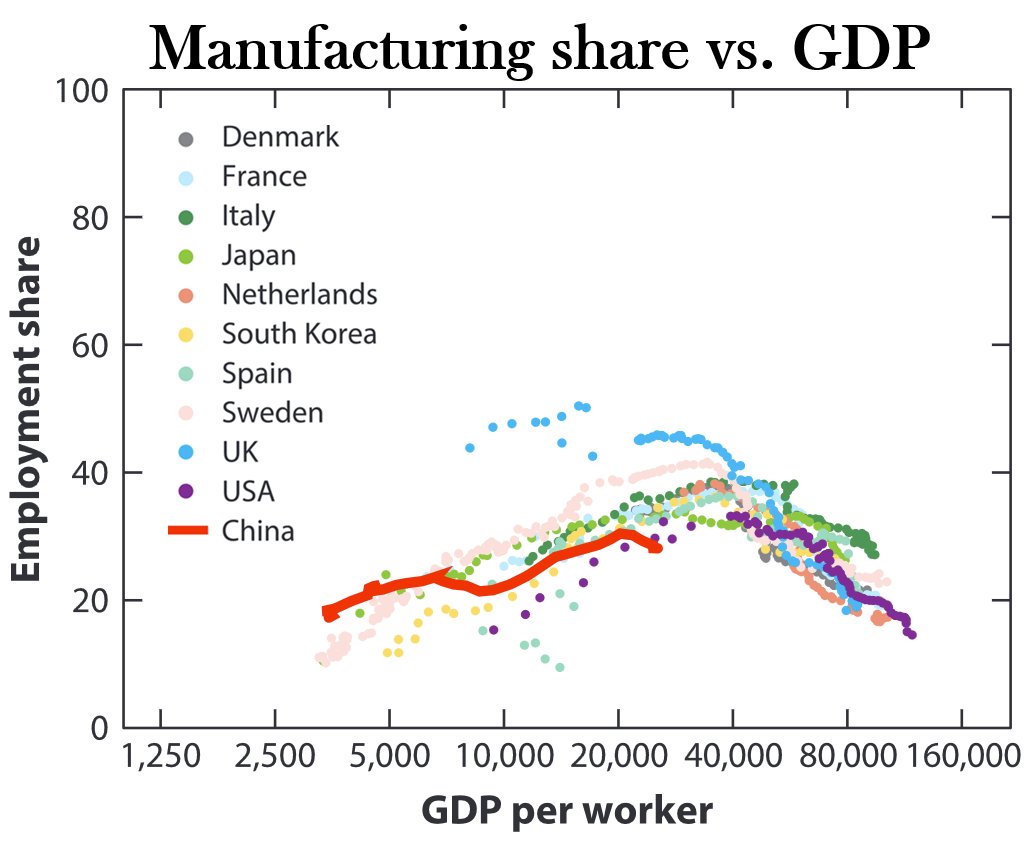
Via Basil Halperin. This is not a question of confusing causation and correlation, if anything it is the protectionists who have such an error in their mind’s eye. These days the average U.S. service sector job pays more than a manufacturing job.
Tariff sentences to ponder
We find that only 15.1 percent of the decline in goods-sector employment from 1992 to 2012 stems from U.S. trade deficits; most of the decline is due to differential productivity growth.
Here is the full paper by Kehoe, Ruhl, and Steinberg, via Zack Mazlish. I believe we have covered this issue before.
Using machine learning to measure CEO depression
We introduce a novel measure of CEO depression by applying machine learning models that analyze vocal acoustic features from CEOs’ conference call recordings. Our research was preregistered via the Journal of Accounting Research‘s registration-based editorial process. In this study, we validate this measure and examine associated factors. We find that greater firm risk is positively associated with CEO depression, whereas higher job demands are negatively associated with CEO depression. Female and older CEOs show a lower likelihood of depression. Using this novel measure, we then explore the relationship between CEO depression and career outcomes. Although we do not find any evidence that CEO depression is associated with CEO turnover, we find some evidence that turnover-performance sensitivity is higher among depressed CEOs. We also find limited evidence of higher compensation and higher pay-performance sensitivity for depressed CEOs. This study provides new insights into the relationship between CEO mental health and career outcomes.
Here is the full article, by Sung-Yuan (Mark) Cheng and Nargess M. Golshan. Via the excellent Kevin Lewis.
How strong is the best case for industrial policy?
The textbook case for industrial policy is well understood: sectors with relatively large external economies of scale should be subsidized at the expense of other sectors. Little is known, however, about the magnitude of the welfare gains from such interventions. We develop an empirical strategy that leverages commonly available trade data to estimate sector-level economies of scale and, in turn, to quantify the gains from optimal industrial policy in a general equilibrium environment. Our results point toward significant economies of scale across manufacturing sectors but gains from industrial policy that are hardly transformative, even among the most open economies.
…recall that South Korea — a country often presented as an industrial policy success story — experienced gains in real GDP per capita of 6.82% a year from 1960 to 1989, as documented in Rodrik (1995). A 4.06% long-run welfare increase in nothing to spit at, but a miracle it is not.
That is from a new JPE piece by Dominick Bartelme, Arnaud Costinot, Dave Donaldson, and Andres Rodriguez-Clare. Here are less gated copies of the piece.
How Good is AI at Twisting Arms? Experiments in Debt Collection
How good is AI at persuading humans to perform costly actions? We study calls made to get delinquent consumer borrowers to repay. Regression discontinuity and a randomized experiment reveal that AI is substantially less effective than human callers. Replacing AI with humans six days into delinquency closes much of the gap. But borrowers initially contacted by AI have repaid 1% less of the initial late payment one year later and are more likely to miss subsequent payments than borrowers who were always called by humans. AI’s lesser ability to extract promises that feel binding may contribute to the performance gap.
That is from a new paper by James J. Choi, Dong Huang, Zhishu Yang, and Qi Zhang. No AI asked me to run this blog post!
The Research Behavior of Individual Investors
Browser data from an approximately representative sample of individual investors offers a detailed account of their search for information, including how much time they spend on stock research, which stocks they research, what categories of information they seek, and when they gather information relative to events and trades. The median individual investor spends approximately six minutes on research per trade on traded tickers, mostly just before the trade; the mean spends around half an hour. Individual investors spend the most time reviewing price charts, followed by analyst opinions, and exhibit little interest in traditional risk statistics. Aggregate research interest is highly correlated with stock size, and salient news and earnings announcements draw more attention. Individual investors have different research styles, and those that focus on short-term information are more likely to trade more speculative stocks.
That is from a new NBER working paper by Toomas Laarits and Jeffrey Wurgler.
Social media and well-being
Here is a new set of results, by Laura Lemahieu, et.al.:
Abstaining from social media has become a popular digital disconnection strategy of individuals to enhance their well-being. To date, it is unclear whether social media abstinences are truly effective in improving well-being, however, as studies produce inconsistent outcomes. This preregistered systematic review and meta-analysis therefore aims to provide a more precise answer regarding the impact of social media abstinence on well-being. The databases of PubMed, Scopus, Web of Science, Communication Source, Cochrane Library, and Google Scholar were searched for studies examining the effect of social media abstinence on three outcomes, namely positive affect, negative affect, and/or life satisfaction. In total, ten studies (N = 4674) were included, allowing an examination of 38 effect sizes across these three outcomes. The analyses revealed no significant effects of social media abstinence interventions on positive affect, negative affect, or life satisfaction. Relationships between social media abstinence duration and the three outcomes were also non-significant. The findings thus suggest that temporarily stepping away from social media may not be the most optimal approach to enhance individual well-being, emphasizing the need for further research on alternative disconnection strategies. Nevertheless, important methodological differences between studies should be considered when interpreting these results.
I thank M. for the pointer.
Where do stock market returns come from?
Here is a new and sure to be controversial piece from the JPE:
Why does the stock market rise and fall? From 1989 to 2017, the real per capita value of corporate equity increased at a 7.2% annual rate. We estimate that 40% of this increase was attributable to a reallocation of rewards to shareholders in a decelerating economy, primarily at the expense of labor compensation. Economic growth accounted for just 25% of the increase, followed by a lower risk price (21%) and lower interest rates (14%). The period 1952–88 experienced only one-third as much growth in market equity, but economic growth accounted for more than 100% of it.
That is by Daniel L. Greenwald, Martin Leftau, and Sydney C. Ludvigson. Of course in more recent times it is tech stocks that have done very well, and they also tend to elevate pay standards.
Men watch women’s sports more than women do
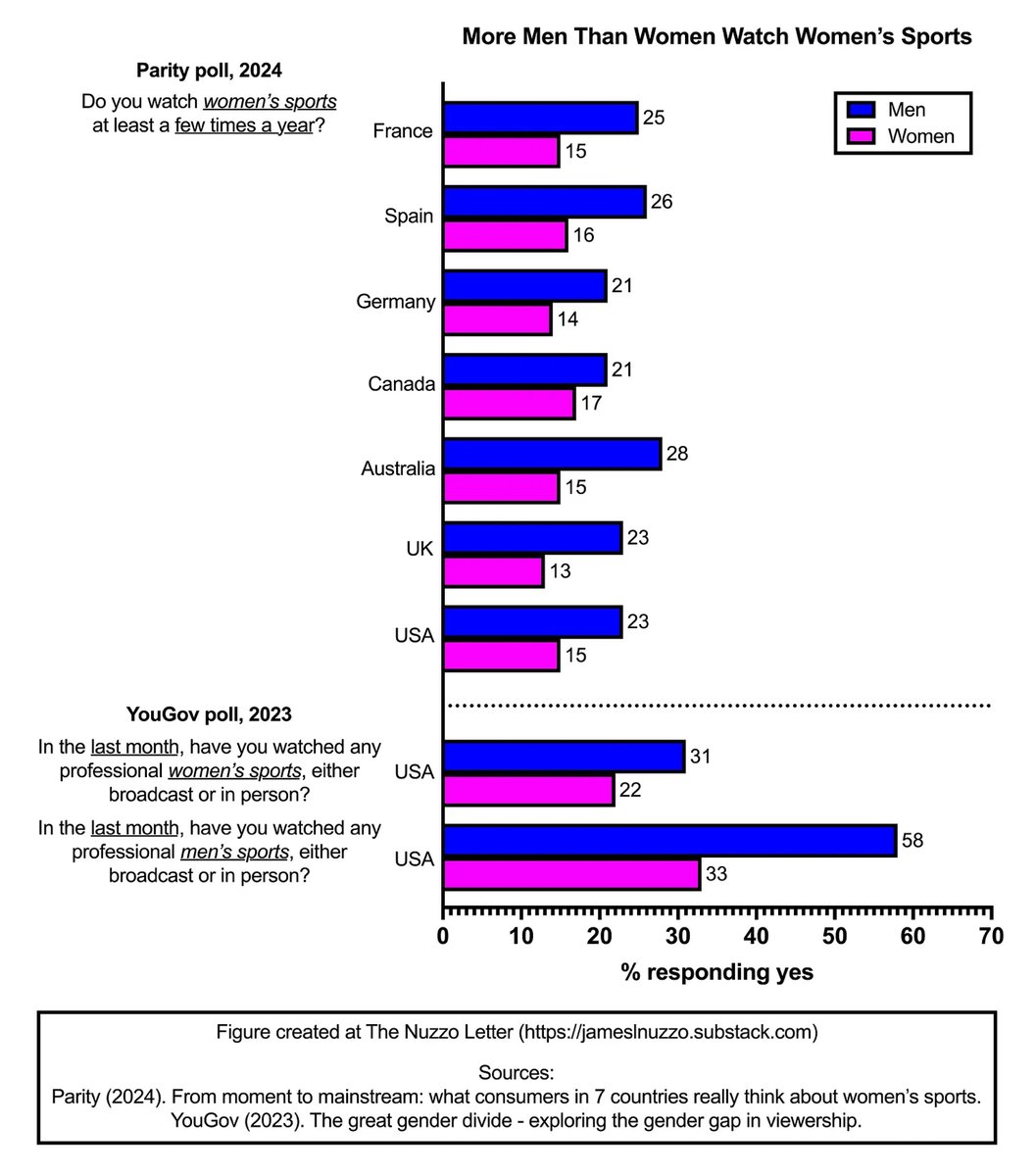
Here is the link, via Alex T.
Who believes in conspiracy theories?
While the psychological dispositions that underlie conspiracy thinking are well researched, there has been remarkably little research on the political preferences of conspiracy believers that go beyond self-reported ideology or single political issue dimensions. Using data from the European Voter Election Study (EVES), the relationship between conspiracy thinking and attitudes on three deeper-lying and salient political dimensions (redistribution, authoritarianism, migration) is examined. The results show a clear picture: Individuals with economically left-wing and culturally conservative attitudes tend to score highest on conspiracy thinking. People at this ideological location seem to long for both economic and cultural protection and bemoan a “lost paradise” where equalities had not yet been destroyed by “perfidious” processes of cultural modernization and economic neoliberalism. This pattern is found across all countries and holds regardless of socioeconomic characteristics such as education and income. While previous research has found that belief in conspiracies tends to cluster at the extremes of the political spectrum, our analysis opens up a more complex picture, showing that conspiracy thinking is not merely related to extremist orientations, but to specific combinations of political attitudes.
Here is the full article by Florian Buchmayr and André Krouwel, via the excellent Kevin Lewis, who is not obsessed with conspiracy theories.
The vanishing male writer
It’s easy enough to trace the decline of young white men in American letters—just browse The New York Times’s “Notable Fiction” list. In 2012 the Times included seven white American men under the age of 43 (the cut-off for a millennial today); in 2013 there were six, in 2014 there were six.
And then the doors shut.
By 2021, there was not one white male millennial on the “Notable Fiction” list. There were none again in 2022, and just one apiece in 2023 and 2024 (since 2021, just 2 of 72 millennials featured were white American men). There were no white male millennials featured in Vulture’s 2024 year-end fiction list, none in Vanity Fair’s, none in The Atlantic’s. Esquire, a magazine ostensibly geared towards male millennials, has featured 53 millennial fiction writers on its year-end book lists since 2020. Only one was a white American man.
Over the course of the 2010s, the literary pipeline for white men was effectively shut down. Between 2001 and 2011, six white men won the New York Public Library’s Young Lions prize for debut fiction. Since 2020, not a single white man has even been nominated (of 25 total nominations). The past decade has seen 70 finalists for the Center for Fiction’s First Novel Prize—with again, not a single straight white American millennial man. Of 14 millennial finalists for the National Book Award during that same time period, exactly zero are white men. The Wallace Stegner Fellowship at Stanford, a launching pad for young writers, currently has zero white male fiction and poetry fellows (of 25 fiction fellows since 2020, just one was a white man). Perhaps most astonishingly, not a single white American man born after 1984 has published a work of literary fiction in The New Yorker (at least 24, and probably closer to 30, younger millennials have been published in total).
Here is more from Jacob Savage at Compact.