Category: Data Source
How effective was pandemic aid?
We use an instrumental-variables estimator reliant on variation in congressional representation to analyze the macroeconomic effects of federal aid to state and local governments across all four major pieces of COVID-19 response legislation. Through December 2022, we estimate that the federal government allocated $603,000 for each state or local government job-year preserved. Our baseline confidence interval allows us to rule out estimates smaller than $220,400. Our estimates of effects on aggregate income and output are centered on zero and imply modest if any spillover effects onto the broader economy.
That is from a new paper by Jeffrey Clemens, Philip Hoxie, and Stan Veuger. Via the excellent Kevin Lewis.
Does the Gender Wage Gap Actually Reflect Taste Discrimination Against Women?
One explanation of the gender wage gap is taste discrimination, as in Becker (1957). We test for taste discrimination by constructing a novel measure of misogyny using Google Trends data on searches that include derogatory terms for women. We find—surprisingly, in our view—that misogyny is an economically meaningful and statistically significant predictor of the wage gap. We also test more explicit implications of taste discrimination. The data are inconsistent with the Becker taste discrimination model, based on the tests used in Charles and Guryan (2008). But the data are consistent with the effects of taste discrimination against women in search models (Black, 1995), in which discrimination on the part of even a small group of misogynists can result in a wage gap.
That is a new NBER working paper by Molly Maloney and David Neumark.
The culture that is German (Roman)
We compare present-day regions that were advanced by Roman culture with those that remained outside of Roman influence. Even when accounting for more recent historical factors, we find that regions developed by Roman civilization show more adaptive personality patterns (Big Five) and better health and psychological well-being today. Results from a spatial regression discontinuity design indicate a significant effect of the Roman border on present-day regional variation in these outcomes. Additional analyses suggest that Roman investments in economic institutions (e.g., trade infrastructure such as Roman roads, markets, and mines) were crucial in creating this long-term effect. Together, these results demonstrate how ancient cultures can imprint a macro-psychological legacy that contributes to present-day regional inequalities.
That is from a recent paper by Obschonka, et.al., via Alexander Le Roy. Also on the German front:
The German parliament will debate on Thursday, January 30th whether to ban the opposition right-wing Alternative für Deutschland (AfD) party.
A group of lawmakers, 113 MPs, have called for parliament to discuss a motion which would invite the constitutional court to decide whether the party is unconstitutional.The motion is supported by MPs from the centre-right CDU/CSU alliance, the far-left Die Linke, as well as the two governing parties, the Social Democrats (SPD) and the Greens.
The signatories claim that the AfD “opposes central basic principles of the free democratic basic order,” questions human dignity, and strives for the “ethno-nationalist strengthening” of the German identity.
Of course the strongest support for AfD is not to be found in Trier. I would not myself support AfD, for both policy and cultural reasons. But I find it strange that Europeans so often see the United States as the locale where democracy is in danger. Right now AfD polls as the second most popular party in Germany — beat them at the ballot box!
Facts about Rwanda
…Rwanda is still poorer than most African countries due to being less urbanized than most African nations (Rwanda is 82% rural compared to Sub Saharan Africa’s 57% average). Rwanda’s donor aid adds up to ~75% of Rwanda’s government spending, which is roughly $1B.
The average Rwandan makes $1K a year ($3300 at purchasing power parity). At purchasing power parity, Rwanda is far poorer than a Nigerian, Kenyan, or Senegalese (for now) but the average Rwandan is still richer than a Ugandan, Burkinabe, or an Ethiopian…
Rwanda is fast growing, but its growing from a very low base. To put in perspective, even though the oil-state, Angola, has on average declined nearly 3% every year from 2013 to 2023 due to the post 2014 oil price collapse, the average Angolan still makes more than 2x the average Rwandan.
And this:
Like most developing countries, Rwanda’s economy is 75% informal. Rwanda blends economic models: besides private companies, Rwanda has military-owned enterprises like Egypt, Pakistan, or Uganda, party-owned enterprises akin to pre-1990s Taiwan & Eritrea, and state-owned enterprises targeting FDI for joint ventures, similar to Vietnam or Singapore…
Kagame initially embraced neoliberal privatization but then walked it back in the early 2000s to create party-owned enterprises through the Rwanda Patriotic Front (RPF). These enterprises supplement limited tax revenue and are managed by RPF-appointed elites, controlling major sectors like real estate, agro-processing, and manufacturing.
Here is more from Yaw, informative throughout.
Congestion pricing update
Data collected by INRIX, a transportation analytics firm, found that travel times across the city and region had actually slowed overall at peak rush hours — by 3 percent in the morning and 4 percent in the evening — during the first two weeks of congestion pricing compared to a similar period last year.
Travel times improved on highways and major roads in Manhattan during both the morning and evening rush hours. But they were slower in Brooklyn and on Staten Island in the morning and in Queens and the Bronx in the evening.
Times also increased in some New Jersey counties, including Essex and Bergen, but improved in Nassau County on Long Island.
Here is more from the NYT. This is very far from the final word, however.
Do Migrants Pay Their Way? A Net Fiscal Analysis for Germany
This study quantifies the direct average net fiscal impact (ANFI) of migration in Germany, taking into account both indirect taxes and in-kind benefits such as health and education spending. Using a status quo approach with data from the German Socio-Economic Panel (SOEP) for 2018 and microsimulation techniques to impute both indirect taxes and in-kind benefits, our results show that migrants, especially first-generation migrants, have a more favorable net fiscal impact on average compared to natives. However, we demonstrate that this result is mainly driven by the favourable age structure of migrants. When controlling for demographic differences between these groups, we show that second-generation migrants contribute very similarly to natives to the German welfare state. Nevertheless, both natives and second-generation migrants, respectively, contribute more than first-generation migrants. These differences persist even when we do not account for indirect taxes and benefits-in-kind.
That is from a recent paper by Hend Sallam and Michael Christl. One interesting point in the paper is that native Germans have a net negative fiscal impact — is that really consistent with blaming the immigrants for the major problems?
Via the excellent Samir Varma.
Gender gaps in education and declining marriage rates
Over the past half-century, the share of men enrolled in college has steadily declined relative to women. Today, 1.6 million more women than men attend four-year colleges in the U.S. This trend has not lowered marriage rates for college women, a substantial share of whom have historically married economically stable men without college degrees. Both historical evidence and cross-area comparisons suggest that worsening male outcomes primarily undermine the marriage prospects of non-college women. The gap in marriage rates between college-and non-college women is more than 50% smaller in areas where men have the lowest rates of joblessness and incarceration.
That is from a new paper by Clara Chambers, Benny Goldman, and Joseph Winkelmann. Via the excellent Kevin Lewis.
The 1920s immigration restrictions
The 1920s immigration restrictions in the US did not affect manufacturing wages.
The US immigration restrictions of the 1920s lowered the occupational standings of whites and incumbent immigrants.
US counties with more immigrants excluded by the quotas of the 1920s saw increased in-migration.
During the Great Black Migration of the US, black southerners moved to northern counties, filling roles left by excluded immigrants.
During the Great Black Migration, blacks who migrated to counties with more excluded immigrants experienced greater economic gains.
That is from a new piece by Bin Xie in the Journal of Comparative Economics. Via the excellent Kevin Lewis.
More on the AI virtual tutor
The results of the randomized evaluation, soon to be published, reveal overwhelmingly positive effects on learning outcomes. After the six-week intervention between June and July 2024, students took a pen-and-paper test to assess their performance in three key areas: English language—the primary focus of the pilot—AI knowledge, and digital skills.
Students who were randomly assigned to participate in the program significantly outperformed their peers who were not in all areas, including English, which was the main goal of the program. These findings provide strong evidence that generative AI, when implemented thoughtfully with teacher support, can function effectively as a virtual tutor.
Notably, the benefits extended beyond the scope of the program itself. Students who participated also performed better on their end-of-year curricular exams. These exams, part of the regular school program, covered topics well beyond those addressed in the six-week intervention. This suggests that students who learned to engage effectively with AI may have leveraged these skills to explore and master other topics independently.
Moreover, the program benefited all students, not just the highest achievers. Girls, who were initially lagging boys in performance, seemed to gain even more from the intervention, highlighting its potential to bridge gender gaps in learning.
Here is more from the World Bank. Replication is required, but this is encouraging.
Gordon Tullock was right
Do minimum wage changes affect workplace health and safety? Using the universe of workers’ compensation claims in California over 2000-2019, we estimate whether minimum wage shocks affect the rate of workplace injuries. Our identification exploits both geographic variation in state-and city-level minimum wages and local occupation-level variation in exposure to minimum wage changes. We find that a 10% increase in the minimum wage increases the injury rate by 11% in an occupation-metro area labor market which is fully exposed to the minimum wage increase. Our results imply an elasticity of the workplace injury rate to minimum-wage-induced wage changes of 1.4. We find particularly large effects on injuries relating to cumulative physical strain, suggesting that employers respond to minimum wage increases by intensifying the pace of work, which in turn increases injury risk.
That is from a new working paper by Michael Davies, R. Jisung Park, and Anna Stansbury, MIT and U. Penn, by the way. Via the excellent Kevin Lewis.
Anonymous Attention and Abuse
There is a new paper by Florian Ederer, Paul Goldsmith-Pinkham, and Kyle Jensen. It concerns what happens on EJMR, and abusive rhetoric in on line economic discourse. I have not yet read it, but very likely it is of interest. Here is the direct paper link.
The circulation of elites, sort of
Is the top tail of wealth a set of fixed individuals or is there substantial turnover? We estimate upper-tail wealth dynamics during the Gilded Age and beyond, a time of rapid wealth accumulation and concentration in the late 19th and early 20th centuries. Using various wealth proxies and data tracking tens of millions of individuals, we find that most extremely wealthy individuals drop out of the top tail within their lifetimes. Yet, elite wealth still matters. We find a non-linear association between grandparental wealth and being in the top 1%, such that having a rich grandparent exponentially increases the likelihood of reaching the top 1%. Still, over 90% of the grandchildren of top 1% wealth grandfathers did not achieve that level.
That is from a new NBER working paper by Priti Kalsi and Zachary Ward.
Facts about U.S. employment
First, the labor market is no longer polarizing— employment in low- and middle-paid occupations has declined, while highly paid employment has grown. Second, employment growth has stalled in low-paid service jobs. Third, the share of employment in STEM jobs has increased by more than 50 percent since 2010, fueled by growth in software and computer-related occupations. Fourth, retail sales employment has declined by 25 percent in the last decade, likely because of technological improvements in online retail.
That is from a recent NBER working paper by David J. Deming, Christopher Ong, and Lawrence M. Summers.
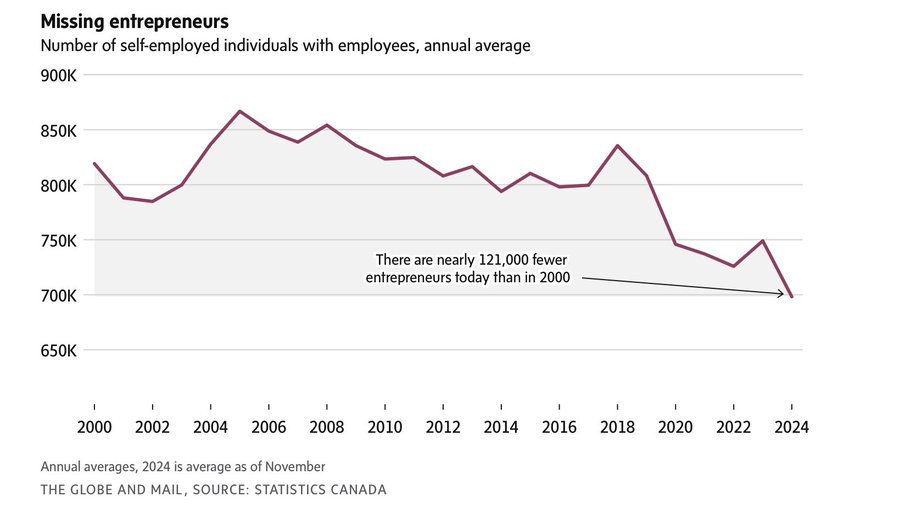
Canada’s missing entrepreneurs
The sick leave culture that is German
Germans are the “world champions in sick leave”, according to the head of the country’s biggest insurer, who was criticised for demanding that workers without a doctor’s note are unpaid for their first day off.
With the economy slowing and the welfare system under pressure, Germany can ill afford its average per worker of 20 sick days a year, said Oliver Bäte, the chief executive of Allianz SE. The EU average is eight.
The figure of 20 days, based on research by the health insurer DAK, puts a further dent in Germany’s ailing work ethic reputation. Last April, Christian Lindner, then finance minister, admitted that the French, Italians and other nationalities worked “a lot more than we do”, after OECD data showed Germans put in significantly fewer working hours per year than their EU and British neighbours…
“In countries like Switzerland and Denmark people work a month longer per year on average — with comparable pay,” he pointed out.
Here is more from the Times of London. If you can get through the gate, you will see it is Mexico that is the work ethic country.