Category: Data Source
Sweden fact of the day
However, following the start of PhD studies, the use of psychiatric medication among PhD students increases substantially. This upward trend continues throughout the course of PhD studies, with estimates showing a 40 percent increase by the fifth year compared to pre-PhD levels. After the fifth year, which represents the average duration of PhD studies in our sample, we observe a notable decrease in the utilization of psychiatric medication.
Here is the article, via Jesse. Here are some relevant tweets. It doesn’t have to be causal to be interesting!
The Economic Consequences of the French Wealth Tax
By Eric Pichet, here is the abstract:
Despite attempts to ‘unwind’ the Impôt de Solidarité sur la Fortune (‘Solidarity Wealth Tax,’ the French wealth tax) during the last legislature (2002-2007), ISF yields had soared by 2006, jumping from €2.5 billion in 2002 to €3.6 billion. Analysis of the economic consequences of this ISF wealth tax has raised the following conclusions: Tax collection costs remain low (around 1.6% of proceeds); Not raising the threshold in line with inflation between 1998 and 2004 created windfall revenues for the French State of €400 million in FY 2004 alone; ISF fraud mainly involving an under-assessment of property assets has stabilised over time at around 28% of total revenues, equivalent; (had the legal framework remained unchanged) to a shortfall for the State of €700 million in 2004; Capital flight since the ISF wealth tax’s creation in 1988 amounts to ca. €200 billion; The ISF causes an annual fiscal shortfall of €7 billion, or about twice what it yields; The ISF wealth tax has probably reduced GDP growth by 0.2% per annum, or around 3.5 billion (roughly the same as it yields); In an open world, the ISF wealth tax impoverishes France, shifting the tax burden from wealthy taxpayers leaving the country onto other taxpayers.
Via Fredrik. I would describe this work as a very loose estimate, nonetheless pointing in the proper direction.
State capacity and economic development
I do not in general trust such methods, but the conclusions are not unwelcome to me:
I provide new empirical estimates of the effect of state capacity on economic development across countries over the period 1960–2022. Specifically, I construct a comprehensive state capacity index based on six different dimensions of effective state institutions available in the Varieties of Democracy (V-Dem) dataset. Then, I estimate heterogeneous parameter models under a common factor framework. My empirical strategy explicitly allows the growth effect of state capacity to differ across countries and accounts for unobserved common factors. My preferred estimates indicate that a one-standard-deviation increase in my V-Dem-based state capacity index predicts a rise in income per person by roughly 6%–7%. The magnitude of such impact equates to less than half of that implied by conventional estimates obtained under highly restrictive assumptions of slope homogeneity and cross-sectional independence. Furthermore, I provide partial evidence suggesting that worldwide heterogeneity in the economic importance of state capacity is deeply rooted in prehistorically determined population diversity, state history, long-term relatedness between countries, and interpersonal trust.
That is from a new paper by Trung V. Vu, via the excellent Kevin Lewis. I am never sure if such results show anything more than “most good things come together at the macro level.”
Are “anchor babies” underrated?
Did you worry about the 2020 fall in U.S. fertility? Well, ponder this:
Birth rates in Canada and the USA declined sharply in March 2020 and deviated from historical trends. This decline was absent in similarly developed European countries. We argue that the selective decline was driven by incoming individuals, who would have travelled from abroad and given birth in Canada and the USA, had there been no travel restrictions during the COVID-19 pandemic. Furthermore, by leveraging data from periods before and during the COVID-19 travel restrictions, we quantified the extent of births by incoming individuals. In an interrupted time series analysis, the expected number of such births in Canada was 970 per month (95% CI: 710-1,200), which is 3.2% of all births in the country. The corresponding estimate for the USA was 6,700 per month (95% CI: 3,400-10,000), which is 2.2% of all births. A secondary difference-in-differences analysis gave similar estimates at 2.8% and 3.4% for Canada and the USA, respectively. Our study reveals the extent of births by recent international arrivals, which hitherto has been unknown and infeasible to study.
That is from a new paper by Amit N. Sawant and Mats J. Stensrud, via the excellent Kevin Lewis.
USA fact of the day
Surprised to learn that the US is below the OECD average for out of pocket health care spending as a fraction of per capita consumption, with virtually the same % as Canada.
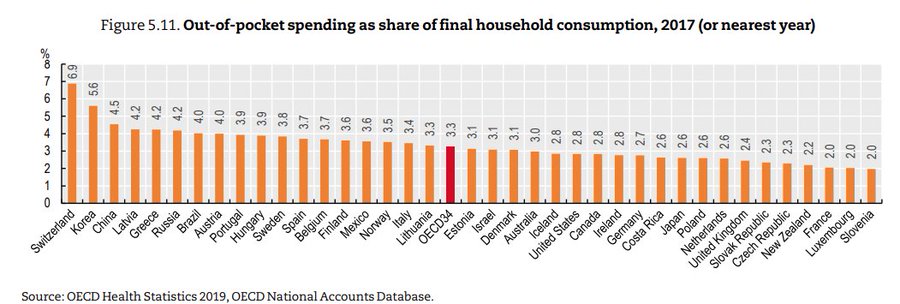
That is Jason Abaluck, via the wisdom of Garett Jones.
“four percent of humanity subscribes to OnlyFans” (from my email)
Andrew Cedotal writes me:
This issue came up with the post where someone claimed that N% of Americans were active OnlyFans content creators, here it is again!
For software services, total accounts ever created is a vanity metric. It’s not used by serious operators or investors of consumer-tech companies (the fact that it shows up in public financial reports so often thus has interesting implications).
The social impact/business value of a software service is about flow (e.g. monthly active users and monthly revenue), not stock. 100 real human signups means many, many fewer actual monthly active users (MAU) at any point, because users churn out. Even the best-retaining services around (e.g. Snap) only have 90% yearly retention, which then compounds downward.
Then there’s the issue that for any public software service, many accounts are bots, throwaways, people who forgot their password, etc.
Rather than make a truly wild guesstimate, let’s look at a frontier based on the report of $6.6B gross payments made by users in 2023 (so average revenue / month is $0.55B). All of the following are possible points on the frontier of paying MAU (paying monthly active users) vs. monthtly APPPU (monthly payments per paying user):
* 10 million paying MAU, $55 monthly APPPU
* 30 million paying MAU, $18.33 monthly APPPU
* 50 million paying MAU, $11 monthly APPPU
* 100 million paying MAU, $5.5 monthly APPPU(Industry standard is to look at ARPPU–average revenue per paying user–and not average payments, but I think here we’re more interested in determining how much money users are putting into it and ignoring platform take rate, not a financial analysis of the company.)
Now, OnlyFans might have ~300M total signups ever, but let’s assume half of those are dupes and bots. So 150M real human signups. It’s unlikely that more than 20% of people who have ever created an account have ever entered a credit card, so that’s 300 * 0.5 * .2 = 30M as a cap on people who have ever paid. Take into account userbase churn, and a guess is ~12M monthly paying accounts right now (0.15% of humanity, not 4%), which would put them at $45.83 monthly APPPU or a yearly APPPU of ~$550. About the annual cost of a gym membership in the U.S.
Which U.S. Stocks Generated the Highest Long-Term Returns?
This report describes compound return outcomes for the 29,078 publicly-listed common stocks contained in the CRSP database from December 1925 to December 2023. The majority (51.6%) of these stocks had negative cumulative returns. However, the investment performance of some stocks was remarkable. Seventeen stocks delivered cumulative returns greater than five million percent (or $50,000 per dollar initially invested), with the highest cumulative return of 265 million percent (or $2.65 million per dollar initially invested) accruing to long-term investors in Altria Group. Annualized compound returns to these top performers relatively were modest, averaging 13.47% across the top seventeen stocks, thereby affirming the importance of “time in the market.” The highest annualized compound return for any stock with at least 20 years of return data was 33.38%, earned by Nvidia shareholders.
Mental health trajectories in the UK
Yes, there is a human capital crisis of sorts:
We show the incidence of mental ill-health has been rising especially among the young in the years and especially so in Scotland. The incidence of mental ill-health among young men in particular, started rising in 2008 with the onset of the Great Recession and for young women around 2012. The age profile of mental ill-health shifts to the left, over time, such that the peak of depression shifts from mid-life, when people are in their late 40s and early 50s, around the time of the Great Recession, to one’s early to mid-20s in 2023. These trends are much more pronounced if one drops the large number of proxy respondents in the UK Labour Force Surveys, indicating fellow family members understate the poor mental health of respondents, especially if those respondents are young. We report consistent evidence from the Scottish Health Surveys and UK samples from Eurobarometer surveys. Our findings are consistent with those for the United States and suggest that, although smartphone technologies may be closely correlated with a decline in young people’s mental health, increases in mental ill-health in the UK from the late 1990s suggest other factors must also be at play.
That is from a new NBER working paper by David G. Blanchflower, Alex Bryson, and David N.F. Bell. By the way, on the “smart phone causality” issue, here are some recent musings. And a response, and a response to that.
Note that in my rough, first-order human capital hypothesis, the variance is rising. So the top achievers are considerably more impressive, but that also means the number of problematic cases, toward the bottom of the distribution, is rising as well.
Ireland fact of the day
Ireland ranks as the loneliest country in Europe, with almost a fifth of people lonely most or all of the time and nearly two-thirds of people suffer from anxiety or depression, according to EU data. One in seven children live in homes below the poverty line, defined as 60 per cent of the median disposable household income.
Here is more from the FT, with much of the piece about how Ireland should spend its budget surplus.
Jon Haidt on causality (from my email)
“Hi Tyler,
i have big news about the debate over social media harming teens.
So much of it hangs on the claim that the evidence is just correlational, not causal.
Zach Rausch and I show that this is not true; the experiments DO show causation, very clearly and consistently.
Here are my 2 tweets about the post:
https://x.com/JonHaidt/status/1829163166066205168
https://x.com/JonHaidt/status/1829165292460859869
A lot of people heard our discussion, and enjoyed how spirited and yet civil it was.
Might you include the link to this post in your daily email:
https://www.afterbabel.com/p/the-case-for-causality-part-1
We have 3 more coming. We think we can prove causality using just the existing experiments.
thanks for considering it.
jon”
TC again: I received this email this morning, and told Jon I would post it on MR without response from me, so here it is.
Failing Banks
From Sergio Correia, Stephan Luck, and Emil Verner:
Why do banks fail? We create a panel covering most commercial banks from 1865 through 2023 to study the history of failing banks in the United States. Failing banks are characterized by rising asset losses, deteriorating solvency, and an increasing reliance on expensive non-core funding. Commonalities across failing banks imply that failures are highly predictable using simple accounting metrics from publicly available financial statements. Predictability is high even in the absence of deposit insurance, when depositor runs were common. Bank-level fundamentals also forecast aggregate waves of bank failures during systemic banking crises. Altogether, our evidence suggests that the ultimate cause of bank failures and banking crises is almost always and everywhere a deterioration of bank fundamentals. Bank runs can be rejected as a plausible cause of failure for most failures in the history of the U.S. and are most commonly a consequence of imminent failure. Depositors tend to be slow to react to an increased risk of bank failure, even in the absence of deposit insurance.
Theory of bank runs: overrated.
Do consumers hate on-line ads?
Not so much it seems:
Research on the causal effects of online advertising on consumer welfare is limited due to challenges in running large-scale field experiments and tracking effects over extended periods. We analyze a long-running field experiment of online advertising in which a random 0.5% subset of all users are assigned to a group that does not ever see ever ads. We recruit a representative sample of Facebook users in the ads and no-ads groups and estimate their welfare gains from using Facebook using a series of incentive-compatible choice experiments. We find no significant differences in welfare gains from Facebook. Our estimates are relatively precisely estimated reflecting our large sample size (53,166 participants). Specifically, the minimum detectable difference in median valuations at standard thresholds is $3.18/month compared to a baseline valuation of $31.95/month for giving up access to Facebook. That is, we can reject the hypothesis that the median disutility from advertising exceeds 10% of the median baseline valuation. Our findings suggest that either the disutility of ads for consumers is relatively small, or that there are offsetting benefits, such as helping consumers find products and services of interest.
That is from a new NBER working paper by
U.S: central city population as a % of metropolitan area
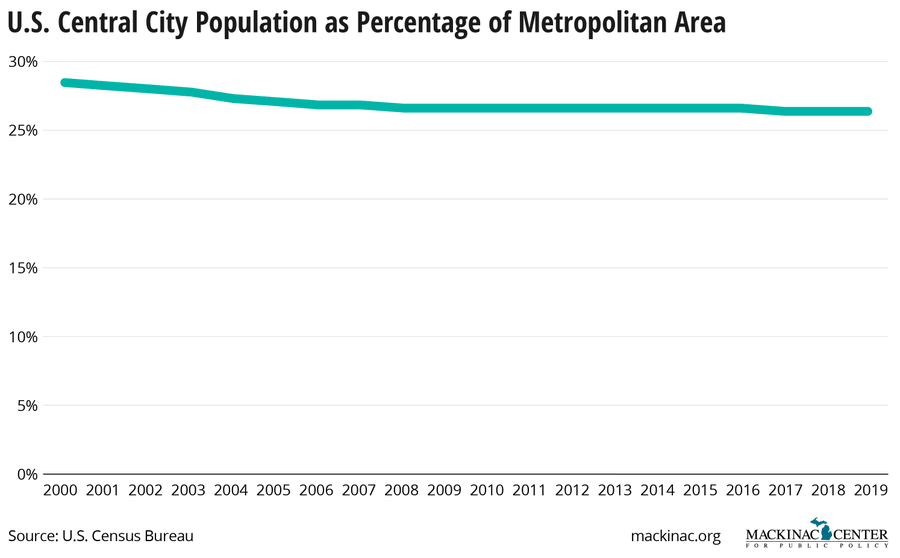
Via James Hohman.
The falling cost of tokens
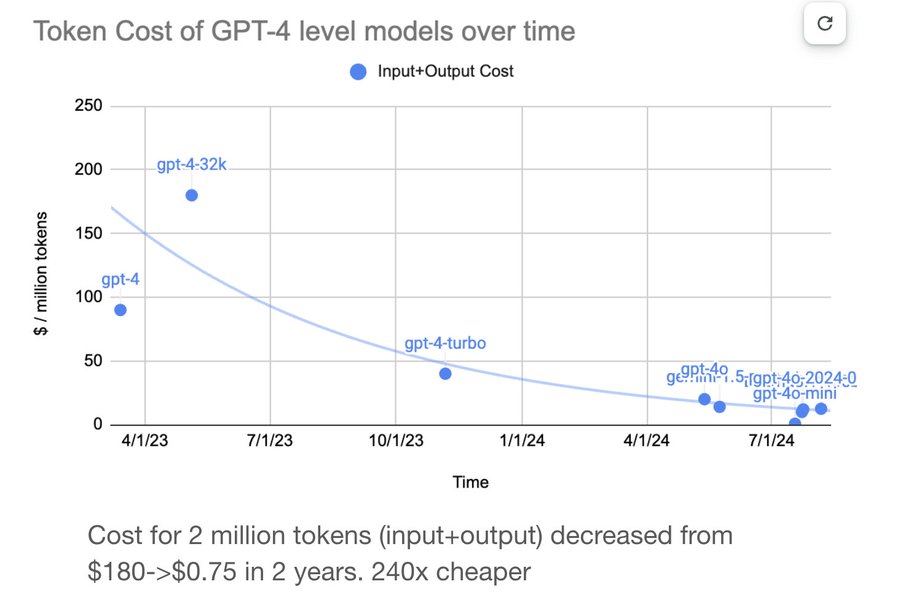
That is from Elad Gil.
How do musical artists end up getting cancelled?
There is a new paper on that topic by Daniel Winkler, Nils Wlömert, and Jura Liaukonyte. Here is the abstract:
This paper investigates how the consumption of an artist’s creative work is impacted when there’s a movement to “cancel” the artist on social media due to their misconduct. Unlike product brands, human brands are particularly vulnerable to reputation risks, yet how misconduct affects their consumption remains poorly understood. Using R. Kelly’s case, we examine the demand for his music following interrelated publicity and platform sanction shocks-specifically, the removal of his songs from major playlists on the largest global streaming platform. A cursory examination of music consumption after these scandals would lead to the erroneous conclusion that consumers are intentionally boycotting the disgraced artist. We propose an identification strategy to disentangle platform curation and intentional listening effects, leveraging variation in song removal status and geographic demand. Our findings show that the decrease in music consumption is primarily driven by supply-side factors due to playlist removals rather than changes in intentional listening. Media coverage and calls for boycott have promotional effects, suggesting that social media boycotts can inadvertently increase music demand. The analysis of other cancellation cases involving Morgan Wallen and Rammstein shows no long-term decline in music demand, reinforcing the potential promotional effects of scandals in the absence of supply-side sanctions.