Category: Data Source
Some Simple Economics of the Google Antitrust Case
The case is straightforward: Google pays firms like Apple billions of dollars to make its search engine the default. (N.B. I would rephrase this as Apple charges Google billions of dollars to make its search engine the default–a phrasing which matters if you want to understand what is really going on. But set that aside for now.) Consumers, however, can easily switch to other search engines by downloading a different browser or changing their default settings. Why don’t they? Because the minor transaction costs are not worth the effort. Moreover, if Google provides the best search experience, most users have no incentive to switch.
Consequently, any potential harm to consumers is limited to minor switching costs, and any remedies should be proportionate. Proposals such as forcing Google to divest Chrome or Android are vastly disproportionate to the alleged harm and risk being counterproductive. Google’s Android has significantly increased competition in the smartphone market, and ChromeOS has done the same for laptops. Google has invested billions in increasing competition in its complements. Google was able to make these investments because they paid off in revenue to Google Search and Google Ads. Kill the profit center and kill the incentive to invest in competition. Unintended consequences.
I argued above that consumer harm is limited to minor switching costs. The plaintiffs’ counter-argue that Google’s purchase of default-status “forecloses” competitors from achieving the scale necessary to compete effectively. This argument relies on network effects – more searches improve search quality through better data. However, this creates a paradox: on the theory of the plaintiffs, two or three firms each operating at smaller scale is worse than one operating at large scale. For the plaintiffs’ argument to hold, it must be shown that we are at the exact sweet spot where the benefits of increased competition in lowering the price of advertising outweighs the efficiency losses to consumer search quality from reduced scale. Yet, there is no evidence in the case—nor even an attempt—to demonstrate that we are at such a sweet spot.
Or perhaps the argument is that with competition we would get even better search but that argument can’t be right because the costs of switching, as noted above, are bounded by some minor transaction costs. Thus, if a competitor could offer better search, it would easily gain scale (e.g. AI search, see below).
Traditional foreclosure analysis requires showing both substantial market closure and consumer harm. Given the ease of switching and the complex relationship between scale and search quality, proving such harm becomes challenging and my read is that the plaintiffs didn’t prove harm.
In my view, the best analogy to the Google antitrust case is Coke and Pepsi battling for shelf space in the supermarket. Returning to my earlier parenthetical point, Apple is like the supermarket charging for prime shelf placement. Is this a significant concern? Not really. Eye-level placement matters to Coke and Pepsi but by construction they are competing for consumers who don’t much care which sugary, carbonated beverage they consume. For consumers who do care, the inconvenience is limited to reaching to a different shelf.
To add insult to injury, the antitrust case is happening when Google is losing advertising share and is under pressure from a new search technology, Artificial Intelligence. AI search from OpenAI, Anthropic, Meta Llama, and xAI is very well funded and making rapid progress. Somehow AI search did manage to achieve scale! As usual, the market appears more effective than the antitrust authorities at creating competition.
Addendum: Admittedly this is outside the remit of the judge, but the biggest anti-competitive activities in tech are probably government policies that slow the construction of new power generation, new power lines, new data centers, and deals between power generators and data centers. I’d prefer the government take on its own anticompetitive effects before going after extremely succesful tech companies that have clearly made consumers much better off.
Literacy Rates and Simpson’s Paradox
 Max T. at Maximum Progress shows that between 1992 and 2003 US literacy rates fell dramatically within every single educational category but the aggregate literacy rate didn’t budge. A great example of Simpson’s Paradox! The easiest way to see how this is possible is just to imagine that no one’s literacy level changes but everyone moves up an educational category. The result is zero increase in literacy but falling literacy rates in each category.
Two interesting things follow. First, this is very suggestive of credentialing and the signaling theory of education. Second, and more originally, Max suggests that total factor productivity is likely to have been mismeasured. Total factor productivity tells us how much more output can we get from the same inputs. If inputs increase, we expect output to increase so to measure TFP we must subtract any increase in output due to greater inputs. It’s common practice, however, to use educational attainment as a (partial) measure of skill or labor quality. If educational attainment is just rising credentialism, however, then this overestimates the increase in output due to labor skill and underestimates the gain to TFP.
This does not imply that we are richer than we actually are–output is what it is–but it does imply that if we want to know why we haven’t grown richer as quickly as we did in the past we should direct less attention to ideas and TFP and more attention to the failure to truly increase human capital.
Unauthorized Immigration and Local Government Finances
This paper examines how unauthorized immigration affects the fiscal health of local governments in the United States. Using detailed data on unauthorized immigrants’ countries of origin and arrival dates from the Syracuse TRAC database, we isolate immigration flows driven by social, economic, and political conditions in source countries. We predict local immigration patterns using a shift-share instrument based on pre-existing foreign-born population distributions. We find that the economic effects of unauthorized immigration depend crucially on local labor market conditions. In areas with structurally tight labor markets—characterized by low unemployment and low labor force participation—unauthorized immigration correlates with lower municipal bond yields. However, areas with typical labor market conditions experience higher yields. Areas with “sanctuary” status also experience higher yields when exposed to unauthorized immigration. These yield effects reflect underlying economic mechanisms: unauthorized immigration predicts loosening of labor markets in areas where they were previously tight, whereas in sanctuary areas, unemployment rates increase by more than twice as much. We find unauthorized immigration explains higher expenditures on local public amenities, including welfare assistance, construction, education, and law enforcement, but these expenditures are not offset by higher tax revenues. Overall, our results provide novel insights into the local economic effects of unauthorized immigration.
That is from a new paper by Jess Cornaggia, Kimberly Cornaggia, and Ryan D. Israelsen. Via the excellent Kevin Lewis.
Germany chart of the day

Here is the link.
Who Americans spend their time with, by age
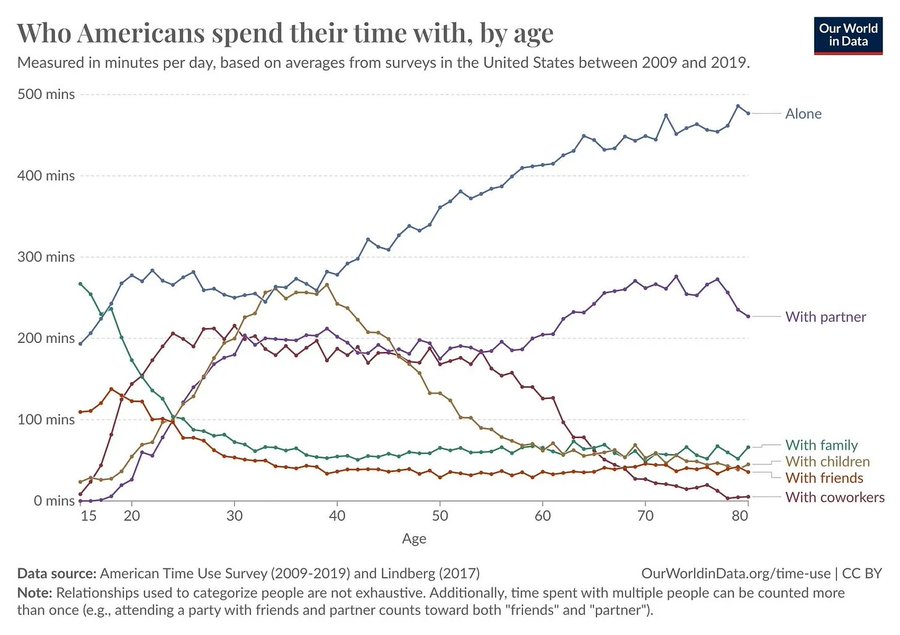
Via the excellent Bryan Caplan.
Birth Dearth and Local Population Decline
Local population decline has spread rapidly since 1970, with half of counties losing population between 2010 and 2020. The workhorse economic models point to net out-migration, likely driven by changing local economies and amenities, as the cause of this trend. However, we show that the share of counties with high net out-migration has not increased. Instead, falling fertility has caused migration rates that used to generate growth to instead result in decline. When we simulate county populations from 1970 to the present holding fertility at its initial level, only 10 percent of counties decline during the 2010s.
That is from a new paper by Brian Asquith and Evan Mast. Via the excellent Kevin Lewis.
Alcohol estimates
The number of deaths caused by alcohol-related diseases more than doubled among Americans between 1999 and 2020, according to new research. Alcohol was involved in nearly 50,000 deaths among adults ages 25 to 85 in 2020, up from just under 20,000 in 1999.
The increases were in all age groups. The biggest spike was observed among adults ages 25 to 34, whose fatality rate increased nearly fourfold between 1999 and 2020.
Women are still far less likely than men to die of an illness caused by alcohol, but they also experienced a steep surge, with rates rising 2.5-fold over 20 years.
The new study, published in The American Journal of Medicine, drew on data from the Centers for Disease Control and Prevention.
Why more South Asian than East Asian CEOs?
Analyses revealed that East Asians faced less prejudice than South Asians and were equally motivated by work and leadership as South Asians. However, East Asians were lower in assertiveness, which consistently mediated the leadership attainment gap between East Asians and South Asians. These results suggest that East Asians hit the bamboo ceiling because their low assertiveness is incongruent with American norms concerning how leaders should communicate.
That is from a new piece by Jackson G. Lu, Richard E. Nibett, and Michael W. Morris, via the excellent Kevin Lewis.
Parents should believe in upward mobility
There is a new paper on this topic, with multiple authors by led by Rebecca Ryan. Here is the abstract:
Research in economics and psychology shows that individuals are sensitive to cues about economic conditions in ways that affect attitudes, beliefs, and behavior. We provide causal evidence that parents’ beliefs about economic mobility prospects shape parental investments of time and money in children. To do so we conduct an on-line information experiment with ~ 1,000 socioeconomically diverse parents of children ages 5-15. The information treatment aimed to manipulate parents’ beliefs in the possibility for future upward (downward) economic mobility in US society. The experimental results yield three conclusions. First, parents are highly sensitive to signals about future economic mobility prospects. Second, parents who are induced to believe in the likely possibility of future upward mobility increase their beliefs about the return on their own investments of time and money. Using a novel measure of time investment we developed, these parents also increase their time investments in the service of boosting children’s skill. Finally, they report being more willing to pay for resources that would boost their child’s skill development. Third, these patterns are true for economically advantaged and disadvantaged families alike. We discuss the implication of these results in terms of reports showing that Americans are losing faith in “The American Dream.”
No, researchers should not lie, but perhaps this gives some additional perspective on who exactly is harming the world. There can be a cost to publishing neurotic, untrue ideas.
Via the excellent Kevin Lewis.
*Is Inequality the Problem?*
Lane Kenworthy has a book coming out next year, I have read it, and it is superb (rooftops) and also very important. Here is a brief excerpt:
Rich democratic nations with higher levels of income inequality or larger increases in income inequality haven’t tended to have slower economic growth, lower or slower-growing household income, or worse household balance sheets…
The notion that income inequality is harmful for health has recieved substantial attention from researchers, and some now take it for granted that inequality reduces longevity. But the country evidence offers very little support for this conclusion.
I will let you know when a pre-order is possible. In the meantime, it shouldn’t matter, but I can also report that Kenworthy is very much a left-leaning thinker, as you can adduce from his policy recommendations toward the end of the book.
How badly do humans misjudge AIs?
We study how humans form expectations about the performance of artificial intelligence (AI) and consequences for AI adoption. Our main hypothesis is that people project human-relevant problem features onto AI. People then over-infer from AI failures on human-easy tasks, and from AI successes on human-difficult tasks. Lab experiments provide strong evidence for projection of human difficulty onto AI, predictably distorting subjects’ expectations. Resulting adoption can be sub-optimal, as failing human-easy tasks need not imply poor overall performance in the case of AI. A field experiment with an AI giving parenting advice shows evidence for projection of human textual similarity. Users strongly infer from answers that are equally uninformative but less humanly-similar to expected answers, significantly reducing trust and engagement. Results suggest AI “anthropomorphism” can backfire by increasing projection and de-aligning human expectations and AI performance.
That is from a new paper by Raphael Raux, job market candidate from Harvard. The piece is co-authored with Bnaya Dreyfuss.
Does declining fertility lower the gender pay gap?
Using a descriptive decomposition and data from the Panel Study of Income Dynamics, we show that, in gross terms, fertility decline can explain almost one-quarter of gender pay convergence from 1980 to 2018. Even net of a host of controls for human capital and job characteristics, fertility decline explains 8 percent of the attenuation of the US gender pay gap 1980–2018—about half as much as changes in education and about a quarter as much as changes in full-time work experience and job tenure combined. Finally, we show that employees’ fertility decline was fastest in the 1980s and subsequently slowed; this, in conjunction with persistent gender differences in parenthood–wage associations, helps explain stalled progress toward gender pay parity.
That is from a newly published article by Alexandra Killewald and Nino José Cricco. Via the excellent Kevin Lewis.
J. Zachary Mazlish on median wages under Biden
An excellent post, one of the best things written this year in economics. Here is part of the bottom line:
Inflation did make the median voter poorer during Biden’s term.
- In no part of the income distribution did wages grow faster while Biden was President than they did 2012-2020.
- This is true in the raw data, and even more stark after compositional adjustment.
- In particular, the change in median incomes was well below its 2012-20 run-rate.
- But, the change in median wages is not what matters; it is the median change in wages that does. And this metric was even weaker under Biden: lower than any period in the last 30 years other than the Great Recession.
- People do not feel wages, they feel total income. And median growth in total income — post taxes and transfers — was not just historically low: it collapsed and was deeply negative from 2021 onwards.
- Much of this decline is due to timing of pandemic stimulus and even less the “fault of Biden” than other things.
Here is the full post, plenty of detail and distinctions throughout.
How well does bar exam performance predict subsequent success as a lawyer?
Eh:
How well does bar exam performance predict lawyering effectiveness? Is performance on some components of the bar exam more predictive? The current study, the first of its kind to measure the relationship between bar exam scores and a new lawyer’s effectiveness, evaluates these questions by combining three unique datasets—bar results from the State Bar of Nevada, a survey of recently admitted lawyers, and a survey of supervisors, peers, and judges who were asked to evaluate the effectiveness of recently-admitted lawyers. We find that performance on both the Multistate Bar Examination (MBE) and essay components of the Nevada Bar have little relationship with the assessed lawyering effectiveness of new lawyers, calling into question the usefulness of these tests.
Here is the full article by Jason M. Scott, Stephen N. Goggin, and David Faigman. Via the excellent Kevin Lewis.
A new meta-meta analysis says things I agree with
We combine societal-level institutional measures from 51 countries between 1996 and 2017 with individual decision-making outcome data from 1,126 laboratory experiments in six meta-analyses to evaluate the effects of within-country institutional change on pro-social and Nash behavior. We find that government effectiveness and regulatory freedom positively correlate with pro-social behavior. We find that freedom from each of the following components of regulation; interest rate controls, binding minimum wages, worker dismissal protections, conscription, and administrative requirements; are correlated with prosocial behavior and are inversely correlated with Nash behavior. These results suggest the importance of considering spillover effects in pro-social behavior when designing government policy.
That is from a new NBER working paper by