Category: Data Source
Hungary fact of the day
Total family subsidy spending exceeds 5 per cent of GDP, or more than double what Hungary spends on defence…
From a record low of 1.23 children per woman in 2011, the country’s fertility rate rose to 1.59 in 2020, but in recent years it has levelled off to about 1.5. In the first half of this year the fertility rate stood at 1.36 babies per woman, the lowest in a decade, said state statistical service KSH. In June, births fell to a record monthly low of barely 6,000 children in the country of 10mn, or about half the level of live births seen in Hungary a generation ago, KSH data shows.
Here is more from Marton Dunai and Valentina Romei at the FT.
USA fact of the day
Results show that from 2003 to 2022, average time spent at home among American adults has risen by one hour and 39 minutes in a typical day. Time at home has risen for every subset of the population and for virtually all activities. Preliminary analysis indicates that time at home is associated with lower levels of happiness and less meaning, suggesting the need for enhanced empirical attention to this major shift in the setting of American life.
Here is the full paper, by Patrick Sharkey, via the excellent Kevin Lewis.
Math SAT scores may be doing worse than we had thought?
Scholastic Aptitude Test (SAT) is crucial for college admissions but its effectiveness and relevance are increasingly questioned. This paper enhances Synthetic Control methods by introducing Transformed Control, a novel method that employs Large Language Models (LLMs) powered by Artificial Intelligence to generate control groups. We utilize OpenAI’s API to generate a control group where GPT-4, or ChatGPT, takes multiple SATs annually from 2008 to 2023. This control group helps analyze shifts in SAT math difficulty over time, starting from the baseline year of 2008. Using parallel trends, we calculate the Average Difference in Scores (ADS) to assess changes in high school students’ math performance. Our results indicate a significant decrease in the difficulty of the SAT math section over time, alongside a decline in students’ math performance. The analysis shows a 71-point drop in the rigor of SAT math from 2008 to 2023, with student performance decreasing by 36 points, resulting in a 107-point total divergence in average student math performance. We investigate possible mechanisms for this decline in math proficiency, such as changing university selection criteria, increased screen time, grade inflation, and worsening adolescent mental health. Disparities among demographic groups show a 104-point drop for White students, 84 points for Black students, and 53 points for Asian students. Male students saw a 117-point reduction, while female students had a 100-point decrease. This research highlights the need to reconsider the SAT’s role in admissions and to update educational strategies to enhance high school math performance.
That is from a new paper by Saannidhya Rawat and Vikram K. Suresh, via the excellent Kevin Lewis.
A 30-nation investigation of lay heritability beliefs
Lay beliefs about human trait heritability are consequential for cooperation and social cohesion, yet there has been no global characterisation of these beliefs. Participants from 30 countries (N = 6128) reported heritability beliefs for intelligence, personality, body weight and criminality, and transnational factors that could influence these beliefs were explored using public nation-level data. Globally, mean lay beliefs differ from published heritability (h2) estimated by twin studies, with a worldwide majority overestimating the heritability of personality and intelligence, and underestimating body weight and criminality. Criminality was seen as substantially less attributable to genes than other traits. People from countries with high infant mortality tended to ascribe greater heritability for most traits, relative to people from low infant mortality countries. This study provides the first systematic foray into worldwide lay heritability beliefs. Future research must incorporate diverse global perspectives to further contextualise and extend upon these findings.
That is from a recent paper by Laura J. Ferris, Matthew J. Hornsey, and Fiona Kate Barlow. Via Br.
Video games and looks
We investigate the relationship between physical attractiveness and the time people devote to video/computer gaming. Average American teenagers spend 2.6% of their waking hours gaming, while for adults this figure is 2.7%. Using the American Add Health Study, we show that adults who are better-looking have more close friends. Arguably, gaming is costlier for them, and they thus engage in less of it. Physically attractive teens are less likely to engage in gaming at all, whereas unattractive teens who do game spend more time each week on it than other gamers. Attractive adults are also less likely than others to spend any time gaming; and if they do, they spend less time on it than less attractive adults. Using the longitudinal nature of the Add Health Study, we find supportive evidence that these relationships are causal for adults: good looks decrease gaming time, not vice-versa.
That is from a new NBER working paper by
New data on marijuana legalization
That is the topic of my latest Bloomberg column, and here is one excerpt:
What do the numbers show? A new study from the Federal Reserve Bank of Kansas City offers some important keys toward an answer.
Start with the good news, or what appears to be the good news. Post-legalization, incomes in legalizing states grew by about 3%, home prices went up by 6%, and populations rose by about 2%. The researchers used appropriate statistical controls, but there is some question about causation vs. correlation. At the very least, it seems highly likely that state GDP went up: A state with legal marijuana can sell it, including to users in other states. Selling marijuana is a new business, and like any new business, it boosts the local economy.
But it is not so simple. Measures of GDP and GDP per capita are usually good metrics for human well-being — but not always. Cigarette sales, for instance, are not as beneficial for citizens as much as the initial GDP boost might indicate, because nicotine is bad for most people…
In states with legal marijuana, self-reported usage rose by 28%. Meanwhile, substance use disorders increased by 17%. Chronic homelessness went up by 35%, a possible sign that marijuana use leads to a downward financial spiral, and perhaps job loss, for many users. Arrests increased by 13%, although reported crime did not itself go up.
And in sum:
That said, these results are hardly a great advertisement for the legalization experiments. They stand in jarring contrast to what advocates promised: an end to black markets, safer marijuana and a better-protected user population. And if I may be allowed to think less like an economist for a moment, I confess I don’t feel good about a social practice that lowers effective IQ. No one smokes pot to perform better on their SATs.
I remain of two minds on the entire question.
Worth a ponder.
Is there too much gender conformity?
Maybe so:
Using thousands of essays written by 11-year-olds in 1969, we construct an index measuring girls’ conformity to gender norms then prevalent in Britain. We link this index to outcomes over the life-cycle. Conditional on age-11 covariates, a one standard deviation increase in our index predicts a 3.5% decline in lifetime earnings, due to lower wages and fewer hours worked. Education, occupation and family formation mediate half of this decline. Holding skills constant, girls who conform less to gender norms live in regions with higher female employment and university attendance, highlighting the role of the environment in which girls grow up.
That is from a new NBER working paper by
The Long-Run Impacts of Banning Affirmative Action in US Higher Education
This paper estimates the long-run impacts of banning affirmative action on men and women from under-represented minority (URM) racial and ethnic groups in the United States. Using data from the US Census and American Community Survey, we use a difference-in-differences framework to compare the college degree completion, graduate degree completion, earnings, and employment of URM individuals to non-URM individuals before and after affirmative action bans went into effect across several US states. We also employ event study analyses and alternative estimators to confirm the validity of our approach and discuss the generalizability of the findings. Results suggest that banning affirmative action results in a decline in URM women’s college degree completion, earnings, and employment relative to non-Hispanic White women, driven largely by impacts on Hispanic women. Thus, affirmative action bans resulted in an increase in racial/ethnic disparities in both college degree completion and earnings among women. Effects on URM men are more ambiguous and indicate significant heterogeneity across states, with some estimates pointing to a possible positive impact on labor market outcomes of Black men. These results suggest that the relative magnitude of college quality versus mismatch effects vary for URM men and women and highlight the importance of disaggregating results by gender, race, and ethnicity. We conclude by discussing how our results compare with others in the literature and directions for future research.
No comparison with the losers from these policies? And wasn’t the original motivation for these policies supposed to be for blacks? That is all from a new NBER working paper by
England and Wales fact of the day
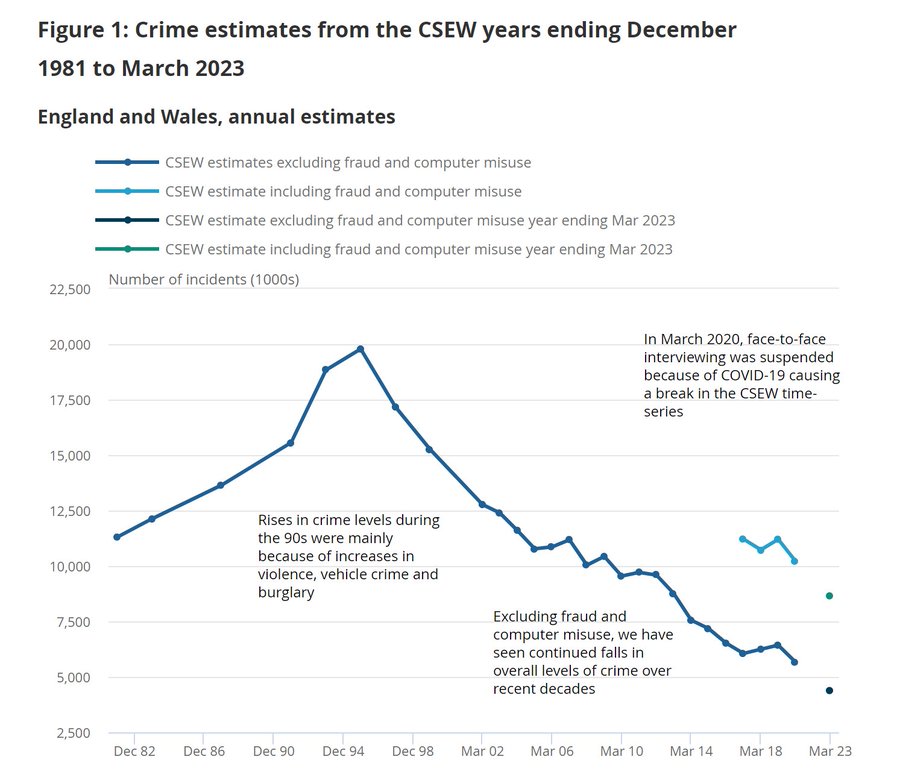
Here is the source.
Operation Warp Speed for Cows
 The UK Health Security Agency has raised their pandemic threat level for H5N1 bird flu from a 3 to a 4 on a 6 point scale.
My takeaway is that we have completely failed to stem the outbreak in cattle, there has been animal to human transmission which we are surely undercounting, but so far the virus has not mutated in a way to make it very adaptable to humans.
The failure to stem the outbreak in cattle is concerning because it suggests we would not be able to stem a human outbreak. We can easily test, quarantine and cull cattle!
It is absolutely outrageous that dairy farmers are refusing to cooperate on testing:
To date dairy farmers have, in large measure, refused to cooperate with efforts to chart how deeply the virus has infiltrated U.S. herds, seeing the possible stigma of admitting they have H5N1-infected cows as a greater risk than the virus itself.
We should be testing at much higher rates and quarantining and culling. The dairy farmers should be and are being compensated but frankly the farmers should have no say in the matter of testing. Externalities! Preventing a pandemic is much cheaper both in resources and in restrictions on liberty than dealing with one.
And how about an Operation Warp Speed for a vaccine for cows? Vaccinate. Vacca! It’s right there in the name! If only we could come up with a clever acronym for an Operation Warp Speed for COWS.
Developing a vaccine for cows would also speed up a human vaccine if one were needed.
Here are some key points from the UK HSA:
There is ongoing transmission of influenza A(H5N1) in the US, primarily through dairy cattle but with multispecies involvement including poultry, wild birds, other mammals (cats, rodents, wild mammals) and humans (1, 2). There is high uncertainty regarding the trajectory of the outbreak and there is no apparent reduction in transmission in response to the biosecurity measures that have been introduced to date. There is ongoing debate about whether the current outbreak should be described as sustained transmission given that transmission is likely to be facilitated by animal farming activities (3). However, given that this is a permanent context, the majority of the group considered this outbreak as sustained transmission with the associated risks.
…There is evidence of zoonotic transmission (human cases acquired from animals). There is likely to be under-ascertainment of mild zoonotic cases.
..Overall, there is no evidence of change in HA which is suggestive of human adaptation through these acquired mutations. Although genomic surveillance data are likely to lag behind infections, the lack of evidence of viral adaptation to α2,6SA receptors after thousands of dairy cattle infected may suggest that transmission within cows does not strongly predispose to human receptor adaptation. Evidence of which sialic acid receptors are present in cows, which is needed to support this hypothesis, is still preliminary and requires confirmation.
Approval timelines really matter for housing
We provide credible estimates of the effect of duration and uncertainty in local regulatory approval times on the rate of housing production. The analysis derives from a novel dataset of development timelines for all multifamily housing projects permitted in the City of Los Angeles between 2010 and 2022. As a lower bound, simply by pulling forward in time the completion of already started projects, we estimate that reductions of 25% in approval time duration and uncertainty would increase the rate of housing production by 11.9%. If we also account for the role of approval times in incentivizing new development, we estimate that the 25% reduction in approval time would increase the rate of housing production by a full 33.0%. Both the expected value and the uncertainty in approval times are salient to incentivizing new development. The results provide new evidence that local approval processes are a significant driver of housing supply and reinforce the notion that municipal regulatory reform is an important component of housing reform.
That is from a new research paper by Stuart Gabriel and Edward Kung, via the excellent Kevin Lewis. Speed also influences total supply! (rooftops)
The new Raj Chetty paper on changes in opportunity
Here is the paper, with co-authors Will Dobbie, Benjamin Goldman, Sonya R. Porter, and Crystal S. Yang. Here is the abstract:
We show that intergenerational mobility changed rapidly by race and class in recent decades and use these trends to study the causal mechanisms underlying changes in economic mobility. For white children in the U.S. born between 1978 and 1992, earnings increased for children from high-income families but decreased for children from low-income families, increasing earnings gaps by parental income (“class”) by 30%. Earnings increased for Black children at all parental income levels, reducing whiteBlack earnings gaps for children from low-income families by 30%. Class gaps grew and race gaps shrank similarly for non-monetary outcomes such as educational attainment, standardized test scores, and mortality rates. Using a quasi-experimental design, we show that the divergent trends in economic mobility were caused by differential changes in childhood environments, as proxied by parental employment rates, within local communities defined by race, class, and childhood county. Outcomes improve across birth cohorts for children who grow up in communities with increasing parental employment rates, with larger effects for children who move to such communities at younger ages. Children’s outcomes are most strongly related to the parental employment rates of peers they are more likely to interact with, such as those in their own birth cohort, suggesting that the relationship between children’s outcomes and parental employment rates is mediated by social interaction [emphasis added]. Our findings imply that community-level changes in one generation can propagate to the next generation and thereby generate rapid changes in economic mobility.
Here is NYT coverage, here is WSJ coverage.
Not the worst news…
We find that markups increased by about 30 percent on average over the sample period. The change is primarily attributable to decreases in marginal costs, as real prices only increased slightly from 2006 to 2019. Our estimates indicate that consumers have become less price sensitive over time.
That is from a new NBER working paper by
…the empirical evidence relating to concentration trends, markup trends, and the effects of mergers does not actually show a widespread decline in competition. Nor does it provide a basis for dramatic changes in antitrust policy. To the contrary, in many respects the evidence indicates that the observed changes in many industries are likely to reflect competition in action.
Rooftops, people…
Germany fact of the day

Here is the source.
The Financial Consequences of Legalized Sports Gambling
Following a 2018 ruling of the U.S. Supreme Court, 38 states have legalized sports gambling. We study how this policy has impacted consumer financial health using the state-by-state rollout of legal sports gambling and a large and comprehensive dataset on consumer financial outcomes. Our main finding is that overall, consumers’ financial health is modestly deteriorating as the average credit score in states that legalize sports gambling decreases by roughly 0.3%. The decline in credit score is associated with changes in indicators of excessive debt. We find a substantial increase in bankruptcy rates, debt collections, debt consolidation loans, and auto loan delinquencies. We also find that financial institutions respond to the reduced creditworthiness of consumers by restricting access to credit. These results are stronger for states that allow sports gambling online compared to states that restrict access to in-person betting and larger for young men in low-income counties. Together, these results indicate that the ease of access to sports gambling is harming consumer financial health by increasing their level of debt.
That is from a new paper by Brett Hollenbeck, Poet Larsen, and Davide Proserpio.