Category: Data Source
Bailouts Forever
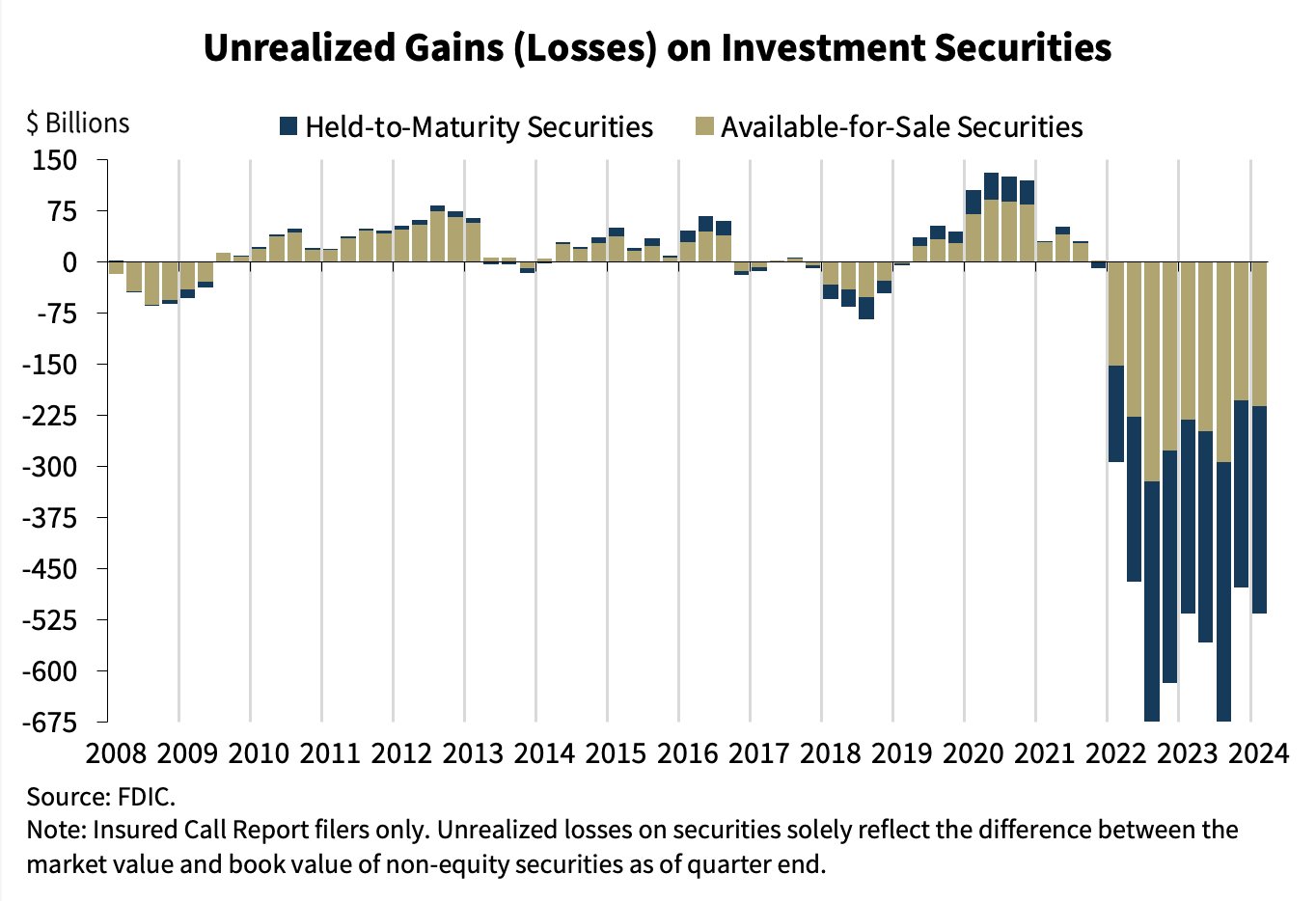
When interest rates rise, the price of long-term assets falls. Consequently, when the Fed began raising interest rates in 2022, the value of bonds and mortgages dropped, causing significant accounting losses for banks heavily invested in these assets. Silicon Valley Bank went bust, for example, because depositors fled upon realizing it was holding lots of Treasury bonds.
Interest rates remain high and many banks have large unrealized losses on their books. According to the latest FDIC data (see below) unrealized losses currently total $516.5 billion, far exceeding levels seen during the 2008-2009 financial crisis. Price risk is not the same as default risk and if the banks can hold onto their assets until maturity then they will be solvent. The real danger, as with SVB, is if unrealized losses are combined with a deposit run. So far that doesn’t seem to be happening but it’s well within the realm of possibility.
In other news, Hypertext has an issue devoted to Anat Admati and Martin Hellwig’s The Banker’s New Clothes. Admati and Hellwig write:
The 2010 Dodd-Frank Act in the United States promised the end of bank bailouts and “too-big-to-fail” institutions. The European Union’s 2014 legislation for dealing with banks likely to fail was claimed to provide “a framework” to “deal with banks that experience financial difficulties without either using taxpayer money or endangering financial stability.” In November 2014, Mark Carney, at the time the governor of the Bank of England and chair of the Financial Stability Board (FSB), a body of financial regulators from around the world, announced triumphantly that an agreement about new rules for the thirty largest and most complex, “globally systemic” financial institutions would prevent bailouts in the future. Many people in politics and the media believed these claims.
Nationalism in Online Games During War
We investigate how international conflicts impact the behavior of hostile nationals in online games. Utilizing data from the largest online chess platform, where players can see their opponents’ country flags, we observed behavioral responses based on the opponents’ nationality. Specifically, there is a notable decrease in the share of games played against hostile nationals, indicating a reluctance to engage. Additionally, players show different strategic adjustments: they opt for safer opening moves and exhibit higher persistence in games, evidenced by longer game durations and fewer resignations. This study provides unique insights into the impact of geopolitical conflicts on strategic interactions in an online setting, offering contributions to further understanding human behavior during international conflicts.
That is from a new paper by Eren Bilen, Nino Doghonadze, Robizon Khubulashvili, and David Smerdon. Imagine if there is some addition Sino-Indian conflict right before the Ding vs. Gukesh WCC match…
For the pointer I thank various MR readers.
The who and how of campaign spending on Meta
Trump targets horse riding, Biden targets football, and RFK Jr. targets comedy.
Trump also can claim Ted Nugent fans, here is the full story. Via A.
Blame California?
This paper reexamines the role of social policy in the doubling of divorce rates. We demonstrate that the short-run rise in divorce rates formerly attributed to unilateral divorce solely depends on the state of California. California receives considerable weight in national analyses and adopted several policies simultaneously. When we examine the independent effects of these social policies, we find that legal abortion leads to a clear and immediate rise in divorce rates. However, legal abortion’s impact also hinges on California and may be contaminated by concurrently adopted policies. We then demonstrate that California’s influence extends to the broader unilateral divorce literature. We conclude by describing best practices to confront the challenges of simultaneous policy adoption.
That is from a recent paper by Lauren Hoehn-Velasco, Jacob Penglase, Michael Pesko, and Hasan Shahid. Via tekl.
What Went Wrong with Federal Student Loans?
At a time when the returns to college and graduate school are at historic highs, why do so many students struggle with their student loans? The increase in aggregate student debt and the struggles of today’s student loan borrowers can be traced to changes in federal policies intended to broaden access to federal aid and educational opportunities, and which increased enrollment and borrowing in higher-risk circumstances. Starting in the late 1990s, policymakers weakened regulations that had constrained institutions from enrolling aid-dependent students. This led to rising enrollment of relatively disadvantaged students, but primarily at poor-performing, low-value institutions whose students systematically failed to complete a degree, struggled to repay their loans, defaulted at high rates, and foundered in the job market. As these new borrowers experienced similarly poor outcomes, their loans piled up, loan performance deteriorated, and with it the finances of the federal program. The crisis illustrates the important role that educational institutions play in access to postsecondary education and student outcomes, and difficulty of using broadly-available loans to subsidize investments in education when there is so much heterogeneity in outcomes across institutions and programs and in the ability to repay of students.
That is from a new NBER working paper by Adam Looney and Constantine Yannellis.
The decline in Native American wealth
I had not realized how negative were the effects of the 1887 Dawes Act, which broke up many Native American reservations. Before 1912:
There was a nontrivial number of relatively wealthy superintendencies, which runs counter to the common perception of uniform poverty during this period. In 1912, the wealthiest superintendency had total per capital wealth levels above $600,000 in 2019 real terms, while total per capital wealth was just $90 in the least wealthy superintendency…
Our results suggest that, on average, Indigenous Peoples in the early twentieth century had substantial levels of wealth per capita, although there was wide diversity in wealth levels. Between 1912 and 1927, wealth per capita declined by nearly 50 percent.
Per capita indigenous wealth had been above white wealth at the beginning of the period.
Here is the AER version of the piece, by Donn. L. Feir, Maggie E.C. Jones, and Angela Redish, ungated here.
How important is “the scientific method”?
From a recently published paper by Alexander Krauss:
Using data on all major discoveries across science including all Nobel Prize and major non-Nobel Prize discoveries, we can address the question of the extent to which “the scientific method” is actually applied in making science’s groundbreaking research and whether we need to expand this central concept of science. This study reveals that 25% of all discoveries since 1900 did not apply the common scientific method (all three features)—with 6% of discoveries using no observation, 23% using no experimentation, and 17% not testing a hypothesis. Empirical evidence thus challenges the common view of the scientific method.
File under “In favor of methodological pluralism.” Via Zhengdong Wang.
Is the internet bad for you?
A global, 16-year study1 of 2.4 million people has found that Internet use might boost measures of well-being, such as life satisfaction and sense of purpose — challenging the commonly held idea that Internet use has negative effects on people’s welfare.
“It’s an important piece of the puzzle on digital-media use and mental health,” says psychologist Markus Appel at the University of Würzburg in Germany. “If social media and Internet and mobile-phone use is really such a devastating force in our society, we should see it on this bird’s-eye view [study] — but we don’t.” Such concerns are typically related to behaviours linked to social-media use, such as cyberbullying, social-media addiction and body-image issues. But the best studies have so far shown small negative effects, if any2,3, of Internet use on well-being, says Appel.
From separate Gallup polls:
Pryzbylski and his colleagues analysed data on how Internet access was related to eight measures of well-being from the Gallup World Poll, conducted by analytics company Gallup, based in Washington DC. The data were collected annually from 2006 to 2021 from 1,000 people, aged 15 and above, in 168 countries, through phone or in-person interviews. The researchers controlled for factors that might affect Internet use and welfare, including income level, employment status, education level and health problems.
…The team found that, on average, people who had access to the Internet scored 8% higher on measures of life satisfaction, positive experiences and contentment with their social life, compared with people who lacked web access. Online activities can help people to learn new things and make friends, and this could contribute to the beneficial effects, suggests Appel.
Do note that in these latter data sets women ages 15-24 still are worse off from internet access.
Here is the Nature piece, via Clara B. Jones.
The culture of Hollywood vs. the culture of Bollywood
In Hollywood movies, the most shameful thing is to be poor.
In Bollywood movies, the most shameful thing is to be unmanly or unfeminine. https://t.co/Qd1S02dE5J pic.twitter.com/Oa1b3O6AOR— Whyvert (@whyvert) May 14, 2024
And a comment: “In Bollywood movies throughout multiple eras, the most shameful thing has always been disrespect of parents/family. By a wide margin.”
The New Zealand sheep-to-people ratio continues to fall

Here is the story, via the excellent Samir Varma.
Did Norwegian schools actually ban cell phones?
Some commentators are suggesting no real ban was in effect. I went back to the Sara Abrahamsson paper to confirm the following:
Schools where students are required to hand in their phones in the morning, and therefore cannot access them during breaks, are considered to have a strict policy against smartphones. Schools where students are allowed to access their phones during breaks but are required to have them on for instance silent [mode] during lectures are classified as having a lenient policy toward smartphones. For mental health, the effect between schools with a more lenient and strict policy is relatively similar, as shown in Figure 10.17. Four years post-ban, girls experience 3.48 and 2.3 fewer visits for specialist care related to psychological symptoms and diseases at schools with a lenient and strict policy respectively (p-values 0.036 and 0.068).18 For bullying, there is not much difference dependent on the type of policy implemented when it comes to bullying, neither for girls as documented in Figure 11, or boys as shown in Appendix Figure A21.
However, girls attending a middle school introducing a strict policy against smartphones, experience an increase by 0.12 standard deviations in GPA. This estimate is significant four years post-ban at the 5% level (p-value 0.032). Additionally, girls attending a middle school with a strict policy have significantly higher teacher-awarded test scores by 0.08 and 0.14 standard deviations, three and four years post-ban (p-values 0.075 and 0.011). These results, shown in Panel A and B in Figure 12, show that both GPA and average grades set by teachers for girls improve after strict smartphone bans in schools are implemented.
…However, there are no detectable differences in the likelihood of attending an academic high school track between schools with strict compared to more lenient policies
In other words, there were strict bans and they had only modest effects, including relative to the less strict bans. On p.34, Figure 2, you will see that 200 schools had strict bans, somewhat less than half the total (not every case is easy to classify). Note also that if smart phone bans could help with mental health problems in a big way, we still should see a change in mental health diagnoses, following the bans, yet we do not.
Here is my original post on the topic.
The US has Low Electricity Prices
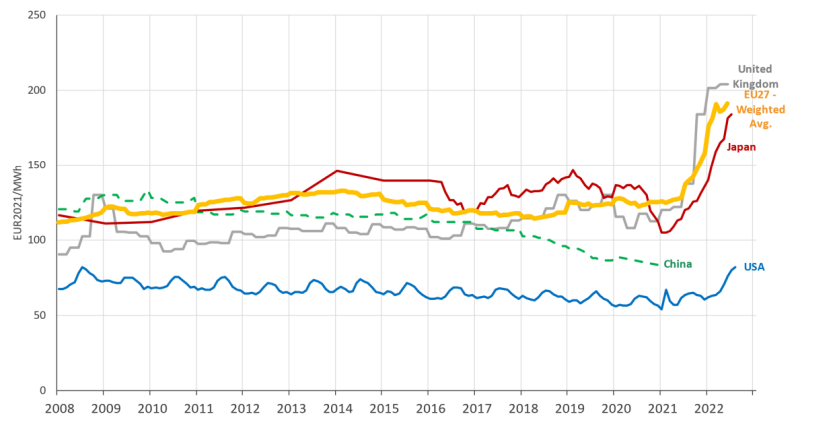
The US has some of the lowest electricity prices in the world. Shown below are industrial retail electricity prices in EU27, USA, UK, China and Japan. Electricity is critical for AI compute, electric cars and more generally reducing carbon footprints. The US needs to build much more electricity infrastructure, by some estimates tripling or quadrupling production. That’s quite possible with deregulation and permitting reform. I am pleased to learn, moreover, that we are starting from a better base than I had imagined.
GPT-4 beats psychologists on a new test of social intelligence
There were significant differences in SI between psychologists and AI’s ChatGPT-4 and Bing. ChatGPT-4 exceeded 100% of all the psychologists, and Bing outperformed 50% of PhD holders and 90% of bachelor’s holders. The differences in SI between Google Bard and bachelor students were not significant, whereas the differences with PhDs were significant; Where 90% of PhD holders excel on Google Bird.
That is from a new paper by Nabil Saleh Sufyan, et.al. In the “good ol’ days” we thought that was the task where AI would never have much of a fighting chance. Now the bets models are just outright beating the humans.
Note that all the subjects were men. Via Christopher Altman.
Mask Mandate Costs
There is now an NBER working paper on this topic:
This paper presents the results from a hypothetical set of questions related to mask-wearing behavior and opinions that were asked of a nationally representative sample of over 4,000 participants in early 2022. Mask mandates were hotly debated in public discourse, and though much research exists on benefits of masks, there has been no research thus far on the distribution of perceived costs of compliance. As is common in economic research that aims to assess the value to society of non-market activities, we use survey valuation methods and ask how much participants would be willing to pay to be exempted from rules of mandatory community masking. The survey asks specifically about a 3 month exemption. We find that the majority of respondents (56%) are not willing to pay to be exempted from mandatory masking. However, the average person was willing to pay $525, and a small segment of the population (0.9%) stated they were willing to pay over $5,000 to be exempted from the mandate. Younger respondents stated higher willingness to pay to avoid the mandate than older respondents. Combining our results with standard measures of the value of a statistical life, we estimate that a 3 month masking order was perceived as cost effective through willingness-to-pay questions only if at least 13,333 lives were saved by the policy.
That is by Patrick Carlin, Shyam Raman, Kosali I. Simon, Ryan Sullivan, and Coady Wing. A few comments:
1. Willingness to be paid magnitudes are often much higher than willingness to pay numbers. Especially when issues of justice and desert are involved. I know some people who might say: “I have a right to refuse a mask. I’m not going to pay anything not to wear one, but you would have to pay me a million dollars to put it on.” There are less extreme versions of this view, noting that even in quite normal laboratory circumstances WTBP can be 5x higher than WTP.
2. For many people the value of masking — either positively or negatively — depends on what others do. Some might feel “I guess I can wear a mask, but if you make everyone do that, that is a gross Orwellian dystopia.” Others, perhaps leaning more to the political left, might say: “I am willing to do my share, but of course I expect the same from everyone else. Let us sing this collective song and with our masks dance to the heavens!”
3. Why not just look at what private sector establishments chose when the force of law was not present? Don’t they have the best sense of how to internalize all the different factors behind what their customers want? Of course the answer here will vary, depending on what stage of the pandemic we are in.
U.S.A.-India fact of the day
US ambassador to India, Eric Garcetti, has emphasized the remarkable success of Indian immigrants in the United States, noting that over 10% of Fortune 500 companmy CEOs as Indian immigrants who studied in the US.
Here is the link. Via the excellent Samir Varma.