Category: Data Source
U.S.A. facts of the day
In 2021, the average American could expect to live until the age of 76, federal health researchers reported on Wednesday. The figure represents a loss of almost three years since 2019, when Americans could expect to live, on average, nearly 79 years.
The reduction has been particularly steep among Native Americans and Alaska Natives, the National Center for Health Statistics reported. Average life expectancy in those groups was shortened by four years in 2020 alone.
The cumulative decline since the pandemic started, more than six and a half years on average, has brought life expectancy to 65 among Native Americans and Alaska Natives — on par with the figure for all Americans in 1944.
Here is more from the NYT. Do note that Native Americans are generally considered to have done OK in terms of their vaccination rates.
The Distributional Effects of Student Loan Forgiveness
Even worse than you thought:
We study the distributional consequences of student debt forgiveness in present value terms, accounting for differences in repayment behavior across the earnings distribution. Full or partial forgiveness is regressive because high earners took larger loans, but also because, for low earners, balances greatly overstate present values. Consequently, forgiveness would benefit the top decile as much as the bottom three deciles combined. Blacks and Hispanics would also benefit substantially less than balances suggest. Enrolling households who would benefit from income-driven repayment is the least expensive and most progressive policy we consider.
That is from a working paper by Sylvaine Catherine and Constantine Yanellis. It is sad that such material even needs to be posted. I hope you are not taken in by Dube-ous ideas to the contrary!
A college degree ain’t what it used to be
Labor market outcomes for young college graduates have deteriorated substantially in the last twenty five years, and more of them are residing with their parents. The unemployment rate at 23-27 year old for the 1996 college graduation cohort was 9%, whereas it rose to 12% for the 2013 graduation cohort. While only 25% of the 1996 cohort lived with their parents, 31% for the 2013 cohort chose this option. Our hypothesis is that the declining availability of ‘matched jobs’ that require a college degree is a key factor behind these developments. Using a structurally estimated model of child-parent decisions, in which coresidence improves college graduates’ quality of job matches, we find that lower matched job arrival rates explain two thirds of the rise in unemployment and coresidence between the 2013 and 1996 graduation cohorts. Rising wage dispersion is also important for the increase in unemployment, while declining parental income, rising student loan balances and higher rental costs only play a marginal role.
That is from a new NBER paper by Stefania Albanesi, Rania Gihleb, and Ning Zhang.
Kin-based institutions and economic development
Though many theories have been advanced to account for global differences in economic prosperity, little attention has been paid to the oldest and most fundamental of human institutions: kin-based institutions—the set of social norms governing descent, marriage, clan membership, post-marital residence and family organization. Here, focusing on an anthropologically well established dimension of kinship, we establish a robust and economically significant negative association between the tightness and breadth of kin-based institutions—their kinship intensity—and economic development. To measure kinship intensity and economic development, we deploy both quantified ethnographic observations on kinship and genotypic measures (which proxy endogamous marriage patterns) with data on satellite nighttime luminosity and regional GDP. Our results are robust to controlling for a suite of geographic and cultural variables and hold across countries, within countries at both the regional and ethnolinguistic levels, and within countries in a spatial regression discontinuity analysis. Considering potential mechanisms, we discuss evidence consistent with kinship intensity indirectly impacting economic development via its effects on the division of labor, cultural psychology, institutions, and innovation.
That is a new and very important paper by Duman Bahrami-Rad, Jonathan Beauchamp, Joseph Henrich, and Jonathan Schulz, the two Jonathans being my colleagues at GMU.
Model this newsroom estimator
The New York Times’s performance review system has for years given significantly lower ratings to employees of color, an analysis by Times journalists in the NewsGuild shows.
The analysis, which relied on data provided by the company on performance ratings for all Guild-represented employees, found that in 2021, being Hispanic reduced the odds of receiving a high score by about 60 percent, and being Black cut the chances of high scores by nearly 50 percent. Asians were also less likely than white employees to get high scores.
In 2020, zero Black employees received the highest rating, while white employees accounted for more than 90 percent of the roughly 50 people who received the top score.
The disparities have been statistically significant in every year for which the company provided data, according to the journalists’ study, which was reviewed by several leading academic economists and statisticians, as well as performance evaluation experts.
…Management has denied the discrepancies in the performance ratings for nearly two years…
And from the economists:
Multiple outside experts consulted by the reporters consistently said the methodology used in the Guild’s most recent analysis was reasonable and appropriate and that the approach used by the company appeared either flawed or incomplete. Some went further, suggesting the company’s approach seemed tailor-made to avoid detecting any evidence of bias.
Rachael Meager, an economist at the London School of Economics, was blunt: “LMAO, that’s so dumb,” she wrote when Guild journalists described the company’s methodology to her. “That’s what you would do if you want to obliterate signal,” she added, using a word that in economics refers to meaningful information.
“This is so stupid as to border on negligence,” added Dr. Meager, who has published papers on evaluating statistical evidence in leading economics journals.
Peter Hull, a Brown University economist who has studied statistical techniques for detecting racial bias, also questioned the company’s approach and recommended a way to test it: running simulations in which bias was intentionally added. The company’s method repeatedly failed to detect racial disparities in those tests.
Here is the full article, prepared by the NYT Guild Equity Committee, including Ben Casselman. Of course we now live in a world where very few people will be surprised by this. Where exactly does the moral authority lie here for making editorial judgments about content concerning race?
Why is female labor force participation declining in India?
One of the big problems in the Indian economy, and in gender relations, is that economic growth has not translated into more women working, in fact the contrary. This paper is a little bit old (2014), but so far the most systematic analysis I have found:
…we analyse four prominent hypotheses of the root causes of declining female participation. The findings in this paper indicate that a number of factors were responsible for the recent sharp decline in estimated labour force participation rates among working-age women. Some factors, such as increased attendance in education and higher household income levels, are no doubt a positive reflection of rapid economic development. Additionally, we find evidence that changes in measurement methodology across survey rounds is likely to have contributed to the estimated decline in female participation, due to the difficulty of differentiating between domestic duties and contributing family work. However, the key long-run issue is the lack of employment opportunities for India’s women, owing to factors such as occupational segregation.
Here is the full paper by Steven Kapsos, Evangelia Bourmpoula, and Andrea Silberman. Dhanaraj and Mahambari suggest that women who work are more likely to be the targets of domestic violence, another factor holding back labor force participation. what else do you know on this topic?
Locus of Control and Prosocial Behavior
We investigate how locus of control beliefs – the extent to which individuals attribute control over events in their life to themselves as opposed to outside factors – affect prosocial behavior and the private provision of public goods. We begin by developing a conceptual framework showing how locus of control beliefs serve as a weight placed on the returns from one’s own contributions (impure altruism) and others contributions (pure altruism). Using multiple data sets from Germany and the U.S., we show that individuals who relate consequences to their own behavior are more likely to contribute to climate change mitigation, to donate money and in-kind gifts to charitable causes, to share money with others, to cast a vote in parliamentary elections, and to donate blood. Our results provide comprehensive evidence that locus of control beliefs affect prosocial behavior.
Here is the full paper by Mark A. Andor, et.al. It is always worth asking which political philosophies encourage such locus of control beliefs, and which do not. That will tell you more than almost any other metric. Wouldn’t it be nice if people would wear little buttons — “My philosophy does not encourage locus of control beliefs” — how simple life would be!
Share of births outside marriage, by country
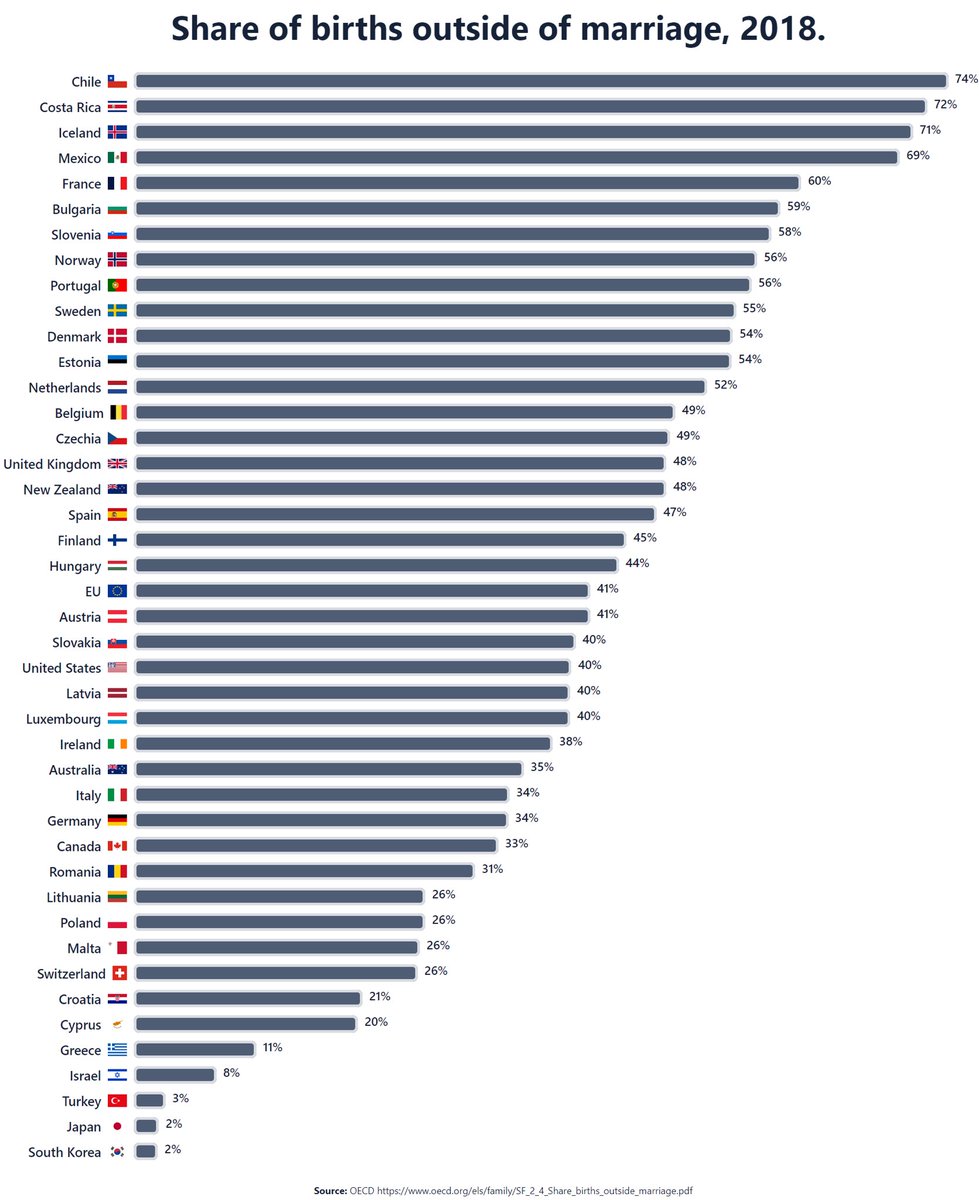
Here is the link.
Corporate campaign spending doesn’t matter much
To what extent is U.S. state tax policy affected by corporate political contributions? The 2010 Supreme Court Citizens United v. Federal Election Commission ruling provides an exogenous shock to corporate campaign spending, allowing corporations to spend on elections in 23 states which previously had spending bans. Ten years after the ruling and for a wide range of outcomes, we are not able to identify economically or statistically significant effects of corporate independent expenditures on state tax policy, including tax rates, discretionary tax breaks, and tax revenues.
That is from a new paper by Cailin R. Slattery, Alisa Tazhitdinova, and Sarah Robinson.
Gender Differences in Persistence and Publishing in Economics
We design an experiment to study gender differences in reactions to editorial decisions on submissions to top economics journals. Respondents read a hypothetical editor’s letter where the decision (e.g., revise and resubmit) is randomized across participants. Relative to an R&R, female assistant professors who receive a rejection perceive a significantly lower likelihood of subsequently publishing the paper in any leading journal than comparable male assistant professors. We do not find this gender difference among tenured professors. We consider several mechanisms, pointing to gender differences in attribution of negative feedback to ability and confidence under time constraints as likely explanations.
Here is the full paper by Gauri Kartini Shastry and Olga Shurchkov. Via the excellent Kevin Lewis.
Rankings where Canada comes in last
Rankings in which Canada is now last among advanced economies:
-Most unaffordable housing
-Highest cellphone bills
-Most COVID debt as % of GDP (public & private)
-Most-delayed airport (Pearson)
-3rd most inefficient port (Vancouver)
via @nationalposthttps://t.co/SMCTXwB7ez— Jon Hartley (@Jon_Hartley_) August 12, 2022
Well-being average is over?
Jon Clifton, the head of Gallup, which has been tracking wellbeing around the world for many years, notes a polarisation in people’s life-evaluations. Compared with 15 years ago (before the financial crisis, smartphones and Covid-19) twice as many people now say they have the best possible life they could imagine (10 out of 10); however, four times as many people now say they are living the worst life they can conceive (0 out of 10). About 7.5 per cent of people are now in psychological heaven, and about the same proportion are in psychological hell.
That is from Tim Harford at the FT. There will be more in Clifton’s forthcoming book Blind Spot.
How on-line education affects grading
This paper examines the role of student facial attractiveness on academic outcomes under various forms of instruction, using data from engineering students in Sweden. When education is in-person, attractive students receive higher grades in non-quantitative subjects, in which teachers tend to interact more with students compared to quantitative courses. This finding holds both for males and females. When instruction moved online during the COVID-19 pandemic, the grades of attractive female students deteriorated in non-quantitative subjects. However, the beauty premium persisted for males, suggesting that discrimination is a salient factor in explaining the grade beauty premium for females only.
That is from a new Economic Letters piece by Adrian Mehic. Via tekl.
Covid in Cuba
Covid in Cuba
"The country’s once-famed health system is in tatters"https://t.co/BPPnY3ARPA @TheEconomist pic.twitter.com/hJHKSsD3rf— Eric Topol (@EricTopol) August 4, 2022
Sex ratio and infant mortality in India
“India has made tremendous progress since 1990. …
What would you expect about sex ratio at birth in India?
I expected the following:
- It would have improved across the whole country.
- It would be worse in the north than in the south.
- It would be worse in rural areas than in urban areas.
- The law banning prenatal sex determination, which was passed almost 30 years ago, would have helped with the known problem of selective abortion of female fetuses.
I had also assumed these to be true and touted them as facts to multiple people, including twice in the last two years. Recently, when I tried to confirm this, I learnt the opposite:
- Sex ratio at birth has gotten worse across the whole country.
- It is better in the south than in the north, but neither is it better in every southern state nor is it good in absolute terms.
- It is worse in urban areas than in rural areas.
- The impact of the law has been mild.”
Here is the link, that is all from Sravan Bhamidipati.