Category: Data Source
Is this about the poll or about the people? (model this)
The sexual orientation of 18-25 yr old college students from @TheFIREorg.
85% of Muslims ID as straight.
84% of Protestants.
83% of Catholics.The biggest shock to me? Latter-day Saints.
Only 78% say they are straight!It's 55% of atheists.
53% of agnostics. pic.twitter.com/o7DddewhT6— Ryan Burge 📊 (@ryanburge) September 18, 2023
Who in America has mental health problems?
There is a new EJPH paper on these questions by Junxiu Liu, et.al. Let’s start with some geography:
The prevalence of symptoms varied significantly across states, ranging from 27.9% (95% CI = 23.8%, 32.0%) in Florida to 46.4% (95% CI = 41.9%, 50.9%) in New Hampshire…
How much of that is a sunshine effect? The full ranking of states supposedly is given in their Appendix A, but I can’t find that on-line. If you can, please let us know.
Furthermore, when it comes to your parents — income good, education bad! Graduate education yikes:
Youths with parents with higher education had more mental health symptoms; the prevalence of mental health symptom was 37.4% (95% CI = 36.3%, 38.5%) among youths whose parents had graduate degrees compared with 30.3% (95% CI = 23.8%, 36.8%) among those whose parents had less than a high school–level education. By contrast, youths from households with the highest income level (≥ $200 000) had a lower prevalence of mental health symptoms at 30.7% (95% CI = 29.1%, 32.3%) than did those from households with the lowest income level (< $25 000) at 37.3% (95% CI = 34.8%, 39.8%).
We’re into uh-oh territory here. As for ethnic groups, mental health problems measure as worst for whites and also for an assorted group known as “other.”
Via the excellent Kevin Lewis.
Where do you live and why?
Map shows most common type of home where people live in each European country. pic.twitter.com/JXEvkfO475
— Xavi Ruiz (@xruiztru) September 16, 2023
Populism fact of the day
Populism at the country level is at an all-time high, with more than 25% of nations currently governed by populists. How do economies perform under populist leaders? We build a new long run cross- country database to study the macroeconomic history of populism. We identify 51 populist presidents and prime ministers from 1900 to 2020 and show that the economic cost of populism is high. After 15 years, GDP per capita is 10% lower compared to a plausible non-populist counterfactual. Economic disintegration, decreasing macroeconomic stability, and the erosion of institutions typically go hand in hand with populist rule.
That is a new piece by Manuel Funke, Moritz Schularick, and Christoph Trebesch, forthcoming in The American Economic Review, arguably the number one journal of the economics profession.
U.S.A. fact of the day
After the Supreme Court struck down Roe v. Wade last year, it looked like the number of abortions would soon plummet across the country. But new estimates suggest that has not happened. The number of legal abortions has held steady, if not increased, nationwide since 2020, our colleagues Amy Schoenfeld Walker and Allison McCann reported today.
How is that possible? New data from the Guttmacher Institute, a nonprofit specializing in reproductive health, implies that more people are traveling across state lines or using telemedicine to get abortions, including through the use of abortion pills. The increase in use of those options has offset the decrease in abortions resulting from new state bans, Amy and Allison found.
Here is more from The New York Times.
Why is the minor key rising in popularity?
Another telltale sign of sad songs is the minor key. This rise in minor key songs has been dramatic. Around 85% of songs were in a major key back in the 1960s, but in more recent years this has fallen in half.
My favorite guru of music data analytics, Chris Dalla Riva, has sent me this chart showing the increasing share of Billboard #1 hits in a minor key. (By the way, I highly recommend Chris’s Substack Can’t Get Much Higher.)
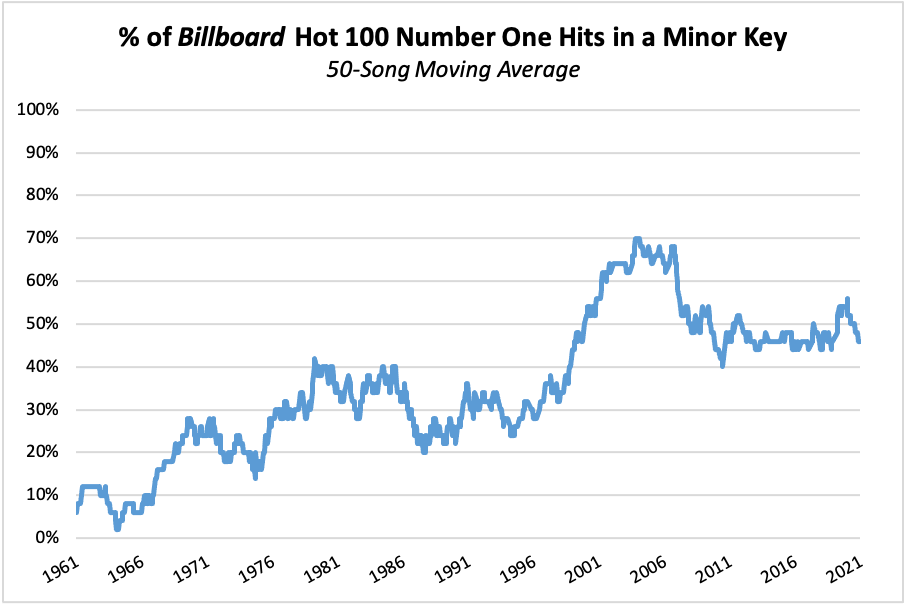
Here is more from Ted Gioia.
Did Katrina boost freedom, wreck state capacity, or both?
We find that Hurricane Katrina had lasting impacts on Louisiana’s formal institutions. In the post-Katrina period, we find that actual Louisiana had persistently higher economic freedom scores for both GE [government employment] and PT [property tax] than the synthetic Louisiana that did not experience the hurricane. These findings imply that the hurricane led to a reduction in both PTs and GE, which indicates a decrease in the relative size of the public sector as a share of the state’s economy.
That is from a new paper by Veeshan Rayamajhee, Raymond J. March, and Corbin C.T. Clark, via the excellent Kevin Lewis.
Attitudes toward capitalism (Poland fact of the day)
The author commissioned a survey on the image of capitalism in 34 countries. In only six of these countries – led by Poland and the United States – do pro-capitalist attitudes dominate. Although approval of capitalism increases when the word ‘capitalism’ is omitted (and instead only described), even then a positive attitude dominates in only seven of 34 countries. The most frequently mentioned criticisms of capitalism are that capitalism is dominated by the rich and that capitalism leads to growing inequality. Respondents with higher incomes and higher levels of education, men, and those who classified themselves as being on the right of the political spectrum are less anti-capitalist or are more pro-capitalist than the population at large in most countries. In 33 countries, anti-capitalists tend to be more conspiracy-minded than pro-capitalists.
That is from a new paper by Rainer Zitelman. And here is Rainer’s recent book In Defense Of Capitalism: Debunking the Myths.
Northern Virginia (Singapore) fact of the day
The data center cluster in Northern Virginia is three times the size of the next-largest data center area in the world, in Singapore. The industry saw a major boost during the pandemic, as more work and social life shifted online. Those boom times are expected to continue, with new artificial intelligence technology driving even more demand for server space. That’s significant for local governments increasingly dependent on the industry for tax revenue.
…Northern Virginia’s data centers had a 2% vacancy rate in the first half of 2023, and prices for companies looking to lease that space jumped by 15-20%, both signs of remarkably high demand for square footage in the massive complexes.
Here is the full story.
The Fast, the Slow, and the Congested
That is a new NBER working paper by Protty A. Akbar, Victor Couture, Gilles Duranton, and Adam Storeygard. Here is the abstract:
We assemble a new global database on motor vehicle travel speed in over 1,200 large cities in 152 countries. We then estimate comparable city-level indices of travel speed and congestion. Most of the variation in urban travel speed is across countries, not within. National income per capita explains most of this cross-country variation in speed. In rich countries, urban travel is roughly 50% faster than in poor countries. To investigate the link between economic development and mobility, we develop an urban model with endogenous travel, road infrastructure, and land area. The model provides an exact decomposition of how city size, infrastructure, and topography contribute to explaining why urban travel is faster in richer countries. We find that richer countries are faster, mainly because their cities have more major roads and wider land areas. These effects operate by increasing uncongested speed, not by reducing congestion.
In general, I am much more skeptical about slower modes of transportation than are many other MR readers, most of all those on the Left.
If you look on p.36, “major road length” is the variable most predictive of speed if you ask why rich countries are faster than are poor countries — please do not forget the Lucas Critique however! After all, they do measure Flint, Michigan as the fastest city [sic] in the world.
Here is a good paragraph (p.37):
Compared to other cities in the oecd, us cities are (exp(−0.27) − 1 =) 24% less populous, cover 72% more area, have 67% more major roads, and have 30% more roads that conform to the road network’s main grid orientation. Panel A of figure 5 reports the corresponding decomposition result. The low density of us cities explains most of why they are faster. Major roads matter too, as do griddier road networks. City size variables account for 47% of the speed difference between the us and other oecd countries, infrastructure accounts for 35%, and the share accounted for by topography is negligible.
If you are wondering, by their measures Dhaka is the slowest city in the world.
An excellent paper, recommended.
The impacts of Covid-19 absences on workers
In the Journal of Public Economics, by Gopi Shah Goda and Evan J. Soltas:
We show that Covid-19 illnesses and related work absences persistently reduce labor supply. Using an event study, we estimate that workers with week-long Covid-19 absences are 7 percentage points less likely to be in the labor force one year later compared to otherwise-similar workers who do not miss a week of work for health reasons. Our estimates suggest Covid-19 absences have reduced the U.S. labor force by approximately 500,000 people (0.2 percent of adults) and imply an average labor supply loss per Covid-19 absence equivalent to $9,000 in forgone earnings, about 90 percent of which reflects losses beyond the initial absence week.
Here is the full article.
Law-Abiding Immigrants
The subtitle is The Incarceration Gap Between Immigrants and the U.S.-Born, 1850–2020, and the authors are Ran Abramitzky, Leah Boustan, Elisa Jácome, Santiago Pérez, and Juan David Torres. Here is the to-the-point abstract:
Combining full-count Census data with Census/ACS samples, the researchers provide the first nationally representative long-run series (1870–2020) of incarceration rates for immigrants and the U.S.-born. As a group, immigrants had lower incarceration rates than the US-born for the last 150 years. Moreover, relative to the U.S.-born, immigrants’ incarceration rates have declined since 1960: Immigrants today are 60% less likely to be incarcerated (30% relative to U.S.-born whites). This relative decline occurred among immigrants from all regions and cannot be explained by changes in immigrants’ observable characteristics or immigration policy. Instead, the decline likely reflects immigrants’ resilience to economic shocks.
Here is the full paper, via Anecdotal.
Labor Day
Thanks capitalism!
The Dominican Republic is underrated
Despite being one of Latin America’s poorest countries in the mid-1960s, the Dominican Republic has made remarkable progress in terms of income convergence…
What is remarkable about the Dominican Republic’s progress is not just the level of convergence but also its speed compared to other countries in the region. By examining the average convergence velocity, or the rate of change in income convergence per decade, it is evident that the Dominican Republic has exhibited the highest average convergence velocity, or “blue shift,” in Latin America over the past 50 years. Panama and Chile have achieved equally meaningful but still lower positive convergence velocities, while the majority of countries in the region have experienced either very low (“green shift”) or negative (“red shift”) convergence velocities.
Here is the full IMF brief, retweeted by Matt Yglesias. There is much more at the link. I have been there twice, including as recently as last year (albeit briefly), and this accords with my intuitions.
Who Runs the AEA?
That is a new JEL publication (gated) by Kevin D. Hoover and Andrej Svorenčík, here is the abstract:
The leadership structure of the American Economic Association is documented using a biographical database covering every officer and losing candidate for AEA offices from 1950 to 2019. The analysis focuses on institutional affiliations by education and employment. The structure is strongly hierarchical. A few institutions dominate the leadership, and their dominance has become markedly stronger over time. Broadly two types of explanations are explored: that institutional dominance is based on academic merit or that it is based on self-perpetuating privilege. Network effects that might explain the dynamic of increasing concentration are also investigated.
And this:
The current paper is based on an extensive prosopographical database covering the entire leadership of the AEA over the
1950–2019 period, including all Presidents, Presidents-elect, Vice Presidents, ordinary members of the Executive Committee, as well as the losing candidates for all elective offices, and members of the Nominating Committee.
The results?:
The 14 institutions in the table account for almost more than 80 percent of the positions for the whole 1950–2019 period. Even within this select group, the distribution is highly skewed with Harvard, the top supplying institution over the period accounting for more than a fifth of the total, and the last five universities accounting for around 2 percent each. The top five institutions, Harvard, MIT, Chicago, Columbia, and Stanford, which we designate as the first tier, account for over half (57.1 percent) of the positions over the whole period…
The authors summarize their findings:
The most obvious lessons are, perhaps, hardly surprising: the AEA leadership is overwhelmingly drawn from a small group of elite, private research universities—in the sense that its leaders were educated at these universities and, to a lesser degree, employed by them. What is less well-known is that for much of the past 70 years, the AEA leadership has been drawn predominantly from just three universities—Harvard, MIT, and Chicago.
By the way, institutional concentration has become more pronounced over time, not less. But since about eighty percent of U.S. students go to state schools, most of those large state schools, I guess we can reconfigure all these panels to have eighty percent state school representation, rather than 80 percent elite school representation. Right? Right?
You may or may not like these facts (I for one am willing to admit to more elitism than are many people), for the time being I will say only this: “Do not listen to what they say, watch what they do!”