Category: Economics
Teacher wages and upward mobility
From David Card, Ciprian Domnisoru, and Lowell Taylor, the last few sentences are the most interesting:
We use 1940 Census data to study the intergenerational transmission of human capital for children born in the 1920s and educated during an era of expanding but unequally distributed public school resources. Looking at the gains in educational attainment between parents and children, we document lower average mobility rates for blacks than whites, but wide variation across states and counties for both races. We show that schooling choices of white children were highly responsive to the quality of local schools, with bigger effects for the children of less-educated parents. We then narrow our focus to black families in the South, where state-wide minimum teacher salary laws created sharp differences in teacher wages between adjacent counties. These differences had large impacts on schooling attainment, suggesting an important causal role for school quality in mediating upward mobility.
This result is not logically inconsistent with the signalling model, but I think it fits more readily into the human capital story. If you think employers cannot easily distinguish between different qualities of worker (without the educational signal, that is), probably you also should think employers cannot distinguish among the quality of adjacent schools on the basis of what they pay their teachers in relative terms. And in that case, the schools hiring the better teachers are probably increasing the productivity of their students.
For the pointer I thank the excellent Samir Varma.
The Long-run Effects of Teacher Collective Bargaining
By Michael Lovenheim and Alexander Willén:
Teacher collective bargaining is a highly debated feature of the education system in the US. This paper presents the first analysis of the effect of teacher collective bargaining laws on long-run labor market and educational attainment outcomes, exploiting the timing of passage of duty-tobargain laws across cohorts within states and across states over time. Using American Community Survey data linked to each respondent’s state of birth, we examine labor market outcomes and educational attainment for 35-49 year olds, separately by gender. We find robust evidence that exposure to teacher collective bargaining laws worsens the future labor market outcomes of men: in the first 10 years after passage of a duty-to-bargain law, male earnings decline by $2,134 (or 3.93%) per year and hours worked decrease by 0.42 hours per week. The earnings estimates for men indicate that teacher collective bargaining reduces earnings by $213.8 billion in the US annually. We also find evidence of lower male employment rates, which is driven by lower labor force participation. Exposure to collective bargaining laws leads to reductions in the skill levels of the occupations into which male workers sort as well. Effects are largest among black and Hispanic men. Estimates among women are often confounded by secular trend variation, though we do find suggestive evidence of negative impacts among nonwhite women. Using data from the 1979 National Longitudinal Survey of Youth, we demonstrate that collective bargaining laws lead to reductions in measured non-cognitive skills among young men.
Here is the NBER link, via Matt Yglesias.
Augur is live
Augur is finally live.
The decentralized platform for betting on real-world predictions was one of the first applications built on top of the ethereum blockchain, and its creators sold “reputation” (REP) tokens for over $5 million in 2015 – a time when few were talking about “ICOs” or “utility coins.” A public beta version of the platform came out the following year, and its team published a revised version of its white paper in January.
Now, the Forecast Foundation, the not-for-profit behind Augur’s development, has announced the launch of the long-awaited platform, which was accompanied by the release of the final version of the Augur application as open-source software.
And:
Augur allows participants to bet on anything.
As long as the outcome can be verified in the real world, users can create a prediction market for anything from ether’s price, an election in Brazil or the outcome of Iceland v. Argentina in the World Cup.
What distinguishes Augur from a traditional betting market is that no single party sits in the middle, meaning that users are likely to pay lower prices.
Removing the centralized intermediary from a betting market presents a problem, however: how to bring dispersed, financially interested parties into agreement about the actual outcome of the predicted event?
In Augur’s system, the creator of a prediction market designates a “reporter” to vet the outcome. This designated entity puts down a deposit of REP tokens, which they lose if they incorrectly report the outcome and other REP holders challenge them. The reporter is compensated through fees.
Day-to-day betting is not done in REP, but in ether, the native token of the ethereum blockchain (though, eventually, the plan is to support other ethereum-based tokens). Users can buy and sell shares in particular predictions, which are priced according to the likelihood the market attaches to each outcome.
Here is the full Coindesk article, here is the white paper, here is their home page.
Genes->Education->Social Mobility
Tens of thousands of studies correlate family socioeconomic status with later child outcomes like income, wealth and attainment and then claim the correlation is causal. Very few such studies control for genetics, although twin adoption studies suggest that genetics is important. Cheap genomic scanning, however, has made it possible to go beyond twin studies. A new paper, for example, looks at differences in education-associated genes between non-identical twins raised in the same family and they find that children with more education-associated genes tend to have greater educational attainment and higher income later in life. In other words, differences in child outcomes both across families and within the same family are in part driven by genetics.
Surprisingly, however, the authors also find evidence for “genetic nurture” the idea that parental genes drive child environment which drives outcomes. That’s surprising because it’s hard to find strong evidence for big environmental effects in adoption studies but here the authors can rely on more precise data. Specifically, the authors look at maternal education-associated genes that are NOT passed on to the children and yet they find that such genes are also correlated with important child outcomes (fyi, they only have maternal genes). So smart parents benefit children twice. First by passing on smart genes and second–even when they do not pass on smart genes–by passing on a smart environment. Previous studies missed the latter effect perhaps because they focused on rich parents rather than smart parents (the former being easier to measure). The authors suggest that by looking at how smart parents help kids without smart genes we may be able to figure out smart environments and generalize them to everyone. That strikes me as optimistic.
Here is the paper abstract:
A summary genetic measure, called a “polygenic score,” derived from a genome-wide association study (GWAS) of education can modestly predict a person’s educational and economic success. This prediction could signal a biological mechanism: Education-linked genetics could encode characteristics that help people get ahead in life. Alternatively, prediction could reflect social history: People from well-off families might stay well-off for social reasons, and these families might also look alike genetically. A key test to distinguish biological mechanism from social history is if people with higher education polygenic scores tend to climb the social ladder beyond their parents’ position. Upward mobility would indicate education-linked genetics encodes characteristics that foster success. We tested if education-linked polygenic scores predicted social mobility in >20,000 individuals in five longitudinal studies in the United States, Britain, and New Zealand. Participants with higher polygenic scores achieved more education and career success and accumulated more wealth. However, they also tended to come from better-off families. In the key test, participants with higher polygenic scores tended to be upwardly mobile compared with their parents. Moreover, in sibling-difference analysis, the sibling with the higher polygenic score was more upwardly mobile. Thus, education GWAS discoveries are not mere correlates of privilege; they influence social mobility within a life. Additional analyses revealed that a mother’s polygenic score predicted her child’s attainment over and above the child’s own polygenic score, suggesting parents’ genetics can also affect their children’s attainment through environmental pathways. Education GWAS discoveries affect socioeconomic attainment through influence on individuals’ family-of-origin environments and their social mobility.
You can find the appendix with the key results here. I find the lab style difficult to follow. The authors run regressions, for example, but you won’t find a regression equation followed by a table with all the results. Instead the regression is described in the appendix and then some coefficients, but by no means all, are presented later in the appendix.
It’s all about investment, not tariffs and trade wars
I’ve been saying this for a while, here is an excellent piece by Shawn Donnan at the FT:
Since it was first created in 1975 as an inter-agency committee, Cfius has been able to review foreign investments only on narrow national security grounds. But if it adopts the broad Trumpian definition of national security as economic security, this could open a whole new range of transactions to its scrutiny. Might a mid-western auto plant that makes components purely for civilian vehicles suddenly be treated as a national security asset and be banned from foreign ownership?
Presidents have for years resisted efforts in Congress to require Cfius to consider an economic benefits test when it approves large foreign investments, as similar bodies do in countries such as Australia and Canada. Mr Trump, however, seems to be embracing the idea. Legislation to reform Cfius, which the Trump administration will have broad powers to shape in its implementation, is nearing its final journey through Congress.
Maybe they’ll have to revise the Star Wars prequels too…
Lower travel costs boost scientific collaboration
Here is a kind of gravity equation for science:
We develop a simple theoretical framework for thinking about how geographic frictions, and in particular travel costs, shape scientists’ collaboration decisions and the types of projects that are developed locally versus over distance. We then take advantage of a quasi-experiment – the introduction of new routes by a low-cost airline – to test the predictions of the theory. Results show that travel costs constitute an important friction to collaboration: after a low-cost airline enters, the number of collaborations increases by 50%, a result that is robust to multiple falsification tests and causal in nature. The reduction in geographic frictions is particularly beneficial for high quality scientists that are otherwise embedded in worse local environments. Consistent with the theory, lower travel costs also endogenously change the types of projects scientists engage in at different levels of distance. After the shock, we observe an increase in higher quality and novel projects, as well as projects that take advantage of complementary knowledge and skills between sub-fields, and that rely on specialized equipment. We test the generalizability of our findings from chemistry to a broader dataset of scientific publications, and to a different field where specialized equipment is less likely to be relevant, mathematics. Last, we discuss implications for the formation of collaborative R&D teams over distance.
That is from a new paper by Christian Catalini, Christian Fons-Rosen, and Patrick Gaulé.
Why doesn’t Mexico’s economy grow more quickly?
That is the topic of my latest Bloomberg column, here is one bit:
Instead, it is education that is arguably Mexico’s most fundamental problem. In most emerging economies, if you are ambitious and seek higher wages, you will invest in more education. Mexicans have traditionally had another choice — crossing the border to work in the U.S. Mexicans who make this choice can move from earning a dollar or two a day to 10 or 15 dollars an hour, though with higher living costs. It is hard to beat that boost simply by finishing high school or even college in Mexico.
And:
Admittedly, this [informal, grey or black market] labor can be and often is absorbed into the more formal, more productive sectors of the economy, including exports. But the rate of absorption is quite slow, which in turn helps to set the slow growth rate of the economy. And in any case neither the high-productivity nor the low-productivity firms have that much room to grow within their respective categories, a major difference from many other emerging economies.
The odds are that Mexico will have to opt for the slow but steady long game, as Denmark once did.
CIVIL and the future of media?
David Siegel emails me:
CIVIL is a new start-up from Consensys, whose goal is to change journalism.
The Civil marketplace is built on a protocol that in turn is built on the Ethereum blockchain.
This ecosystem is built around a token-curated registry, using what we call a “skin-in-the-game coin,” the CVL. This is an application of mechanism design to blockchain-based tokens that can be acquired, exchanged, and go up in value, creating a new micro-economy for – in this case – truthy journalism. The basic unit of Civil is a newsroom. A newsroom is a person or group who can publish anything they like. They can charge readers using CVL tokens or credit cards or anything else. What makes Civil interesting is that anyone can challenge a story’s veracity.
To challenge a story, you send some CVL coins to a smart contract. The community then votes on the veracity of the story, or even the newsroom itself. Anyone who votes must stake coins. If the story is voted true, those who voted true take the pot – they win all the staked tokens. If the community finds it’s false, then those who voted for false share the purse. This skin-in-the-game mechanism is the next evolution of communities like Steem and is game-theoretically far more advanced than Reddit or Quora. It promises to eliminate fake ratings, reviews, and content farms pumping out propaganda. By creating token-based games that reward virtuous behavior – the first one of which was Bitcoin – today’s blockchain entrepreneurs promise to bring us a new era of less biased news, better blogging, more accurate ratings, and potentially better science.
Mobile money in Somaliland
Since its launch in 2009, Zaad, which means “to grow” in Somali, has swelled to 850,000 users—roughly one-quarter of the nation’s population. Locals use the platform on battered old cellphones and, less frequently, on smartphones and a designated app.
Without mobile money, cash has a hard time flowing through the country. No commercial banks really operate here, and hauling physical cash over rough roads is time-consuming. Companies use Zaad for their monthly payrolls, instead of handing wads of cash to their employees.
Today, each user on average makes 35 Zaad transactions a month, and Somalilanders say they try to use Zaad for most transactions. A rudimentary texting system makes it easy even for the many Somalilanders who are illiterate.
It seems to be a kind of free banking:
Apart from phone-to-phone transactions, users can top up their mobile wallets by handing cash—shillings [the Somaliland currency] or dollars—over to an official agent, who is often a single person in a shack on the side of the road.
“This service has been a driving force for the smooth operation of our economy,” said Abdikarim Dil, Telesom’s chief executive.
Since mobile-money services aren’t regulated by the central bank, they aren’t subject to the restrictions that traditional banks face, including requirements meant to block terror financing.
Here is the story (WSJ) by the consistently interesting Matina Stevis-Gridneff (there are few journalists better to read these days), via the excellent Samir Varma.
If technology has arrived everywhere, why has income diverged?
That is the topic of a new paper by Diego Comin and Martí Mestieri, published in AEJ: Macroeconomics, here is the abstract:
We study the cross-country evolution of technology diffusion over the last two centuries. We document that adoption lags between poor and rich countries have converged, while the intensity of use of adopted technologies of poor countries relative to rich countries has diverged. The evolution of aggregate productivity implied by these trends in technology diffusion resembles the actual evolution of the world income distribution in the last two centuries. Cross-country differences in adoption lags account for a significant part of the cross-country income divergence in the nineteenth century. The divergence in intensity of use accounts for the divergence during the twentieth century.
I am struck by the strength of the two major stylized facts in this paper. The mean adoption lag for spindles, classified as a 1779 technology, was 130 years, or in other words that is how long it took for the technology to move to poorer countries. For ships, listed as a 1788 technology, the mean lag is 110 years. Synthetic fiber is a 1931 technology, with a mean adoption lag of 29 years. For the internet, a 1983 technology (is that right?), the mean adoption lag is only 6 years.
But the overall story is not so simple. The more advanced countries use more of these technologies, and use them more effectively (“intensity”), and that gap has been growing over time. Yes, Ghana has the internet, but it is Silicon Valley that is working wonders with it. Some technology use begs more technology use.
If you calibrate those parameters properly, it turns out you can explain about 3/4 of the evolution of income divergence across rich and poor countries.
Friendship with telepathy
Imagine that people could read each other’s minds, at least once they knew each other and focused on each other’s presence in a common physical space. They can’t do this perfectly or with full transparency, but still they have a much better idea what the other person is thinking and feeling than what they receive today from external signals. They can even “feel” those thoughts from the other at some times, leading to potential embarrassment, both.in positive and negative ways of course. Still, some noise remains, so you are never sure just how intentional, explicit, or sincere a “sampled thought” might be.
Solve for the equilibrium:
1. Many people would develop thicker skins, as they would learn what others really thought of them. They also would tolerate more evil thoughts from others, though at the margin most people still would try to look better rather than worse.
2. A large minority of people, for instance potential child molesters, could not go out in public very much.
3. Sometimes we would meet people and, before initiating a friendship, decide to “get everything out of the way.” Think all the bad (and good?) thoughts up front, and acknowledge this mutually. Make it clear that this is your standard practice with all your friends. Then, if the person later on catches you having a particular thought, you can just say, or intuit, back to them: “Of course I am thinking of stealing a dollar from you. I thought that on the very first day we met, right after wishing you didn’t get that big raise. You’re simply sampling residual memories from all the intentional sins we committed together when initiating our friendship. We did that so subsequent negative signals aren’t really new signals at all.”
And it’s not just thoughts: people preemptively might do everything they are afraid others might discover they are thinking. Get it out of the way. Restore that pooling equilibrium, as they say. Make sure everyone has every thought, using action if need be.
4. A boss hiring a new worker may try to prevent the worker from going through this “mind clearing” process early on. The worker may try to do it. And trying to engage in “mind clearing” with your boss may not be such a negative signal if everyone has unacceptable thoughts of some kind or another. We’re just trying to get back to an equilibrium where those thoughts don’t matter so much. Is that so terrible?
What else?
5. You might keep special friends, with whom you don’t act out or think through all the possible suspicions in advance. In essence they would be “surprise friends.” We would call them surprise friends because you would sample their thoughts in real time and with some degree of surprise. Those sampled thoughts actually would contain significant new information about what the person was thinking about you. Having a surprise friend might be considered a sign of courage.
6. Alternatively, people might simply prefer dopey friends, namely those with weak telepathic abilities.
7. Other people will form vice groups, somewhat akin to current gangs.
8. Note that if you can interpret the bad thoughts of others in a truly Bayesian manner (“well, that may sound horrible, but most of the other people are thinking something much worse…”), it is harder for other people to engage in the signal-jamming equilibrium of transmitting all bad thoughts in advance. You would take their signal-jamming as a very negative signal of what their true thoughts are like, and thus the better people would refrain from signal-jamming. At the margin, thoughts would become relevant again, including bad thoughts.
Is there thus a positive or negative social value to an individual turning more Bayesian in this setting, and thus discouraging the signal-jamming in advance?
What else?
Sentences to ponder
Overall, global activity is growing at 4.4 per cent, about 0.6 per cent above trend, and a full percentage point higher than a couple of months ago.
That is from Gavyn Davies at the FT.
Why Sexism and Racism Never Diminish–Even When Everyone Becomes Less Sexist and Racist
The idea that concepts depend on their reference class isn’t new. A short basketball player is tall and a poor American is rich. One might have thought, however, that a blue dot is a blue dot. Blue can be defined by wavelength so unlike a relative concept like short or rich there is some objective reality behind blue even if the boundaries are vague. Nevertheless, in a thought-provoking new paper in Science the all-star team of Levari, Gilbert, Wilson, Sievers, Amodio and Wheatley show that what we identify as blue expands as the prevalence of blue decreases.
In the figure below, for example, the authors ask respondents to identify a dot as blue or purple. The figure on the left shows that as the objective shading increases from very purple to very blue more people identify the dot as blue, just as one would expect. (The initial and final 200 trials indicate that there is no tendency for changes over time.) In the figure at right, however, blue dots were made less prevalent in the final 200 trials and, after the decrease in the prevalence, the tendency to identify a dot as blue increases dramatically. In the decreasing prevalence condition on the right, a dot that previously was previously identified as blue only 25% of the time now becomes identified as blue 50% of the time! (Read upwards from the horizontal axis and compare the yellow and blue prediction lines).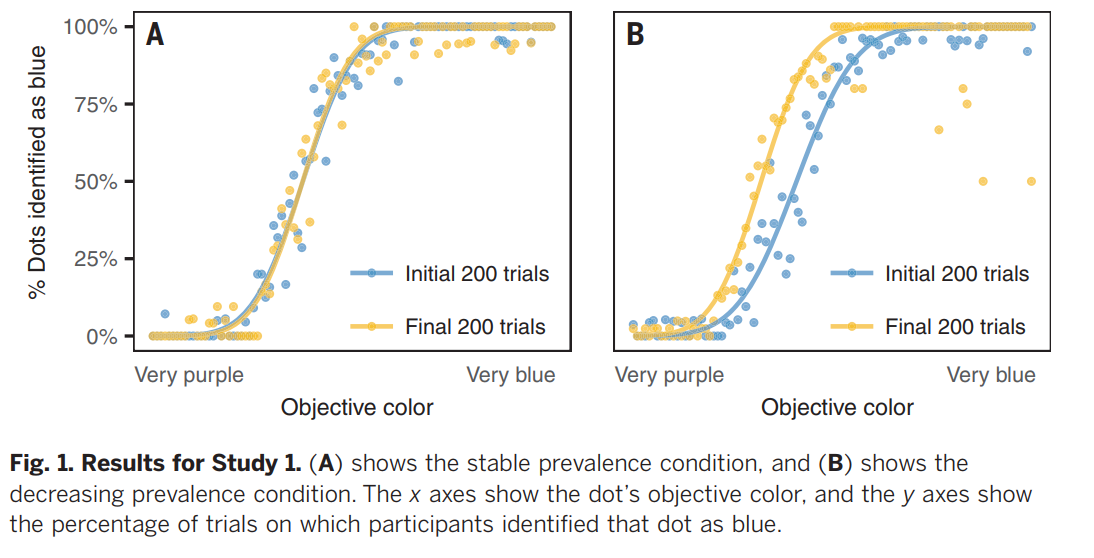
Clever. But so what? What the authors then go on to show, however, is that the same phenomena happens with complex concepts for which we arguably would like to have a consistent and constant identification.
Are people susceptible to prevalence-induced concept change? To answer this question, we showed participants in seven studies a series of stimuli and asked them to determine whether each stimulus was or was not an instance of a concept. The concepts ranged from simple (“Is this dot blue?”) to complex (“Is this research proposal ethical?”). After participants did this for a while, we changed the prevalence of the concept’s instances and then measured whether the concept had expanded—that is, whether it had come to include instances that it had previously excluded.
…When blue dots became rare, purple dots began to look blue; when threatening faces became rare, neutral faces began to appear threatening; and when unethical research proposals became rare, ambiguous research proposals began to seem unethical. This happened even when the change in the prevalence of instances was abrupt, even when participants were explicitly told that the prevalence of instances would change, and even when participants were instructed and paid to ignore these changes.
Assuming the result replicates (the authors have 7 studies which appear to me to be independent, although each study is fairly small in size (20-100) and drawn from Harvard undergrads) it has many implications.
…in 1960, Webster’s dictionary defined “aggression” as “an unprovoked attack or invasion,” but today that concept can include behaviors such as making insufficient eye contact or asking people where they are from. Many other concepts, such as abuse, bullying, mental disorder, trauma, addiction, and prejudice, have expanded of late as well.
… Many organizations and institutions are dedicated to identifying and reducing the prevalence of social problems, from unethical research to unwar
ranted aggressions. But our studies suggest that even well-meaning agents may sometimes fail to recognize the success of their own efforts, simply because they view each new instance in the decreasingly problematic context that they themselves have brought about. Although modern societies have made extraordinary progress in solving a wide range of social problems, from poverty and illiteracy to violence and infant mortality, the majority of people believe that the world is getting worse. The fact that concepts grow larger when their instances grow smaller may be one source of that pessimism.
The paper also gives us a way of thinking more clearly about shifts in the Overton window. When strong sexism declines, for example, the Overton window shrinks on one end and expands on the other so that what was once not considered sexism at all (e.g. “men and women have different preferences which might explain job choice“) now becomes violently sexist.
Nicholas Christakis and the fearless Gabriel Rossman point out on twitter (see at right) that it works the other way as well. Namely, the presence of extremes can help others near the middle by widening the set of issues that can be discussed or studied without fear of opprobrium.
But why shouldn’t our standards change over time? Most of the people in the 1850s who thought slavery was an abomination would have rejected the idea of inter-racial marriage. Wife beating wasn’t considered a violent crime in just the very recent past. What racism and sexism mean has changed over time. Are these examples of concept creep or progress? I’d argue progress but the blue dot experiment of Levari et al. suggests that if even objective concepts morph under prevalence inducement then subjective concepts surely will. The issue then is not to prevent progress but to recognize it and not be fooled into thinking that progress hasn’t been made just because our identifications have changed.
The resurgence of China pessimism
Agree or not, it has returned. Here is David G. Landry from Foreign Policy:
A recent Foreign Policy piece points out that individuals and firms have made up an increasingly large share of China’s total foreign asset purchases in recent years, from 12 percent in 2011 to nearly 40 percent in 2017, as the People’s Bank of China’s share of total foreign direct investment shrank. It turns out that these new investors are poor asset judges. As their share of China’s portfolio grew, its aggregate returns dwindled. In 2016, the total return on Chinese foreign investment was 0.4 percent, which is dramatically lower than the 4 percent earned by foreign reserves.
…fixed-asset investment — a core driver of Chinese growth that includes spending on new buildings, machinery and infrastructure — grew at its slowest annual pace since at least 1995 through the first five months of this year. Retail sales, an indicator of consumer demand, also increased at their slowest pace since 2003. China’s currency, meanwhile, hit a six-month low against the dollar this week, while the Shanghai Composite index, the country’s key stock market index, dropped 10 per cent in June. Last weekend, the People’s Bank of China cut the reserve requirement ratio, the amount of cash that banks must hold in reserve at the central bank, freeing up Rmb700bn ($106bn) for new lending and investment. The PBoC insists that monetary policy remains “prudent” but the cut to the RRR is the latest in a series of “ subtle easing” moves in recent months, including other forms of cash injection into the financial system.
…much of the recent slowdown is perceived to be the result of Beijing’s policies. A sharp fall in infrastructure spending by local governments led the drop in fixed-asset investment, as the central government reined in runaway borrowing by local governments.
One way or another, you will be hearing more about this.
The Ex-Post Dead Are Not Ex-Ante Hopeless
It’s well known that a large faction of medical spending occurs in the last 12 months of life but does this mean that the money spent was fruitless? Be careful as there is a big selection effect–we don’t see the people we spent money on who didn’t die. A new paper in Science by Einav, Finkelstein, Mullainathan and Obermeyer finds that most spending is not on people who are predicted to die within the next 12 months.
That one-quarter of Medicare spending in the United States occurs in the last year of life is commonly interpreted as waste. But this interpretation presumes knowledge of who will die and when. Here we analyze how spending is distributed by predicted mortality, based on a machine-learning model of annual mortality risk built using Medicare claims. Death is highly unpredictable. Less than 5% of spending is accounted for by individuals with predicted mortality above 50%. The simple fact that we spend more on the sick—both on those who recover and those who die—accounts for 30 to 50% of the concentration of spending on the dead. Our results suggest that spending on the ex post dead does not necessarily mean that we spend on the ex ante “hopeless.
…”Even if we zoom in further on the subsample of individuals who enter the hospital with metastatic cancer…we find that only 12% of decedents have an annual predicted mortality of more than 80%.
Thus, we aren’t spending on people for whom there is no hope but it doesn’t follow that it’s the spending that creates the hope. What we really want to know is who will live or die conditional on the spending. And to that issue this paper does not speak.