Category: Economics
VIX and the Fed rate hike
This is what it looks like when expected volatility plummets:
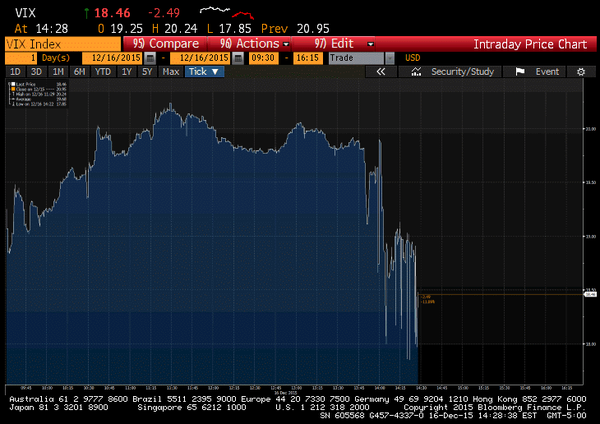
Gold is up a good deal too, but mostly the world proceeds as if not so much has happened. Emerging market currencies reacted strongly.
By the way, Lemin Wu remains highly undervalued
Lemin is recently out of UC Berkeley, and I have heard that he is on the American market right now.
Here is Lemin’s paper on the Malthusian trap (pdf), one of the most interesting papers of the last few years. The key point is that some kinds of production drive down living standards and other kinds of production do not, therefore enriching and disaggregating Malthus’s theory, some might say overturning it. Here is one excerpt:
It follows that the Romans were rich not because technological progress temporarily exceeded population growth—as Malthusianists claim—but because Rome had a business-friendly legal system and an active market economy. Well-functioning courts and market-places boost industry more than they boost agriculture. Thus biasing production structure to luxury, they raised the average living standards of the whole society. Conversely, the Agricultural Revolution left an unfortunate legacy: the hunter-and-gatherer-turned peasants failed to achieve the level of leisure and nutrition their ancestors once enjoyed (Diamond, 1987). Growth was immiserizing because agriculture biased production structure to subsistence. The same tragedy recurred when potato dominated the Irish diet in the late 18th century.
Lemin then introduces cross-societal migration into the model and shows that “…A tiny bit of bias in migration (say, if people are extremely reluctant to move and slow to learn) can still suppress a strong tendency of growth.” The Industrial Revolutipn did not come to Song China because there were insufficient mechanisms for exclusion.
Here is Lemin Wu’s home page. Here are some of his other papers and ideas.
Very good New York Times sentences Arlington fact of the day
“Consider Arlington, Va., our best guess for where you might be reading this article.”
That is from an excellent NYT piece on health care and prices. The very interesting original research is here (pdf), main point is that where (properly adjusted) Medicare spending is high is surprisingly uncorrelated with where private health care spending is high. Furthermore policy may have been encouraging too many hospital mergers.
Here is Kevin Drum summarizing the study’s results on the importance of competition.
The new Cato eBook on understanding the growth slowdown
Brink Lindsey writes to me:
The book is an outgrowth of last year’s Cato conference on the future of U.S. economic growth. Chapters explore the U.S. economy’s long-term growth outlook, debate the future of innovation, and examine whether economic dynamism is in decline.
FYI, here are links to sites currently offering the ebook for sale and download.
Cato Institute: https://store.cato.org/book/understanding-growth-slowdown
iTunes: https://itunes.apple.com/us/book/understanding-growth-slowdown/id1067327743?mt=11
Google Play: https://play.google.com/store/books/details/Brink_Lindsey_Understanding_the_Growth_Slowdown?id=XBQuCwAAQBAJ&hl=en
Alex T. is in this book…
The FDA and Magical Thinking
Vox had a piece yesterday on the Cruz-Lee proposal to make it easier for U.S. patients to access drugs and devices already approved in other developed countries. The Vox piece had some howlers. Most notably this:
“There’s no evidence the FDA blocks innovation or makes innovation harder or makes it more costly,” said Kesselheim.
Frankly, that would be laughable were it not coming from a professor of medicine at Harvard Medical School. It costs well over a billion dollars to get the average new drug approved and much of that cost comes from FDA required clinical trials. Longer and larger clinical trials mean that the drugs that are eventually approved are safer. But longer trials also mean that good drugs are delayed. And the more expensive it is to produce new drugs the fewer new drugs will be produced. In short, longer and larger trials mean drug delay and drug loss.
We live in a world of tradeoffs. Let’s debate the tradeoffs. But let’s not engage in magical thinking where there are no tradeoffs and “no evidence” that the FDA makes drug development more costly.
A more subtle error was committed by the author who writes:
But it’s not clear that this legislation can solve the biggest problem here — the lack of promising treatments in the pipeline. In other words, a faster approval process can’t fix a dearth of innovation from labs themselves.
Many factors go into drug development that are outside the FDA’s purview. Nevertheless, faster drug approval can and does increase innovation. Approving drugs more quickly is equivalent to a decrease in the costs of research and development. Time is money. Reducing the cost of development increases the incentive to develop new drugs.
The Prescription Drug User Fee Act, for example, reduced drug approval times by about 10 months. Philipson et al. calculate that:
…the more rapid access of drugs on the market enabled by PDUFA saved the equivalent of 140,000 to 310,000 life years.
(PDUFA does not appear to have materially affected safety but Philipson et al. calculate that even under a worst case scenario the benefits of PDUFDA far exceeded the costs).
Moreover, Vernon et al. find that the reduction in approval time from PDUFA increased new drug development:
Controlling for other factors such as pharmaceutical profitability and cash flows, we estimate that a 10% decrease (increase) in FDA approval times leads to an increase (decrease) in R&D spending from between 1.4% and 2.0%. Combining this estimate with recent research on the link between PDUFA and FDA approval times…we calculate PDUFA may have incentivized an additional $10.8 billion to $15.4 billion in pharmaceutical R&D. Recent economic research has shown that the social rate of return on pharmaceutical R&D is very high; therefore, the social benefits of PDUFA (over and above the benefits of more rapid consumer access) are likely to be substantial.
Finally, return to the issue of reciprocity. Many of the critics of reciprocity respond with simple appeals to nationalism. We are the best! Rah, rah, rah! But if the critics were German or French they would argue that the EMA is superior to the FDA. Indeed, when I raise the issue of reciprocity with Europeans they respond in exactly the same way as Americans. How could anyone suggest that the EMA automatically approve drugs approved by the FDA! The horror.
The argument for reciprocity, however, isn’t that the FDA is uniquely bad or always worse than the EMA or vice-versa. The argument is that it’s wasteful to duplicate the lengthy approval process and that both agencies sometimes make mistakes. As a result, it’s simple common sense to let Americans avail themselves of drugs and devices approved in other developed countries.
Is America’s middle class diminishing?
I’ve been reading through the new Pew report (pdf) on this question. I found these to be the two most interesting passages:
As the middle-income population hovers near minority status, the population of upper-income adults is growing more rapidly than the population of lower-income adults. From 1971 to 2015, the number of adults in upper-income households increased from 18.4 million to 51 million, a gain of 177%. During the same period, the number of adults in lower -income households increased from 33.2 million to 70.3 million, a gain of 112%.
I would say America is developing its top twenty percent rather nicely. The future refrain will have to be: “We are the eighty percent!”, or something like that. Then there is this:
The biggest winners since 1971 are people 65 and older. This age group was the only one that hada smaller share in the lower-income tier in 2015 than in 1971. Not coincidentally, the poverty rate among people 65 and older fell from 24.6% in 1970 to 10% in 2014. Evidence shows that rising Social Security benefits have played a key role in improving the economic status of older adults. The youngest adults, ages 18 to 29, are among the notable losers with a significant rise in their share in the lower-income tiers.
That part augurs not so well for our future, given a certain degree of persistence of earnings.
I was part of an NPR On Point discussion of the study.
In which English counties was the Industrial Revolution most strongly rooted?
There is a new and very interesting paper by Morgan Kelly, Joel Mokyr, and Cormac Ó Gráda on this topic, here is the abstract:
We analyze factors explaining the very different patterns of industrialization across the 42 counties of England between 1760 and 1830. Against the widespread view that high wages and cheap coal drove industrialization, we find that industrialization was restricted to low wage areas, while energy availability (coal or water) had little impact Instead we find that industrialization can largely be explained by two factors related to the human capability of the labour force. Instead of being composed of landless labourers, successful industrializers had large numbers of small farms, which are associated with better nutrition and height. Secondly, industrializing counties had a high density of population relative to agricultural land, indicating extensive rural industrial activity: counties that were already reliant on small scale industry, with the technical and entrepreneurial skills this generated, experienced the strongest industrial growth. Looking at 1830s France we find that the strongest predictor of industrialization again is quality of workers shown by height of the population, although market access and availability of water power were also important.
Garett Jones, telephone! Here is a related paper on human capital and industrialization (pdf), in that study it is the elites who matter. And here is a new Eric Chaney paper (pdf) on the decline of Islamic science and the role of political elites.
I also found this summary bit from the first paper interesting: “…the early Industrial Revolution was less about the sudden appearance of radically new technologies than about improving fairly familiar technologies to the stage where they became commercially viable…”
Senators Cruz and Lee Introduce Reciprocity Bill
Senators Ted Cruz (R-Texas) and Mike Lee (R-Utah) have just introduced a bill that would implement an idea that I have long championed, making drugs, devices and biologics that are approved in other developed countries also approved for sale in the United States. Highlights of the “Reciprocity Ensures Streamlined Use of Lifesaving Treatments Act (S. 2388), or the RESULT Act,” include:
- Amending the Food, Drug and Cosmetic Act to allow for reciprocal approval of drugs, devices and biologics from foreign sponsors in certain trusted, developed countries including EU member countries, Israel, Australia, Canada and Japan.
- Encouraging the FDA to expeditiously review life-saving drug and device applications, this legislation would provide the FDA with a 30-day window to approve or deny a sponsor’s application….
- The HHS Secretary is instructed to approve a drug, device or biologic if the FDA confirms the product is:
- Lawfully approved for sale in one of the listed countries;
- Not a banned device by current FDA standards;
- There is a public health or unmet medical need for the product.
- If a promising application for a life-saving drug is declined Congress is granted the authority to disapprove of a denied application and override an FDA decision with a majority vote via a joint resolution.
In explaining why he introduced the bill Senator Cruz argued:
We continue to lose far too many of our loved ones to the “invisible graveyard,” as economist Alex Tabarrok has described: lives that could have been saved but for a bureaucratic barrier that rejects medical cures and innovation…The bill I am introducing takes the first step to reverse this trend. It provides for reciprocal drug approval, so that cures and medical devices that are already approved in other countries can more expeditiously come to the U.S.
Do compensating differentials play a key role in boosting inequality?
Isaac Sorkin is a job candidate from the University of Michigan, and he has some fascinating new research on that question. Here is the abstract:
Firms account for a substantial share of earnings inequality. Although the standard explanation for why is that search frictions support an equilibrium with rents, this paper finds that compensating diff erentials are at least as important. To reach this finding, this paper develops a structural search model and estimates it on U.S. administrative data with 1.5 million firms and 100 million workers. The model analyzes the revealed preference information contained in how workers move between firms. Compensating di fferentials are revealed when workers systematically move to lower-paying fi rms, while rents are revealed when workers systematically move to higher-paying firms. With the number of parameters proportional to the number of firms (1.5 million), standard estimation approaches are infeasible. The paper develops an estimation approach that is feasible for data on this scale. The approach uses tools from numerical linear algebra to measure central tendency of worker flows, which is closely related to the ranking of firms revealed by workers’ choices.
The paper is here.
Here is Adam Ozimek on the research. I would put it this way: very often when workers switch jobs, they take a pay cut, voluntarily, in return for better amenities. In this regard “true inequality” is lower than measured income inequality would suggest.
See also Isaac’s paper on the long-run effects of the minimum wage.
China’s workforce could rise rather than fall
That is the subject of a new FT article by Steve Johnson. I’ve already covered this on MR, but here is a recap of some of Johnson’s points:
1. Official pension ages in urban areas are 50 for blue-collar women, 55 for white-collar women and 60 for men. Those could be raised by the government thereby boosting the labor force. For instance, in terms of actual practice, at age 60 only 55 of urban Chinese men are still in the labor force, and just one-third of urban Chinese women are still in the labor force.
2. Chinese pension policy penalizes late retirement and this easily could be changed.
As Johnson writes: “…if China adopted measures to retain older workers in the labor force, its working population would barely fall at all until at least the mid-2030s.”
With more women working, China in 2040 might have a labor force as large as it has today. If the retirement issue and the gender issue are both solved, China’s labor force in 2040 likely will be 10 percent higher than it is today.
So the common meme of “the Chinese labor force is about to start shrinking” doesn’t really have to be true. The Chinese economy has many problems, but I think this one is overrated. And we haven’t even talked yet about possible productivity increases.
How to visit Singapore
Two different people have asked me this question this week, so I thought I would write out my answer. My approach is slightly unorthodox, but here goes:
1. Go to the top of Marina Bay Sands hotel and get a view of the skyline, the harbor, and the Straits. Watch the ships queuing. This is one of my favorite views in the whole world. Most of all I am struck by the contrast between what Singapore has achieved so quickly and also its continuing ultimate vulnerability; the view captures both of those. If you can afford it, stay in the hotel and swim in the Infinity Pool. That alone justifies dragging your body all the way to Singapore.
2. Organize the rest of your trip around food. For Malay food, visit the hawker centre at Geylang Serai Night Market. For Indian food, go to the hawker centre at the entrance to Little India, and walk around the adjacent shopping bazaar as well. For Singaporean food, there are many good choices, depending on your location. The optimal time to arrive is by 10:30, before most of the queues start. Ask cabbies for the best chili and pepper crab.
3. Eat at David Thompson’s Thai restaurant, in the mall next to Marina Bay Sands.
4. Once it is dark, and edging toward 9 p.m., walk around the Merlion area and the bridge, where the city comes to life.
5. Spend the rest of your time seeking out “retro Singapore” as much as possible. Haw Par Villa is one place to start, but there are multiple substitutes, including the hawker centres away from downtown and their special dishes.
6. The Asian Civilizations Museum is by far the best museum in town. The zoo and the bird park are first-rate.
7. Much as Singapore calls itself a “city-state” I think of it as a “suburb-state,” unlike Hong Kong which is a true city. I consider this high praise, but Singaporeans often are slightly insulted when I put it this way. Your mileage may vary, but I say enjoy it as you would a suburb.
8. Talk to as many Singaporean civil servants as you can.
9. Take a day trip by cab or bus into Johor Bahru, in neighboring Malaysia, a thirty minute trip if there are no delays. The food there is even better and you will learn some political science. Read this book for background on both countries. Read Lee Kuan Yew.
Here is my earlier post “Why Singapore is special.” In a nutshell, it’s one of the world’s greatest trips, safe and easy to deal with too.
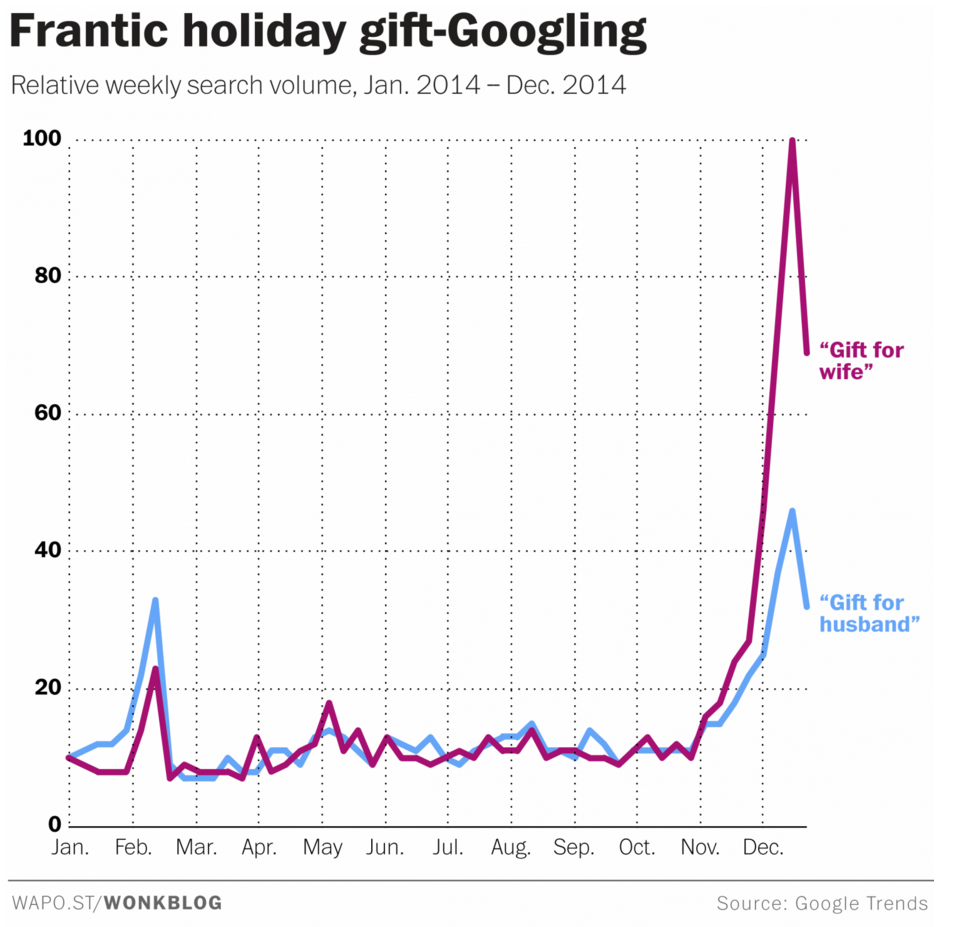
Last Minute Gift Shopping by Gender of Spouse
A timely chart from Christopher Ingraham at Wonkblog. Christopher concludes that compared to wives, husbands wait till the last minute to gift shop for their spouse. A plausible interpretation, although do note that it’s not the case that women are searching earlier just less.
Economists don’t know what they are talking about
I am sorry, I would not have written that post title a few months ago, as it is not in general my style. But I am disheartened by the recent Booth poll of economists, where the weight of opinion suggests that the Fed should raise rates this December. Only seventeen percent say “uncertain,” when in my view that is obviously the correct answer. I won’t myself say “don’t raise rates,” but there are enough good arguments for that view (see Krugman for instance) that it deserves more than 19% support. In the space for comments, there was not a lot of talk about how outlining the broader path for monetary policy was a better and more important question.
This same group, in September, gave a lot of support to the idea of a $15 national minimum wage, a policy change which Alan Krueger himself rejects. How many of those supportive economists were primed to first think of typical manufacturing wages in Mississippi?
You people on that panel, you are all better economists than I am. Except when you are allowed to vote.
But quite seriously, my opinion of the professional consensus — on topics outside an individual’s research specialty — really has gone down as a result of these polls. And, not to put too fine a gloss on it, but my opinion of myself has gone up. Why should I not just come out and say it?
China in two stories
Here is one, by Adam Minter:
According to data released this week by the China Association of Automobile Manufacturers, sales of electric cars are poised to exceed those in the U.S. for the first time ever. Already, they’ve grown 290 percent year-on-year to 171,145 vehicles. They’re expected to reach 220,000 to 250,000 for the year, whereas the U.S. market is predicted to top out at around 180,000 cars.
What’s fueling the mainland’s electric-car surge? As with so many other things in China, cost is the main factor.
Here is the other, from Vanessa Piao at NYT’s Sinosphere blog:
Neither story, taken alone, leaves you with the right impression.
Arrived in my email pile
Concrete Economics: The Hamilton Approach to Economic Growth and Policy
By Stephen S. Cohen and J. Bradford DeLong, it is due out in February.