Category: Education
Does economic freedom lead to greater tolerance?
Mostly, yes, although with some caveats (the headline of the piece doesn’t exactly capture this). That is the topic of my latest column for The Upshot. Here is one excerpt:
Niclas Berggren…and Therese Nilsson…have produced a fascinating series of papers on these questions, sometimes writing singly, sometimes together or with the collaboration of a variety of co-authors. Their most notable study is perhaps a paper they wrote together, “Does Economic Freedom Foster Tolerance?”
…One of their most striking findings is that societies characterized by greater economic freedom and greater wealth do indeed exhibit greater tolerance toward gay people, a tendency suggesting that gay rights, including gay marriage, will spread globally as national economies liberalize and develop.
Some metrics of economic freedom count more than others:
This greater tolerance is strongly associated only with certain features of what has often been defined as economic freedom. For example, a smaller government, measured as a share of gross domestic product, is often included in so-called economic freedom indexes as an objective measure of freedom. But the data show that smaller government has a slight negative correlation with tolerance of gay people by heterosexuals. One implication is that many conservatives may be overly preoccupied with the size of government as a measure of how free societies actually are.
On the other hand, the data shows that when a society has impressive scores on property rights security and low inflation — two other components of economic freedom indexes — these characteristics are strongly and positively correlated with tolerance of gays. It’s possible that low inflation, and the behavior of a central bank, are stand-ins for the general trustworthiness of a nation’s government and broader institutions, and such trustworthiness helps foster tolerance.
The results for race are not nearly as strong, namely both freedom and prosperity are less clearly associated with higher levels of racial tolerance, although the correlation is still a positive one.
And there is this:
We are often told that education is an important remedy, yet it does not register as a meaningful factor in the cross-country data in this paper. Higher levels of education simply have not correlated significantly with higher levels of tolerance across countries.
Do read the whole thing.
The Supply Curve
Here is our video introducing the supply curve from our principles of micro-economics course at MRUniversity. Supply, Demand and Equilibrium are available now. Next week, elasticity!
What we really need to know about QE
From the letters page of the FT:
Sir, Whether the European Central Bank chooses to embark on a programme of sovereign QE (or quantitative easing, as it used to be known) is of little day-to-day interest to most citizens of the EU. Whether the compilers of dictionaries accept that QE is now a word in its own right — as opposed to an abbreviation — is of far more relevance to us scrabble players. Using a Q without needing a free U it would rapidly be up there with Qi (the Chinese word for life force) as one of the most useful words in the lexicon.
Richard Kemmish
Surbiton, Surrey, UK
I would think that for the foreseeable future QE would be ruled an abbreviation, not a word, although enough years of macroeconomic misery eventually could flip this the other way.
Here are other “Q without U” words which are eligible for use in Scrabble.
John Bayley has passed away
SNB tweets to ponder
It’s funny how faculty who work at universities with large endowments can’t understand the decisions of the Swiss National Bank…
That one is from me. In this kind of status-driven, bureaucratic environment, the incentive is to extend your cushion, not run it down and have to print up new money to replenish it, thereby receiving egg on your face and appearing dependent and outside the rules of the game. You’ll do better understanding the SNB by reading Pierre Bourdieu on social capital than portfolio theory or the literature on optimal seigniorage.
I will note that university endowments are somewhat of a puzzle too (pdf) — for instance why don’t schools spend them down more, as a kind of crude political business cycle theory might suggest?
(On the other hand, just try dropping your items into a Swiss recycling bin on a Sunday.)
There is at least one big difference here: the SNB doesn’t want a balance sheet which is as large as possible, because that means both assets and liabilities. Colleges and universities are far more likely to wish to maximize their endowments, which do not (one hopes) come with offsetting liabilities. The “endowment” of a central bank has more to do with political chits, favors, and public impressions, backed by extreme solvency but not too big a target either.
Paul Krugman makes some good and interesting points about the comparison with Hong Kong; in my view influence capital in Hong Kong has been (ultimately) determined externally for a very long time, first Britain now China. That gives the territory some special feasibility properties for a wide variety of issues. Krugman is falling into a kind of sophisticated “public choice” mistake that is more frequently committed by libertarians.
In none of these cases am I suggesting that the current incentives are optimal from a social point of view. And here is an earlier post on central banks and capital. It is not that a partially privately-owned, cantonally owned SNB is maximizing raw seigniorage, a view which has come in for some rebuttal as of late. Rather the partial private ownership helps account for what kind of legitimacy needs to be produced and what kinds of rules that legitimacy requires.
C’mon people, read your Gramsci!
The commodification and litigation of niños
Here is the latest:
It was not what Derek Nash expected to find in his 5-year-old’s school bag: A bill demanding a “no-show fee” for another child’s birthday party.
Nash said the bill from another parent sought 15.95 pounds ($24.00) because his son Alex had not attended the party at a ski center in Plymouth, southwest England.
Nash told the BBC on Monday he had initially accepted the party invitation, but later realized Alex was supposed to visit his grandparents that day. He said he did not have contact details to let the other family know.
The birthday boy’s mother, Julie Lawrence, told the BBC that her contact details were on the party invitation.
Nash says Lawrence has threatened him with small claims court but he has no plans so far to pay.
The link is here. And here is yet another account. I thank Drew for the pointer.
Which economic theories are especially widely misunderstood?
A lot of them are, actually. The efficient markets hypothesis might be one, as I’m not sure I understand it myself! (Would the existence of just one investor “beating the market” disprove it? Probably not, but then how many are needed? How many of them have to beat the market “for the right reasons”? And for how long? How many dimensions exactly does this problem consist of?)
But today I’ll nominate Rudi Dornbusch’s exchange rate overshooting model. When I see it cited, and I mean by professional economists or economics writers, more than half the time people seem to get it wrong. They use it to refer to all sorts of back and forth exchange rate movements, whereas the Dornbusch logic requires that the overshooting be in line with covered interest parity and thus the subsequent adjustment of the exchange rate is both expected and predicted by interest rate differentials in advance. That’s hardly ever how it happens.
What else? How about real balance effects and price level determination, as analyzed by Patinkin, Pesek and Saving, Harry Johnson, and others in the 1960s and 70s? Most people get the right answer, but if you push them on it they fall apart, quivering and begging for mercy. “Hey bud, that explanation sounded nice! How about applying it to the difference between inside and outside money? How does that shake out?” Talk about microaggression.
Most economists do pretty well stating the Modigliani-Miller theorem. They do less well when you ask them how it relates to the infamous “spanning condition,” which indeed it does.
Paul Krugman has remarked a few times on how many economists seem to get Ricardian Equivalence wrong.
At least half the time, in casual conversation, economists seem to forget that for a normal indirect utility function consumers are not risk-averse in terms of prices.
How about a Fisher effect question:? “If people expect prices to go up in the future, why don’t a lot of those prices go up right now?” Thereby removing much of the inflation premium from the nominal interest rate. Oops.
Or try this one: “Why is the interest rate a market price which can be expected to rise (fall) in the future, without rising (falling) now in anticipation of the future change? After all, liquid cash doesn’t have much of a storage cost.” Unpack all of that in two sentences or less and set it straight. Deadly.
Most economists who don’t do finance don’t know much finance.
Can one economist in forty properly define the “independence of irrelevant alternatives” axiom behind the Arrow Impossibility Theorem, taking care not to confuse intra- and inter-profile versions of the theorem, the latter of course being canonical? Me thinketh not. Wikipedia gets pretty close but is not fully clear. The typical mistake is to think it is about “taking something off the menu,” and a resulting invariance of choice, when in fact the pairwise ordering alone should contain all of the relevant information. Ah, but how exactly are those two conditions related?
How many people can define “rational expectations” correctly? Is it: a) the market forecast is right on average, b) individual errors are serially uncorrelated over time, c) market forecast errors are serially uncorrelated over time, d) individual errors are normally distributed, symmetric around the mean, or e) individuals know the “correct model” of the economy (with what specificity? That of God in the Quran?). Maybe all of the above? Some of the above? Let’s put this one on the SAT.
Time consistency vs. subgame perfection anyone?
Sometimes economists confuse “the law of large numbers” with the potential risk benefits from subdivision of a gamble into many smaller parts. Arrow himself made this mistake at least once.
How many people can get all of those right? And how many other common but frequently misunderstood propositions in economics can you think of? Nothing partisan or policy-based please, and please leave macroeconomics aside, let’s stick to analytics for this exercise. I’ve already covered the Heckscher-Ohlin theorem.
I am sure this post contains several errors.
Henry Manne has passed away at age 86
He was one of the original builders of the GMU Law School, and an important founding scholar of law and economics, very sad news of course.
Addendum: David Henderson comments.
No, A Majority of US Public School Students are Not In Poverty
In widely reported article the Washington Post says a Majority of U.S. public school students are in poverty. The article cites the Southern Education Foundation:
The Southern Education Foundation reports that 51 percent of students in pre-kindergarten through 12th grade in the 2012-2013 school year were eligible for the federal program that provides free and reduced-price lunches.
Eligibility for free and reduced-price lunches, however, depends on eligibility rules and not just income levels let alone poverty rates. The New York Times article on the study is much better:
Children who are eligible for such lunches do not necessarily live in poverty. Subsidized lunches are available to children from families that earn up to $43,568, for a family of four, which is about 185 percent of the federal poverty level.
The number of children eligible for subsidized lunches has probably increased in part because the federal Agriculture Department now allows schools with a majority of low-income students to offer free lunches to all students, regardless of whether they qualify on an individual basis or not.
Frankly I suspect that this study was intended to confuse the media by conflating “low-income” with “below the poverty line”. Indeed, why did this study grab headlines except for the greater than 50% statistic? It is very easy to find official numbers of the number of students in poverty according to the federal poverty standard. Here is what the National Center for Education Statistics says about school-age children and poverty (most recent data):
In 2012, approximately 21 percent of school-age children in the United States were in families living in poverty.
The number of school-age children living in poverty today is relatively high and not surprisingly did increase with the 2008 recession and its aftermath (green line in figure below – the numbers here differ slightly from NCES but the time line is longer). But recent numbers do not look like especially remarkable compared to the history.
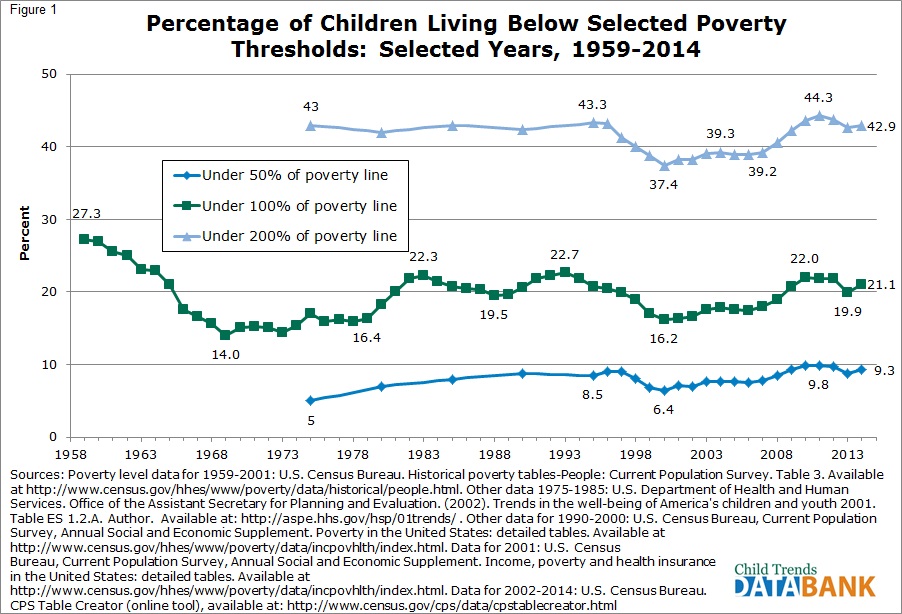
It’s certainly worthwhile discussing why poverty has increased. The economy is one possible reason as are issues to do with family formation and marriage rates. Another possibility is immigration. A higher poverty rate caused by the immigration of more low-income children is compatible with everyone becoming better off over time and not necessarily a bad thing. Those are just a few possible topics worthy of investigation. I don’t claim that any of them are correct.
I do claim, however, that we won’t get very far understanding the issue by shifting definitions and muddying the waters with misleading but attention grabbing statistics.
When foundations and behavioral economists write soap operas
Brendan Greeley has the scoop:
Before she won an Academy Award in 2014 for her role in 12 Years a Slave, Lupita Nyong’o starred in two seasons of the TV drama Shuga. Set first in Nairobi and then in Lagos, Shuga features young, attractive people who sleep with each other. It’s wildly popular and shown on broadcast channels that reach 500 million people, mostly in Africa.
“I would say that it’s an African version of Gossip Girl, but with sexual-health messages weaved through,” says Georgia Arnold, executive director of MTV’s Staying Alive Foundation, which produces the show with the twin goals of promoting safer sex and removing the taboo around HIV. Shuga isn’t a commercial project; it’s sponsored by donors including the Bill & Melinda Gates Foundation. Now in its fourth season, the show recently added a new member to its production team: Eliana La Ferrara, a professor at the University of Bocconi in Italy who specializes in a mix of behavioral and development economics. La Ferrara wasn’t hired for her writing talent. MTV and its donors want to apply a more rigorous approach to make sure Shuga’s message actually creates change where it airs.
The article has numerous other points of interest.
Scott Sumner’s new career
…involves working with me! Here is Scott:
I have spent the past 6 years trying to do two jobs at once, my teaching job at Bentley and lots of blogging/writing/speaking on monetary reform. I am pleased to announce that from now on I’ll be able to focus on monetary policy. Through a very generous donation of Kenneth Duda (a Silicon Valley entrepreneur who is supportive of market monetarism), the Mercatus Center has created a new program on monetary policy, and appointed me as director. I’m sure people will have some questions about this, so let me provide a bit more detail.
A few months back I began raising money to set up a NGDP futures market. At the time, Ken Duda offered to support the project with a large donation. He also expressed an interest in supporting my NGDP targeting in any way he could. Initially he suggested setting up a foundation to promote monetary reform, and having me direct the foundation. I thought it might make more sense to work within an institution such as a university or a think tank, where I could get managerial support. We eventually decided to embed the project within the Mercatus Center.
There is more at the link. Of course at George Mason and Mercatus we are all very excited about this.
Kevin Drum on Charter Schools
 Kevin Drum reports two factlets.
First: Neerav Kingsland says that SAT scores of new teachers are rising and that most of them are staying in teaching for at least five years. He comments: “If I was going to bet on whether American education will improver, flatline, or get worse — I would look very hard at the academic performance of teachers entering the profession, as well as how long these better qualified teachers stayed in the classroom. The aforementioned data makes me more bullish on American education.”
Second: Adam Ozimek says we’re selling charter schools short when we say that on average they do about as well as public schools. That’s true, but there’s more to it:
I would like to propose a better conventional wisdom: “some charter schools appear to do very well, and on average charters do better at educating poor students and black students”. If the same evidence existed for some policy other than charter schools, I believe this would be the conventional wisdom.
….The charter sectors’ ability to do better for poor students and black students is important given that they disproportionately serve them….53% of charter students are in poverty compared 48% for public schools. Charters also serve more minority students than public schools: charters are 29% black, while public schools are 16%. So not only do they serve more poor students and black students, but for this group they relatively consistently outperform public schools.
How much do subsidies to community college attendance matter?
That is a new NBER Working Paper by Angrist, Autor, Hudson, and Pallais. Here is the sentence of interest for the recent community college initiative:
Awards offered to prospective community college students had little effect on college enrollment or the type of college attended.
Do note that some other kinds of awards appeared to be more effective, so this is not an anti-subsidy result per se. And here is a new Bulman and Hoxby paper on federal tax credits and the demand for higher education (not just community colleges):
We assess several explanations why the credits appear to have negligible causal effects.
Making these programs work is not so easy. Reihan Salam offers good points, so does Arnold Kling.
What is the rate of return on community college?
Here is a 2010 research paper (pdf) by Schenk and Matsuyama, and here is one sentence from the abstract:
Our results show returns are six percent for those completing a community college degree.
Other work shows that fewer than forty percent of those who start will finish with a degree-based reward and that number may be lower yet for the marginals who are not currently enrolled. Of course those who do not complete will waste some time and money along the way, although the learning may raise their productivity somewhat.
The overall return on additional subsidies to community college participation is therefore…?
The initial pointer is from @herdingbats.
MRU New Course: Principles of Microeconomics!
Our newest MRUniversity online course in economics is now starting, Principles of Microeconomics! Tyler and I have created what we think is our most engaging course yet — featuring high production quality videos filled with great examples to illustrate key concepts.
We’ll cover all of the important topics in microeconomics, such as competition, monopoly, price discrimination, externalities, public goods and more. There are practice questions along the way to test your knowledge, and don’t hesitate to post your questions on each video page.
Check out our video introducing the course and economics more generally. We begin with a great story about incentives!