Category: Education
The life of a Western economist in China
For most academics not in China, it is difficult for them to understand the level of scrutiny and monitoring we face on regular basis. Most professors have students assigned to monitor them and security officials approaching many people to report on our behavior. Our email is widely acknowledged, even by students, as being read. While there are some overt obvious forms of intimidation as I have detailed, much of it is also the “deal you can’t refuse” variety. There are no overt threats but the message is clear.
There is much more here, from Christopher Balding (pdf of his vita), worth the read.
Facebook is introducing more choices for gender identification
You don’t have to be just male or female on Facebook anymore. The social media giant is adding a customizable option with about 50 different terms people can use to identify their gender, as well as three preferred pronoun choices: him, her or them.
I’m all for this development, and I’ll note one extra thing: people who write on “the paradox of choice” are unlikely to ever use this as an example.
How does teaching work in Singapore?
Importantly, teachers also broadly share an authoritative vernacular or “folk pedagogy” that shapes understandings across the system regarding the nature of teaching and learning. These include that “teaching is talking and learning is listening”, authority is “hierarchical and bureaucratic”, assessment is “summative”, knowledge is “factual and procedural,” and classroom talk is teacher-dominated and “performative”.
Clearly, Singapore’s unique configuration of historical experience, instruction, institutional arrangements and cultural beliefs has produced an exceptionally effective and successful system. But its uniqueness also renders its portability limited.
And:
…teachers only make limited use of checking a student’s prior knowledge or communicating learning goals and achievement standards. In addition, while teachers monitor student learning and provide feedback and learning support to students, they largely do so in ways that focus on whether or not students know the right answer, rather than on their level of understanding.
The article, by David Hogan, is interesting throughout.
Are natural scientists smarter?
Social science professors at elite institutions are more likely to be religious and politically extreme than their counterparts in the natural sciences, argues a new paper in the Interdisciplinary Journal on Research and Religion. The reason? Natural scientists are just smarter, it says.
“There is sound evidence of a negative correlation between intelligence and religiosity and between intelligence and political extremism,” reads the paper, which examines existing data on academic scientists’ IQs by field, and on religious beliefs and political extremism among science professors in the U.S. and Britain. (An abstract of the paper is available here.) “Therefore the most probable reason behind elite social scientists being more religious than are elite physical scientists is that social scientists are less intelligent.”
The paper, written by Edward Dutton, adjunct professor of cultural anthropology at the University of Oulu, in Finland, and Richard Lynn, a retired professor of psychology from the University of Ulster, in Northern Ireland, who is known for his work on race and IQ, continues: “Intelligence is also a factor in interdisciplinary differences in political extremism, [with] physicists, who have high IQs, being among the least extreme and lower-IQ scholars being among the most extreme.”
There is more here, though I will note, without wishing to offend anyone in particular, that just about all of us are capable of being spectacularly dense, natural scientists included and these authors too. I believe these correlations, to the extent they are true, are better explained by sociological factors than by IQ. In the United States for instance various brands of humanities professors are in fact remarkably secular and I take this to be a stamp of a particular kind of affiliation to (and against) other social groups, not a sign of IQ in either direction. Note also that political extremism has to select against low IQ at some margins, if only because the extreme doctrine involves a complicated ideological apparatus of some sort rather than just “folk morality.”
By the way, here is Dutton’s earlier 2010 piece “Why did Jesus Go To Oxford University?” (pdf), which suggests the smarter and more creative students are more likely to have evangelical religious experience.
Free economics resources on-line
Here is a bleg from Austin Frakt:
I’m looking for free or cheap, but good, resources on economics, ones people might use for self-education. I’ve listed some about which I’m aware below, though I haven’t looked in detail at all of them, so the extent to which they—or that to which they link—are “good” is not fully known to me. I’m specifically not looking for health economics, and my interest is a bit tilted toward micro vs. macro, but not strongly. Nevertheless, if you’re aware of good stuff in the econ realm of any flavor, or have used any of the following, let me know what you think.
- Marginal Revolution University
- EconLib/EconTalk (My, now pretty old, review of EconTalk is here. I’ve also been aguest on the program.)
- Economics For Dummies (Don’t laugh. Every Dummies book I’ve read, including this one, is good.)
- Microeconoics Principles, by Rittenberg and Tregarthen (free, online text, which I have not examined closely)
- Jon Gruber’s Principles of Economics (MIT Open Courseware)
- WikiEducator’s list of free, online economics texts
- A list of microeconomics e-books
Though they can be high-cost if bought new, feel free to mention textbooks you like. Sometimes one can find them used or older editions for prices that someone intending to self-educate might pay. For what it’s worth, the texts I’ve read most closely are by Cowen and Tabarrok. I was impressed by their micro book and also enjoyed their macro one, some of my thoughts on which are here. Also, I’ve read and contributed to Health Economics, by Santerre and Neun. With that bias in mind, I recommend it.
Comments are open (time limited).
Here is a free economics resources page from Walter Antoniotti. Alex recommends this Preston McAfee text.
Does money make lottery winners more right-wing?
Lottery winners tend to switch towards support for a right-wing political party and to become less egalitarian, according to new research on UK data by Professor Andrew Oswald of the University of Warwick and Professor Nattavudh Powdthavee of the London School of Economic and the Melbourne Institute of Applied Economic and Social Research, University of Melbourne.
Their study, published as a new University of Warwick working paper under the title “Does Money Make People Right-Wing and Inegalitarian: A Longitudinal Study of Lottery Wins
”, shows that the larger the win, the more people tilt to the right. The study uses information on thousands of people and on lottery wins up to 200,000 pounds sterling. The authors say it is the first research of its kind.
The article is here, via Charles Klingman.
John Cochrane’s excellent essay on on-line education
You will find it here, it is one of the very best short pieces written on this topic. Excerpt:
A lot of mooc is, in fact, a modern textbook — because the twitter generation does not read. Forcing my campus students to watch the lecture videos and answer some simple quiz questions, covering the basic expository material, before coming to class — all checked and graded electronically — worked wonders to produce well prepared students and a brilliant level of discussion. Several students commented that the video lectures were better than the real thing, because they could stop and rewind as necessary. The “flipped classroom” model works.
Read the whole thing.
Are young Germans now spurning apprenticeships?
From the FT, Chris Bryant reports:
…in Germany, growing numbers of school leavers are choosing to go to university instead of starting an apprenticeship, triggering alarm that small businesses will struggle to fill skilled positions.
…The number of young Germans starting an apprenticeship declined 4 per cent last year to 530,700, the lowest level since German reunification in 1990. Some 33,500 apprenticeships went unfilled, the most since 1996.
…The reasons for the falling number of apprentices are hotly debated. Partly it reflects demographic trends: there are fewer young people around today than when the baby boomer generation came of age.
Studying for an undergraduate degree has become more attractive, in part because it no longer takes so long. German students can obtain a bachelor’s degree in just three years, instead of five years for the old-style diploma.
Almost 500,000 Germans began a university degree last year, compared with fewer than 360,000 a decade ago. Nevertheless, around one-quarter of German students break off their studies prematurely and do not graduate at all.
Meanwhile, trade unions accuse cost-conscious companies of offering an insufficient number of apprenticeships, and point to an increase last year in the number of young people who were unable to find one.
Jutta Rump, director of the Institute for Employment and Employability (IBE) in Ludwigshafen, said there had indeed been a “cannibalisation” of vocational training via increasing university attendance.
The Germans can’t quite seem to extend a model that everyone else is falling in love with and trying to copy…
For the pointer I thank Jim Olds.
Words of wisdom from Bryan Caplan
BC: Every economist who gives policy advise is implicitly relying on philosophy. Unfortunately, most economists want to rely on philosophy without really reflecting on it, so they’re usually just crude utilitarians (with a heavy bias toward the status quo and democratic fundamentalism).
And:
The Economics of Online Education
The Economist covers the economics of online education:
Alex Tabarrok…reckons the most salient feature of the online course is its rock-bottom marginal cost: teaching additional students is virtually free.
..as prices converge towards marginal cost, there will be little scope for undercutting the competition. Instead MOOCs are likely to compete on quality…Higher production costs are a small price to pay to attract much greater numbers of students. Such markets often evolve into winner-take-all, “superstar” competitions. The best courses attract the most customers and profit handsomely as a result. In this respect online education may more closely resemble information industries such as film-making than service industries such as hair-cutting.
The market for textbooks already fits this description. New textbooks are costly to write and design but can be reproduced fairly cheaply. Not surprisingly, only four introductory economic texts account for half of the American market, according to Mr Tabarrok. Indeed, says Tyler Cowen, a co-founder of Marginal Revolution University, it is possible that textbook publishers are better equipped than universities to develop MOOCs profitably.
I agree also with a point made by Caroline Hoxby:
Less selective institutions are close substitutes for MOOCs. Course content is often standardised and interaction with professors is limited in order to keep costs down.
…Elite institutions face very different circumstances, Ms Hoxby reckons. They operate like venture-capital firms, offering subsidised, labour-intensive education to highly qualified students. They aim to cultivate a sense of belonging and gratitude in students in order to recoup their investment decades later in the form of donations from successful alumni…. For top schools, the best bet may simply be to preserve their exclusivity.
The history of political economy workshop at Duke
Bruce Caldwell emails me:
The Center for the History of Political Economy at Duke University will be hosting another Summer Institute on the History of Economics this coming June. The program is designed for students in graduate programs in economics. Students will be competitively selected and successful applicants will receive a $2000 stipend for attending, plus free housing and reading materials. The deadline for applying is March 3. More information on the Summer Institute is available at our website,
http://hope.econ.duke.edu/I am writing to ask you if you would again promote our program on the Marginal Revolution blog. The 2012 institute, which was also aimed at grad students (the 2013 one was for faculty), attracted applicants from a host of universities, and we want to keep the momentum going. When we did follow up with previous participants to see how they had found out about the institute, a significant majority of them said that it was from reading about it on a blog.
Very good Ezra Klein profile
You can read it here, by Benjamin Wallace, excerpt:
One evening last January, I sat with Klein at the MSNBC studio near American University in Washington, D.C., as he was getting ready to guest-host The Last Word With Lawrence O’Donnell. It was clearly part of an ongoing audition for his own show. But even though Klein has a pleasant TV persona, you could see the tension between his desire to be good at hosting and the sense that it wasn’t the most comfortable fit. When a producer suggested that Klein ask Barney Frank about supposed anti-gay remarks made by Chuck Hagel, the nominee for secretary of Defense, Klein deflected: “I just don’t think that attack on Hagel is very interesting.” Later, he anguished over his opening line about Obama’s choice of Hagel. “I kind of want to write, ‘It was the worst day for neoconservatives since the day Vice-President Cheney shot a dude in the face,’ ” he said to me. “Which is a funny way to open the show. But I feel like, Do I need to poke Dick Cheney? This is the thing about TV that I do find hard: It rewards a sharpness that I wouldn’t use in my writing.”
This is the piece on Ezra which captures him pretty well and I found it interesting the whole way through.
I recall, by the way, the last time I mentioned Ezra on this blog there were — as any time I mention a well-known blogger, columnist, commentator, or Wonkblog creator — rude comments. The same happens for say Thomas Friedman or David Brooks or a variety of others and I am reminded of Jonathan Swift’s remark that “Censure is the tax a man pays to the public for being eminent.” Try doing their jobs for a week or two.
More generally, I wish to make a few points.
First, a lot of us out there who write, or who do economics, or who blog, know each other. We get on together, or not, based on a lot of factors but not mainly whether we agree on a bunch of political questions. Personally, I find taste in food, music, and movies to be better predictors of a sense of mutuality than politics. Those are ideologies too! (Should we not discuss Krugman’s taste in music a bit more and his views on fiscal policy a bit less? It’s OK enough stuff, but why can’t he listen to Bach more? Why can’t he promote this? Does he not yearn for a fugue or a complex raga in lieu of Arcade Fire, at the appropriate margin that is? Or some early Brian Eno? On science fiction I have kinship with him, though not exactly the same tastes.)
Second, when it comes to the category “working hard continually to improve what he does,” in the very top tier of people I have met — ever — is Ezra. Also Paul Krugman. Also Alex. These people deserve special appreciation, no matter what else you might disagree with them on. And furthermore these people should never be underestimated.
No, I cannot explain to you how Ezra’s new venture might make money (or not), but in its broadest terms think of it as a platform for measuring value and then adjusting. Successful ventures almost always evolve into something other than their exact origins. That doesn’t mean it will succeed financially but it is an important piece of perspective. Furthermore financial success is only one kind of success and it is not always the one most worth pursuing.
Third, if we are going to play the ideology game, why not do it on a global scale? What’s so special about the national level for politics? Virtually all Americans share so many preconceptions about the world it is a mix of embarrassing and disconcerting. If you, as an American, are getting too bent out of shape about the other Americans you disagree with, I say you need to spend more time in Russia, Haiti, and India, for a start.
End of sermon people, thanks for listening.
How much snow it takes to cancel school
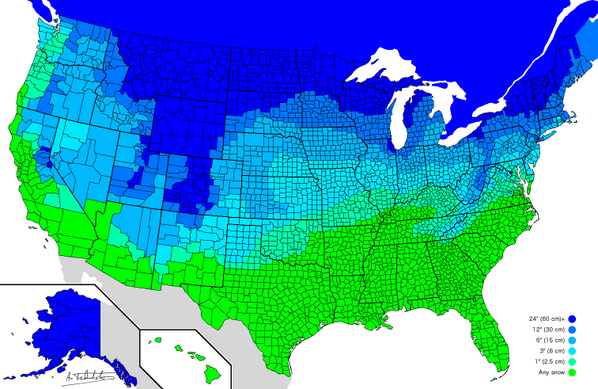
The pointer is from Ángel Cabrera, link here.
Do scholars produce too much and revise too little?
Art Carden asks me:
…do you think scholars spend too much time producing new content and too little time revising and refining their arguments? I’m thinking about the Scholars of Old (e.g. Smith) taking their work through multiple editions. Thomas Sowell is good about producing revised versions of some of his books, but a glance at my shelf makes me wonder if Eminent Scholar should’ve revised his/her first book instead of writing a second or third or fourth.Do you think books go through the optimal number of revisions? Is the editing process so good today that the first edition usually should be the last?
In music, Brahms is notorious for having spent a lot of time revising his drafts. Pierre Boulez explicitly revised and improved many of his pieces, after adding in years of extra work. Stravinsky’s later 1947 version of Petrouchka is much sharper and cleaner than his 1911 release. In all of these cases the revisions are worthwhile, because these works were very special and worth improving. Brahms’s first symphony might have done better with some further revisions yet.
When it comes to economics, individual works are less and less special all the time, unlike in the days of Adam Smith. Smith waited, more or less perfected his book, and in the meantime he was not really scooped. Today it is the collective body of work which carries the force. We also live in the age of the working paper, where it is the first released draft which matters most. There is an institutional failure that first released drafts are released too soon, for the purposes of receiving attention and credit. Yet I don’t think there is a corresponding problem of too few editions of the working paper. Ideally there should be no more than two. A first “here I am” version, to stimulate discussion and feedback, and eventually a final version which maximizes accuracy.
In fact if scholars had to commit to only two versions of the paper, they might be induced to make the early release more accurate in advance, knowing they cannot magically revise away errors a week later with the magic of word processing and web re-posting. This move toward fewer editions would offset some of the costs of premature release. Again, we do not see a case where a greater number of revisions would be better.
The scarcity of attention is the key reason why a very small number of accuracy-enhancing revisions is more or less optimal.
Meeting one’s higher calling?
From Madurai, Robyn Eckhardt reports:
Onion, cauliflower, fenugreek, garlic, egg white, potato, mushroom and masala are just some of the variations on dosa offered by the 49-year-old Mr. Karthikeyan, who took over the business from his father after earning a master’s degree in economics. “What could I do? There was no one else,” he explained as he unhurriedly worked five griddles simultaneously — four for dosai and one for fried dishes like masala powder-seasoned hard-boiled eggs with onion, cilantro and curry leaves. “Back then, a dosai cost a quarter of a rupee,” he said. Today Ayyappan charges 10 rupees and up.
There is more here, via these sources.