Category: Education
Why don’t we nudge people toward more risk?
Most paternalistic nudges encourage more safety (or at least the appearance of safety), such as when government steers people away from trans fats with a warning label or when the transportation authority structures the contours of a road to induce drivers to slow down. I can think of a few nudges in the direction of greater risk-taking:
1. QEII and activist monetary policy more generally. Investment tax credits and upbeat Presidential speeches.
2. Military recruitment campaigns and ads.
3. Social norms that people should pursue the love of their life, propose marriage, have children, and so on.
What else?
The Hansonian question is why the bias toward safety is neglected for risk-taking in these areas. Is it a simple utilitarian standard? Is it that these forms of risk-taking are affiliated with larger social purposes, namely ones whose relative status we are trying to boost? Are nudges toward risk just as common as nudges toward safety, but we are less willing to describe them as such?
Risk-taking by eating dangerous food has a relatively low social status, perhaps because the gain is mostly private. Sushi or sampling street food in exotic locales have minority or cult followings, perhaps because they are (sometimes) associated with higher class values. Many people eat and enjoy trans fats but few people defend or elevate them.
Trust the reactions of your peers more
Dan Gilbert, Tim Wilson, and co-authors have found:
Two experiments revealed that (i) people can more accurately predict their affective reactions to a future event when they know how a neighbor in their social network reacted to the event than when they know about the event itself and (ii) people do not believe this. Undergraduates made more accurate predictions about their affective reactions to a 5-minute speed date (n = 25) and to a peer evaluation (n = 88) when they knew only how another undergraduate had reacted to these events than when they had information about the events themselves. Both participants and independent judges mistakenly believed that predictions based on information about the event would be more accurate than predictions based on information about how another person had reacted to it.
The link to the article is here.
Anything but the election, part II
In The Journal of Cosmology, Rhawn Joseph, Ph.D. writes:
Humans are sexual beings and it can be predicted that male and female astronauts will engage in sexual relations during a mission to Mars, leading to conflicts and pregnancies and the first baby born on the Red Planet. Non-human primate and astronaut sexual behavior is reviewed including romantic conflicts involving astronauts who flew aboard the Space Shuttle and in simulated missions to Mars, and men and women team members in the Antarctic. The possibilities of pregnancy and the effects of gravity and radiation on the testes, ovaries, menstruation, and developing fetus, including a child born on Mars, are discussed. What may lead to and how to prevent sexual conflicts, sexual violence, sexual competition, and pregnancy are detailed. Recommendations include the possibility that male and female astronauts on a mission to Mars, should fly in separate space craft.
The piece has numerous flaws, which are some mix of sad, funny, and outrageous, depending on your point of view.
Hat tip goes to The Browser.
Is Obama a Keynesian?
Hat tip: Stephen Miller.
*State of Emergency*
Could it be the best non-fiction book so far this year? The author is Dominic Sandbrook and the subtitle is The Way We Were: Britain, 1970-1974, here is an excerpt:
As a spender, Joseph had only one Cabinet rival: the Education Secretary, Margaret Thatcher. Derided as the "Milk Snatcher" in 1971 because she had to carry out Macleod's plan to scrap free school milk for children aged between 8 and 11. Mrs Thatcher was actually a big-spending education chief who secured the funds to raise the leaving age to 16 and to invest £48 million in new buildings. In December 1972, she even published a White Paper envisaging a massive £1 billion a year for education by 1981, with teaching staff almost doubling and vast amounts of extra cash for polytechnics and nursery schools. She wanted "expansion, not contraction", she said. It never happened; if it had, her reputation in the education sector might be very different.
Every page of this book has excellent analysis and information, attractively presented. It masterfully covers a wide range of topics, ranging from how the British started drinking wine, to how the power cuts affected public morale, to the strategies of British labor unions, to the insightfulness of Fawlty Towers. It's a key book for understanding how the Thatcher Revolution ever came to pass.
It is simply a first-rate book. It is out only in the UK, but I was happy to pay the extra shipping charge from UK Amazon, which you too can pay here. Or maybe try these used sellers. Some reviews are here.
Popularizing Deadweight Loss
Indy requests a popularization of deadweight loss. Let's do the deadweight loss from a tax.
Imagine that you want to go to New York on a trip. You value the trip at $50 and a bus ticket costs $40. Do you take the trip?
A. Yes. The value ($50) of the trip exceeds the cost of the ticket ($40) so you travel to New York.
How much consumer surplus (net value) do you get from the trip?
A. $10=$50-$40.
The government taxes bus tickets which raises the price of a bus ticket to $60. Do you take the trip?
A. No. The value of the trip is now less than the price of the ticket.
What happened to the $10 consumer surplus which you used to get when there was no tax?
A. It's gone since no trip takes place.
Did the government get any tax revenue from you?
A. No.
Key idea: Consumers lose but the government does not gain from trips that are not taken.
Conclusion: Deadweight loss is the value of the trips (trades) which do not happen because of the tax.
Chat with a computer, about a free market economy
John – Are you into sports.
[ Af:0 At:10 Sp:0] Sports is not my cup of tea. I prefer intellectual challenges like Go.
John – Who's the world Go champion.
[ Af:0 At:10 Sp:0] Sorry. I can't help you. A celebrity of some sort?
John – Do you play chess?
[ Af:0 At:10 Sp:0] I don't play any games except Go.
John – Can we play Go on here?
[ Af:0 At:10 Sp:0] About playing… Does it make sense to you that we reward athletes more than scientists?
John – Television coverage makes that possible.
[ Af:0 At:10 Sp:0] It's a free market economy. And people value entertainment more than serious things like science and education.
John – And your point is?
One judge thought that "Suzette" was more human than a competing human decoy, but I would have been suspicious of the line about a "free market economy." There is more here, including more of the dialogue, and also here.
I thank Michelle Dawson for the pointer; here is my paper with Michelle on the Turing test.
Which economic ideas are hard to popularize?
Ryan, a loyal MR reader, asks:
1. What are the most important economic ideas that are not popularized, i.e. not accessible to laypeople in books and articles by credible authors? …Are there any theories that have gained traction over competing theories based primarily on their ability to be more easily conveyed to a layperson audience as opposed to their providing a better solution to a particular problem?
As for non-popularized theories, I have a few nominations. First, the sensitivity of many economic results to assumptions about Bertrand, Cournot-Nash, and other solution concepts is not easily popularized. Second (until the Cowen-Tabarrok macro text), the Solow growth model was not easily popularized. The difference between a "once-and-for-all" change and a "change in the rate of growth" is not well understood, probably not at any level, yet it is important. Tax incidence theory is not easily popularized, although an incorrect version of it — "they'll pass it all along to consumers" — circulates.
Most behavioral economics can be easily explained in popular terms and that partially accounts for its broad influence. Most people are also capable of grasping a crude version of Keynesian economics, albeit without the subtleties of Keynes ("we should spend more" resonates). The insights of supply-side economics and monetarism have been popularized without much difficulty.
Most of all, it is hard to popularize "maybe" claims, agnoticism, uncertainties, confidence intervals, and contingencies. The marketing process encourages excess certainty.
In terms of good but hard to popularize economic theories, what else can you think of?
xkcd on Efficient Markets
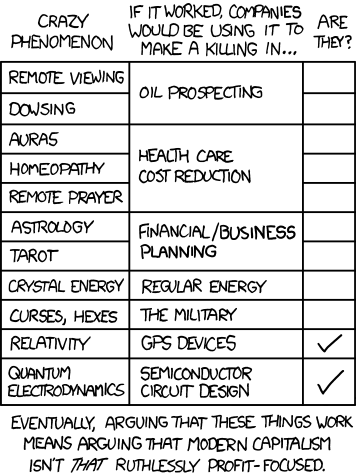
Not to mention that there is an easy $1,000,000 lying on the sidewalk for the true practitioner of the paranormal, supernatural, or occult.
Hat tip: Brad DeLong.
Words of wisdom
The best advice about how to conduct yourself at work is to know yourself, and get new information–from outside your own experience–about what is possible in the world. And that is what fiction, and plays, and poetry, and this blog, are about.
More here. I thank Alex and Garett for having done a short (very short) jaunt to El Salvador with me; more on that soon.
The culture that is Washington
Business is the most common academic major in the nation, representing one-fifth of all college degrees. And business ranks second among academic majors in the Washington area, but it's a distant second, representing 11 percent of the college-educated population.
Literature and languages rank third. Liberal arts and history rank fourth.
The data show "that D.C. is less business-focused than the country as a whole," said William Frey, a demographer at the Brookings Institution.
The full story is here.
The ongoing saga of British expenditure reform
Prof. Steve Smith, president of Universities U.K., which represents Britain’s higher-learning institutions, said the government was likely to cut about 80 percent of the current $6.2 billion it pays annually for university teaching, and about $1.6 billion from the $6.4 billion it provides for research.
To make up for the shortfall, universities would have to raise tuition to an average of more than $11,000, Professor Smith said, and doing so would require Parliament to lift the cap on such fees, now set at $5,260.
Here is the full story.
Kosmos, a career networking site for classical liberals
Created by the Institute for Humane Studies, Kosmos is:
…a social-networking site for liberty-friendly academics. Here you can meet others in your discipline, share ideas and receive feedback, get career advice, and discover networking events near you.
Sentences to ponder
You never hear little kids say they want to be "powerful" when they grow up. Parents don't encourage that sort of thing, since it's kind of terrifying coming from a toddler.
Here is more, mostly on whether we are good judges of our own happiness. Hat tip goes to DailyExpositions.
Economic Misconceptions
Students typically come to an economics class with many misconceptions, not just random errors but systematic biases (see especially Caplan 2002).
Bill Goffe recently (2009) surveyed one of his macro principles classes and found, for example, that the median student believes that 35% of workers earn the minimum wage and a substantial fraction think that a majority of workers earn the minimum wage (Actual rate in 2007: 2.3% of hourly-paid workers and a smaller share of all workers earn the minimum wage, rates are probably somewhat higher today since the min. wage has risen and wages have not).
When asked about profits as a percentage of sales the median student guessed 30% (actual rate, closer to 4%).
When asked about the inflation rate over the last year (survey was in 2009) the median student guessed 11%. Actual rate: much closer to 0%. Note, how important such misconceptions could be to policy.
When asked by how much has income per person in the United States changed since 1950 (after adjusting for inflation) the median student said an increase of 25%. Actual rate an increase of about 248%, thus the median student was off by a factor of 10.
I would add that there are also theoretical misconceptions that are probably even more important than factual misconceptions. For example, I think it would be useful to ask questions such as:
1. A number of new furniture manufacturers open in North Carolina, since the new competition forced existing manufacturers to reduce prices the effect of this additional competition was to reduce wages for workers in the furniture industry.
Rate this argument on a 1 to 10 scale from least to most plausible or likely.
2. Competition from Korean automobile manufacturers caused US manufacturers to cut quality in order to reduce their costs. Rate this argument on a 1 to 10 scale from least to most plausible or likely.
3. A law that prevents supermarkets from advertising the prices of their products will reduce the supermarket costs and in turn this will reduce prices to consumers. Rate this argument on a 1 to 10 scale from least to most plausible or likely.
Note that the point here is not to say that an answer is wrong but to understand the implicit models that students are using. It can help a teacher to know what these conceptions and misconceptions are in advance so that they can be addressed.
To further this research, Bill Goffe is putting together a colloborative database on economic misconceptions that teachers are welcome to contribute towards. See also Bill's page on the large literature on teaching in physics much of which is also relevant to economics.