Category: History
Perhaps intergenerational mobility has not declined in the United States after all
From the latest American Economic Review:
A large body of evidence finds that relative mobility in the US has declined over the past 150 years. However, long-run mobility estimates are usually based on White samples and therefore do not account for the limited opportunities available for nonwhite families. Moreover, historical data measure the father’s status with error, which biases estimates toward greater mobility. Using linked census data from 1850 to 1940, I show that accounting for race and measurement error can double estimates of intergenerational persistence. Updated estimates imply that there is greater equality of opportunity today than in the past, mostly because opportunity was never that equal. (JEL J15, J62, N31, N32)
That is from Zachary Ward of Baylor University. If that is true, and it may be, how many popular economics books from the last twenty years need to be tossed out? How many “intergenerational mobility is declining” newspaper columns and magazine articles? Ouch. No single article settles a question, but for now this seems to be the best, most up to date word on the matter.
Reassessing China’s Rural Reforms: The View from Outer Space
We study one of the central reforms in China’s economic miracle, the Household Responsibility System (HRS), which decollectivized agriculture starting in 1978. The HRS is commonly seen as having significantly boosted agricultural productivity—but this conclusion rests on unreliable official data. We use historical satellite imagery to generate new measurements of grain yield, independent of official Chinese statistics. Using two separate empirical designs that exploit the staggered rollout of the HRS across provinces and counties, we find no causal evidence that areas that adopted the HRS sooner experienced faster grain yield growth. These results challenge our conventional understanding of decollectivization, land reform, and the origins of the Chinese miracle.
That is a new paper by Joel Ferguson and Oliver Kim, with Kim being on the job market from Berkeley this year. Here is Kim’s thread on Twitter. Intriguing results, which have won praise from Pseudoerasmus…
The Big Fail
The Big Fail, Joe Nocera and Bethany McLean’s new book about the pandemic, is an angry book. Rightly so. It decries the way the bien pensant, the self-righteously conventional,  were able to sideline, suppress and belittle other voices as unscientific, fraudulent purveyors of misinformation. The Big Fail gives the other voices their hearing— Martin Kulldorff, Sunetra Gupta, Jay Bhattacharya and Emily Oster are recast not as villains but as heroes; as is Ron DeSantis who is given credit for bucking the conventional during the pandemic (Nocera and McLean wonder what happened to the data-driven DeSantis, as do I.)
Amazingly, even as highly-qualified epidemiologists and economists were labelled “anti-science” for not following the party line, the biggest policy of them all, lockdowns, had little to no scientific backing:
…[lockdowns] became the default strategy for most of the rest of the world. Even though they had never been used before to fight a pandemic, even though their effectiveness had never been studied, and even though they were criticized as authoritarian overreach—despite all that, the entire world, with a few notable exceptions, was soon locking down its citizens with varying degrees of severity.
In the United States, lockdowns became equated with “following the science.” It was anything but. Yes, there were computer models suggesting lockdowns would be effective, but there were never any actual scientific studies supporting the strategy. It was a giant experiment, one that would bring devastating social and economic consequences.
The narrative lined up “scientific experts” against “deniers, fauxers, and herders” with the scientific experts united on the pro-lockdown side (the following has no indent but draws from an earlier post). But let’s consider. In Europe one country above all others followed the “ideal” of an expert-led pandemic response. A country where the public health authority was free from interference from politicians. A country where the public had tremendous trust in the state. A country where the public were committed to collective solidarity and public welfare. That country, of course, was Sweden. Yet in Sweden the highly regarded Public Health Agency, led by state epidemiologist Anders Tegnell, an expert in infectious diseases, opposed lockdowns, travel restrictions, and the general use of masks.
It’s important to understand that Tegnell wasn’t an outsider marching to his own drummer, anti-lockdown was probably the dominant expert opinion prior to COVID. In a 2006 review of pandemic policy, for example, four highly-regarded experts argued:
It is difficult to identify circumstances in the past half-century when large-scale quarantine has been effectively used in the control of any disease. The negative consequences of large-scale quarantine are so extreme (forced confinement of sick people with the well; complete restriction of movement of large populations; difficulty in getting critical supplies, medicines, and food to people inside the quarantine zone) that this mitigation measure should be eliminated from serious consideration.
Travel restrictions, such as closing airports and screening travelers at borders, have historically been ineffective.
….a policy calling for communitywide cancellation of public events seems inadvisable.
The authors included Thomas V. Inglesby, the Director of the Johns Hopkins Center for Health Security, one of the most highly respected centers for infectious diseases in the world, and D.A. Henderson, the legendary epidemiologist widely credited with eliminating smallpox from the planet.
Nocera and McLean also remind us of the insanity of the mask debate, especially in the later years of the pandemic.
But by the spring of 2022, the CDC had dropped its mask recommendations–except, incredibly, for children five and under, who again, were the least likely to be infected.
…Once again it was Brown University economist Emily Oster who pointed out how foolish this policy was…The headline was blunt: Masking Policy is Incredibly Irrational Right Now. In this article she noted that even as the CDC had dropped its indoor mask requirements for kids six and older, it continued to maintain the policy for younger children. “Some parents of young kids have been driven insane by this policy,” Oster wrote, “I sympathize–because the policy is completely insane…”
As usual, her critics jumped all over her. As usual, she was right.
Naturally, I don’t agree with everything in the Big Fail. Nocera and McLean, for example, are very negative on the role of private equity in hospitals and nursing homes. My view is that any theory of what is wrong with American health care is true because American health care is wrong in every possible way. Still, I don’t see private equity as a driving force. It’s easy to find examples where private equity owned nursing homes performed poorly but so did many other nursing homes. More systematic analyses find that PE owned nursing homes performed about the same, worse or better than other nursing homes. Personally, I’d bet on about the same overall. Covid in the Nursing Homes: The US Experience (open), my paper with Markus Bjoerkheim, shows that what mattered more than anything else was simply community spread (see also this paper for the ways in which I disagreed with the GBD approach). More generally, my paper with Robert Omberg, Is it possible to prepare for a pandemic? (open) finds that nations with universal health care, for example, didn’t have fewer excess deaths.
The bottom line is that vaccines worked and everything else was a sideshow. Had we approved the vaccines even 5 weeks earlier and delivered them to the nursing homes, we could have saved 14,000 lives and had we vaccinated nursing home residents just 10 weeks earlier, before the vaccine was approved, as Deborah Birx had proposed, we might have saved 40,000 lives. Nevertheless, Operation Warp Speed was the shining jewel of the pandemic. The lesson is that we should fund further vaccine R&D, create a library of prototype vaccines against potential pandemic threats, streamline our regulatory systems for rapid response, agree now on protocols for human challenge trials and keep warm rapid development systems so that we can produce vaccines not in 11 months but in 100 days.
The Big Fail does a great service in critiquing those who stifled debate and in demanding a full public accounting of what happened–an accounting that has yet to take place.
Addendum 1: I have reviewed most of the big books on the pandemic including the National Covid Commission’s Lessons from the COVID WAR, Scott Gottlieb’s Uncontrolled Spread, Michael Lewis’s The Premonition, Andy Slavitt’s Preventable and Abutaleb and Paletta’s Nightmare Scenario.
Addendum 2: I also liked Nocera and McLean’s All the Devils are Here on the financial crisis. Sad to say that the titles could be swapped without loss of validity.
In which I talk *GOAT* with Russ Roberts on EconTalk
My 18th EconTalk episode with @tylercowen and I think the best of the bunch. Thank you, Tyler. https://t.co/RMriSq2h3f
— Russ Roberts (@EconTalker) November 27, 2023
The book of course is here.
Bona Vacantia
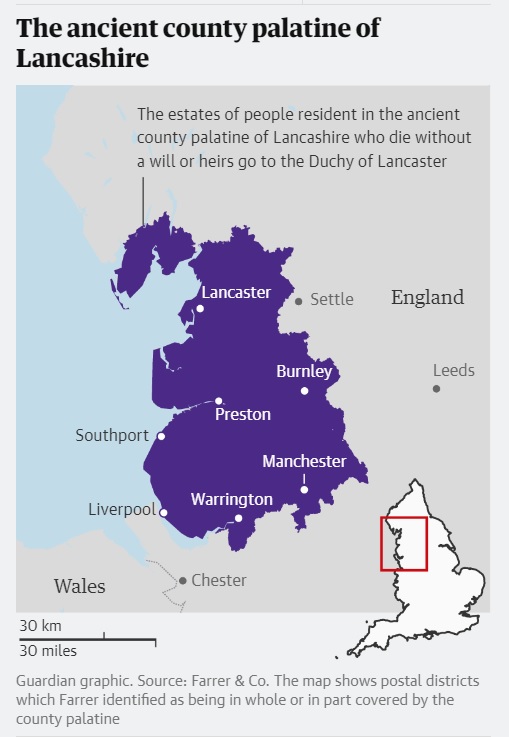 Bona vacantia are unowned assets–primarily the assets of people who die without a will and without heirs. In Britain, as in the United States, unowned assets generally pass to the government but Britain is full of ancient and strange traditions and one of them is that the estates of people resident in the “ancient county palatine of Lancashire” who die without a will or heirs go to the Duchy of Lancaster.
The Duchy of Lancaster is “a portfolio of lands, properties, and assets held in trust for the sovereign.” The Duchy dates back to 1265 but in 1461 Edward IV made it a distinct and private inheritance of the reigning monarch. As such the reigning monarch is not allowed to sell the Duchy but is due any returns. To be clear, this is all different from the Crown Estate which are a bunch of land and property nominally owned by the monarch and dedicated to funding the monarchy but yet not owned by the monarch privately. Having fun yet?
Periodically someone discovers the duchies and kicks up a fuss and there is a debate about making the revenues public and giving the monarch a stipend instead. The latest fuss was kicked up by the Guardian with an article that describes the whole thing in accurate but lurid terms:
The king is profiting from the deaths of thousands of people in the north-west of England whose assets are secretly being used to upgrade a commercial property empire managed by his hereditary estate, the Guardian can reveal.
Great stuff! It could only have been improved by adding “the king and his son” are profiting from the deaths of thousands of people because there is another Duchy in Cornwall which is owned by the eldest son of the reigning monarch, in this case Prince William, where the same rules apply. Prince William also has the rights to all the royal fish caught off the shores of the Duchy—namely to whales, porpoises, and sturgeon (obviously).
Despite having once read a book on the subject, I am obviously not an expert in the intricacies of British inheritance law. Who is? But I found the back story very amusing.
What am I thankful for?
Tyler Cowen, economist and blogger
I am thankful for being able to watch and to try to understand the procession of history before us. That is one of the greatest and least appreciated privileges. In a year that has had some bad events, that is one form of solace.
Here is the remainder of the Free Press symposium, with many interesting notables.
A Tax Puzzle
Analyze the following four images. For each image, guess what is being taxed. Use only the information in the image.

FYI ChatGPT was not able to solve this question directly, although it was very good at analyzing what was distinctive or odd about each image and thus suggesting some possible answers.
Hat tip: Lionel Page, via Shruti Rajagopalan, includes answers and some variants.
My Conversation with the excellent Jennifer Burns
Here is the audio, video, and transcript. Here is the episode description:
Jennifer Burns is a professor history at Stanford who works at the intersection of intellectual, political, and cultural history. She’s written two biographies Tyler highly recommends: her 2009 book, Goddess of the Market: Ayn Rand and the American Right and her latest, Milton Friedman: The Last Conservative, provides a nuanced look into the influential economist and public intellectual.
Tyler and Jennifer start by discussing how her new portrait of Friedman caused her to reassess him, his lasting impact in statistics, whether he was too dogmatic, his shift from academic to public intellectual, the problem with Two Lucky People, what Friedman’s courtship of Rose Friedman was like, how Milton’s family influenced him, why Friedman opposed Hayek’s courtesy appointment at the University of Chicago, Friedman’s attitudes toward friendship, his relationship to fiction and the arts, and the prospects for his intellectual legacy. Next, they discuss Jennifer’s previous work on Ayn Rand, including whether Rand was a good screenwriter, which is the best of her novels, what to make of the sex scenes in Atlas Shrugged and The Fountainhead, how Rand and Mises got along, and why there’s so few successful businesswomen depicted in American fiction. They also delve into why fiction seems so much more important for the American left than it is for the right, what’s driving the decline of the American conservative intellectual condition, what she will do next, and more.
Here is one excerpt:
COWEN: What’s the future of Milton Friedman, say, 30, 40 years from now? Where will the reputation be? University of Chicago is no longer Friedmanite, right? We know that. There are fewer outposts of Friedmanite-thinking than there had been. Will he be underrated or somehow reinvented or what?
BURNS: Let me look into my crystal ball. I don’t think the name will have faded. I think there are still names that people read. People still read Keynes and Mill and figures like that to see what did they say in their day that was so influential. I think that Friedman has got into the water and into the air a bit. I do some work on tracing out his influence.
Within economics, no one’s going to say, “Oh, I’m a Friedmanite,” or fewer people are, but this is someone whose major work was done half a century or more ago, so I don’t think that’s surprising. It would be surprising if economics had been at a standstill as Friedman still called the tune. When you think about the way we accord importance to the modern Federal Reserve, of course, there were things that happened in the world, but Friedman’s ideas did so much to shape that understanding.
He’s still in policymakers’ minds. He’s still in the monetary policy establishment’s minds, even if they’re not fully following him. I think we’re in the middle of a big reckoning now. You saw all the debate about M2 and the pandemic and monetary spending. I don’t know where it’s all going to settle out. It’s a more complicated world than the one that Friedman looked at. I tend to think he is an essential thinker, that the basics of what he talked about are going to be known 50 years from now, for sure.
COWEN: Did Milton Friedman have friends?
Definitely recommended, and Jennifer’s new book Milton Friedman: The Last Conservative is one of my favorite books of the year. It will likely stand as the definitive biography of Friedman.
Malthus was smarter than you think, vice and prostitution edition
That is a passage from my new book GOAT: Who is the Greatest Economist of all Time and Why Does it Matter?
So one way to read Malthus is this: if a society is going to have any prosperity at all, the people in that society either will be morally quite bad, or they have to be morally very, very good, good enough to exercise that moral restraint. Alternatively, you can read Malthus as seeing two primary goals for people: food and sex. His accomplishment was to show that, taken collectively, those two goals could not easily be obtainable simultaneously in a satisfactory fashion. In late Freudian terms, you could say that eros/sex amounts to the death drive, but again painted on a collective canvas and driven by economic mechanisms.
Malthus also hinted at birth control as an important social and economic force, especially later in 1817, putting him ahead of many other thinkers of his time. Birth control was widely practiced for centuries through a variety of means, and Malthus unfortunately was not very specific. He did call it “unnatural,” and the mainstream theology of his Anglican church condemned it, as did many other churches. But what did he really think? Was this unnatural practice so much worse than the other alternatives of misery and vice that his model was putting forward? Or did Malthus simply fail to see that birth control could be so effective and widespread as it is today? It doesn’t seem we are ever going to know.
From Malthus’s tripartite grouping of vice, moral restraint, and misery, two things should be clear immediately. The first is why Keynes found Malthus so interesting, namely that homosexual passions are one (partial) way out of the Malthusian trap. The second is that there is a Straussian reading of Malthus, namely that he thought moral restraint, while wonderful, was limited in its applicability. So maybe then vice wasn’t so bad after all? Is it not better than war and starvation?
I don’t buy the Straussian reading as a description of what Malthus really meant. But he knew it was there, and he knew he was forcing you to think about just how bad you thought vice really was. Malthus for instance is quite willing to reference prostitution as one possible means to keep down population. He talks about “men,” and “a numerous class of females,” but he worries that those practices “lower in the most marked manner the dignity of human nature.” It degrades the female character and amongst “those unfortunate females with which all great towns abound, more real distress and aggravated misery are perhaps to be found, than in any other department of human life.”
How bad are those vices relative to starvation and population triage? Well, the modern world has debated that question and mostly we have opted for vice. You thus can see that the prosperity of the modern world does not refute Malthus. We faced the Malthusian dilemma and opted for one of his options, namely vice. It’s just that a lot of us don’t find those vices as morally abhorrent as Malthus did. You could say we invented another technology that (maybe) does not suffer from diminishing returns, namely improving the dignity and the living conditions those who practice vice. Contemporary college dorms seem pretty comfortable, and they have plenty of birth control, and of course lots of vice in the Malthusian sense. While those undergraduates might experience high rates of depression and also sexual violation, that life of vice still seems far better than life near the subsistence point. I am not sure what Malthus would think of college dorm sexual norms (and living standards!), but his broader failing was that he did not foresee the sanitization and partial moral neutering of what he considered to be vice.
Written by me, recommended, and open source at the above link.
That was then, this is now
…the first German pogroms of the modern age, the so-called Hep-Hep riots, took place in 1819. Jews were attacked on the streets and Jewish stores were ransacked. It was a new and as yet unknown phenomenon in the German-speaking lands. The riots were led by students, ostensibly the anti-absolutist and progressive force in German society.
That is from Shlomo Avineri’s Herzl’s Vision: Theodor Herzl and the Foundation of the Jewish State. Here is a new bulletin from MIT.
Claims about extinction and evolution
Advances in evolutionary theories (the Extended Synthesis) demonstrate that organisms systematically modify environments in ways that influence their own and other species’ evolution. This paper utilizes these theories to examine the economic consequences of human dispersal from Africa. Evidence shows that early humans’ dispersal affected the adaptability of animal species to human environments and, through this, the extinction of large mammals during Homo sapiens’ out-of-Africa migration. Empirical analyses explore the variation in extinction rates as a source of exogenous pressure for cooperation and innovation among hunter–gatherers and examine the impact of extinction on long-run development. The results indicate that extinction affects economic performance by driving continental differences in biogeography, disease environments, and institutions. Eurasia’s location along the out-of-Africa migratory path provided human and animal populations with coevolutionary foundations for domestication and agriculture, which gave Eurasians technological and institutional advantages in comparative development.
That is from a recent paper by Ideen A. Riahi, published in The Economic Journal. Via the excellent Kevin Lewis.
Behavioral Economics and GPT-4: From William Shakespeare to Elena Ferrante
There is a new paper on LLMs by Gabriel Abrams, here is the abstract:
We prompted GPT-4 (a large language model) to play the Dictator game, a classic behavioral economics experiment, as 148 literary fictional characters from the 17th century to the 21st century.
Of literary interest, this paper analyzed character selfishness by century, the relative frequency of literary character personality traits, and the average valence of these traits. The paper also analyzed character gender differences in selfishness.
From an economics/AI perspective, this paper generates specific and quantifiable Turing tests which the model passed for zero price effect, lack of spitefulness and altruism, and failed for human sensitivity to relative ordinal position and price elasticity (elasticity is significantly lower than humans). Model updates from March to August 2023 had relatively minor impacts on Turing test outcomes.
There is a general and mainly monotonic decrease in selfish behavior over time in literary characters. 50% of the decisions of characters from the 17th century are selfish compared to just 19% of the decisions of characters from the 21st century. Overall, humans exhibited much more selfish behavior than AI characters, with 51% of human decisions being selfish compared to 32% of decisions made by AI characters.
Historical literary characters have a surprisingly strong net positive valence across 2,785 personality traits generated by GPT-4 (3.2X more positive than negative). However, valence varied significantly across centuries. The most positive century, in terms of personality traits, was the 21st — over 10X the ratio of positive to negative traits. The least positive century was the 17th at just 1.8X. “Empathetic,” “fair” and “selfless,” were the most overweight traits in the 20th century. Conversely, “manipulative,” “ambitious” and “ruthless” were the most overweight traits in the 17th century.
Male characters were more selfish than female characters: 35% of male decisions were selfish compared to just 24% for female characters. The skew was highest in the 17th century where selfish decisions for male and female were 62% and 20% respectively.
This analysis offers a specific and quantifiable partial Turing test. In a few ways, the model is remarkably human-like; The key human-like characteristics are the zero price effect, lack of spitefulness and altruism. However, in other ways, GPT-4 reflects unusual or inhuman preferences. The model does not appear to have human sensitivity to relative ordinal position and has significantly lower price elasticity than humans.
Model updates in GPT-4 have made it slightly more sensitive to ordinal value, but not more selfish. The model shows preference consistency across model runs for each character with respect to selfishness.
To which journal might you advise him to send this paper?
Apple Ad From 1999
My excellent Conversation with Stephen Jennings
Recorded in Tatu City, Kenya, not far from Nairobi, Tatu City is a budding Special Enterprise Zone. Here is the transcript, audio, and video. Here is the episode overview:
Stephen and Tyler first met over thirty years ago while working on economic reforms in New Zealand. With a distinguished career that transitioned from the New Zealand Treasury to significant ventures in emerging economies, Stephen now focuses on developing new urban landscapes across Africa as the founder and CEO of Rendeavour.
Tyler sat down with Stephen in Tatu City, one of his multi-use developments just north of Nairobi, where they discussed why he’s optimistic about Kenya in particular, why so many African cities appear to have low agglomeration externalities, how Tatu City regulates cars and designs for transportation, how his experience as reformer and privatizer informed the way utilities are provided, what will set the city apart aesthetically, why talent is the biggest constraint he faces, how Nairobi should fix its traffic problems, what variable best tracks Kenyan unity, what the country should do to boost agricultural productivity, the economic prospects for New Zealand, how playing rugby influenced his approach to the world, how living in Kenya has changed him, what he will learn next, and more.
Here is one excerpt:
COWEN: Just give us some basic facts. Where is Tatu City right now, and where will it be headed when it’s more or less finished?
JENNINGS: Tatu City is the only operational special economic zone [SEZ] in the country. It is 5,000 hectares of fully planned urban development. It is at quite an advanced stage. We have 70 large-scale industrial companies with us, including major multinationals and many of the regional leaders. We have 3,000 students come on site every day to our four new schools. We’re advanced in building the first phase of the first new CBD for the region. We have tens of thousands of core center jobs moving into that area, together with other modern office amenities. All of the elements — we have many residential modules, thousands of new residential units at a wide range of price points — all of the elements of a new city are in place.
COWEN: How many people will end up living here?
JENNINGS: Around 250,000.
COWEN: And how many businesses?
JENNINGS: There’ll be thousands of businesses.
And delving more deeply into matters:
COWEN: What do you think is the book [on economic development] that has influenced you most?
JENNINGS: It’s a very good question. I think I’ve read just about everything in development. There’s nothing I really like very much. Development is a black box. I don’t think there’s anything that has much predictive power. There’s a lot of ex post explanations, whether they be policy settings, location, culture. I think 90% of them are ex post; very few of them are predictive. Some of them are just tautologies. I really like factualization.
It’s descriptive more than analytical, but it just makes it clear that most of the world has been on a very similar development trajectory. It’s just not sequenced. Sweden started early; Ethiopia started late. But the nature of the transition and the inevitability of that transition, other than very extreme circumstances, is kind of the same.
COWEN: What do you think economists get wrong?
JENNINGS: I don’t think we really understand development at all, because if we could, we could predict it. We can predict virtually nothing. It’s just too complicated. It’s too connected with politics. I think there’s a lot of feedback loops and elements of development that we don’t understand properly. We certainly can’t quantify them because the development’s happening in such a wide range of settings, from communism dictatorships through to very liberal systems and with all different kinds of industrial — on every dimension, there’s a huge range of variables.
Excellent and interesting throughout.
The Burial
I loved The Burial on Amazon Prime. Not because it’s a great movie but because it serves as a cinematic representation of my academic paper with Eric Helland, Race, Poverty, and American Tort Awards. Be warned—this isn’t a spoiler-free discussion, but the plot points are largely predictable.
 The Burial is a legal drama based on real events starring Jamie Foxx as Willie Gary, a flashy personal injury lawyer who takes the case of Jeremiah O’Keefe, a staid funeral home operator played by Tommy Lee Jones. O’Keefe is suing a Canadian conglomerate over a contract dispute and he hires Gary because he’s suing in a majority black district where Gary has been extremely successful at bringing cases (always black clients against big corporations).
As a drama, I’d rate the film a B-. The major failing is the implausible friendship between the young, black, flamboyant Willie Gary and the older, white subdued Jeremiah O’Keefe. Frankly, the pair lack chemistry and the viewer is left puzzled about the foundation of their friendship. The standout performance belongs to Jurnee Smollett, who excels as the whip-smart opposing counsel.
What makes The Burial interesting, however, is that it tells two stories about Willie Gary and the lawsuits. The veneer is that Gary is a crusading lawyer who uncovers abuse to bring justice. Most reviews review the veneer. Hence we are told this is a David versus Goliath story, a Rousing True Story and a story about the “dogged pursuit of justice.” The veneer is there to appease the simple minded, an interpretation solidified by The Telegraph which writes, without hint of irony:
The audience at the showing was basically adult and they applauded at the end which you often see in children’s movies but rarely in adult films.
The real story is that Gary is a huckster who wins cases in poor, black districts using a combination of racial resentment and homespun black-church preaching to persuade juries to redistribute the wealth from out-of-state big corporations to local knuckleheads. I use the latter term without approbation. Indeed, Gary says as much in his opening trial where he persuades the jury to give his “drunk”, “tanked” “wasted”, “no-good”, “depressed,” “suicidal” client, $75 million dollars for being hit by a truck! Why award damages against the corporation? Because, “they got the bank.” (He adds that his client had a green light–this is obviously a lie. Use your common sense.)
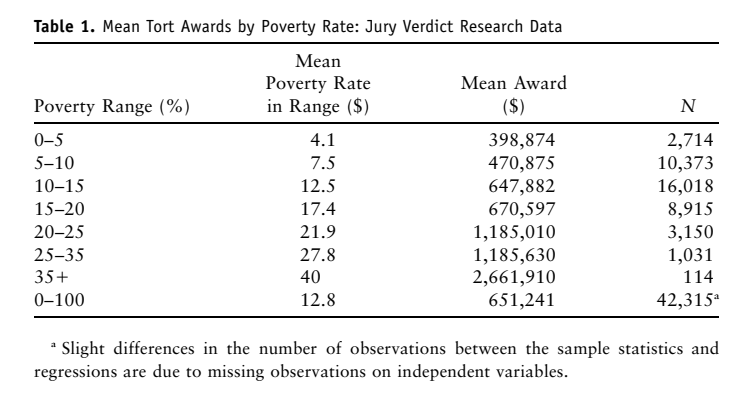 My paper with Helland, Race, Poverty, and American Tort Awards, finds that tort awards during this period were indeed much higher in counties with lots of poverty, especially black poverty. We find, for example, that the average tort award in a county with 0-5% poverty was $398 thousand but rose to a whopping $2.6 million in counties with poverty rates of 35% or greater! The Burial is very open about all of this. The movie goes out of its way to explain, for example, that 2/3rds of the population of Hinds county, the county in which the trial will take place, is black and that is why Willie Gary is hired.
The case on which the movie turns is as absurd as the opening teaser about the drunk, suicidal no-good who collects $75 million. Indeed, the two trials parallel one another. The funeral home conglomerate, the Loewen group, offered to buy three of O’Keefe’s funeral homes but after shaking on a deal they didn’t sign the contract. That’s it. That’s the dispute. The whole premise is bizarre as Loewen could have walked away at any time. Moreover, O’Keefe claims huge damages–$100 million!–when it’s obvious that O’Keefe’s entire failing business isn’t worth anywhere near as much. So why the large claim of damages? Have you not being paying attention? Because the Loewen group, “they got the bank.”
Furthermore, and in parallel with the earlier case, it’s O’Keefe who is the no-gooder. O’Keefe’s business is failing because he has taken money from burial insurance premiums–money that didn’t belong to him and that should have been invested conservatively to pay out awards–and lost it all in a high-risk venture run by a scam artist. Negligence at best and potential fraud at worst. Moreover, in a strange scene motivated by what actually happened, O’Keefe agrees to sell to Loewen only if he gets to keep a monopoly on the burial insurance market. Thus, it’s O’Keefe who is the one scheming to maintain high prices.
Indeed, the whole point of both of Gary’s cases is that he is such a great lawyer that he can win huge awards even for no-good clients. As if this wasn’t obvious enough, there is an extended discussion of Willie Gary’s hero….the great Johnnie Cochran, most famous for getting a murderer set free.
Loewen should have won the case easily on summary judgment but, of course, [spoiler alert!] the charismatic Gary wows the judge and the jury with entirely irrelevant tales of racial resentment and envy. The jury eats it up and reward O’Keefe with $100 million in compensatory damages and $400 million in punitive damages! The awards are entirely without reason or merit. The awards drive the noble Canadians of the Loewen group out of business.
The Burial is a courtroom drama surfaced with only the thinnest of veneers to let the credulous walk away feeling that justice was done. But for anyone with willing eyes, the interplay of racism, poverty, and resentment is truthfully presented and the resulting miscarriage of justice is plain to see. I enjoyed it.
Addendum: My legal commentary pertains only to the case as presented in the movie although in that respect the movie hews reasonably close to the facts.