Category: History
John Aubrey’s account of his own life
In part:
Born at Easton Piers, march twelfth, 1621, about sun-rising: very weak and like to die, and therefore christened that morning before prayer. I think I have heard my mother say I had an ague [fever] shortly after I was born.
1629: about three or four years old, I had a grievous ague. I can remember it. I got not health till eleven, or twelve: but had sickness of vomiting for thirteen hours every fortnight for…years…This sickness nipped by strength in the bud.
1633: eight years old, I had an issue (natural) in the coronal suture of my head, which continued running till twenty-one.
1634: October: I had a violent fever that was like to have carried me off. ‘Twas the most dangerous sickness that ever I had.
About 1639 (or 1640) I had the measles, but that was nothing: I was hardly sick.
1639: Monday after Easter week my uncle’s nag ran away with me, and gave a very dangerous fall.
1643: April and May, the small-pox at Oxford; and shortly after, left that ingenious place; and for three years led a sad life in the country…
1646: April — admitted of the Middle Temple. But my father’s sickness, and business, never permitted me to make any settlement to my study…
1655 (I think) June fourteenth, I had a fall at Epsom, and broke one of my ribs and was afraid it might cause an apostumation [abscess]…
1656: December: Veneris morbus [venereal disease]
1657: November, twenty-second, obiit domina [died Lady] Katherine Ryves, with whom I was to marry; to my great loss
Nor were those the end of his troubles…
That is all from John Aubrey’s Brief Lives, the autobiographical section, an excellent book more generally. Progress Studies!
China fact of the day
By 1978, Han constituted 42 percent of Xinjiang’s population, up from a mere 6 percent in 1949. The flow was reversed in the reform era, as many Han who had been forcibly relocated to the province returned to China proper. In 1990, the Han share of the population was down to 37.5 percent, and official estimates of the time projected a decline to 25.0 percent by 2030.
That is from Adeeb Khalid’s excellent Central Asia: A New History from the Imperial Conquests to the Present.
Is Haiti Governable Right Now? (at all)
More generally, might there be some countries that simply are not viable nation-states any more, no matter what we do? That is the topic of my latest Bloomberg column, here is one excerpt:
In other words, at the moment there doesn’t seem to be any way to govern Haiti. One problem is that foreign flows of money, whether from the drug trade or from Venezuelan foreign aid, have overwhelmed the domestic incentives to play by the rules. Haiti’s political institutions are mostly consumed by bribes and rents, with no stable center. The news, so to speak, is that such problems do not always have solutions. At all.
It is fine to suggest that Haiti invest in building up its political institutions — but those institutions have been unraveling for decades. I was a frequent visitor to the country in the 1990s, and although the poverty was severe, it was possible to travel with only a modest risk of encountering trouble. Government was largely ineffective, but it did exist.
These days the risk of kidnapping is so high that a visit is unthinkable.
And:
The buildup and rise of nation-states has become so ordinary that the opposite possibility is now neglected: their enduring collapse. It’s not history running in reverse. It’s that modernity has created new forces and incentives — drug money, kidnapping ransoms, payments from foreign powers, and so on — that can be stronger and more alluring than the usual reasons for supporting an internal national political order. If the rest of the world gets rich more quickly than you do, it might have the resources to effectively neutralize your incentives for peace and good government.
So where else might the political order soon unravel? In parts of Afghanistan, external forces (Pakistan, China, Russia, the U.S.) have so much at stake that the conditions there may never settle down. Other risks might be found in small, not yet fully orderly nations such as Guyana, Equatorial Guinea, and Eswatini (formerly Swaziland). El Salvador and Nicaragua seem to be consolidating their political orders, but at the cost of losing fair democratic political competition. The nation-state as we know it might not survive in every part of Nigeria, where the recent surge in kidnappings is striking.
In the Baltics and Taiwan, dangers from larger, aggressive neighbors lurk. In spite of generally good governance in these places, the pressures from outside powers might be too much to bear, reflecting broadly similar destabilizing mechanisms — namely, that the internal rewards for coordinating support for a status quo might not be high enough.
Recommended.
Book Review: Andy Slavitt’s Preventable
Like Michael Lewis’s The Premonition which I reviewed earlier, Andy Slavitt’s Preventable is a story of heroes, only all the heroes are named Andy Slavitt. It begins, as all such stories do, with an urgent call from the White House…the President needs you now! When not reminding us (e.g. xv, 14, 105, 112, 133, 242, 249) of how he did “nearly the impossible” and saved Obamacare he tells us how grateful other people were for his wise counsel, e.g. “Jared Kushner’s name again flashed on my phone. I picked up, and he was polite and appreciative of my past help.” (p.113), “John Doer was right to challenge me to make my concerns known publicly. Hundreds of thousands of people were following my tweets…” (p. 55)
Slavitt deserves praise for his work during the pandemic so I shouldn’t be so churlish but Preventable is shallow and politicized and it rubbed me the wrong way. Instead of an “inside account” we get little more than a day-by-day account familiar to anyone who lived through the last year and half. Slavitt rarely departs from the standard narrative.
Trump, of course, comes in for plenty of criticism for his mishandling of the crisis. Perhaps the most telling episode was when an infected Trump demanded a publicity jaunt in a hermetically sealed car with Secret Service personnel. Trump didn’t care enough to protect those who protected him. No surprise he didn’t protect us.
The standard narrative, however, leads Slavitt to make blanket assertions—the kind that everyone of a certain type knows to be true–but in fact are false. He writes, for example:
In comparison to most of these other countries, the American public was impatient, untrusting, and unaccustomed to sacrificing individual rights for the public good. (p. 65)
Data from the Oxford Coronavirus Government Response Tracker (OxCGRT) show that the US “sacrifice” as measured by the stringency of the COVID policy response–school closures; workplace closures; restrictions on public gatherings; restrictions on internal movements; mask requirements; testing requirements and so forth–was well within the European and Canadian average.
The pandemic and the lockdowns split Americans from their friends and families. Birthdays, anniversaries, even funerals were relegated to Zoom. Jobs and businesses were lost in the millions. Children couldn’t see their friends or even play in the park. Churches and bars were shuttered. Music was silenced. Americans sacrificed plenty.

Some of Slavitt’s assertions are absurd.
The U.S. response to the pandemic differed from the response in other parts of the world largely in the degree to which the government was reluctant to interfere with our system of laissez-faire capitalism…
Laissez-faire capitalism??! Political hyperbole paired with lazy writing. It would be laughable except for the fact that such hyperbole biases our thinking. If you read Slavitt uncritically you’d assume–as Slavitt does–that when the pandemic hit, US workers were cast aside to fend for themselves. In fact, the US fiscal response to the pandemic was among the largest and most generous in the world. An unemployed minimum wage worker in the United States, for example, was paid a much larger share of their income during the pandemic than a similar worker in Canada, France, or Germany (and no, that wasn’t because the US replacement rate was low to begin with.)

This is not to deny that low-wage workers bore a larger brunt of the pandemic than high-wage workers, many of whom could work from home. Slavitt implies, however, that this was a “room-service pandemic” in which the high-wage workers demanded a reopening of the economy at the expense of low-wage workers. As far as the data indicate, however, the big divisions of opinion were political and tribal not by income per se. The Washington Post, for example, concluded:
There was no significant difference in the percentage of people who said social distancing measures were worth the cost between those who’d seen no economic impact and those who said the impacts were a major problem for their households. Both groups broadly support the measures.
Perhaps because Slavitt believes his own hyperbole about a laissez-faire economy he can’t quite bring himself to say that Operation Warp Speed, a big government program of early investment to accelerate vaccines, was a tremendous success. Instead he winds up complaining that “even with $1 billion worth of funding for research and development, Moderna ended up selling its vaccine at about twice the cost of an influenza vaccine.” (p. 190). Can you believe it? A life-saving, economy-boosting, pandemic ending, incredibly-cheap vaccine, cost twice as much as the flu vaccine! The horror.
Slavitt’s narrative lines up “scientific experts” against “deniers, fauxers, and herders” with the scientific experts united on the pro-lockdown side. Let’s consider. In Europe one country above all others followed the Slavitt ideal of an expert-led pandemic response. A country where the public health authority was free from interference from politicians. A country where the public had tremendous trust in the state. A country where the public were committed to collective solidarity and the public welfare. That country, of course, was Sweden. Yet in Sweden the highly regarded Public Health Agency, led by state epidemiologist Anders Tegnell, an expert in infectious diseases who had directed Sweden’s response to the swine flu epidemic, opposed lockdowns, travel restrictions, and the general use of masks.
Moreover, the Public Health Agency of Sweden and Tegnell weren’t a bizarre anomaly, anti-lockdown was probably the dominant expert position prior to COVID. In a 2006 review of pandemic policy, for example, four highly-regarded experts argued:
It is difficult to identify circumstances in the past half-century when large-scale quarantine has been effectively used in the control of any disease. The negative consequences of large-scale quarantine are so extreme (forced confinement of sick people with the well; complete restriction of movement of large populations; difficulty in getting critical supplies, medicines, and food to people inside the quarantine zone) that this mitigation measure should be eliminated from serious consideration.
Travel restrictions, such as closing airports and screening travelers at borders, have historically been ineffective.
….a policy calling for communitywide cancellation of public events seems inadvisable.
The authors included Thomas V. Inglesby, the Director of the Johns Hopkins Center for Health Security, one of the most highly respected centers for infectious diseases in the world, and D.A. Henderson, the legendary epidemiologist widely credited with eliminating smallpox from the planet.
Tegnell argued that “if other countries were led by experts rather than politicians, more nations would have policies like Sweden’s” and he may have been right. In the United States, for example, the Great Barrington declaration, which argued for a Swedish style approach and which Slavitt denounces in lurid and slanderous terms, was written by three highly-qualified, expert epidemiologists; Martin Kulldorff from Harvard, Sunetra Gupta from Oxford and Jay Bhattacharya from Stanford. One would be hard-pressed to find a more expert group.
The point is not that we should have followed the Great Barrington experts (for what it is worth, I opposed the Great Barrington declaration). Ecclesiastes tells us:
… that the race is not to the swift, nor the battle to the strong, neither yet bread to the wise, nor yet riches to men of understanding, nor yet favor to men of skill; but time and chance happeneth to them all.
In other words, the experts can be wrong. Indeed, the experts are often divided, so many of them must be wrong. The experts also often base their policy recommendations on factors beyond their expertise, including educational, class, and ideological biases, so the experts are to be trusted more on factual questions than on ethical answers. Nevertheless, the experts are more likely to be right than the non-experts. So how should one navigate these nuances in a democratic society? Slavitt doesn’t say.
Slavitt’s simple narrative–Trump bad, Biden good, Follow the Science, Be Kind–can’t help us as we try to improve future policy. Slavitt ignores most of the big questions. Why did the CDC fail in its primary mission? Indeed, why did the CDC often slow our response? Why did the NIH not quickly fund COVID research giving us better insight on the virus and its spread? Why were the states so moribund and listless? Why did the United States fail to adopt first doses first, even though that policy successfully saved lives by speeding up vaccinations in Great Britain and Canada?
To the extent that Slavitt does offer policy recommendations they aren’t about reforming the CDC, FDA or NIH. Instead he offers us a tired laundry list; a living wage, affordable housing, voting reform, lobbying reform, national broadband, and reduction of income inequality. Surprise! The pandemic justified everything you believed all along! But many countries with these reforms performed poorly during the pandemic and many without, such as authoritarian China, performed relatively well. All good things do not correlate.
Trump’s mishandling of the pandemic make it easy to blame him and call it a day. But the rot is deep. If we do not get to the core of our problems we will not be ready for the next emergency. If we are lucky, we might face the next emergency with better leadership but a great country does not rely on luck.
*The Volga: A History of Russia’s Greatest River*
The author is Janet M. Hartley from LSE, here is one excerpt:
…the religious composition on the Volga is complex. Finno-Ugric settlers originally followed shamanistic beliefs, although many converted, at least nominally, to Orthodoxy after they became subjects of the Russian Empire. The ruler and the elite in Khazaria probably converted to Judaism sometime in the early ninth century. Kalmyks in the south and south-east of the Volga were Buddhists (the only Buddhists in Europe). The Bolgar state, the Golden Horse and the khanates of Kazan and Astrakhan were, or became, Muslim. the Russian and Soviet states were conscious of the potential threat of Islam in the Volga region from the time of the conquest of Kazan in 1552. The history of the Volga is, in part, the history of (often forced) conversion to Orthodoxy by the Russian government and the reaction to this of the local inhabitants. In many cases, the conversion process was incomplete or, in the case of Islam, could be reversed. The remoteness of much of the Volga countryside attracted Old Believers — that is, schismatics from the Russian Orthodox Church who did not accept the changes in liturgy and practice in the middle of the seventeenth century.
Let’s all have a revisionist Fourth of July
That is the theme of my latest Bloomberg column, here is one excerpt:
Revisionist history serves many useful purposes, and for the most part it should be encouraged — even though many particular revisionist claims turn out to be wrong. The natural human state of affairs is a kind of complacency and acceptance of the status quo. If historians sometimes write a bit too sharply or speculatively to capture the audience’s attention, it is a price worth paying. At any rate, the audience tends not to take them literally or to pay close attention to their more detailed claims.
And:
The problem is that the revisionism isn’t diverse enough. A few issues — most of all those raised by Critical Race Theory — get caught up in the culture wars and are debated above all others. I agree that we should devote more time and attention to America’s disgraceful history of slavery and race relations, and I have incorporated that into my own teaching.
Still, other matters are being neglected. The longer trajectory of U.S. foreign policy is hardly debated, or what that history should mean for current decisions. There is plenty of carping about “the deep state,” but actual history has fallen down a memory hole, including the history of U.S. intelligence agencies.
It gets worse yet. According to one recent survey, 63% of the American public is not aware that six million Jews were killed in the Holocaust. Ten percent had not heard of the Holocaust at all. Or consider the treatment of Native Americans, which was terrible and produced few heroes. Yet American soul-searching on this history seems to be minimal.
America needs revisionism, more of it please, and on timely and controversial topics. But it also needs less politicized and more intellectually diverse interpretations of its history. On this Fourth of July, what America needs is not the promotion of some particular claim of historical hypocrisy, but the elevation of the historical itself.
Recommended, and have a happy Fourth!
U.S. Citizenship exam from 1944
Here is one sample question:
Which of the following states seceded during the Civil War?
The choices are Kentucky, Maryland, Delaware, Florida.
Or try this one:
What evidence is required for a citizen to be convicted of treason?
The options are:
— It varies by state
— Nothing beyond what is needed to convict an ordinary crime
— The testimony of two eyewitnesses or a open confession in court
— The testimony of two eyewitnesses and an open confession in court
Here is the full Bloomberg piece by David Shipley. There are many more questions — how many would you get?
The Premonition
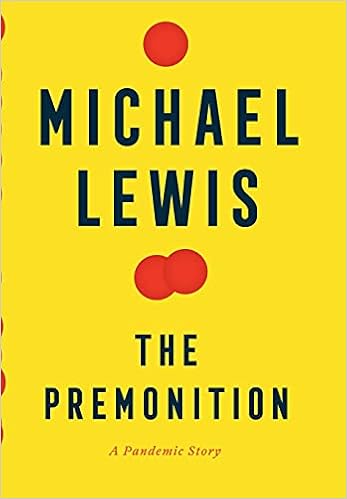 In The Premonition Michael Lewis brings his cast of heroes together like the assembling of the Avengers. In the role of Captain America is Charity Dean, the CA public health officer who is always under-estimated because she is slight and attractive, until she cracks open the ribcage of a cadaver that the men are afraid to touch. Then there is Carter Mecher, the redneck epidemiologist who has a gift for assembling numbers into coherent patterns. And Richard Hatchett the southern poet who finds himself at the head of The Coalition for Epidemic Preparedness (CEPI), the world’s most important organization during the pandemic; and Joe DiRisi the brilliant, mad scientist picked by the Chan Zuckerberg Initiative as the person most likely to cure disease…all of them. As you might expect from Michael Lewis, it’s all terribly well done, albeit formulaic and sometimes over-the-top, e.g.
Charity’s purpose was clear….she was put on earth to fight battles, and wars, against disease. To save lives and perhaps even an entire country. p. 200-201
But Lewis has a bigger problem than over-the-top writing.
The heroes were defeated. Lewis likes to tell stories of brilliant mavericks like Billy Beane and Michael Burry who go against the grain but eventually, against all odds, emerge victorious. But six hundred thousand people are dead in the United States and whatever victory we have won was ugly and slow. Indeed, Lewis assembles his mighty team but then The Premonition trails off as the team is defeated by bureaucracy, indecision, complacency and malaise before they even have a chance to enter the real battle against the virus. It’s telling that none of Lewis’s heroes are even mentioned in Andy Slavitt’s Preventable (about which I will say more in a future post).
To be fair, Lewis’s heroes are fascinating, brilliant people who did some good. As part of the Kremer team I interacted a bit with Richard Hatchett and CEPI. Hatchett headed CEPI and understood the danger of SARS-COV-II before anyone else and with Bill Gates’s support started funding vaccine production and shoring up supply lines before anyone else was off the starting line. CEPI was magnificent and their story has yet to be told in full measure. Had Lewis’s heroes been in charge I have no doubt that many lives could have been saved but, for the most part, the heroes were sidelined. Why and how that happened is the real question but Lewis’s story-telling skills aren’t the right skills to answer that question.
If there is one central villain in The Premonition, it’s the CDC. Lewis acknowledges that his perspective has changed. In The Fifth Risk, the system (the “deep state” used non-pejoratively if you will) is full of wisdom and power but it’s under threat from Trump. In The Premonition, Trump is an after-thought, at best a trigger or aggravating factor. Long before Trump or the pandemic:
Charity had washed her hands of the CDC. “I banned their officers from my investigations,” she said. The CDC did many things. It published learned papers on health crisis, after the fact. It managed, very carefully, public perception of itself. But when the shooting started, it leapt into the nearest hole, while others took fire. “In the end I was like ‘Fuck you’, said Charity. “I was mad they were such pansies. I was mad that the man behind the curtain ended up being so disappointing.” p. 42
As the pandemic starts the CDC fails repeatedly. At the beginning of the pandemic on January 29 the government had started to repatriate Americans from Wuhan bringing some of them to a National Guard base just outside of Omaha. But shockingly the CDC doesn’t test them for the virus.
Never mind that every single one of the fifty-seven Americans in quarantine wanted to be tested: the CDC forbade it. And [James] Lawler [US Naval Commander and national security coordinator on pandemic response] never understood the real reason for the CDC’s objections…Whatever the reasons, fifty-seven Americans spent fourteen days quarantined in Omaha, then left without having any idea of whether they’d been infected, or might still infect others. “There is no way that fifty-seven people from Wuhan were not shedding virus,” said Lawler. p. 176
Many of the people brought home from China are not even quarantined just told to self-quarantine:
…When local health officers…set out to find these possibly infected Americans, and make sure that they were following orders to quarantine, they discovered that the CDC officials who had met them upon arrival had not bothered to take down their home addresses.
…[Charity] posed a rude question to the senior CDC official moved on the call: How can you keep saying that Americans are at low risk from the virus if you aren’t even testing for the virus. She’d been answered with silence, and then the official move on to the next topic. [p.206-207, italics in original]
And all of this is before we get to the CDC’s famously botched test an error which was amplified by the FDA’s forbidding private labs and state governments to develop their own tests. Charity Dean wanted California to ignore the CDC and FDA and, “blow open testing and allow every microbiology lab to develop its own test.” But Dean is ignored and so by as late as February 19, “Zimbabwe could test but California could not because of the CDC. Zimbabwe!” p. 223. The failure of testing in the early weeks was the original sin of the crisis, the key failure that took a containment strategy ala South Korea and Taiwan off the table.
Lewis’s most sustained analysis comes in a few pages near the end of The Premonition where he argues that the CDC became politicized after it lost credibility due to the 1976 Swine Flu episode. In 1976 a novel influenza strain looked like it might be a repeat of 1918. Encouraged by CDC head David Sencer, President Ford launched a mass vaccination campaign that vaccinated 45 million people. The swine flu, however, petered out and the campaign was widely considered a “debacle” and a “fiasco” that illustrated the danger of ceding control to unelected experts instead of the democratic process. The CDC lost authority and under Reagan the director became a political appointee rather than a career civil servant. Thus, rather than being unprecedented, Trump’s politicization of the CDC had deep roots.
Today the 1976 vaccination campaign looks like a competent response to a real risk that failed to materialize, rather than a failure. So what lessons should we take from this? Lewis doesn’t say but my colleague Garett Jones argues for more independent agencies in his excellent book 10% Less Democracy. The problem with the CDC was that after 1976 it was too responsive to political pressures, i.e. too democratic. What are the alternatives?
The Federal Reserve is governed by a seven-member board each of whom is appointed to a single 14- year term, making it rare for a President to be able to appoint a majority of the board. Moreover, since members cannot be reappointed there is less incentive to curry political favor. The Chairperson is appointed by the President to a four-year term and must also be approved by the Senate. These checks and balances make the Federal Reserve a relatively independent agency with the power to reject democratic pressures for inflationary stimulus. Although independent central banks can be a thorn in the side of politicians who want their aid in juicing the economy as elections approach, the evidence is that independent central banks reduce inflation without reducing economic growth. A multi-member governing board with long and overlapping appointments could also make the CDC more independent from democratic politics which is what you want when a once in 100 year pandemic hits and the organization needs to make unpopular decisions before most people see the danger.
Lewis hasn’t lost his ability to write exhilarating prose about heroic oddballs. Page by page, The Premonition is a good read but the heroes in Lewis’s story were overshadowed by politics, bureaucracy and complacency–systems that Lewis’s doesn’t analyze or perhaps quite understand–and as a result, his hero-centric story ends up unsatisfying as story and unedifying as analysis.
*The Dope: The Real History of the Mexican Drug Trade*
That is a new and very useful book by Benjamin T. Smith, oddly it came out first in the UK. Here is one excerpt:
Over the past fifty years, to earn the median wage, a Mexican has had to sell an average of 700 grams of marijuana, 18 grams of heroin, or 66 grams of cocaine on the U.S. streets. It amounts to weed weighing two cans of soup, coke weighing a tennis ball, or smack weighing just three U.S. quarters. And this is only the average. During the economic collapse of the mid-1980s, it took only 280 grams of marijuana and 4.8 grams of heroin to make the annual wage. You could earn as much growing a single marijuana plant or a window box of poppies as driving a cab for a year.
And this:
Up to the 1970s, violence was rarely employed to sort out disputes between drug traffickers. The trade was relatively peaceful. Cooperation was the rule. Deep ties of blood, marriage, friendship, and neighborhood, which linked many of the traffickers, prevented the frequent use of force. In general, so did the local protection rackets. Both state governors and state cops were keen to avoid conflicts that risked exposing their own ties to the traffickers.
This changed because sometimes the later state authorities sought to institute their own protection rackets, using force toward that end. Many of the gangs sought to extend their turf beyond drugs to other commercial areas, also leading to conflict. Finally, the U.S.-led war on drugs induced a form of Mexican aggressive counternarcotics policing that bred conflict as well.
Overall this is a good book about a hard to research topic.
*Sub-Saharan Africa: Architectural Guide*
Seven volumes, $200 in paperback, multiple editors, due out in July. I just pre-ordered. Much better than wasting your time reading about the debates du jour.
I am very much looking forward to this one, I will learn lots from it. Will this be the book(s) of the year?
What should I ask Ruth Scurr?
Dr Ruth Scurr FRSL (born 1971, London) is a British writer, historian and literary critic. She is a Fellow of Gonville & Caius College, Cambridge.
Her first book, Fatal Purity: Robespierre and the French Revolution (Chatto & Windus, 2006; Metropolitan Books, 2006) won the Franco-British Society Literary Prize (2006), was shortlisted for the Duff Cooper Prize (2006), long-listed for the Samuel Johnson Prize (2007) and was listed among the 100 Best Books of the Decade in The Times in 2009. It has been translated into five languages.
Her second book, John Aubrey: My own Life (Chatto & Windus, 2015; New York Review of Books, 2016) was shortlisted for the 2015 Costa Biography Award and the James Tait Black Memorial Prize. It was chosen as a 2015 Book of the Year in fifteen newspapers and magazines, including: the Daily Telegraph, the Financial Times, the Times, the Sunday Times, the Times Literary Supplement, the Sunday Express, the Guardian, the Spectator and the New Statesman. It was chosen as a 2016 Book of the Year by Publisher’s Weekly, Kirkus Review and the Washington Post.
Scurr began reviewing regularly for The Times and The Times Literary Supplement in 1997. Since then she has also written for The Daily Telegraph, The Observer, New Statesman, The London Review of Books, The New York Review of Books, The Nation, The New York Observer, The Guardian and The Wall Street Journal.
That is from her Wikipedia page. She is an expert in the philosophy of biography and her new biography of Napoleon, which views his life through the medium of his involvement with gardens, has been receiving rave reviews. And here is her home page, and her article on her Cambridge house.
So what should I ask her?
Milton Friedman was once a Keynesian
In the early 1940s, Friedman’s own analysis of monetary policy adhered closely to the dismissive tone prevalent in much other Keynesian literature of that vintage. His solo-authored contribution to 1943’s Taxing to Prevent Inflation, written while he was at the Treasury, plotted growth rates of the nominal money stock and nominal income for the United States for the period 1899-1929. To the modern reader, the scatter plot in Friedman’s paper indicates that the monetary growth/income relationship is clearly positive, and reasonably tight by the standards of rate-of-change data. That was not, however, the judgment Friedman reached in his 1943 paper, in which he concluded instead that the relationship was “extremely unstable.”
That is from p.95 of the recent Edward Nelson two-volume set on Milton Friedman — one of the best books written on any economist!
Long-term gene–culture coevolution and the human evolutionary transition
It has been suggested that the human species may be undergoing an evolutionary transition in individuality (ETI). But there is disagreement about how to apply the ETI framework to our species, and whether culture is implicated as either cause or consequence. Long-term gene–culture coevolution (GCC) is also poorly understood. Some have argued that culture steers human evolution, while others proposed that genes hold culture on a leash. We review the literature and evidence on long-term GCC in humans and find a set of common themes. First, culture appears to hold greater adaptive potential than genetic inheritance and is probably driving human evolution. The evolutionary impact of culture occurs mainly through culturally organized groups, which have come to dominate human affairs in recent millennia. Second, the role of culture appears to be growing, increasingly bypassing genetic evolution and weakening genetic adaptive potential. Taken together, these findings suggest that human long-term GCC is characterized by an evolutionary transition in inheritance (from genes to culture) which entails a transition in individuality (from genetic individual to cultural group). Thus, research on GCC should focus on the possibility of an ongoing transition in the human inheritance system.
That is by Timothy M. Waring and Zachary T. Wood, via a loyal MR reader.
North vs. South India?
The data set used by Paul and Sridhar starts with the year 1960, when per capita income in Tamil Nadu was 51 per cent higher than UP’s. In the early 1980s, this difference had narrowed to 39 per cent. However, over the following decades the gap began to rapidly grow, and in 2005 an average resident of Tamil Nadu earned 128 per cent more than an average resident of Uttar Pradesh. (Statistics available online suggest that by 2021 the gap has increased to almost 300 per cent.)
Taking the South as a whole and the North as a whole, the book found that while the two regions differed only by 39 per cent in terms of per capita income in 1960-61, forty years later the gap had widened to 101 per cent. Now, in 2021, the gap has widened much further. Currently, the average annual per capita income of the four northern states profiled by Paul and Sridhar is about US $4,000, and of the four southern states, in excess of US $10,000, or roughly 250 per cent higher.
The data analysed by Paul and Sridhar show that there are two areas in which the South has done much better than the North. First, with regard to human development indicators such as female literacy rate, infant mortality and life expectancy. Second, in areas critical to economic development such as technical education, electricity generation, and quality and extent of roads. The first set of factors prepares healthier and better educated citizens to participate in the modern economy, while the second set enables much higher rates of productivity and efficiency in manufacturing and services.
Paul and Sridhar also found that the South fares substantially better than the North on governance indicators.
Here is the full piece by Ramachandra Guha, interesting throughout, with a pointer to Alice Evans, via Paul Novosad.
The Edward Nelson books on Milton Friedman
Two volumes, such a wonderful book, for sure one of the best of the year. Not quite a biography, more a study of Friedman’s career, but his career was his life so this is a wonderful biography too. Here is one excerpt:
Friedman was a student of business cycles who was prone to say that he did not believe there was a business cycle. He was a trenchant critic of reserve requirements as a monetary policy tools and a strong advocate of financial deregulation, yet he had many favorable things to say about moving to a regime of 100 percent reserve requirements. he stressed the looseness of the relationship between money and the economy, yet critics saw his policy prescriptions as predicated on a tight relationship. He criticized in detail the way the Federal Reserve allowed the money stock to adjust to the state of the economy, yet he was often characterized as treating empirical money-stock behavior as exogenous. He made fundamental contributions to the development of Phillips-curve theory, yet he was averse to conducting discussion of inflation prospects using Phillips-curve analysis. He spent much of his first two decades as a researcher working on labor unions and the use of market power in setting prices, yet for the subsequent five decades he found himself accused by critics of predicating his economic analysis on an atomistic labor market, a one-good model, or perfectly competitive firms.
Here is Scott Sumner on the book. Highly recommended, here is the Amazon link, and volume II.