Category: History
My excellent Conversation with Marc Andreessen
I’ve been wanting to do this one for some while, and Marc did not disappoint. Here is the audio, transcript, and video. Here is the summary:
Marc joined Tyler to discuss his ever-growing appreciation for the humanities and more, including why he didn’t go to a better school, his contrarian take on Robert Heinlein, how Tom Wolfe helped Marc understand his own archetype, who he’d choose to be in Renaissance Florence, which books he’s reread the most, Twitter as an X-ray machine on public figures, where in the past he’d most like to time-travel, his favorite tech product that no longer exists, whether Web will improve podcasting, the civilization-level changes made possible by remote work, Peter Thiel’s secret to attracting talent, which data he thinks would be most helpful for finding good founders, how he’d organize his own bookstore, the kinds of people he admires most, and why Deadwood is equal to Shakespeare.
And the opening:
COWEN: Simple question: Have you always been like this?
ANDREESSEN: [laughs] Yes. I believe that my friends would say that I have.
COWEN: Let’s go back to the junior high school Marc Andreessen. At that time, what was your favorite book and why?
ANDREESSEN: That’s a really good question. I read a lot. Probably, like a lot of people like me, it was a lot of science fiction. I’m one of the few people I know who thinks that late Robert Heinlein was better than early Robert Heinlein. That had a really big effect on me. What else? I was omnivorous at an early age.
COWEN: Why is late Robert Heinlein better?
ANDREESSEN: To me, at least to young me — see if older me would agree with this — a sense of exploration and discovery and wonder and open-endedness. For me, it was as if he got more open-minded as he got older. I remember those books, in particular, being very inspiring — the universe is a place of possibilities.
COWEN: What’s the seminal television show for your intellectual development in, say, junior high school?
ANDREESSEN: Oh, junior high school — it’s hard to beat Knight Rider.
COWEN: Why Knight Rider?
ANDREESSEN: There was a wave of these near science fiction shows in the late ’70s, early ’80s that coincided with . . . Some of it was the aftermath of Star Wars, but it was the arrival of the personal computer and the arrival of computer technology in the lives of ordinary people for the first time. There was a massive wave of anxiety, but there was also a tremendous sense of possibility.
Recommended, excellent throughout.
Against Historic Preservation II
In Manhattan, once famed for its ever-evolving skyline, an astonishing 27 percent of the borough’s lots now fall under the purview of the landmarks commission.
That’s from Jacob Andinder’s What Historic Preservation Is Doing to American Cities in the Atlantic. It’s a pretty good history of the movement for historic preservation focusing (of course) on some of the racist motivations and effects. But it has little to say about what to do about the consequent difficulties of building anything new. Similarly, here’s Binyamin Applebaum in the NYTimes correctly decrying the fact that historic preservation laws mean you can’t put solar panels on the rooftops of many homes in Washington, DC. Applebaum suggests a tiered approach.
I am more radical. All historical preservation laws should be repealed.
It’s one thing to require safety permits but no construction project should require a historic preservation permit. Here are three reasons:
First, it’s often the case that buildings of little historical worth are preserved by rules and regulations that are used as a pretext to slow competitors, maintain monopoly rents, and keep neighborhoods in a kind of aesthetic stasis that benefits a small number of people at the expense of many others.
Second, a confident nation builds so that future people may look back and marvel at their ancestor’s ingenuity and aesthetic vision. A nation in decline looks to the past in a vain attempt to “preserve” what was once great. Preservation is what you do to dead butterflies.
Ironically, if today’s rules for historical preservation had been in place in the past the buildings that some now want to preserve would never have been built at all. The opportunity cost of preservation is future greatness.
Third, repealing historic preservation laws does not mean ending historic preservation. There is a very simple way that truly great buildings can be preserved–they can be bought or their preservation rights paid for. The problem with historic preservation laws is not the goal but the methods. Historic preservation laws attempt to foist the cost of preservation on those who want to build (very much including builders of infrastructure such as the government). Attempting to foist costs on others, however, almost inevitably leads to a system full of lawyers, lobbying and rent seeking–and that leads to high transaction costs and delay. Richard Epstein advocated a compensation system for takings because takings violate ethics and constitutional law. But perhaps an even bigger virtue of a compensation system is that it’s quick. A building worth preserving is worth paying to preserve. A compensation system unites builders and those who want to preserve and thus allows for quick decisions about what will be preserved and what will not.
List of American membership associations with at least 1% of American adults enrolled as members, 1733-2004
https://twitter.com/Scholars_Stage/status/1536424749299032064
The book of the year?
Yale University Press is republishing Mancur Olson’s The Rise and Decline of Nations: Economic Growth, Stagflation, and Social Rigidities, with a new introduction by Ed Glaeser.
Here is an earlier Alex post on the book.
Facts about chickens
Although previous studies have made claims for an early origin of chickens, our results suggest that unambiguous chickens were not present until ∼1650 to 1250 BCE in central Thailand. A correlation between early chickens and the first appearance of rice and millet cultivation suggests that the production and storage of these cereals may have acted as a magnet, thus initiating the chicken domestication process.
Here is the full paper, via Anecdotal.
Factory Built Housing
Government concerns about great disparities in housing conditions, what are often called housing crises, date to at least the 1920s. These great disparities are, of course, still with us 100 years later. In this essay, we argue there will be no progress ending these great disparities until the residential construction industry adopts technology that other industries began adopting more than 100 years ago – factory production methods. There have been attempts to introduce these methods in residential construction for the last century, but they are always blocked and sabotaged by monopolies in the traditional construction sector, that is, the sector producing homes outside, on-site, using “stick-built” methods. Monopolies in traditional construction sabotage many types of factory-built homes. In this essay, we focus on the sabotage of particular types of such homes, what we call small-modular homes. These homes can be produced and sold at very-low prices, so that the sabotage of these homes has disproportionately hurt the low-income. The sabotage is the primary reason for the existence of, and perpetuation of, U.S. housing crises.
[Small-modular homes]…are blocked from most areas of the country – it’s simply illegal for a household to purchase such a home and place it on land owned by the household. In areas where they are “allowed,” they are often zoned for areas like manufacturing districts and dumps. Even then, regulations mean higher production costs for these homes in factories. They also mean the homes are financed as automobiles (with personal loans, or chattell loans) and not real estate loans. It’s clear why these homes are a threat to those constructing stick-built homes, especially in the lower-priced home market, and why monopolies in traditional construction have invested so heavily in blocking these small-modular homes. The homes are of high-quality, built to a strict national building code. They are manufactured at a cost per square foot that is one-third to one-half less than the cost per square foot to construct homes with traditional methods.
That’s from James Schmitz’s paper for the Minneapolis Fed, Solving the Housing Crisis will Require Fighting Monopolies in Construction.
Amazingly, a majority of the houses produced in the early 1970s were factory-built before these types of houses were driven out of the market. Capps at Bloomberg notes:
Manufactured homes briefly dominated the U.S. housing market during the 1960s. By 1972, these homes — not just mobile homes but small-scale modular houses — accounted for some 60% of all new single-family homes produced nationwide, according to census data. That number has diminished so much that the role of factories in building affordable housing has gone all but forgotten.
The Biden administration wants to put America’s house factories — those used to be a thing, really — back to work. A new housing plan by the White House offers a set of actions designed to close the nation’s massive affordability gap.
As Schmitz discusses at length in another paper, part of the reason economists have ignored the destruction of factory built housing is that economists came to think of the danger of monopoly as solely involving price (or, to put it the other way as Austrians do, they thought of the virtue of competition as only involving price.). In fact, monopolies reduce productivity and they use the political process to sabotage other firms. Competition isn’t just about price but about increased productivity and creative destruction.
P.S. I am in the process of building a factory-built house. The factory part was by far the easiest and most efficient part of the process.
Rubin and Koyama on the Industrial Revolution
From Dylan Matthews:
The big question is what drove this transformation. Historians, economists, and anthropologists have proposed a long list of explanations for why human life suddenly changed starting in 18th-century England, from geographic effects to forms of government to intellectual property rules to fluctuations in average wages.
For a long time, there was no one book that could explain, compare, and evaluate these theories for non-experts. That’s changed: How the World Became Rich, by Chapman University’s Jared Rubin and George Mason University’s Mark Koyama, provides a comprehensive look at what, exactly, changed when sustained economic growth began, what factors help explain its beginning, and which theories do the best job of making sense of the new stage of life that humans have been experiencing for a couple brief centuries.
Here is the full coverage with interview. And you can order the book here from Amazon. I haven’t read it yet, but this is surely self-recommending…
Moving From Opportunity: The High Cost of Restrictions on Land Use
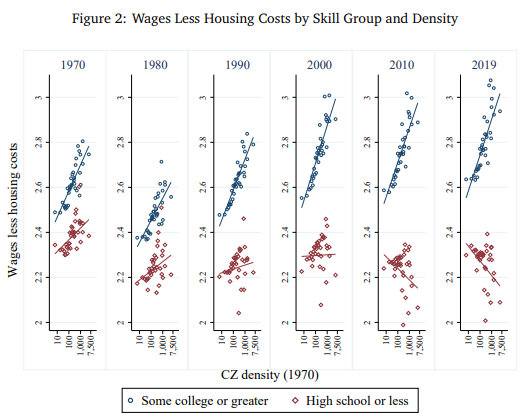
As I wrote earlier, it used to be that poor people moved to rich places. A janitor in New York, for example, used to earn more than a janitor in Alabama even after adjusting for housing costs. As a result, janitors moved from Alabama to New York, in the process raising their standard of living and reducing income inequality. Today, however, after taking into account housing costs, janitors in New York earn less than janitors in Alabama. As a result, poor people no longer move to rich places. Indeed, there is now a slight trend for poor people to move to poor places because even though wages are lower in poor places, housing prices are lower yet.
Ideally, we want labor and other resources to move from low productivity places to high productivity places–this dynamic reallocation of resources is one of the causes of rising productivity. But for low-skill workers the opposite is happening – housing prices are driving them from high productivity places to low productivity places. Furthermore, when low-skill workers end up in low-productivity places, wages are lower so there are fewer reasons to be employed and there aren’t high-wage jobs in the area so the incentives to increase human capital are dulled. The process of poverty becomes self-reinforcing.
Why has housing become so expensive in high-productivity places? It is true that there are geographic constraints (Manhattan isn’t getting any bigger) but zoning and other land use restrictions including historical and environmental “protection” are reducing the amount of land available for housing and how much building can be done on a given piece of land. As a result, in places with lots of restrictions on land use, increased demand for housing shows up mostly in house prices rather than in house quantities.
Moreover, as I also argued earlier, even though the net wage is still positive for college-educated workers a signficant share of the returns to education are actually going to land owners! Enrico Moretti (2013) estimates that 25% of the increase in the college wage premium between 1980 and 2000 was absorbed by higher housing costs. Moreover, since the big increases in housing costs have come after 2000, it’s very likely that an even larger share of the college wage premium today is being eaten by housing. High housing costs don’t simply redistribute wealth from workers to landowners. High housing costs reduce the return to education, reducing the incentive to invest in education. Thus higher housing costs have reduced human capital and the number of skilled workers with potentially significant effects on growth.
How did the IR community get Russia/Ukraine so wrong?
In proper Tetlockian fashion, I thought I would look back and consider how well IR experts did in the time leading up to the current war in Ukraine. In particular, how many of them saw in advance that a war was coming? And I don’t mean a day or two before the war started, though there were still many commentators in denial at such a late point.
Where to start? One might look at the mid-2021 words of the very smart Daniel Drezner:
Wertheim thinks that Ukraine could trigger a great-power war. Meh. In 2021 we have already had one round of Putin brandishing the sword on Ukraine, Biden standing firm, and the situation de-escalating. NATO’s deterrent power seems important to the region. To be honest I would be more worried about flash points in the Pacific Rim.
Drezner lived in the Donbas region for some while in the 1990s, so he is hardly a stranger to the relevant issues.
More recently Chris Blattman, who is also very able and very smart, wrote in February that Putin probably was not going to attack. Chris has just published a very well-received major book titled Why We Fight: The Roots of War and the Path to Peace. Chris does not pretend he is a Ukraine/Russia expert (“I know very little about Ukraine or Russia”), but he does command the literature on war and violent conflict with very real authority.
John Mearsheimer is one who foresaw the very real possibility of a war against Ukraine. I think he is quite wrong about NATO as the provocation, but if you are grading him on predictions alone obviously he wins some serious kudos.
See also this Scott Alexander post, though mainly I am looking for somewhat earlier predictions. By December 2021 a lot of us knew because it was pretty obvious (as for Scott’s puzzlement over me, due to the information flows I am sometimes in, I am not always in a position to make all my predictions fully public).
Garry Kasparov is another one who was right about the motives and the willingness of Putin to engage in further violent conquest, and I will return to him later. Garry knows a lot of IR, but of course he is not an IR scholar in the academic sense of that term.
Who were the other voices speaking up with urgency? IR voices? Comments are open and I hope you can guide me to the very best commentators who got this one right.
When I google “who predicted Russia war against Ukraine” I get Mearsheimer, a retired Russian general, and a blind psychic, but no bevy of IR scholars.
You might argue that IR scholarship is not about prediction, just as some macroeconomic theories themselves imply that recessions cannot be generally predicted. Still, if IR scholars understand this region reasonably well, many more of them should have been raising red flags, no pun intended. There is no analog of the efficient markets hypothesis here, so IR work should not be so far from some degree of predictive accuracy. Not so many scholars (of various kinds) predicted the collapse of the USSR, and I think it is absolutely correct to conclude they did not understand the late 1980s USSR very well. The same can be said of the earlier Iranian revolution, which also was not widely predicted.
As for further instances of getting it wrong, how about Obama’s famous gaffe in the 2012 debate with Mitt Romney, mocking Romney for his fear of Russia and cold war mentality? While Obama was a President and not an IR scholar, this was toward the end of his first-term and his was a “presidency of expertise” like few others have been. Obama was not irresponsibly “winging it” with his sarcastic take on Russian danger, rather it was a common point of view, especially among Democrats and Democratic political science experts at that time.
Or consider this more recently:
During Burns’ Senate confirmation hearing in February, he said that, as CIA director, he would have “four crucial and inter-related priorities.” They were: “China, technology, people and partnerships.” Russia was not on that priorities list.
Again, he is not an IR scholar but still:
To be fair, few people in Washington were bothered by that at the time. The city was far more obsessed, on a bipartisan basis, with China and its ambitions.
Overall, on a scale of one to ten, how would we grade the performance of IR scholars on the Russia-Ukraine war? 2? 2.5?
What are some possible reasons for those individuals so consistently missing the boat on this issue? I see a few options:
1. The IR community is mostly Democrats, and they were unprepared for the narrative that Putin might invade under Biden but not Trump. They too much had mental models where the evil of Putin works through Trump.
2. Perhaps the IR community doesn’t put enough emphasis on historical continuity and persistence. Russia has been messing around in Ukraine since at least Catherine the Great during the 18th century. Since that time, how many of those years has Ukraine been a semi-free, autonomous nation? Hardly any.
3. The IR community is risk-averse, and preserving of its academic reputations, and thus its members are less willing to make bold predictions than say pundits are. You might even think that is good, all things considered, but it will help explain the missed predictions here.
4. Perhaps partly for ideological reasons, it is hard for much of the IR community to internalize how much Putin (correctly?) thinks of the Western Europeans as cowards who will not defend themselves. The Western European nations are supposed to represent reasonable ways of running a polity, committed to social democracy above all else, and that is what so many academics believe as well. It might be hard for them to see that Western Europe has been full of folly, including with respect to nuclear energy and also collective defense.
5. Amongst academic and many of the scholars outside of academia but on the fringes, thoughts about evil are channeled into domestic directions, such as Trump, guns, “the right wing,” and so on. Maybe there isn’t enough mental energy to stay sufficiently alert about possible evils elsewhere. Along related lines, we don’t always have the background in the humanities, and history, to recognize that a certain kind of destructive evil still is possible in today’s world.
What else?
Listing those five points returns my attention to Kasparov, who has been banging the drum about Putin for quite a few years now and telling us Putin is going to do something like this. Garry is often considered an “extremist” by academics, or “not one of the club,” but it seems to me he has been entirely right and most of them entirely wrong. I know Garry, and can report that he really is able to pierce the veil on 1-5 very clearly. Perhaps that helped him see what was coming. For instance, Garry is strongly anti-Trump, but he doesn’t let that distract him from other issues of relevance. He also knows Russian history and the humanities very well, and his understanding of evil is well-calibrated to yield good predictions in situations like this.
I’ve also found that many individuals from the Baltic states, with real skin in the game, have had an appropriate level of suspicion about Russia for a long time. Anecdotally might this broadly Baltic view be more correct than the weaker suspicions held by the IR scholars?
Addendum: I’ve heard a few people claim that Putin is just an irrational madman and that he lies outside the sphere of prediction altogether. Well, the action in Ukraine had very definite and very direct precursors, including other invasions of Ukraine! It hardly seems like a pure black swan. Furthermore, a lot of the Russian public supports or at least tolerates the invasion. “Putin’s propaganda,” some cry, but all that same machinery of censorship and propaganda was not enough to get the Russian public to trust the Sputnik vaccine, which very likely would have saved many of their lives. So these events are not just about Putin by any means.
Also, if you are curious as to where I think things stand now, here is a good and interesting thread on the current state of the war and where it might be headed.
The Unfairness Doctrine
The great George Will hits another one out of the ballpark with some useful reminders:
Government pratfalls such as the Disinformation Governance Board are doubly useful, as reminders of government’s embrace of even preposterous ideas if they will expand its power, and as occasions for progressives to demonstrate that there is no government expansion they will not embrace.
…Using radio spectrum scarcity as an excuse, even before the Fairness Doctrine was created, Republicans running Washington in the late 1920s pressured a New York station owned by the Socialist Party to show “due regard” for other opinions. What regard was “due”? The government knew. So, it prevented the Chicago Federation of Labor from buying a station, saying all stations should serve “the general public.”
In 1939, Franklin D. Roosevelt’s administration conditioned one station’s license renewal on ending anti-FDR editorials. (Tulane Law School professor Amy Gajda’s new book, “Seek and Hide: The Tangled History of the Right to Privacy,” reports that earlier, FDR had “unsuccessfully pushed for a code of conduct for newspapers as part of the Depression-era National Recovery Act and had envisioned bestowing on compliant newspapers an image of a blue eagle as a sort of presidential seal of approval.”)
John F. Kennedy’s Federal Communications Commission harassed conservative radio, and when a conservative broadcaster said Lyndon B. Johnson used the Gulf of Tonkin incident in 1964 as an excuse for Vietnam escalation, the Fairness Doctrine was wielded to force the broadcaster to air a response.
Hat tip: Don Boudreaux at Cafe Hayek.
The fall of Sri Lanka
After the end of a devastating 26-year civil war in 2009, the island of 22mn had the makings of an Asian economic success story. Under governments run by the powerful Rajapaksa family, annual economic growth peaked at 9 per cent. By 2019, the World Bank had classified the island as an upper-middle income country. Sri Lankans enjoyed a per capita income double that of neighbours such as India, along with longer lifespans thanks to strong social services such as healthcare and education. The country tapped international debt lenders to rebuild, becoming a key private Asian bond issuer and participant in China’s Belt and Road Initiative.
And yet now everything is in tatters (that passage is from a very good FT piece). Here is one bit:
Sri Lanka’s reserves have fallen from $7.5bn in November 2019 to the point where finding $1mn is “a challenge”, Wickremesinghe, the new prime minister, said in an address last week. This has meant shortages of not only fuel but food and medicine, with hospitals forced to postpone surgeries. The country has the worst inflation in Asia at about 30 per cent in April and the currency has almost halved in value since it was floated in March. The UN Development Programme says that nearly half the population is in danger of falling below the poverty line, and warns of a looming humanitarian crisis as the urban poor and former middle class begin to cut back on meals.
And:
“Most people are down to one meal a day”, says her neighbour, Mohammad Akram, “but are embarrassed to admit it.”
I believe we have not yet internalized how rapidly a middle income country can fall from grace and into utter chaos.
That is now, this was then, Taiwan edition
Words matter, in diplomacy and in law.
Last week President Bush was asked if the United States had an obligation to defend Taiwan if it was attacked by China. He replied, “Yes, we do, and the Chinese must understand that. Yes, I would.”
The interviewer asked, “With the full force of the American military?”
President Bush replied, “Whatever it took” to help Taiwan defend itself.
A few hours later, the president appeared to back off this startling new commitment, stressing that he would continue to abide by the “one China” policy followed by each of the past five administrations.
Where once the United States had a policy of “strategic ambiguity” — under which we reserved the right to use force to defend Taiwan but kept mum about the circumstances in which we might, or might not, intervene in a war across the Taiwan Strait — we now appear to have a policy of ambiguous strategic ambiguity. It is not an improvement.
Here is the full 2001 Wapo Op-Ed — can you guess who the author was? Hint: a prominent Senator at the time. Via tekl.
Vodou Economics on the NYT on Haiti
From Craig Palsson, an expert in the economic history of Haiti and also fluent in Creole. Here goes:
My main argument is The New York Times is trying to expand from the paper of record to the academic journal of record. This is not the first time NYT has done this. The 1619 project had the same ambitions and similarly ignored academic standards. While I am an academic, I don’t see this as an existential threat. But I do think it has consequences. The 1619 project is now influencing academic work and school curricula…
To me, the biggest problem with the articles is a shocking lack of nuance and too much causal language for conclusions we cannot make. We can see this in the article titled, Invade Haiti, Wall Street Urged. The U.S. Obliged. Even that title lacks nuance and uses strong causal language…
The NYT article barely even considers the other motivations for invading Haiti. It alludes to political instability, but do you come away from that article understanding that the caco forces that resisted the Occupation were the same ones overthrowing the government before the invasion? It mentions the US paranoia that Germany might try to take over Haiti. But do you read the article and understand that Germans controlled about 80% of Haiti’s commerce? Or that the invasion happens during World War I, when Europe warned about German businesses operating in Latin America?
There is much more at the link, and Craig shows how the articles are geared to deliver a particular kind of selective moral message about guilt and blame, not to give the reader a decent understanding of Haiti and its history. A lot of the series focuses on the terrible French decision to extract reparations from Haiti, starting in the 19th century. You will not be taught, however, that Haiti and the Dominican Republic have diverged significantly since 1960, and since then the DR has become one of the wealthier nations in Latin America and Haiti has collapsed politically and is mired in extreme poverty, probably the worst in this hemisphere. Perhaps that divergence since 1960 needs to be addressed and cannot simply be reduced to much earlier imperialist crimes. There is even a massive Haitian decline since the 1990s, a time of relative hope.
I am not a “New York Times hater,” and would readily admit and indeed emphasize that significant parts of the newspaper are much, much better than anything else out there. But on particular topics, you just know you are being taken for a ride.
*21st Century Monetary Policy*
I am pleased to have received an autographed copy of this very carefully done work. I think it is (by far) the best treatment of what the Fed has been up to since the 1970s, at least on the monetary policy front. There really isn’t anyone who would know better than Ben, keeping in mind he was not only Fed chair but also a top, possibly Nobel-quality monetary economist and also economic historian. The clarity and writing quality are high.
In one way, however, this is an unusual book — there is remarkably little “of Ben” in the book. To be clear, Ben already has published his personal memoir. Still, if most of this book had been written by someone else, I would not have known. Or maybe that is what it means to “put Ben in this book.” Imagine Elon Musk writing a book on rocketry and focusing on the rockets.
In any case recommended. Here is a good David Leonhardt NYT review. It is striking to me how few reviews there are so far — why? Therein lies a lesson too, though I have yet to figure out what it is.
The stuff of horror movies?
Though the trend is a positive one:
We study the intergenerational persistence of inequality by estimating grandmother-mother associations in the loss of a child, using pooled data from 119 Demographic and Health Surveys in 44 developing countries. Compared with compatriots of the same age, women with at least one sibling who died in childhood face 39% higher odds of having experienced at least one own-child death, or 7 percentage points at age 49. Place fixed effects reduce estimated mortality persistence by 47%; socioeconomic covariates explain far less. Within countries over time, persistence falls with aggregate child mortality, so that mortality decline disproportionately benefits high-mortality lineages.
That is from a new NBER working paper by Frances R. Lu and Tom Vogl.