Category: Law
China in two stories
Here is one, by Adam Minter:
According to data released this week by the China Association of Automobile Manufacturers, sales of electric cars are poised to exceed those in the U.S. for the first time ever. Already, they’ve grown 290 percent year-on-year to 171,145 vehicles. They’re expected to reach 220,000 to 250,000 for the year, whereas the U.S. market is predicted to top out at around 180,000 cars.
What’s fueling the mainland’s electric-car surge? As with so many other things in China, cost is the main factor.
Here is the other, from Vanessa Piao at NYT’s Sinosphere blog:
Neither story, taken alone, leaves you with the right impression.
Thomas Schelling on Adapting to Climate Change
Yesterday, Thomas Schelling gave a seminar on climate change here at the Center for Study of Public Choice. Schelling’s main argument was that lots of resources are going into predicting and understanding climate change but very little thought or resources are going into planning for adaptation.
If Washington, DC, Boston and Manhattan are to remain dry, for example, we are almost certainly going to need flood control efforts on the level of the Netherlands. It takes twenty years just to come up with a plan and figure out how to pay for these kinds of projects let alone to actually implement them so it’s not too early to beginning planning for adaptation even if we don’t expect to need these adaptations for another forty or fifty years. So far, however, nothing is being done. Climate deniers think planning for adaptation is a waste and many climate change proponents think planning for adaptation is giving up.
Schelling mentioned a few bold ideas. We can protect every city on the Mediterranean from Marseilles to Alexandria to Tel Aviv or we could dam the Strait of Gibraltar. Damming the strait would be the world’s largest construction project–by far–yet by letting the Mediterranean evaporate somewhat it could also generate enough hydro-electric power to replace perhaps all of the fossil fuel stations in Europe and Africa.
Schelling didn’t mention it but in the 1920s German engineer Herman Sörgel proposed such a project calling it Atlantropa (more here). In addition to power, damming the strait would open up a huge swath of valuable land. Gene Roddenberry and Phillip K. Dick were fans but needless to say the idea never got very far. A cost-benefit analysis, however, might show that despite the difficulty, damming the strait would be cheaper than trying to save Mediterranean cities one by one. But, as Schelling argued, no one is thinking seriously about these issues.
I argued that capital depreciates so even many of our buildings, the longest-lived capital, will need to be replaced anyway. Here, for example, is a map showing the age of every building in New York City. A large fraction, though by no means all, are less than one hundred years old. If we let the areas most under threat slowly deteriorate the cost of moving inland won’t be as high as one might imagine–at least if the water rises slowly (not guaranteed!). Schelling agreed that this was the case for private structures but he doubted that we would be willing to let the White House go.
If we are going to save cities, especially buildings not yet built, should we not start taxing land today that is under threat of future flood? Act now to mitigate future moral hazard problems. John Nye and Robin Hanson raised this issue. See Robin’s post for more.
It was an enjoyable seminar. At 94, Schelling remains sharp, provocative, and in command of the facts.
How martial a country should the United States be? #guncontrol
Chris Blattman cites a recent estimate that Americans own 42% of the civilian guns in the world.
You’ll also see estimates that America accounts for about half of the world’s defense spending. I believe those numbers are a misuse of purchasing power parity comparisons, but with proper adjustments it is not implausible to believe that America accounts for…about 42% of the defense spending. Or thereabouts.
I see those two numbers, and their rough similarity, as the most neglected fact in current debates about gun control.
I see many people who want to lower or perhaps raise those numbers, but I don’t see enough people analyzing the two as an integrated whole.
I don’t myself so often ask “should Americans have fewer guns?”, as that begs the question of how one might ever get there, which indeed has proven daunting by all accounts. But I do often ask myself “should America be a less martial country in in its ideological orientation?”
Note that the parts of the country with the most guns, namely the South, are especially prominent in the military and support for the military.
More importantly, if America is going to be the world’s policeman, on some scale or another, that has to be backed by a supportive culture among the citizenry. And that culture is not going to be “Hans Morgenthau’s foreign policy realism,” or “George Kennan’s Letter X,” or even Clausewitz’s treatise On War. Believe it or not, those are too intellectual for the American public. And so it must be backed by…a fairly martial culture amongst the American citizenry. And that probably will mean a fairly high level of gun ownership and a fairly high degree of skepticism about gun control.
If you think America can sustain its foreign policy interventionism, or threat of such, without a fairly martial culture at home, by all means make your case. But I am skeptical. I think it is far more likely that if you brought about gun control, and the cultural preconditions for successful gun control, America’s world role would fundamentally change and America’s would no longer play a global policeman role, for better or worse.
So who’s in this debate?
1. There are the anti-gun modern Democrats, who want Americans to own many fewer firearms, and who maybe favor slight cuts in defense spending, in order to spend more on redistribution. They don’t come to terms with the reality that their vision for America’s international state requires a fairly martial supporting culture at home, including strong attachments to gun ownership.
By the way, citations of the Australian gun control experience are a good indicator of this position and its partial naivete; Australian pacifism can to some extent free ride upon American martial interest. Another “warning sign” is if someone is incredulous that the San Bernardino attack is strengthening America’s attachment to a relatively martial internal culture, rather than leading to gun control. That person is out of touch, even if he or she is right about the substance of the issue.
2. There is the radical, anti-war, anti-military-industrial complex, semi-pacifist, anti-gun Left. Their positions on these issues are quite consistent, though this branch of the Left has disappeared almost entirely.
3. There are the libertarians, who hate martial culture on the international scene, but who wish to allow it or maybe even encourage it (personally, not through the government) at home, through the medium of guns. They are inconsistent, and they should consider being more pro-gun control than is currently the case. But I don’t expect them to budge: they will see this issue only through the lens of liberty, rather than through the lens of culture as well. They end up getting a lot of the gun liberties they wish to keep, but losing the broader cultural battle and somehow are perpetually surprised by this mix of outcomes.
I except non-American libertarians from these charges, and indeed many of them, albeit under the table, in fact support gun control as a libertarian and indeed pro-peace position.
4. There are the “right-wing conservatives.” They support a martial ethic, they support America’s active foreign policy abroad, and they are anti-gun control for the most part. And they find their greatest strength in the relatively martial American South. Like the old anti-war Left, their positions are consistent, and their positions are rooted in a cultural understanding of the issue. They see the gun control movement as a war on America’s greatness, America’s martial culture and the material embodiments of said culture. They don’t understand why “the world’s greatest nation” should give up its superpower role, and its supporting internal martial culture, all for the sake of limiting the number of suicides and maybe stopping a few shootings too. To them it’s not close to being worth it.
OK, now look at who is winning this debate in terms of actual policy changes. It is the conservatives, for the most part. No matter how much you may disagree with them, they have the most coherent cultural and intellectual position, apart from the old anti-war Left. And in a fight between the right-wing conservatives, and the old anti-war Left, for the hearts and minds of the American people, we already know that, for better or worse, the conservatives usually will win.
I find that pro-gun control Democrats, and libertarians, are incapable of understanding the issue in these cultural terms. But if you read something by a “really stupid conservative” on gun control, the more emotive and manipulative the text the better, it is often pretty close to the mark on the actual substance of what is at stake here.
Here is my earlier post, The culture of guns, the culture of alcohol.
The Moral Character of Cryptographic Work
Here is a new and interesting paper by Philip Rogaway at UC Davis (pdf), here is the abstract:
Cryptography rearranges power: it configures who can do what, from what. This makes cryptography an inherently political tool, and it confers on the field an intrinsically moral dimension. The Snowden revelations motivate a reassessment of the political and moral positioning of cryptography. They lead one to ask if our inability to effectively address mass surveillance constitutes a failure of our field. I believe that it does. I call for a community-wide effort to develop more effective means to resist mass surveillance. I plea for a reinvention of our disciplinary culture to attend not only to puzzles and math, but, also, to the societal implications of our work.
Recommended, the paper has a good deal of substance, via Vitorino Ramos and Will Wilkinson.
Will investment banks institute a meaningful blockchain?
I’ve been saying “no, not really” for a while now. Here is a good Philip Stafford FT story on the question, excerpt:
With an internal blockchain “all you’ve done is set up an interbank liability”, says Peter Randall, chief executive of Setl, a UK blockchain start-up, and the former head of the Chi-X Europe share trading venue. “True settlement is where you never have to see the other party again. Settlement can only take place in central bank money.”
Any such system would have to be grafted on to banks’ existing IT and payment systems, some of which have been in place for decades, and meet the requirements of market watchdogs. Regulatory issues include anti-money laundering and trade reporting laws.
“In theory it could bring benefits,” says Mr Swanson. “But if we’re not rigorous in issues like switching costs and all the ‘boring stuff’, it won’t go anywhere.”
Many in the industry say expectations are too high, and favour a long-term, phased approach to putting asset classes on the blockchain. It could start with central bank transfers in the payments system and then move on to settlement of various types of security.
And this:
“In terms of total R&D at banks, it’s a drop in the ocean,” says Virginie O’Shea, an analyst at Aite. “They don’t see it as going to revolutionise their business. It’s more speculative than anything. Blockchain is this year’s ‘big data’.”
I’m going to stick with my prediction.
Zuist arbitrage culture that is Iceland and Sumerian too
Icelanders opposed to the state funding of religion have flocked to register as Zuists, a movement that worships ancient Sumerian gods and – perhaps more importantly – promises its followers a tax rebate.
More than 3,100 people – almost 1% of Iceland’s population – have joined the Zuist movement in the past two weeks in protest at paying part of their taxes to the state church and other religious bodies. Followers of Zuism will be refunded the tax element earmarked for religion.
Icelanders are required to register their religion with the state, with almost three-quarters of the population affiliated to the established Evangelical Lutheran Church of Iceland. There are more than 40 other registered religious bodies that qualify for “parish fees” paid through the taxation system. The amount set in next year’s budget is the equivalent of about $80 (£53) per taxpayer over a year.
“There is no opt-out. Those who are unaffiliated or belong to unregistered religions effectively just pay higher taxes,” said Sveinn Thorhallsson, a Zuist spokesperson. An opinion poll published in September showed 55% of respondents want an end to the system.
According to the article, some of the participants are starting to show interest in the religion. Hmm…
China fact (estimate) of the day
The China Medical Doctors’ Association recently found that 13 per cent of doctors surveyed had been physically attacked in the past year.
The FT article by Andrew Ward and Patti Waldmeir is interesting throughout, here is another bit:
Doctors are paid on average one-fifth the amount received by their counterparts in Europe and are required to see up to 150 patients a day.
Overall the Chinese health care system is considered to be extremely corrupt.
What I’ve been reading, and not reading
1. Michael Denning, Noise Uprising: The Audiopolitics of a World Musical Revolution. How recording began to revolutionize “world music” in the 1920s, a bit scattershot but still an interesting conceptual book about the history of music.
2. Mary Beard, SPQR: A History of Ancient Rome. I have only browsed this one, but it does appear to be one of the best and most readable overall histories of Rome. I’m keeping it in the basement and someday I’ll go back to it.
3. Peter Turchin, Ultra Society: how 10,000 years of war made humans the greatest cooperators on earth: “The central idea of this book is that it was competition between groups, usually taking the form of warfare, that transformed humanity from small-scale foraging bands and farming villages into huge societies with elaborate governance institutions and complex and highly productive economic life.” Basically true, in my view,and this book argues for that position persuasively.
4. Karthik Ramanna, Political Standards: Corporate Interest, Ideology, and Leadership in the Shaping of Accounting Rules for the Market Economy. Here is one opening summary bit: “With the financialization of the U.S. economy, particularly since the 1990s, we see a growing impact of investment banks and asset-management firms in accounting rule-making. These groups are more likely to propose rules that accelerate financial-statement recognition of anticipated economic gains — that is, fair-value accounting rules. Under certain circumstances, this can result in higher compensation to executives in these firms.” Most generally, the amount of lobbying over accounting rules seems to be increasing. Here is an NYT Op-Ed by Ramanna. Underdiscussed topics, I have only pawed through this one but it appears to be wel-informed.
How did China’s Cultural Revolution affect adolescent outcomes for the rusticated?
Yes, I thought this year it was time to search the job market candidates at National University of Singapore. I ran across some fascinating work by Huihua Xie:
Does a difficult environment in early life shape people’s core beliefs and values? We examine the long-term impact of the send-down movement during China’s Cultural Revolution, when urban educated youths were forced out of cities to work and live in undesirable rural areas. The mandatory policy applied to urban youth who graduated from junior or senior high school between 1966 and 1976. We identify the send-down effect by regression discontinuity, comparing individuals who graduated just before and just after the implementation of the policy. Using individual-level survey data, we find that rusticated individuals value family and relationships more highly, are less likely to believe in luck as the most important factor for success, and support social equality more strongly.
The paper, with Jie Gong and Yi Lu, is here, under resubmission at the JPE. She also has an interesting paper on how being rusticated during the Cultural Revolution led to later problems with chronic illness and mental health. Yet another paper considers whether and how the education of your sibling can make you better off or worse off, using regression discontinuity methods.
A guaranteed annual income for Finland?
The Finnish government is currently drawing up plans to introduce a national basic income. A final proposal won’t be presented until November 2016, but if all goes to schedule, Finland will scrap all existing benefits and instead hand out 800 euros per month—to everyone.
It sounds far-fetched, but it’s looking likely that Finland will carry through with the idea. Whereas several Dutch cities will introduce basic income next year and Switzerland is holding a referendum on the subject, there is strongest political and public support for the idea in Finland.
A poll commissioned by the government agency planning the proposal, the Finnish Social Insurance Institution or KELA, showed that 69% support (link in Finnish) a basic income plan. Prime minister Juha Sipilä is in favor of the idea and he’s backed by most of the major political parties.
There is more here, by Olivia Goldhill, via Matt Yglesias.
High skilled migration and global innovation
Another argument against the brain drain hypothesis is that bringing talented workers to the “frontier” countries will boost the supply of global public goods. Rui Xu, in her job market paper from Stanford (pdf), considers exactly this effect. Here are her main results:
Science and engineering (S&E) workers are the fundamental inputs into scientific innovation and technology adoption. In the United States, more than 20% of the S&E workers are immigrants from developing countries. In this paper, I evaluate the impact of such brain drain from non-OECD (i.e., developing) countries using a multi-country endogenous growth model. The proposed framework introduces and quantifies a “frontier growth effect” of skilled migration: migrants from developing countries create more frontier knowledge in the U.S., and the non-rivalrous knowledge diffuses to all countries. In particular, each source country is able to adopt technology invented by migrants from other countries, a previously ignored externality of skilled migration. I quantify the model by matching both micro and macro moments, and then consider counterfactuals wherein U.S. immigration policy changes. My results suggest that a policy – which doubles the number of immigrants from every non-OECD country – would boost U.S. productivity growth by 0.1 percentage point per year, and improve average welfare in the U.S. by 3.3%. Such a policy can also benefit the source countries because of the “frontier growth effect”. Taking India as an example source country, I find that the same policy would lead to faster long-run growth and a 0.9% increase in average welfare in India. This welfare gain in India is largely the result of additional non-Indian migrants, indicating the significance of the previously overlooked externality.
In other words, the brain drain argument is overrated. You might also wish to sample our MRUniversity video on the brain drain argument.
Is the gig economy taking over Washington, D.C.?
No, basically:
We first look at the number of District taxpayers who have paid self-employment taxes. The data show that the total number of people who pay self-employment taxes has increased in the District from 35,000 in 2006 to nearly 49,000 in 2014. This is a very steep increase (36 percent overall and nearly 4.5 percent annualized) even when compared to the relatively rapid increase in the District’s population and tax filers (tax filers grew at about 2 percent per year during the same period). But data show that the rapid increase in the number of filers who paid self-employment taxes occurred before 2010. In fact, since 2010, the share of tax filers who pay self-employment taxes has been stable at about 14 percent.
That is from a longer post, there is more at the link. Here is the broader (and excellent) blog on the law and economics of Washington, D.C., DistrictMeasured.com.
The optimal regulation of massage and prostitution
The job market paper of Amanda Nguyen, of UCLA, is on that topic, I found her results intriguing:
Despite its illegality, prostitution is a multi-billion dollar industry in the U.S. A growing share of this black market operates covertly behind massage parlor fronts. This paper examines how changes to licensing in the legal market for massage parlors can impact the total size and risk composition of the black market for prostitution, which operates either illegally through escorts or quasi-legally in massage parlors. These changes in market structure and risk consequently determine the net impact of prostitution on sexually transmitted diseases (STDs) and sexual violence. I track the impact of two policy changes in California that resulted in large variation in barriers to entry via massage licensing fees. Using a novel dataset scraped from Internet review websites, I find that lower barriers to entry for massage parlors makes the black market for prostitution larger, but also less risky. This is due to illegal prostitution buyers and suppliers switching to the quasi-legal sector, as well as quasi-legal sex workers facing a reduced wage premium for high-risk behavior. Consequently, the incidence of gonorrhea and rape falls in the general population. I also present evidence that growth in the quasi-legal sector imposes a negative competition externality on purely legal massage firms.
I don’t find the rape result intuitive, but I am seeing it pop up in a number of papers, so perhaps it should be taken seriously.
A Dual-Track Drug Approval Process
In a post earlier this year I noted that Japan has significantly liberalized its approval process for regenerative medicine. Writing in Forbes, Bart Madden and Nobelist Vernon Smith outline a similar proposal for the United States.
Recently, Japanese legislation has implemented the core Free To Choose Medicine (FTCM) principles of allowing not-yet-approved drugs to be sold after safety and early efficacy has been demonstrated; in addition, observational data gathered for up to seven years from initial launch will be used to determine if formal drug approval is granted.
…FTCM legislation in the U.S. would create a dual track system (see figure below) that preserves the existing FDA clinical trial process while offering patients an alternative. Patients, advised by their doctors, would be able to contract with a drug developer to use not-yet-approved drugs after Phase I safety trials are successfully completed and one or more Phase II trials have demonstrated continued safety and initial efficacy. The resulting early access could make FTCM drugs available up to seven years before conventional FDA approval, which entails Phase III randomized control trials and a lengthy FDA review before the FDA makes an approval decision.
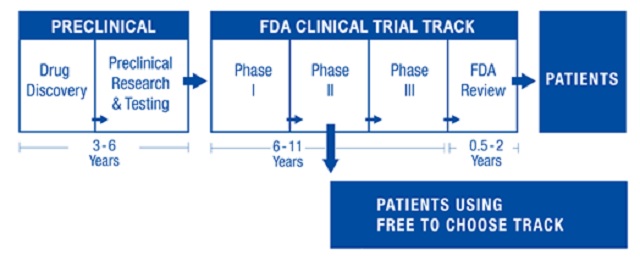
…The heart of the dual track system is the Tradeoff Evaluation Drug Database (TEDD) which would be available to the public through a government-supervised web portal. TEDD would contain all treatment results of FTCM drugs including patients’ health characteristics and relevant biomarkers, but no personal identification. This open access database would be a treasure-trove of information to aid drug developers in making better R&D decisions consistent with fast-paced learning and innovation.
…Today’s world of accelerating medical advancements is ushering in an age of personalized medicine in which patients’ unique genetic makeup and biomarkers will increasingly lead to customized therapies in which samples are inherently small. This calls for a fast-learning, adaptable FTCM environment for generating new data. In sharp contrast, the status quo FDA environment provides a yes/no approval decision based on statistical tests for an average patient, i.e., a one-size-fits-all drug approval process.
I hold the Bartley J. Madden Chair in Economics at the Mercatus Center so I am biased but this is an important proposal. Japan is leading the way and similar ideas are being discussed in Great Britain but as the most important pharmaceutical market in the world, the United States has an outsize influence on world drug development. We need to lower costs and speed new drugs to market.
*The Rise and Fall of Violent Crime in America*
That is a forthcoming book by Barry Latzer, it is very clear and well argued and I am happy to recommend it. Here are a few bits from the book:
1. From the 1930s through the 1950s, black cirrhosis death rates were lower than those for whites.
2. For Miami, Haitians were 3.5 percent of the murder suspects when they were 14 percent of the city’s population, from a 1985-1995 study.
3. If you ignore levels, and just look at rates of change, crime rates in Canada track those in the United States to an astonishing degree. How can that be? If demographics or jobs were the main driving force, maybe, but they are not…
4. He criticizes lead-based theories on the grounds that they seem “…unable to explain why the affected populations had relatively high offending rates in the years just prior to the great crime decline.”
You can pre-order it here.