Category: Law
Jim Crow and Black Economic Progress After Slavery
This paper studies the long-run effects of slavery and restrictive Jim Crow institutions on Black Americans’ economic outcomes. We track individual-level census records of each Black family from 1850 to 1940, and extend our analysis to neighborhood-level outcomes in 2000 and surname-based outcomes in 2023. We show that Black families whose ancestors were enslaved until the Civil War have considerably lower education, income, and wealth than Black families whose ancestors were free before the Civil War. The disparities between the two groups have persisted substantially because most families enslaved until the Civil War lived in states with strict Jim Crow regimes after slavery ended. In a regression discontinuity design based on ancestors’ enslavement locations, we show that Jim Crow institutions sharply reduced Black families’ economic progress in the long run.
That paper, by Lukas Althoff and Hugh Reichardt, will be coming out in the QJE, was it Florian Ederer who mentioned this on Twitter?
The Intellectual Roots of YIMBYism
At the Democratic National Convention former President Obama came out strongly in favor of housing deregulation saying “we need to build more homes and clear away some of the outdated laws and regulations that make it harder to build homes”. Robert Kwasny asks on X, “What are the intellectual roots of present-day YIMBYism?”
Looking at MR I think the first truly YIMBY post was a 2005 guest post by Tim Harford, Red tape and housing prices, pointing to a Slate article by Steven Landsburg. Here’s Landsburg:
Instead of the traditional formula “housing price equals land price + construction costs + reasonable profit,” we seem to be seeing something more like “housing price equals land price + constructions costs + reasonable profit + mystery component.” And, most interestingly, the mystery component varies a lot from city to city.
Even in cities like San Francisco, where there’s little room to build and land is consequently dear (on the order of $85,000 per quarter acre, compared with $2,200 for Dallas), you can’t use land prices to explain away housing prices. The mystery component in San Francisco housing—that is, the amount left over when you subtract land prices and construction costs from house prices—is the highest in the country.
Edward Glaeser of Harvard and Joe Gyourko of the University of Pennsylvania have computed these mystery components for about two dozen American cities. They speculate that the mystery component is essentially a “zoning tax.” That is, zoning and other restrictions put a brake on competitive forces and keep housing prices up. (Read one of their papers here.)
Zoning’s Steep Price, the Glaeser and Gyourko paper is actually from 2002 (a popular version of their NBER piece presented that same year at the NYFed) so you can see back in the old days it took years for ideas to circulate even among the bloggers! Nevertheless, 22 years from NBER paper to Presidential campaign is a great accomplishment. I see Glaeser and Gyourko as the YIMBY fountainhead. All hail Glaeser and Gyourko!
MR continued to promote housing deregulation on and off for years but I think it picked up around 2017 which is when the first YIMBY reference I can find on MR appeared in an assorted link. Here’s Tyler in 2017 pointing to a job market paper on how regulation increases housing prices and here is me in early 2018 on Why Housing in California is Unaffordable. The increase in research on this topic gave us something to talk about which is an interesting model of how ideas are transmitted.
Kwasny also wonders why Democrats seem to have picked up YIMBY more than Republicans, especially given that deregulation, anti-zoning, pro-growth, pro-developers would seem more compatible with Republican rhetoric and political support. Indeed, Zoning’s Steep Price was published in Cato’s Regulation and the assorted link which introduced YIMBY to MR was to an article blaming YIMBY on libertarians, Peter Theil and tech bros! (Congratulations Jeremy Stoppelman for an extremely effective EA donation!)
While it might have started out as being coded libertarian, Ezra Klein and Matt Yglesias are to be credited with pushing YIMBY and housing growth among Democratic elites. (Jon Favreau, an Obama speech writer, says Obama sounds like Ezra Klein!) But it’s not too late for Republicans to come home. Can’t we all agree on building more? Read Bryan Caplan in the NYTimes and buy his book!
Addendum: Tyler traces the intellectual roots of YIMBY back much further to Nicolas Barbon’s An Apology for the Builder which is also recommended by Marc Andreessen. For Britain, Sam Bowman points Mark Pennington’s excellent 2002 monograph Liberating the Land: The Case for Private Land-Use Planning (pdf).
Sweden fact of the day
…the country’s migration minister is celebrating the fact Sweden has “negative net immigration”, with more people thought to be leaving the country than entering for the first time in more than half a century.
“The number of asylum applications is heading towards a historically low level, asylum-related residence permits continue to decrease and for the first time in 50 years Sweden has net emigration,” Maria Malmer Stenergard announced earlier this month.
Sweden’s Moderate-led government, which is supported by the far-right Sweden Democrats, has pursued increasingly restrictive asylum policies, including plans for a “snitch law” that would legally require public sector workers to report undocumented people.
…the UN high commissioner for refugees confirmed the trend. It was surprising, the UNHCR said, that while global displacement was at an all-time high, the number of people seeking asylum in Sweden was at an all-time low.
“The statistics show Sweden having a net outflow of immigrants for the first time in decades,” Annika Sandlund, the UNHCR representative to the Nordic and Baltic countries, told the Guardian.
Here is the full Guardian piece. I think this is all going to work out reasonably well.
Why Top CEOs Earn Big Paychecks
 CEO compensation at large firms is high, especially in comparison to average worker wages, sparking debates over income inequality. Critics argue that such pay packages are unfair and disproportionate to actual company performance. Proponents contend that high pay reflects productivity and is necessary to attract scarce top talent to large firms. Let’s go to the ticker tape.
On August 12 shares of Starbucks were selling for about $77, a level they had been stable at for some time. On August 13, shares were selling for $94. What changed? On August 13, Starbucks announced that they were hiring a new CEO, Brian Niccol, who had held the top position at Chipotle.
There are some 1,132,800,000 Starbucks share outstanding so hiring Niccol instantly increased the value of Starbucks by just over $19 billion. In comparison, Niccol will be paid $1.6 million in salary, a bonus payment of $10 million and potential equity incentives that could be worth on the order  of $100 million or more if the stock continues to do well.
No question, Niccol is paid handsomely but it’s only a small percentage of the billions the market estimates he will create for other people, both consumers and investors.
Niccol has had a phenomenal streak as CEO of Chipotle raising the stock price from about $6 to $56. Thus, it wasn’t surprising that on the announcement of his move, Chipotle stock plunged from $56 to $46 (later recovering to around $52).
Using the latter number, the value of Chipotle fell by about $5.5 billion on the day of the Niccol announcement. That’s a remarkable fall given that the number two at Chipotle is probably no slouch. But heh, Kevin Durant doesn’t make quite as much as Steph Curry. (See yesterday’s post on the benefits of inequality!) Last year, Chipotle paid Niccol a total compensation package worth about $22.5 million. Again, a nice pay package but is there any question that Chipotle investors are sorry to see Niccol go?
Note also that the market expects Niccol to raise the value of Starbucks going forward more than he would have raised the value of Chipotle going forward so this move was a net gain for society. It’s important to remember that CEO pay is not just about incentives it’s about allocation.
Bottom line is that in the estimation of people who put their money where there mouth is, Niccol is worth the pay.
Addendum: Don’t forget my previous post in this series from 2013, The Value of a CEO looking at what happened when Ballmer exited Microsoft. Same basic lesson but in reverse! N.B. look at what has happened to Microsoft stock since!
All of this should also be put in the context of the Extreme Shortage of High-IQ Workers which one can also understand as the shortage of talent.
Go for the Gold!
Bob Lawson and I have an op-ed in Barrons with a new perspective on inequality. Kamala Harris has said inequality is “the defining economic challenge of our time.” Indeed, the Gini coefficient for the United States is 0.4, one of the highest among developed nations, and Senator Bernie Sanders says US inequality is “obscene.” But consider another economy:
In this economy, the Gini coefficient is a whopping 0.60—much higher than in the United States or just about any country in the world. Living in this economy must be miserable, right? Well, what if we told you that the average wage in this economy was around $3 million, the median wage close to $1 million, and the poorest 1% earned nearly $800,000 a year?
The economy we are talking about is the NFL. Is comparing inequality within countries to inequality within a sports league an unfair or irrelevant comparison? We don’t think so. NFL inequality can teach us a lot about what inequality statistics mean.
First, inequality does not mean poverty. The average income in the NFL is well above the U.S. average income. Even the poorest 1% do well. Is that a special case? Not at all. The average income in the United States is well above the world average income. And while our poorest 1% don’t have it easy, their situation looks far better when compared to most people in the developing world.
Second, unequal does not mean unjust. Salaries in the NFL are set by competitive market forces. Jared Goff (Detroit Lions) at the top of the NFL roster earns a lot more than Cameron Sutton (Pittsburgh Steelers), who earns the veteran minimum. But Goff didn’t steal his position from Sutton. Nor do Goff’s riches come from Sutton’s penury. Goff doesn’t earn more because Sutton earns less. Goff earns more because he produces more.
[Some people warn that inequality leads to envy, resentment, societal dysfunction and even collapse. But] Steph Curry’s salary dwarfs those of most of his teammates on the Golden State Warriors. Yet, do we see resentment manifesting on the court? Do Steph Curry’s lesser-paid colleagues refuse to pass him the ball or secretly hope for his downfall? On the contrary, Curry’s teammates rally around him. They recognize that his success elevates their chances of winning championships, enhances their visibility, and potentially increases their own market value.
The dynamics throughout our entire society are certainly more complex, but the sports analogy illustrates a crucial point: When inequality is perceived as a result of merit, effort, and value creation—rather than exploitation or unfair advantage—it fosters collaboration instead of resentment.
In such an environment, people see high earners as role models and partners in success, not adversaries. In the same way, if inequality in the United States is seen as a result of merit, effort and value creation it can help the U.S. team cooperate against rivals in the rest of the world. Go Curry! Go Team USA!
[Sports inequality helps us to understand inequality more generally.] The goal shouldn’t be to eliminate inequality, but to ensure it reflects real value creation in a system with ample opportunity and dignity for all. That is best achieved through competitive markets. Do that, and inequality transforms from a divisive force into a driver of progress.
In short: Don’t fear inequality. Fear unfairness. Build a just system, and let the scoreboard reflect the game.
India’s Cities
The Economist has a good piece on India’s cities. Mumbai has done a great job in recent years at building more infrastructure but infrastructure alone is not enough:
…An overly prescriptive, 2,200-page National Building Code and a surfeit of local rules prevent developers from making optimal use of pricey urban land. Mumbai has some of the most restrictive land-use regulations of any global megacity. In most well-functioning cities about 90% of land is given over to streets, public spaces and buildings. In Mumbai and other Indian cities, those uses take up less than half of the land area, according to analysis by Bimal Patel, an urban planner. The rest is wasted on “private open spaces”—mostly building compounds that are walled off and put to no good use.
The result is that Indian cities are sparsely built-up yet feel densely crowded, note Sanjeev Sanyal and Aakanksha Arora of the prime minister’s Economic Advisory Council. Cities sprawl outwards, driving up the cost of providing infrastructure.
The Economist misses, however, that to truly solve the problem what is needed is better institutions including private cities. Here’s Shruti Rajagopalan and myself writing in the NYTimes:
If China shows the costs of too much top-down planning, India shows the costs of too little. Indian urban development has suffered under an imposing edifice of overlapping bureaucracies and a philosophy of economics that prioritizes village life over urbanization. Together, Nehruvian bureaucracy and Gandhian economics, romanticizing rural agrarian life, have made it extremely costly to convert rural land for urban use. Indian urban development has lagged that of China, and the pressures for urbanization have resulted in the unofficial building of slums and illegal and chaotic development in large cities.
Gurgaon, a city southwest of New Delhi, is an exception. Gurgaon was a small town 25 years ago, but today it’s a city of some two million people filled with skyscrapers, luxury apartment towers, golf courses, five-star hotels and shopping malls. Often called “the Singapore of India,” Gurgaon is home to offices for nearly half the Fortune 500 firms.
Gurgaon, however, grew not by plan but in a fit of absence of mind. After the state of Haryana streamlined the licensing process, it left developers in Gurgaon to their own devices with little intervention from any national, state or local government. As a result, almost everything that works in Gurgaon today is private. Security, for example, is privately provided for almost all housing, shopping and technology complexes. Over all, about 35,000 private security guards protect Gurgaon, compared with just 4,000 public officers. Gurgaon also has India’s only private fire department, filling an important gap, because it must be capable of reaching Gurgaon’s tallest skyscrapers.
But not all is well. No developer in Gurgaon was large enough to plan for citywide services for sewage, water or electricity. For a price, private companies provide these, but in inefficient ways. Sewage doesn’t flow to a central treatment plant but is often collected in trucks and then dumped on public land. Tap water is often delivered by private trucks or from illegally pumped groundwater. Reliable electricity is available 24 hours a day, but often using highly polluting diesel generators.
Compared with the rest of India, Gurgaon fares well but its functioning is far from ideal. Is there a middle ground between China’s ghost cities and the anarchy of Gurgaon? Surprisingly, privately planned cities may be an answer. And one of the oldest is in India.
Jamshedpur was founded by Tata Steel, as a company town, in 1908. It has landscaped parks, paved roads and even a lake, but it’s no playground for the rich. It’s a working town. Nevertheless, it is the only city in the state of Jharkhand with a sewage treatment plant, and it’s one of the few cities in all of India where residents enjoy reasonably priced, reliable electricity and safe tap water. In a survey by the marketing research company Nielsen, residents ranked the city among the best in India for its cheap and reliable provision of sewage, water, electricity, public sanitation and roads.
Jamshedpur works because Tata owned enough land so that it had the right incentives to plan and invest in citywide infrastructure. Tata has also had to maintain good services in order to attract workers. In Gurgaon, private developers built lots of infrastructure, but only up to the property line. By extending the property line to city-scale, the incentives to build large-scale infrastructure like sewage, water and electricity plants are also extended.
See also Lessons from Gurgaon: India’s Private City and my MRU video Skyscrapers and Slums: What’s Driving Mumbai’s Housing Crisis?
Hat tip: Salim Furth.
Why doesn’t Switzerland have more air conditioners?
Installing air conditioning in Switzerland is often subject to rules set at the cantonal level. Geneva is the strictest canton. To qualify, a home owner must prove they have a legitimate need, for example, by producing a medical certificate, and install systems that capture some of the heat emissions and condensation produced.
Other cantons require air conditioners to be powered by solar panels. This increases the upfront cost for anyone without solar panels, putting them out of reach of many home owners.
Here is the full story, via Nicholas. And, via Steve Rossi, here is a Guardian article with the header “Neighbours turn on each other in Portofino air-con crackdown. Some residents of wealthy Italian village reportedly passing on photos to police who are hunting illegal units.”
Tabarrok on China: World of DAAS Podcast
I was very pleased to appear on Safegraph CEO Auren Hoffman’s World of DAAS podcast. We covered lots of material including this (lightly edited) bit on China.
Auren Hoffman (23:06.518):
Now, you’ve thought a lot about things like reshoring, building manufacturing capacity. How do you think we could be thinking about that differently?
Alex (23:24.058)
I understand that there are some concerns about China, and there is an argument and I think it’s a legitimate argument, that there are some things such as chips that we want to make sure, it’s not good to have them located in Taiwan, right? We want to make sure that we onshore those. However, I have three concerns. One is, fundamentally, I don’t think China and the United States have such a clash of interest. Of course, it’s not perfect harmony, but there’s a lot of harmony of interest between China and the United States. We do lot of trade with China, which benefits both China and the United States.
..China’s getting richer Okay, people are worried because they’re getting more military whatever but also what this means is that people in China are getting cancer. Well now there’s 1 .4 billion people who want to cure for cancer, and they’re willing to put some money into it, right? And then that’s going to increase the amount of research and development for all kinds of high-tech goods, which is amazing for us. Like, I would be thrilled if an American wins the Nobel Prize for curing cancer. I would be 99.5 % as happy if a Chinese scientist wins a Nobel Prize for curing cancer.
So we have a lot to gain from a richer China. That’s point one. Point two is that, yeah, I get the idea that we want to onshore chip manufacturing, but I think we want to friendshore, right? So we don’t want to just have protection against all countries. Like I get it, okay, a hundred percent tariff on your Chinese EVs. It’s kind of crazy, but all right. However, let’s reduce tariffs on Germany.
Let’s reduce tariffs on Europe. In fact, let’s create a free trade, even a free immigration block among the Western democracies, you know, including Japan, Australia, New Zealand. So, let’s not turn a small problem in foreign policy, which is to make sure that we have a ready military supply. Let’s not turn that into trying to create a fortress America Which is going to make us poorer and actually less safe instead, you know, let’s build up the free world. Okay, let’s create an immigration and free trade with Europe and Canada and Mexico and so forth. Let’s build up the free world. That’s point two.
Point three is that look. It’s very, very easy to take a foreign policy argument and turn it into rent seeking for the benefit of special interests and protectionism for the benefit of special interests. Right? So at one point in the United States, probably even still today, you know, we were prohibiting mohair imports. Okay. Why? Because we use mohair to make military uniforms. The whole thing is ridiculous. But it’s very easy, almost inevitable, that this kind of argument is turned into a special interest trough.
I think this is one of my best podcast appearances because we covered some new material on crime, the universities, why Tyler and I are able to cooperate on so many projects, a conspiracy theory I believe and more. Listen to the whole thing.
US Human Experimentation Without Consent or Contract
In July 1946, 20-year-old Helen Hutchison walked into the Vanderbilt University prenatal clinic in Nashville, Tennessee. Helen found herself pregnant after her husband had returned from combat in World War II. The pregnancy, however, had not been easy. During her visit to the clinic Helen’s doctor handed her a small drink.
“What is it?” she asked.
“It’s a little cocktail,” her doctor replied. “It’ll make you feel better.”
“Well I don’t know if I should be drinking a cocktail,” she responded in jest.
“Drink it all. Drink it all down” (quoted in Welsome 1999, p. 220).Helen did as her doctor ordered.
Three months later Helen’s daughter, Barbara, was born. Not long after, Helen began to experience some frightening health problems; her face swelled, and her hair fell out. She then experienced two miscarriages, one of which necessitated 16 blood transfusions (Welsome 1999, p. 220). Baby Barbara experienced her own health problems from early childhood. She suffered from extreme fatigue and developed an autoimmune disorder and eventually skin cancer.
…Unbeknownst to Helen, she and her unborn baby had been subjects in a government-funded experiment. She was one of hundreds of women who received an experimental “cocktail” between 1945 and 1947 during one of their prenatal visits, compliments of the U.S. Atomic Energy Commission (AEC), which provided the materials (Wittenstein 2014, p. 39).
The 829 women of the Vanderbilt clinic were but a few of hundreds of thousands of individuals, mostly U.S. citizens, who would be subjected to illegal experiments and suffer human-rights violations during in the post-World War II period at the hands of scientists with funding and materials provided by the U.S. government. These experiments were meant to provide the government with information about the effects of atomic weapons on the human body to advance military capabilities in the name of “national security.”
This paper tells the story of U.S. government activities related to human experimentation after World War II.
That’s Coyne and Hall writing on Dr. Mengele, USA Style: Lessons from Human Rights Abuses in Post World War II America. It’s interesting that these immoral experiments using radiation and also agents of chemical warfare are less well known to the public than say the Tuskegee Study even though they involved far more people.
New data on marijuana legalization
That is the topic of my latest Bloomberg column, and here is one excerpt:
What do the numbers show? A new study from the Federal Reserve Bank of Kansas City offers some important keys toward an answer.
Start with the good news, or what appears to be the good news. Post-legalization, incomes in legalizing states grew by about 3%, home prices went up by 6%, and populations rose by about 2%. The researchers used appropriate statistical controls, but there is some question about causation vs. correlation. At the very least, it seems highly likely that state GDP went up: A state with legal marijuana can sell it, including to users in other states. Selling marijuana is a new business, and like any new business, it boosts the local economy.
But it is not so simple. Measures of GDP and GDP per capita are usually good metrics for human well-being — but not always. Cigarette sales, for instance, are not as beneficial for citizens as much as the initial GDP boost might indicate, because nicotine is bad for most people…
In states with legal marijuana, self-reported usage rose by 28%. Meanwhile, substance use disorders increased by 17%. Chronic homelessness went up by 35%, a possible sign that marijuana use leads to a downward financial spiral, and perhaps job loss, for many users. Arrests increased by 13%, although reported crime did not itself go up.
And in sum:
That said, these results are hardly a great advertisement for the legalization experiments. They stand in jarring contrast to what advocates promised: an end to black markets, safer marijuana and a better-protected user population. And if I may be allowed to think less like an economist for a moment, I confess I don’t feel good about a social practice that lowers effective IQ. No one smokes pot to perform better on their SATs.
I remain of two minds on the entire question.
Worth a ponder.
Schengen eroding, child legal arbitrage markets in everything
“We are increasing surveillance, in part to increase security, but also to prevent hired Swedish child soldiers who come to Copenhagen to carry out tasks in connection with gang conflicts,” he added.
Hummelgaard revealed on Thursday that there had been 25 incidents since April where Danish criminal gangs had hired what he called “child soldiers” to commit crimes in Denmark. In the last two weeks alone, Danish police have linked three shootings to Swedish teenagers…
Swedish police say that powerful criminal gangs often use children to commit murders as they will receive light sentences. Drug gangs — many of whom are led by second-generation immigrants now living outside the country — have infiltrated parts of the welfare, legal and political systems, meaning the fight against them could take decades, according to Swedish officials.
Here is more from Richard Milne at the FT. Elsewhere, “Brown bears are protected under EU law,” solve for the equilibrium (FT).
England and Wales fact of the day
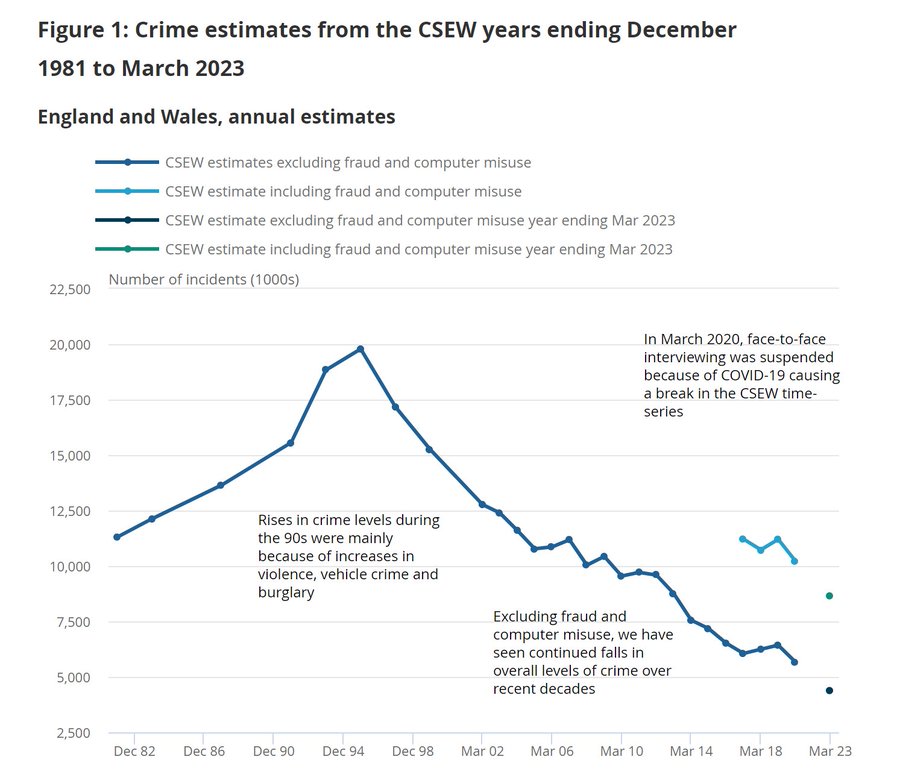
Here is the source.
Shaping the Habits of Teen Drivers
Here is one new method to lower teen-age driving deaths:
We show that a targeted law can modify teens’ risky behavior. We examine the effects of an Australian intervention banning first-year drivers from driving late at night with multiple peers, which had accounted for one-fifth of their traffic fatalities. Using data on individual drivers linked to crash outcomes, we find the reform more than halves targeted crashes, casualties and deaths. There are large positive spillovers through lower crashes earlier in the evening and beyond the first year, suggesting broad and persistent declines in high-risk driving. Overall, the targeted intervention delivers gains comparable to harsher restrictions that delay teen driving.
That is by Timothy J. Moore and Todd Morris in American Economic Journal: Economic Policy.
Approval timelines really matter for housing
We provide credible estimates of the effect of duration and uncertainty in local regulatory approval times on the rate of housing production. The analysis derives from a novel dataset of development timelines for all multifamily housing projects permitted in the City of Los Angeles between 2010 and 2022. As a lower bound, simply by pulling forward in time the completion of already started projects, we estimate that reductions of 25% in approval time duration and uncertainty would increase the rate of housing production by 11.9%. If we also account for the role of approval times in incentivizing new development, we estimate that the 25% reduction in approval time would increase the rate of housing production by a full 33.0%. Both the expected value and the uncertainty in approval times are salient to incentivizing new development. The results provide new evidence that local approval processes are a significant driver of housing supply and reinforce the notion that municipal regulatory reform is an important component of housing reform.
That is from a new research paper by Stuart Gabriel and Edward Kung, via the excellent Kevin Lewis. Speed also influences total supply! (rooftops)
Rent Control Reduces New Development: Bug or Feature?
The minimum wage will tend to increase unemployment among low-skill workers, often minorities. To many people that’s an argument against the minimum wage. But to progressives at the opening of the 20th century that was an argument for the minimum wage–progressive’s demanded minimum wages to get women and racial minorities out of the work force.
Something similar may be happening with rent control. Rent control reduces new development. Bug or feature? California Republican Tony Strickland argues that reduced development is a feature. New state laws in California prevent cities from restricting development but if rent control was legal cities could be used it to do the same thing just by making it unprofitable to build.
Politico: Strickland said Weinstein’s rent control measure [allowing cities to use rent control] would block “the state’s ability to sue our city” because Huntington Beach could slap steep affordability requirements on new, multi-unit apartment projects that are now exempt from rent control. Such requirements, he argued, could stop development that would “destroy the fabric” of the town’s quaint “Surf City” vibe…. “It gives local governments ironclad protections from the state’s housing policy and therefore overreaching enforcement.”
“On paper, it would be legal to build new homes. But it would be illegal, largely speaking, to make money doing so,” said Louis Mirante…
Hat tip: Ben Krauss at Slow Boring.