Category: Law
Mask Mandate Costs
There is now an NBER working paper on this topic:
This paper presents the results from a hypothetical set of questions related to mask-wearing behavior and opinions that were asked of a nationally representative sample of over 4,000 participants in early 2022. Mask mandates were hotly debated in public discourse, and though much research exists on benefits of masks, there has been no research thus far on the distribution of perceived costs of compliance. As is common in economic research that aims to assess the value to society of non-market activities, we use survey valuation methods and ask how much participants would be willing to pay to be exempted from rules of mandatory community masking. The survey asks specifically about a 3 month exemption. We find that the majority of respondents (56%) are not willing to pay to be exempted from mandatory masking. However, the average person was willing to pay $525, and a small segment of the population (0.9%) stated they were willing to pay over $5,000 to be exempted from the mandate. Younger respondents stated higher willingness to pay to avoid the mandate than older respondents. Combining our results with standard measures of the value of a statistical life, we estimate that a 3 month masking order was perceived as cost effective through willingness-to-pay questions only if at least 13,333 lives were saved by the policy.
That is by Patrick Carlin, Shyam Raman, Kosali I. Simon, Ryan Sullivan, and Coady Wing. A few comments:
1. Willingness to be paid magnitudes are often much higher than willingness to pay numbers. Especially when issues of justice and desert are involved. I know some people who might say: “I have a right to refuse a mask. I’m not going to pay anything not to wear one, but you would have to pay me a million dollars to put it on.” There are less extreme versions of this view, noting that even in quite normal laboratory circumstances WTBP can be 5x higher than WTP.
2. For many people the value of masking — either positively or negatively — depends on what others do. Some might feel “I guess I can wear a mask, but if you make everyone do that, that is a gross Orwellian dystopia.” Others, perhaps leaning more to the political left, might say: “I am willing to do my share, but of course I expect the same from everyone else. Let us sing this collective song and with our masks dance to the heavens!”
3. Why not just look at what private sector establishments chose when the force of law was not present? Don’t they have the best sense of how to internalize all the different factors behind what their customers want? Of course the answer here will vary, depending on what stage of the pandemic we are in.
What should I ask Velina Tchakarova?
Yes, I will be doing a Conversation with her. She runs a geopolitics firm, hails from Bulgaria, is in my view broadly classical liberal, focuses on conflict in Eastern Europe and Ukraine, and is very active on Twitter.
Here is Velina on LinkedIn. She does not seem crazy.
So what should I ask her?
The world of labor shortages, the culture that is alcohol
Drunken-driving deaths in the U.S. have risen to levels not seen in nearly two decades, federal data show, a major setback to long-running road-safety efforts.
At the same time, arrests for driving under the influence have plummeted, as police grapple with challenges like hiring woes and heightened concern around traffic stops.
Here is more from the WSJ. “About 13,500 people died in alcohol-impairment crashes in 2022…” Here is my earlier post on the culture of guns and the cultural of alcohol.
Via the excellent Kevin Lewis.
Migrants at Sea: Unintended Consequences of Search and Rescue Operations
Many countries are facing and resisting strong migratory pressure, fueling irregular migration. In response to mounting deaths in the Central Mediterranean, European nations intensified rescue operations in 2013. We develop a model of irregular migration to identify the effects of these operations. We find that smugglers responded by sending boats in adverse weather and utilizing flimsy rafts, thus inducing more crossings in dangerous conditions and ultimately offsetting intended safety benefits due to moral hazard. Despite the increased risk, these operations likely increased aggregate migrant welfare; nevertheless, a more successful policy should instead restrict supply of rafts and expand legal alternatives.
That is by Claudio Deiana, Vikram Maheshri and Giovanni Mastrobuoni, published in the latest issue of the AEA policy journal.
As a side point, the call for greater legality is under-argued to say the least. This is a classic example of academic bias not being called out, as there is zero consideration of the costs of such migration. Loyal MR readers will know I am hardly unsympathetic to immigration, but there are reasons why the arrival of so many migrants in Europe is unpopular. Policy recommendations can be issued without considering those reasons? And there is a call for the EU to help Africa grow — are there plausible policy instruments there with benefits above costs? Enough to matter for the migration problem? Doesn’t making poor societies richer often boost the flow of migrants because now migration can be planned and afforded? Also not discussed.
Or maybe it is that no one thinks these are real policy discussions, rather it is not “mood affiliation permissible” to simply end a piece on the note that trying to help vulnerable individuals can backfire and lead to a lot of moral hazard? And so a mood affiliation of “we care about them nonetheless” has to be slipped in at the end?
Either way come on, both authors and editors…
Nonetheless this is an interesting paper, worthy of attention! Here are less gated versions of the paper.
My Conversation with the excellent Coleman Hughes
Here is the audio, video, and transcript. Here is part of the episode summary:
Coleman and Tyler explore the implications of colorblindness, including whether jazz would’ve been created in a color-blind society, how easy it is to disentangle race and culture, whether we should also try to be ‘autism-blind’, and Coleman’s personal experience with lookism and ageism. They also discuss what Coleman’s learned from J.J. Johnson, the hardest thing about performing the trombone, playing sets in the Charles Mingus Big Band as a teenager, whether Billy Joel is any good, what reservations he has about his conservative fans, why the Beastie Boys are overrated, what he’s learned from Noam Dworman, why Interstellar is Chris Nolan’s masterpiece, the Coleman Hughes production function, why political debate is so toxic, what he’ll do next, and more.
Here is one excerpt:
COWEN: How was it you ended up playing trombone in Charles Mingus Big Band?
HUGHES: I participated in the Charles Mingus high school jazz festival, which they still do every year. It was new at the time. They invite bands from all around to audition, and they identify a handful of good soloists and let them sit in for one night with the band. I sat in with the band, and the band leader knew that I lived close by in New Jersey, and so essentially invited me to start playing with the band on Monday nights.
I was probably 16 or 17 at this point, so I would take the NJ Transit into New York City on a Monday night, play two sets with the Mingus Band sitting next to people that had been my idols and were now my mentors — people like Ku-umba Frank Lacy, who is a fantastic trombone player; played with Art Blakey and D’Angelo and so forth. Then I would go home at midnight and go to school on Tuesday morning.
COWEN: Why is the music of Charles Mingus special in jazz? Because it is to me, but how would you articulate what it is for you?
Here is another:
COWEN: If I understand you correctly, you’re also suggesting in our private lives we should be color-blind.
HUGHES: Yes. Broadly, yes. Or we should try to be.
COWEN: We should try to be. This is where I might not agree with you. So I find if I look at media, I look at social media, I see a dispute — I think 100 percent of the time I agree with Coleman, pretty much, on these race-related matters. In private lives, I’m less sure.
Let me ask you a question.
HUGHES: Sure.
COWEN: Could jazz music have been created in a color-blind America?
HUGHES: Could it have been created in a color-blind America — in what sense do you mean that question?
COWEN: It seems there’s a lot of cultural creativity. One issue is it may have required some hardship, but that’s not my point. It requires some sense of a cultural identity to motivate it — that the people making it want to express something about their lives, their history, their communities. And to them it’s not color-blind.
HUGHES: Interesting. My counterargument to that would be, insofar as I understand the early history of jazz, it was heavily more racially integrated than American society was at that time. In the sense that the culture of jazz music as it existed in, say, New Orleans and New York City was many, many decades ahead of the curve in terms of its attitudes towards how people should live racially: interracial friendship, interracial relationship, etc. Yes, I’d argue the ethos of jazz was more color-blind, in my sense, than the American average at the time.
COWEN: But maybe there’s some portfolio effect here. So yes, Benny Goodman hires Teddy Wilson to play for him. Teddy Wilson was black, as I’m sure you know. And that works marvelously well. It’s just good for the world that Benny Goodman does this.
Can it still not be the case that Teddy Wilson is pulling from something deep in his being, in his soul — about his racial experience, his upbringing, the people he’s known — and that that’s where a lot of the expression in the music comes from? That is most decidedly not color-blind, even though we would all endorse the fact that Benny Goodman was willing to hire Teddy Wilson.
HUGHES: Yes. Maybe — I’d argue it may not be culture-blind, though it probably is color-blind, in the sense that black Americans don’t just represent a race. That’s what a black American would have in common — that’s what I would have in common with someone from Ethiopia, is that we’re broadly of the same “race.” We are not at all of the same culture.
To the extent that there is something called “African American culture,” which I believe that there is, which has had many wonderful products, including jazz and hip-hop — yes, then I’m perfectly willing to concede that that’s a cultural product in the same way that, say, country music is like a product of broadly Southern culture.
COWEN: But then here’s my worry a bit. You’re going to have people privately putting out cultural visions in the public sphere through music, television, novels — a thousand ways — and those will inevitably be somewhat political once they’re cultural visions. So these other visions will be out there, and a lot of them you’re going to disagree with. It might be fine to say, “It would be better if we were all much more color-blind.” But given these other non-color-blind visions are out there, do you not have to, in some sense, counter them by not being so color-blind yourself and say, “Well, here’s a better way to think about the black or African American or Ethiopian or whatever identity”?
Interesting throughout.
Dean Ball on the new California AI bill (from my email)
SB 1047 was written, near as I can tell, to satisfy the concerns of a small group of people who believe widespread diffusion of AI constitutes an existential risk to humanity. It contains references to hypothetical models that autonomously engage in illegal activity causing tens of millions in damage and model weights that “escape” from data centers—the stuff of science fiction, codified in law.
The bill’s basic mechanism is to require developers to guarantee, with extensive documentation and under penalty of perjury, that their models do not have a “hazardous capability,” either autonomously or at the behest of humans. The problem is that it is very hard to guarantee that a general-purpose tool won’t be used for nefarious purposes, especially because it’s hard to define what “used” means in this context. If I use GPT-4 to write a phishing email against an urban wastewater treatment plan, does that count? Under this bill, quite possibly so.
If, back in the 70s, Steve Jobs and Steve Wozniak had to guarantee that their computers would not be used for serious crimes, would they have been willing to sign with potential jail time on the line? Would they have even bothered to found Apple?
Finally, because of its requirements (or very strong incentives) for developers to monitor and have the means to shut off a user’s access, the bill could make it nearly impossible to open-source models at the current AI frontier—much less the frontiers of tomorrow.
And here is Dean’s Substack on emerging technology (including AI) and the future of governance.
The work culture that is German, something about France too
In Germany, robots must obey the sabbath pic.twitter.com/vphLpXAA0e
— Matthew Yglesias (@mattyglesias) April 25, 2024
As for Canada, “Justice Minister defends house arrest power for people feared to commit a hate crime in future.“
The Prisoner’s Dilemma of Non-Competes
I agree with Tyler, that the FTC ban on non-competes is overly broad and not tailored to fields where the drawbacks outweigh the benefits. Additionally, the FTC’s authority to enact this rule, rather than Congress, is questionable.
Nevertheless, I don’t think banning non-competes is without merit. The reason is not the standard Twitter-econ view that non-competes are bad for workers. Indeed, some non-competes, so-called “gardening leave”, pay the worker during the non-compete period. Sounds pretty good! More generally, non-competes are just one item in the wage bargain like hours, health and pension benefits. As a result, the FTC is quite wrong to think that banning non-competes will raise wages–the most immediate effect will be to reduce wages. Indeed, more workers will be willing to work at lower wages precisely to the extent that non-competes were a burden. Can’t have it both ways. Instead of being bad for workers, my skepticism about non-competes is that they are bad for industry.
The problem with non-competes is that every firm wants non-competes on the workers it fires but no firm wants non-competes on the workers it hires. However, firms only control the terms on which they hire workers so it’s possible for each firm acting in its self-interest to create a situation which is in the interests of none. Or, to put it differently, firms may approve of the decision to ban non-competes because it’s a package deal, firms can’t restrict their own former employees but they gain the ability to recruit freely from competitors.
More generally, worker mobility often carries externalities. As I wrote earlier, ideas are in heads and if you don’t move the heads, often the ideas don’t move either. The innovation that results from mobility is a public good. Non-competes are a type of intellectual property, call it intellect property. Once again, firms want to lock up their intellectual property but they also want to use ideas from other firms. Firms only control the former decision not the latter so IP in general has a prisoner’s dilemma issue which is one reason IP in the US is too strong (see the Tabarrok Curve) and non-competes are part of that package. Ultimately, if the innovation effects are important, wages could rise but those effects would be for more or less all workers not specifically for those with non-competes.
Governments aren’t good at the fine details of optimizing IP so perhaps a heavy-handed approach is the best we can expect. Non-competes also aren’t a huge issue for most firms, even firms that use them, so given the above I am willing to give the experiment a try.
Why do I prefer current airport procedures?
Michael Stack writes me:
“Hi Tyler – you wrote about preferring current airport procedures to pre-9/11 procedures. Do you plan to elaborate on this? I have a hard time understanding why you’d feel that way.
Here is the list I produced – these are guesses as to why you might feel the way you do:
- Because friends/family can’t meet you at the gate, it reduces crowding in some of the stores, restaurants, and waiting areas.
- Security imposes a higher cost on travelers which reduces crowding – what are the pricing effects? Is this a transfer from airlines? From travelers?
- You’re very worried about another terrorist attack and think our security substantially reduces the chance of an attack.
I can’t really think of many other reasons you’d prefer the current approach.”
TC again: My view is fully his third explanation. Whether we like it or not, people and policymakers respond irrationally to terror attacks on airplanes, or terror attacks using airplanes. I do think the current procedures stop or discourage some number of idiots, noting they likely would not stop a sufficiently sophisticated attack attempt. But a lot of criminals are simply some mix of stupid and incompetent or poor on execution. You don’t want to have attacks on airplanes become any more focal/copycatted than they already are.
I fully get all the “why don’t they just set off a bomb by the passengers waiting to get through security” points, and the like. I just don’t think that is how it works. Why don’t school shooters go to playgrounds instead, or wherever? Maybe someday they will, but for now there is an odd stickiness in the nature of the events.
I don’t doubt that various features of the status quo could be improved, such as more security entry points being open and a better bureaucracy for generating and confirming pre-check privileges. Some of those improvements, however, might be more rather than less intrusive, such as more spot checks of passengers at security or during boarding.
Many people have objected to the point I made, but I don’t think the benefit-cost analysis on this one is close. Nor do I see a huge voter or elite demand to return to the pre-9/11 world for airports.
Four Thousand Years of Egyptian Women Pictured
 In an excellent, deep-dive Alice Evans looks at patriarchy in Egypt using pictures drawn from four thousand years of history. Here are three examples.
A wealthy woman, shown at right circa 116 CE. Unveiled, immodest, looking out at the world. A person to be reckoned with.
After the Arab conquests, pictures of people in general disappear, and there are no books written by women. With the dawn of photography in the 19th century we see (at left) what was probably typical, veiled women, and very few women on the street.
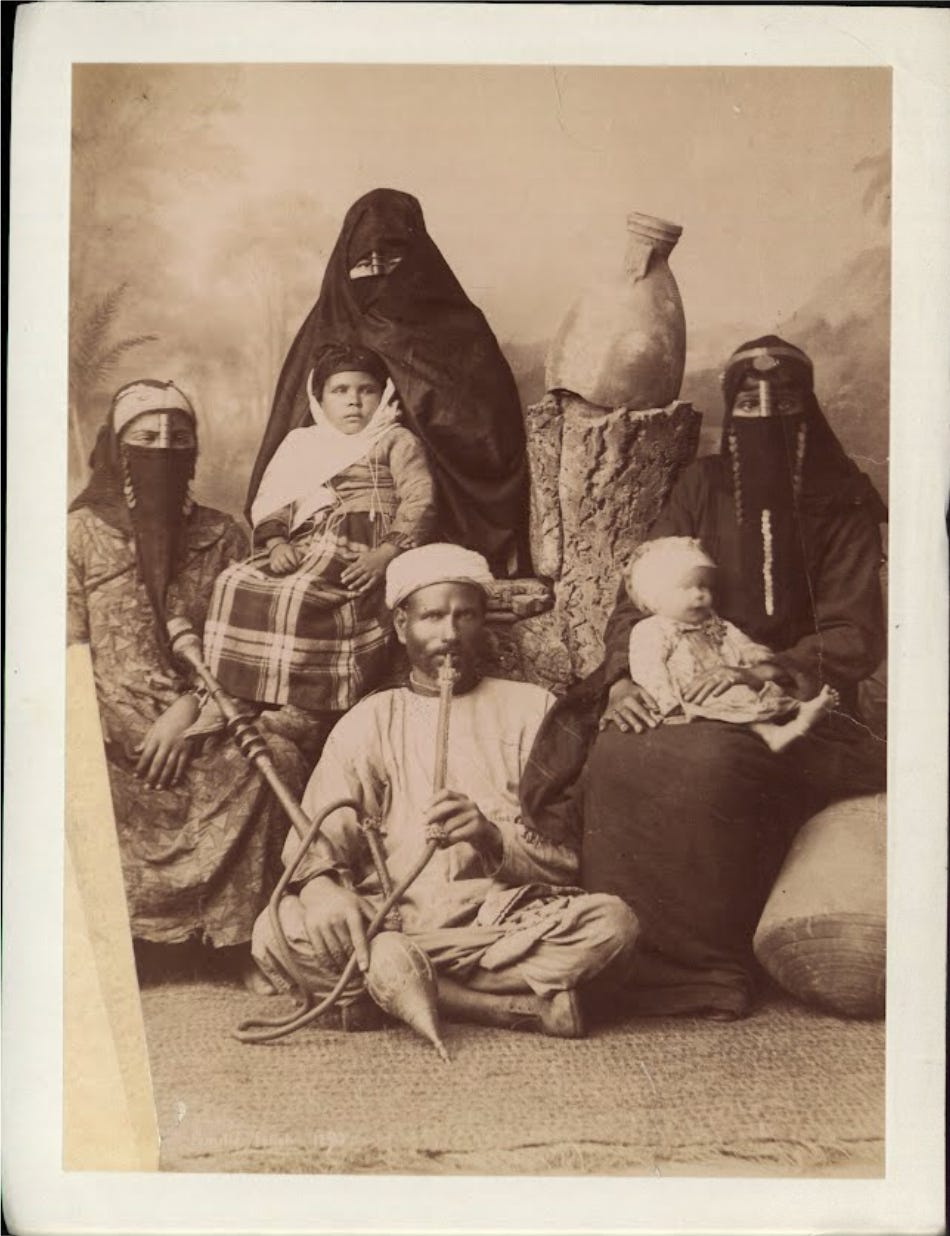
In the 1950s and 1970s we see a remarkable revitalization and liberalization noted most evidently in advertisements (advertisers being careful not to offend). Note the bare legs and the fact that many advertisements are directed at women (below)

This period culminates in a remarkable video unearthed by Evans of Nasser in 1958 openly laughing at the idea that women should or could be required to veil in public. Worth watching.
In the 1980s, however, it all ends.
Egyptians who came of age in the 1950s and ‘60s experienced national independence, social mobility and new economic opportunities. By the 1980s, economic progress was grinding down. Egypt’s purchasing power was plummeting. Middle class families could no longer afford basic goods, nor could the state provide.
As observed by Galal Amin,
“When the economy started to slacken in the early 1980s, accompanied by the fall in oil prices and the resulting decline in work opportunities in the Gulf, many of the aspirations built up in the 1970s were suddenly seen to be unrealistic and intense feelings of frustration followed”.
‘Western modernisation’ became discredited by economic stagnation and defeat by Israel. In Egypt, clerics equated modernity with a rejection of Islam and declared the economic and military failures of the state to be punishments for aping the West. Islamic preachers called on men to restore order and piety (i.e., female seclusion). Frustrated graduates, struggling to find white collar work, found solace in religion, whilst many ordinary people turned to the Muslim Brotherhood for social services and righteous purpose.
That’s just a brief look at a much longer and fascinating post.
Tying the Knot
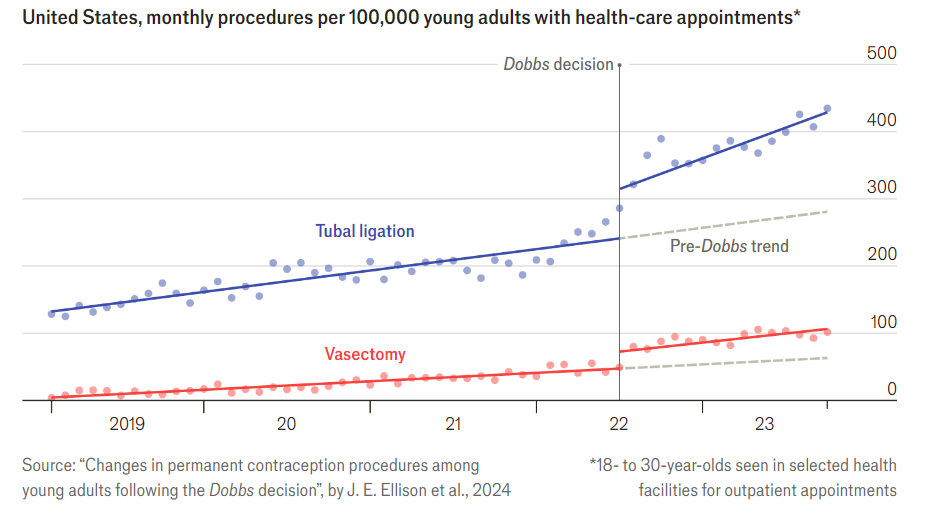
Dobbs, of course, was the Supreme Court decision saying that the constitution does not provide a right to abortion, thus leading to restrictions on abortion in many states. The pictures is from The Economist, the original paper is here.
Decoupling from China?
Maybe, but maybe not:
Amid the current U.S.-China technological race, the U.S. has imposed export controls to deny China access to strategic technologies. We document that these measures prompted a broad-based decoupling of U.S. and Chinese supply chains. Once their Chinese customers are subject to export controls, U.S. suppliers are more likely to terminate relations with Chinese customers, including those not targeted by export controls. However, we find no evidence of reshoring or friend-shoring. As a result of these disruptions, affected suppliers have negative abnormal stock returns, wiping out $130 billion in market capitalization, and experience a drop in bank lending, profitability, and employment.
That is from the NY Fed, by Matteo Crosignani, Lina Han, Marco Macchiavelli, and André F. Silva. Via RH.
Data on private security forces
From a recent paper:
We bring novel data to bear on these questions, presenting the largest empirical study of private security to date. We introduce an administrative dataset covering nearly 300,000 licensed private security officers in the State of Florida. By linking this dataset to similarly comprehensive information about public law enforcement, we have, for the first time, a nearly complete picture of the entire security labor market in one state. We report two principal findings. First, the public and private security markets are predominantly characterized by occupational segregation, not integration. The individuals who compose the private security sector differ markedly from the public police; they are, for example, significantly less likely to be white men. We also find that few private officers, roughly 2%, have previously worked in public policing, and even fewer will go on to policing in the future. Second, while former police make up a small share of all private security, roughly a quarter of cops who do cross over have been fired from a policing job. In fact, fired police officers are nearly as likely to land in private security as to find another policing job, and a full quarter end up in one or the other. We explore the implications of these findings, including intersections with police abolition and the future of policing, at the paper’s close.
That is by Ben Grunwald, John Rappaport, and Michael Berg. Via the excellent Kevin Lewis.
The Adderall Shortage: DEA versus FDA in a Regulatory War
A record number of drugs are in shortage across the United States. In any particular case, it’s difficult to trace out the exact causes of the shortage but health care is the US’s most highly regulated, socialist industry and shortages are endemic under socialism so the pattern fits. The shortage of Adderall and other ADHD medications is a case in point. Adderall is a Schedule II controlled substance which means that in addition to the FDA and other health agencies the production of Adderall is also regulated, monitored and controlled by the U.S. Drug Enforcement Administration (DEA).
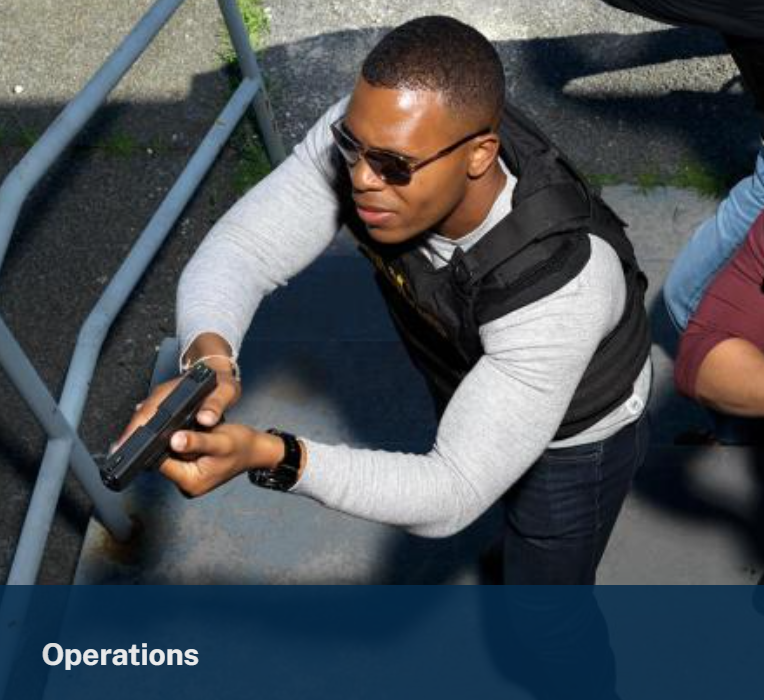 The DEA aims to “combat criminal drug networks that bring harm, violence, overdoses, and poisonings to the United States.” Its homepage displays stories of record drug seizures, pictures of “most wanted” criminal fugitives, and heroic armed agents conducting drug raids. With this culture, do you think the DEA is the right agency to ensure that Americans are also well supplied with legally prescribed amphetamines?
Indeed, there is a large factory in the United States capable of producing 600 million doses of Adderall annually that has been shut down by the DEA for over a year because of trivial paperwork violations. The New York Magazine article on the DEA created shortage has to be read to be believed.
Inside Ascent’s 320,000-square-foot factory in Central Islip, a labyrinth of sterile white hallways connects 105 manufacturing rooms, some of them containing large, intricate machines capable of producing 400,000 tablets per hour. In one of these rooms, Ascent’s founder and CEO — Sudhakar Vidiyala, Meghana’s father — points to a hulking unit that he says is worth $1.5 million. It’s used to produce time-release Concerta tablets with three colored layers, each dispensing the drug’s active ingredient at a different point in the tablet’s journey through the body. “About 25 percent of the generic market would pass through this machine,” he says. “But we didn’t make a single pill in 2023.”
… the company has acknowledged that it committed infractions. For example, orders struck from 222s must be crossed out with a line and the word cancel written next to them. Investigators found two instances in which Ascent employees had drawn the line but failed to write the word.
 The causes of the DEA’s crackdown appears to be precisely the contradiction in its dueling missions. Ascent also produces opioids and the DEA crackdown was part of what it calls Operation Bottleneck, a series of raids on a variety of companies to demand that they account for every pill produced.
To be sure, the opioid epidemic is a problem but the big, multi-national plants are not responsible for fentanyl on the streets and even in the early years the opioid epidemic was a prescription problem (with some theft from pharmacies) not a factory theft problem (see figure at left). Maybe you think Adderall is overprescribed. Could be but the DEA is supposed to be enforcing laws not making drug policy. The one thing one can say for certain is that Operation Bottleneck has surely been a success in creating shortages of Adderall.
The DEA’s contradictory role in both combating the illegal drug trade and regulating the supply of legal, prescription drugs is highlighted by the fact that at the same as the DEA was raiding and shutting down Ascent, the FDA was pleading with them to increase production!
For Ascent, one of the more frustrating parts of being told by the government to stop making Adderall is that other parts of the government have pleaded with the company to make more. The company says that on multiple occasions, officials from the FDA asked it to increase production in response to the shortage, and that Ron Wyden, the Democratic senator from Oregon, also pressed Ascent for help. They received responses similar to those the company gave the stressed-out callers looking for pills: Ascent didn’t have any information. Instead, the company directed them to the DEA.
UNOS Kills
I’ve long been an advocate of increasing the use of incentives in organ procurement for transplant; either with financial incentives or with rules such as no-give, no-take which prioritize former potential organ donors on the organ recipient list. What I and many reformers failed to realize, however, is that the current monopolized system is so corrupt, poorly run and wasteful that thousands of lives could be saved even without incentive reform. (To be clear, these issues are related since an incentivized system would never have become so monopolized and corrupt in the first place but that is a meta-issue for another day.) Here, for example, is one incredible fact:
An astounding one out of every four kidneys that’s recovered from a generous American organ donor is thrown in the trash.
Here’s another:
Organs are literally lost and damaged in transit every single week. The OPTN contractor is 15 times more likely to lose or damage an organ in transit than an airline is a suitcase.
Organs are not GPS-tracked!
In an era when consumers can precisely monitor a FedEx package or a DoorDash dinner delivery, there are no requirements to track shipments of organs in real time — or to assess how many may be damaged or lost in transit.
“If Amazon can figure out when your paper towels and your dog food is going to arrive within 20 to 30 minutes, it certainly should be reasonable that we ought to track lifesaving organs, which are in chronic shortage,” Axelrod said.
Here’s one more astounding statistics:
Seventeen percent of kidneys are offered to at least one deceased person before they are transplanted….
Did you get that? The tracking system for patients is so dysfunctional that 17% of kidneys are offered to patients who are already dead–thus creating delays and missed opportunities.
All of this was especially brought to light by Organize, a non-profit patient advocacy group who under an innovative program embedded with the HHS and working with HHS staff produced hard data.
Many more details are provided in this excellent interview with Greg Segal and Jennifer Erickson, two of the involved principals, in the IFPs vital Substack Statecraft.