Category: Medicine
Aaron Carroll on Medicaid Wars
Enough people have linked to this piece that I thought I should write a response, which you will find under the fold…
To start with a general remark. Often defenders of ACA request some kind of conservative engagement with the policy, rather than voting for the 34th (?) time for outright repeal with no coherent story of replacement. I’ve laid out a coherent scenario of how ACA could evolve into something which I consider better, and actually with only modest changes to the law itself. The mandate gets narrowed, the system as a whole evolves into means-tested vouchers (which proponents such as Zeke Emanuel favor), and possibly HSAs are given a larger role again. I say states will try to limit Medicaid growth, not that they should but that probably they can over the longer run. Defenders of the current ACA don’t have to favor my analysis, but in fact what I get back is sheer annoyance from Carroll, repetition of Carroll from various others, and an attack from Krugman, with no substantive engagement on the policy proposal at all.
Carroll writes five times that he is annoyed by my piece, but in hardly any of those cases is he disagreeing with any position I took. Let’s go through them one-by-one:
I get a bit annoyed when people claim that we can’t “afford” more government intervention or, god-forbid, single-payer. That kind of statement willfully ignores the fact that every country that has MORE government intervention spends LESS.
I most definitely did not say this and in fact I mentioned that single payer systems lower cost. Spending more on Medicaid, however, will not save the U.S. money (the Oregon study shows this), whether or not we can normatively “afford” it.
I get a bit annoyed by the claim that an expansion of government insurance leads to lines and waiting when lots of countries have universal access and less of a wait-time problem than we do.
A significant influx of people into Medicaid, under current institutions, will lead to more queuing. That is true whether or not you think other countries with single-payer have big queueing problems. What I wrote was this:
Unfortunately, Medicaid has some of the worst features of single-payer systems. Typically, a single-payer system will bargain down medical prices, thus adding to affordability, but at the risk of having long lines of patients waiting for care. As it stands now, though, the low reimbursement rates of Medicaid already lead to long lines, or an inability to find a good doctor altogether, while the higher reimbursement rates of Medicare and private insurance keep health care costs high.
It’s even carefully worded “…at the risk of having long lines of patients waiting for care.” Supply elasticities are positive and so single-payer systems do run this risk. Yet I am clear that in critical regards the systems of other countries get the better end of this deal compared to the United States.
Another bit:
I get a bit annoyed by blanket claims that doctors won’t accept Medicaid. Such statements often ignore the fact that the majority of Medicaid beneficiaries are children and pregnant women. We don’t need all types of doctors to accept Medicaid patients in equal numbers. They also ignore the fact that lots of doctors won’t accept new patients with Medicare or private insurance, either.
It is very difficult to find a good doctor in northern Virginia who takes Medicaid and I speak from personal experience (helping others). Or try any number of basic websites, with common quotations such as “Finding a Medicaid doctor constitutes a challenge…” Medicaid dentists are hard to find. Try calling say the Washingtonian “best doctors” list and see how many of them take Medicaid. Large numbers of doctors do take Medicaid but overall they tend to be much worse and there are also problems with queuing. Think about it: why would the lower payers end up first in line?
There is more annoyance:
I get a bit annoyed when people just claim government programs are “unpopular”. Like Medicare? I don’t think so. Is there any evidence that Medicaid is unpopular? I’d like to see it. Personally, I think that the fact that (a) all 50 states have bought in over time and (b) the Supreme Court just ruled that threatening to take it away is “coercive” speaks to the opposite. Additionally, polling shows the opposite of what Tyler (and lots of others) suggest.
I am sorry but this is a total “read fail.” I am saying Medicaid (not “government programs” or “Medicare”) will become increasingly unpopular. (In fact I am known for arguing that big government as a whole is quite popular.) Every day in the newspaper there is handwringing by governors, not all Republican ones, about wishing to limit or escape Medicaid obligations. A lot of them would prefer to get block grants and spend the money elsewhere (a simple question for Carroll: if Medicaid is so popular with voters, there is no reason to fear block grants to the states, right? Voters surely will insist that Medicaid spending be kept at current levels or perhaps even increased.) Daily Kos serves up plenty of evidence for the lukewarm support for Medicaid, as does Ezra Klein: “But, for a host of reasons, Democrats worry that Medicaid is more endangered than people realize.” Also note how skimpy Medicaid coverage is in many states. A lot of states don’t really try to cover poor adults, without children, at all. Frankly this is standard fare, especially on the left, but somehow if I write it he gets annoyed.
If you poll people and ask them whether they favor health care for the poor, of course they will say yes. The bottom line is this: right now we are borrowing about forty cents of every dollar spent. As we move toward fiscal balance, which are among the most vulnerable programs? Defense spending may be cut somewhat, but Medicaid is far more vulnerable than either Social Security or Medicare. I didn’t know that was under dispute and in fact it really isn’t.
Some more annoyance from Carroll:
I get a bit annoyed at the blanket acceptance of the awesomeness of the free market in health care, when there is no phenomenal evidence of its success. And again, those countries with less free market are cheaper, universal, and often just as good. So why are we always trying to run away from them?
That is another “read fail.” What did I call for in the column?
We would then have government-subsidized and mandated catastrophic insurance, and a freer market for other health care expenditures. We might even return to a health savings account approach on the noncatastrophic side.
I also note in the column that is not my first best, but we Americans probably cannot get easily to a first best system (for me a Singapore-style system, with single payer on the catastrophic side rather than mandates for private insurance purchase). My accompanying blog post even noted that the HSAs could be supplemented with government funds, if it was so desired.
The real argument of the column is that ACA will fall apart for political reasons because it creates too many different groups with different treatment. The “mood affiliation” of the column is something other than celebration of ACA, and so Carroll pulls out all of the old chestnuts and attacks them, rather than responding to the actual argument. Basically he should go back and reread the piece itself.
The new tug of war over Medicaid
My New York Times column is here, it has two parts, a prediction and a proposal. The prediction:
Medicaid has never been especially popular, and when its expanded role becomes more widely understood, it is likely to become less popular still.
I am not expecting that governors will turn away nearly-free federal dollars outright. (Though probably some will, here is an update on how the governors are reacting, which as I see it involves lots of bargaining.) I am predicting that the extreme subsidies for states to hop on to the expansion will at some point weaken or go away.
Change might come soon. If Mitt Romney wins the presidential election, and if Republicans control both houses of Congress, they could turn Medicaid into a block grant program, where states can spend the money as they wish.
Even if President Obama is re-elected, some state governments will work hard to reduce the number of people covered by Medicaid. State officials know that limiting Medicaid will place more individuals in the new, subsidized health care exchanges, and that those bills will be paid by the federal government. The basic dynamic is that state and federal governments have opposite incentives as to how many people should be kept in Medicaid.
The proposal? Here is my best take on how Obamacare might evolve into something more practical:
1. Many of the states slip out of expanded Medicaid obligations and many employers slip out of expanded mandate obligations to cover their employees (waivers, willingness to pay fines, lobby to have the law altered). The system evolves toward a form of means-tested vouchers, sold on the exchanges.
2. The subsidies for the private exchanges become so expensive that the individual mandate is limited in scope. Eventually the mandate applies to catastrophic coverage only.
3. For catastrophic coverage, we move toward a mandate and subsidized exchanges, and for non-catastrophic coverage there is no mandate and health savings accounts, the latter supplemented by public contributions if needed or if you wish.
I am not predicting that, nor is it my first or even preferred second-best solution. It is however the best solution I can see evolving out of ACA in its current form.
Medicaid Wars, Episode IV
While the resistance of Republican governors has dominated the debate over the health-care law in the wake of last month’s Supreme Court decision to uphold it, a number of Democratic governors are also quietly voicing concerns about a key provision to expand coverage.
At least seven Democratic governors have been noncommittal about their willingness to go along with expanding their Medicaid programs, the chief means by which the law would extend coverage to millions of Americans with incomes below or near the poverty line.
Here is more.
The pivot
…since the Supreme Court upheld the Democrats’ 2010 health care law, Republicans, led by Mitt Romney, have reversed tactics and attacked the president and Democrats in Congress by saying that Medicare will be cut too much as part of that law. Republicans plan to hold another vote to repeal the law in the House next week, though any such measure would die in the Democratic-controlled Senate.
“Obamacare cuts Medicare — cuts Medicare — by approximately $500 billion,” Mr. Romney has told audiences.
I have been predicting this. There is more here. Paul Ryan offered this account:
Mr. Ryan, of Wisconsin, was unavailable for comment, but, pressed on the issue on ABC’s “This Week” on Sunday, he said: “Well, our budget keeps that money for Medicare to extend its solvency. What Obamacare does is it takes that money from Medicare to spend on Obamacare.”
From Austan Goolsbee
Of all the public reactions to last Thursday’s surprise ruling from the Supreme Court on the Affordable Care Act, one of the most interesting came from the markets: Nothing happened.
Here is more, “The Supreme Court Rules, Markets Yawn.”
The Supreme Court and ACA
I liked Will’s post, these comments from John Cochrane, Ross Douthat, Megan McArdle, and these remarks by Ezra, among others. See also Krauthammer. A few points:
1. Trust is higher now, and that is worth something, even if like me you never favored the mandate segment of ACA.
2. Implicit in some of these writings is the notion of “contingent on the fact that Roberts upheld ACA.” You might have thought ex ante: “I don’t think Roberts should uphold ACA.” But Roberts is a smart and savvy guy, smarter and savvier than most of us and of course better informed about the Court than just about anyone. You could have held this view ex ante and still now hold: “Conditional on the fact that Roberts upheld ACA, I should think he did the right thing.”
Hardly anyone employs that line of reasoning, but that is a sign of our irrationality.
3. The Court maximizing or at least defending its prestige is sometimes necessary, even in a well-established constitutional democracy. The Court is not there to do what you want it to, or even necessarily to do what is right. Get used to that.
4. You may have noticed that I haven’t blogged the legal challenge to ACA all year. I think that plenty of what our government does is unconstitutional; just remember back to when an amendment was considered necessary for “The War against Alcohol”. But I’ve also long considered health care policy a matter to be settled by the legislature not the courts. Those are the modern rules of the game, for better or worse, and all along I have thought that trying to live outside those rules was a fool’s errand of sorts.
5. The Republican Party, by the way, still doesn’t have a coherent alternative for health care reform, nor do they seem willing to embrace many of the better parts of ACA, such as (partially) deregulating dentistry or the Medicare Advisory Board. Romney seems to want to replace the mandate with more expensive tax credits. Furthermore, I believe that many Republican legislators would rather run against an unpopular Obamacare than to have to craft an actual, legislate-able alternative.
6. I still believe the mandate segment of ACA will prove unworkable, but I won’t be expecting the courts to fix that.
7. I don’t vouch for this, but it is an angle I had not considered: “Making the mandate a tax has at least one other effect. It makes repeal easier. Now that the mandate has been deemed taxation, it can likely be jettisoned through use of the reconciliation process — meaning the Senate will need to muster only a bare majority for repeal, not 60 votes.”
8. I do think the Medicaid alterations in the Court’s decision will prove a big deal. I am well aware that the large federal subsidies mean it still makes financial sense for states to continue with the program and the various extensions embedded in ACA. But overall the program is not popular, and bringing it into the limelight in this fashion will go a long way toward making that common knowledge. Most of the coverage extension under ACA came through Medicaid, I saw that as in danger in the first place, and now all the more so.
The Massachusetts health care reform reduced emergency room visits
I just spotted a new paper by Sarah Miller (a fellow Messiaen fan), who seems to be on the job market this year from U. Illinois:
Abstract:This paper analyzes the impact of a major health reform in Massachusetts on emergency room (ER) visits. I exploit the variation in pre-reform uninsurance rate across counties to identify the causal effect of the reform on ER visits. My estimates imply that the reform reduced ER usage by about 8 percent, nearly all of which is accounted for by a reduction in non-urgent visits that could be treated in alternative settings. In contrast, I find no effect for non-preventable emergencies such as heart attacks. These estimates are consistent with a large causal effect of insurance on ER usage and imply that expanding insurance coverage could have a substantial impact on the efficiency of health services.
Don’t worry, I’ll get back to Stuxnet and related topics by Thursday.
Yana reviews the new John Goodman book
You can buy Priceless: Curing the Health Care Crisis here, her comments are under the fold…
Goodman’s *Priceless: Curing the Healthcare Crisis* is an excellent treatise on the healthcare industry and how our political solutions are making that world increasingly perverse, ineffective, and stagnant. Tyler has written before about how healthcare is one of the few remaining industries with low-hanging fruit for innovation. In my work I am consistently struck by how many great healthcare delivery ideas are illegal and Goodman showcases many examples of healthcare entrepreneurship which aren’t allowed to take off because of the regulatory environment and the entrenchment of major players.
Goodman at once lays a strong foundation for healthcare as a system “too complex for any single individual (or group of individuals) to grasp or understand” and makes a strong case for how much hubris policy has had in trying to address the problems of the industry. Herein lies the most powerful lesson of the book: while it is impossible that any entrepreneur will devise an overarching solution for our healthcare problems we have forgotten how to let process innovators test solutions and chip away at problems the way they do to roaring success in other industries.
Goodman pinpoints various turns the US has taken to bring existing private coverage and provision of services under the government umbrella. Woven together, these examples provide a vivid picture of systematically government payers have crowded out private sector solutions. This has led to stagnation while propagating the myth that the government is the only capable provider of services for everything from prescription drug coverage (with the passage of Medicare Part D) to comparative-effectiveness research ($1.1 billion allocated under the stimulus bill alone). This has led to a price system so broken that it does not exist. Goodman’s discussion of time prices exposes that we cannot simply push prices down without shifting the costs to other means of rationing. Similarly, his comparison of Medicaid to food stamps showcases how ridiculous Medicaid’s prohibitions on supplementing care with cash are, even within the internal logic of a robust welfare state.
Goodman is not shy about exposing the politics of healthcare and how it stands in the way of treating those who need care the most, including the poor and elderly, but this book is no exercise in partisanship. Rather, he homes in on one of the biggest insurmountable obstacles that the political debate brings to bear:
“Normally I do not comment on the motives of people I disagree with…Yet through the years I have discovered that the most important differences people have over health policy have little to do with facts, reasoning or logical argument. The most important differences stem from differences in fundamental world views. There are a very large number of people in this field who find the price system distasteful – at least for medical care…For well-intentioned reasons perhaps, they are emotionally predisposed to favor the suppression of normal market processes.”
Goodman has a strong grasp of realities such as the fact that many acute care services will always be sticky to being provided locally but that ambulatory and elective procedures make up the majority of the market and have the potential for reinventing how healthcare is delivered. Many will disagree with the ideas presented but the book will push the thinking of anyone involved in healthcare. This is especially true since Goodman has a thoroughgoing understanding of healthcare as an industry, a quality which most of the loudest voices in policy sorely lack.
Will Uruguay legalize marijuana?
Uruguay is showing a novel approach to Latin America’s growing fatigue with the war on drugs with a new proposal: normalize marijuana use and hand over its distribution and marketing to the government.
Under a plan Defense Minister Eleuterio Fernández Huidobro announced late Wednesday, which the leftist government will soon present to lawmakers, the state will oversee sales, which would be allowed only to adults 18 and older.
The article is here, here is more, hat tip goes to @EndeavoringE.
Medical Tourism
We have all heard about medical tourism to India, Singapore or Thailand, places where patients can enjoy high quality and low prices. But do you know about medical tourism to the United States? By some estimates, around 400,000 people travel to the United States for medical treatment every year and the big surprise is that for tourists U.S. health care prices can be very low! Canadians coming to the United States can get a knee replacement for less than half of what Americans pay and at a price not much more than they would pay in India. I learned this from John Goodman’s very interesting new book, Priceless: Curing the Healthcare Crisis (this is an Independent Institute book where I am director of research).
Nor is that the end of the story. Here is Goodman on an even more surprising twist:
Moreover, you do not have to be a foreigner to benefit from domestic medical tourism.
Colorado-based BridgeHealth International offers US employer plans a specialty network
with flat fees for surgeries paid in advance that are 15 percent to 50 percent less than a
typical network. North American Surgery, Inc., has negotiated deep discounts with 22
surgery centers, hospitals and clinics across the United States as an alternative to foreign
travel for low-cost surgeries. As noted, the “cash” price for a hip replacement in the
network is $16,000 to $19,000, making it competitive with facilities in India and
Singapore.One reason why so little is known about the domestic medical tourism market is that
hospitals prefer that most of their patients not know about it. The reason: they are often
offering the traveling patient package prices not available to local patients. That occurs
because the hospital is only competing on price for the patients who travel.
To be sure, the prices paid in the “travel” market are probably closer to marginal prices than average prices. Nevertheless, I think Goodman is absolutely right to focus in on the sectors of the health care economy which are competitive, it is in these sectors that we see listed prices, falling costs and increasing quality. Priceless is about how we can expand the competitive sectors. More on the book here.
What kind of mandate should “the right” have supported?
The conservatives and libertarians who earlier supported a mandate, ideally, should have been looking for the following qualities in a health care policy:
1. A very small number (one?) of categories for health care coverage and also reimbursement rates. Mandates for everyone, in other words. No Medicare, no Medicaid, no separate set of people in an employer-based, tax-subsidized health insurance sector, rather a unified system. Switzerland comes relatively close to this, and of course some commentators hope ACA will evolve into this (“means-tested vouchers”), though I suspect the scope of the mandate and the cost of the subsidies will prevent this.
2. A rejection of health care egalitarianism, namely a recognition that the wealthy will purchase more and better health care than the poor. Trying to equalize health care consumption hurts the poor, since most feasible policies to do this take away cash from the poor, either directly or through the operation of tax incidence. We need to accept the principle that sometimes poor people will die just because they are poor. Some of you don’t like the sound of that, but we already let the wealthy enjoy all sorts of other goods — most importantly status — which lengthen their lives and which the poor enjoy to a much lesser degree. We shouldn’t screw up our health care institutions by being determined to fight inegalitarian principles for one very select set of factors which determine health care outcomes.
3. A modest bundle of guaranteed coverage and services. I am very influenced by David Braybrooke’s book on meeting basic needs. Yet for me basic needs truly are basic and do not involve cable TV or small probability chances of delaying death from prostate cancer.
4. Price transparency (mandated if need be) and real competition in the health care sector, including freer immigration for doctors, nurses, and other caregivers, and relaxation of medical licensing and encouragement of retail medical clinics, a’la WalMart style. This helps keep the cost of the mandate to reasonable levels. Most cost-saving innovation should come through markets. The man strapped to a gurney, bleeding, while negotiating a price with his doctor is the exception in this sector, not the rule. In any case the insurance companies can prearrange the price for that one.
5. If you wish to move away from the strictly conservative direction, you could consider price controls on some areas of medicine. Singapore does them.
6. Always convert dollars of benefits, usually a private good, into dollars of support for medical research and development, a public good. You will never end up at a margin where this is a bad trade.
7. Society should firmly believe that it is the duty of the government, first and foremost, to protect us against foreign enemies, environmental catastrophes, pandemics, and other existential threats. History shows that such existential threats are real. Alleviating individual sufferings through governmental charity can be a useful source of mutual advantage but it should be subordinate to these broader goals. Furthermore we should be determined to resist the creation of a large class of perpetual beneficiaries who will strangle the government fiscally and pull it away from these more basic duties.
I would think that such a mandate would be a serious policy option, though maybe not a first best choice. (There are also mixes of single payer backstops and HSAs, as in Singapore, and a variety of provincial systems.) Yet that is far from the ACA. We should not “blame” Obama for that difference (it’s not clear what his more utopian preferences might be, though it is clear he could not have passed them), but still it seems to me that observers can support some version of an individual mandate and oppose ACA.
I agree, by the way, with Ezra Klein’s analysis of the “motivated reasoning” of many particular individuals when confronted with ACA a few years ago. You can think of this post as an “ideal type” analysis which may or may not apply to many actual people.
Drug Shortages Caused by the FDA
 Shortages of drugs, especially generic injectables, continue to cause significant harm to patients. A new Congressional report offers the best account to date of the shortages and provides details confirming my earlier post. The story in essence is this:
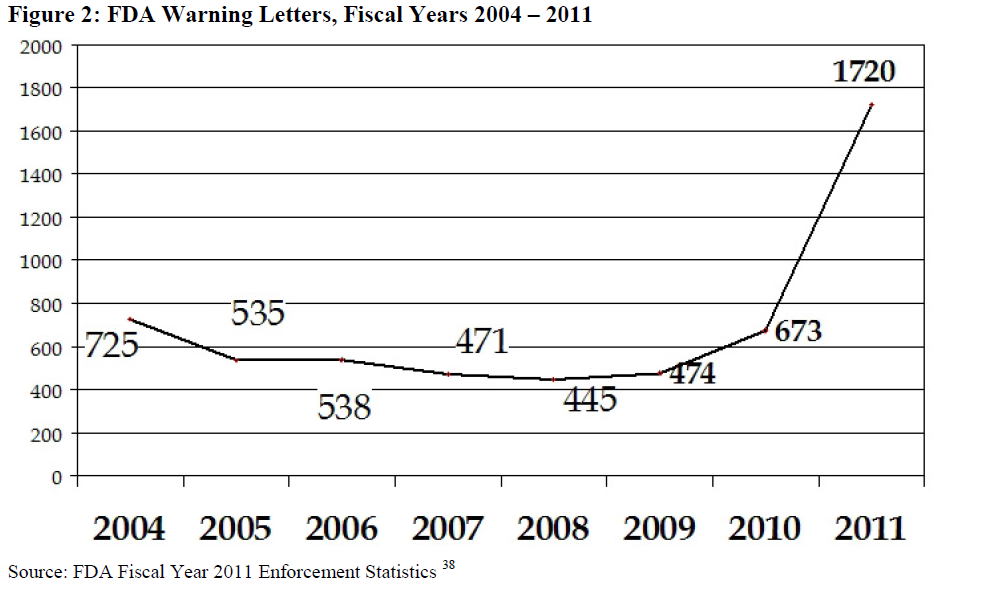 The FDA began to ramp up GMP rules and regulations under the new commissioner in 2010 and 2011 (see figure at left (N.B. this includes all warning letters not just GMP so it is just illustrative, AT added). In fact, the report indicates that FDA threats shut down some 30% of the manufacturing capacity at the big producers of generic injectables. The safety of these lines was not a large problem and could have been handled with a targeted approach but instead the FDA launched a sweep against all the major manufacturers at the same time. These problem have been exacerbated by a change in Medicare reimbursement rules and by the rise of GPOs (buying groups) which reduced the prices of generics. Thus, in response to the cut in capacity, firms have shifted production from less profitable generics to more profitable branded drugs, so we get shortages of generics rather than of branded drugs.
Add to these major factors a few unique events such as the FDA now requiring pre-1938 and pre-62 drugs to go through expensive clinical trials, the slowdown of ANDAs and crazy stuff such as DEA control over pharmaceutical manufacturing and you get very extensive shortages.
East Asian public health bleg
What are the best sources to read on the significant public health improvements of the East Asian tigers, including in the years which preceded their spectacular bursts of economic growth? In particular where did those improvements come from and to what extent were they driven by specific policies? Your suggestions are much appreciated.
*The Great Divide: Nature and Human Nature in the Old World and the New*
That is the new book by the very active and very smart Peter Watson, due out soon but I bought a copy in the UK.
Why has the New World been so different from the Old World? What a splendid seventeenth and eighteenth century question. Imagine Jared Diamond — and with comparable scope — yet with shamans, peyote, and El Niño playing a role in the argument. I recommend it to everyone who can keep in mind how speculative the argument will be.
If we had to sum up what has gone before and describe in a few words the main features shaping early life in the Old World, those words would be: the weakening monsoon, cereals (grain), domesticated mammals and pastoralism, the plough and the traction complex, riding, megaliths, milk, alcohol. One way to highlight the differences between the two worlds is to perform the same summing-up exercise for the Americas…For the New World the crucial and equivalent words would be: El Niño, volcanoes, earthquakes, maize (corn), the potato, hallucinogens, tobacco, chocolate, rubber, the jaguar, and the bison.
Unlike Diamond, this book assigns ideology a central role in the story. Europe and the Middle East generate the ideas of the shepherd, the New World the ideas of the shaman, some of which may have been picked up or carried from the Chukchi of Siberia. Perhaps my favorite point in the book is the observation that the Old World had a greater diversity of ideologies.
Watson touches on many Hansonian themes about the differences between gatherers and foragers. Here is a Guardian review. Here is an Independent review. Here is a Matthew Price review.
This is an easy book to criticize, see the reviews or for instance take this passage:
…artwork was not developed [in the early stages of the New World] because there was no need to establish either dedicated territories or tribal identities. And/or food was in such plentiful supply that they had no need to keep records that assisted their memory of animal habits.
One really does have to take this book as a scenario, not as science. It is nonetheless interesting if used with care.
Caveat emptor black markets in everything
Nonetheless this story, from the BBC, caught my eye:
South Korea says it will increase customs inspections targeting capsules containing powdered human flesh.
The Korea Customs Service said it had found almost 17,500 of the capsules being smuggled into the country from China since August 2011.
The powdered flesh, which officials said came from dead babies and foetuses, is reportedly thought by some to cure disease and boost stamina.
But officials said the capsules were full of bacteria and a health risk.
Here is more.