Category: Music
Some Economics of Pay What You Want Pricing
A number of musicians and game developers have experimented with pay-what-you-want pricing (e.g. see the important field experiment by Gneezy et al. and less formal reports from Radiohead, Norwegian composer Gisle Martens Meyer and the video-game makers 2D Boy and Joost van Dongen.)
Imagine that under the pay-what-you-want model consumers choose to split their consumer-surplus with the seller. Here is a neat little proof for the linear demand case that under this heuristic profits are as large as under monopoly pricing! I have also assumed MC of zero which makes sense for digital goods and is also quite important to the result as pay-what-you-want can result in negative profits should consumers choose to pay less than marginal cost.
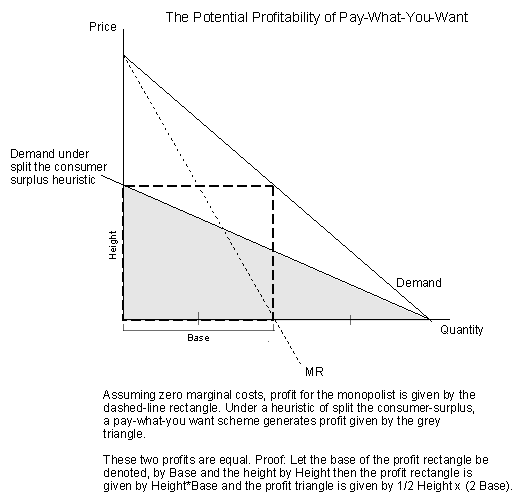
Split the consumer surplus is optimistic for the seller although splitting the gains does happen quite often in the dictator game so it is not without interest. Probably more importantly, pay-what-you-want pricing is going to be advantageous when the seller also sells a complementary good, such as concerts, which benefit from consumption spillovers from the pay-what-you-want good.
Two CDs in a row
Diamond Mine, by King Creosote and Jon Hopkins,
followed by
Julianna Barwick, The Magic Place.
They sound much better, one after the other, in that order. I will file them together on my shelf, once they leave my living room, and break my usual habit of alphabetizing.
I also like to follow Mahler symphonies with a short Mozart piano piece, in a major key preferably.
Can you think of other sensible combinations of music or CD sequences?
Headlines to ponder
“Whitney Houston: 15 ebooks on singer published since her death”
For one thing, this may blunt the “affiliation demand” to buy CDs or music downloads to honor her life.
Hat tip goes to Bookslut.
Beethoven Violin Concerto #1
Stefan Jackiw, excerpt here. For the pointer I thank Jacob Robbins.
IP Feudalism and the Shrinking of the Public Domain
Creators of intellectual property used to be granted up to 56 years of monopoly before their works entered the public domain. Since the 1976 copyright act (which came into effect in 1978) copyright has been progressively lengthened so it now extends to the life of the author plus an additional 70 years, i.e. an author’s heirs now get significantly more monopoly power than an author did prior to 1978, truly a kind of IP feudalism.
It’s hard to believe that the extension of copyright for decades after an author’s death can appreciably increase artistic creation and innovation, thus the public has gained little from copyright extension. What has been lost?
If the pre-1976 law were still in place then as of Jan 1, 2012 the following books, movies and music would have entered the public domain (from the Center for the Study of the Public Domain):
- J.R.R. Tolkien’s The Return of the King, the final installment in his Lord of Rings trilogy
- The Family of Man, Edward Steichen’s book of photographs showing the diversity and universality of human experience
- Michihiko Hachiya’s Hiroshima Diary: The Journal of a Japanese Physician, August 8–September 30, 1945, translated by Warner Wells, md
- Evelyn Waugh’s Officers and Gentlemen, the second book in his Sword of Honour trilogy
- C.S. Lewis’ The Magician’s Nephew, the sixth volume his The Chronicles of Narnia
- Vladimir Nabokov’s Lolita
- Jerome Lawrence & Robert E. Lee’s play about the Scopes “Monkey Trial,” Inherit the Wind
- Isaac Asimov’s The End of Eternity.
- Jack Finney’s The Body Snatchers
- The Seven Year Itch, directed by Billy Wilder; starring Marilyn Monroe and Tom Ewell
- Lady and the Tramp, Walt Disney Productions’ classic animation
- Alfred Hitchcock’s To Catch a Thief, starring Cary Grant and Grace Kelly
- The thriller The Night of the Hunter, directed by Charles Laughton; starring Robert Mitchum and Shelley Winters
- Two of James Dean’s three major motion pictures: East of Eden, directed by Elia Kazan and co-starring Raymond Massey and Julie Harris; and Rebel Without a Cause, directed by Nicholas Ray and co-starring Natlie Woods, Sal Mineo, and Jim Backus
- Hollywood versions of major Broadway musicals such as Oklahoma! and Guys and Dolls
- Richard III, Laurence Olivier’s film version of the Shakespeare play, co-starring Claire Bloom, Cedric Hardwicke, Nicholas Hannen, Ralph Richardson, and John Gielgud
- Unchained Melody (Hy Zaret & Alex North)
- Ain’t That a Shame (Antoine “Fats” Domino and Dave Bartholomew)
- Blue Suede Shoes (Carl Perkins), Folsom Prison Blues (Johnny Cash)
- The Great Pretender (Buck Ram)
- Maybellene (Chuck Berry, Russ Fratto, & Alan Freed),
- Tutti Frutti (Richard Penniman (aka Little Richard)
Under the old law these works and many others could today have been read, seen and played at low cost throughout the world. Consumers have certainly lost from copyright extension. What about creators?
We typically frame copyright and patent strength as an issue between consumers and creators, with consumers assumed to favor weaker rules and creators stronger. But, as I discuss in Launching the Innovation Renaissance, that is the wrong frame. A vibrant public domain can be good for consumers and for creators.
Under the old law, the above works could not only have been consumed they could also at low cost and without requiring the express permission of the original copyright holder have been remixed, reworked and extended in new directions. Under the new regime, innovators will not be able to easily build on these works until 2051 and it could be well into the 22nd century before we get Star Wars prequels worthy of the name.
Are we stagnating aesthetically?
Some of you have been emailing, asking for my opinion of this recent Kurt Andersen Vanity Fair article. Here is the summary introductory paragraph:
For most of the last century, America’s cultural landscape—its fashion, art, music, design, entertainment—changed dramatically every 20 years or so. But these days, even as technological and scientific leaps have continued to revolutionize life, popular style has been stuck on repeat, consuming the past instead of creating the new.
There is plenty more at the link. A serious response would require a book or more, so let me offer a few conclusions, noting that it’s not possible in blog space to defend these judgments at any length. This is all about aesthetics, and it is distinct from the TGS technology argument, though one might believe that technical breakthroughs are needed to usher in aesthetic innovations, and that slowness in the one area would lead to slowness in the other. That’s not a claim I’ve ever made, but it’s worth considering even if it can’t be settled very easily. In any case, here’s my view of the evidence:
1. Movies: The Hollywood product has regressed, though one can cite advances in 3-D and CGI as innovations in the medium if not always the aesthetics. The foreign product is robust in quality, though European films are not nearly as innovative as during the 1960s and 70s. Still, I don’t see a slowdown in global cinema as a whole.
2. TV: We just finished a major upswing in quality for the best shows, though I fear it is over, as no-episode-stands-alone series no longer seem to be supported by the economics.
3. Books/fiction: It’s wrong to call graphic novels “new,” but they have seen lots of innovation. If we look at writing more broadly, the internet has led to plenty of innovation, including of course blogs. The traditional novel is doing well in terms of quality even if this is not a high innovation era comparable to say the 1920s (Mann, Kafka, Proust, others).
4. Computer and video games: This major area of innovation is usually completely overlooked by such discussions.
5. Music: Popular music has been in a Retromania sludge since the digital innovations of the early 90s, but classical contemporary music continues to show vitality and it is even establishing some foothold in the concert hall and in nightclubs too. Jazz has plenty of niche innovation, but it’s not moving forward with new, central ideas which command the attention of the field.
6. Painting and sculpture: Lots of good material, no breakthrough central movements comparable to Pop Art or Abstract Expressionism. Photography has seen lots of innovation.
7. Your personal stream: This is arguably the biggest innovation in recent times, and it is almost completely overlooked. It’s about how you use modern information technology to create your own running blend of sources, influences, distractions, and diversions, usually taken from a blend of the genres and fields mentioned above. It’s really fun and most of us find it extremely compelling. See chapter three of Create Your Own Economy/The Age of the Infovore.
8. Architecture: Slows down after 2008, but there were numerous innovative blockbuster buildings prior to the crash.
Today the areas of major breakthrough innovation are writing, computer games, television, photography (less restricted to the last decade exclusively) and the personal stream. Let’s hope TV can keep it up, and architecture counts partially. For one decade, namely the last decade, that’s quite a bit, though I can see how it might escape the attention of a more traditional survey. Some other areas, such as the novel, global cinema, and the visual arts are holding their own and producing plenty of small and mid-size innovations.
Although that is a relatively optimistic take on the aesthetics of the last decade, it nonetheless supports the view that aesthetic innovation relies on technological innovation. Most (not all) of the major areas of progress have relied on digitalization, and indeed that is the one field where the contemporary world has brought a lot of technological progress as well.
Favorite popular music of 2011
Here goes, in no particular order:
1. Abigail Washburn, City of Refuge.
2. Lykke Li, Wounded Rhymes.
3. James Blake, James Blake and also Enough Thunder.
4. St. Vincent, Strange Mercy.
5. Shabazz Palaces, Black Up.
6. Miles Davis, Live in Europe 1967.
7. This May be My Last Time Singing: Raw African-American Gospel on 45 RPM, 1957-1982, assorted artists.
8. Wilco, The Whole Love.
9. The Smile Sessions, The Beach Boys.
10. Indeed, by Oren Ambarchi and Jim O’Rourke (LP only, a real winner, beautiful sound).
11. Opika Pende, Africa at 78 RPM.
A few observations: Lots of good music this year, but I haven’t yet heard anything path breaking. Most indie rock is overrated and overall it is a less vital genre than pop, although since the latter is centered around songs rather than albums it is underrepresented on this list. The artist I listened to the most this year was probably Lonnie Mack, followed by John Fahey. The two best concerts I saw were Satyagraha at the Met and Brad Mehldau and Joshua Redman playing together. Indian classical music lost some of its leading lights. I like both P.J. Harvey and Tom Waits, but at this point do I need to buy more music by them? I still listen to Gilbert O’Sullivan sometimes. Beck seemed like a distant memory.
Addendum: Here is a favorite music list from Angus.
The music is over
With clouds over Europe darkening, managers like Mr. Burnstein are increasingly turning their long-term focus to places with stronger currencies, like South America, Southeast Asia and Australia. When Metallica ended their “World Magnetic” tour in Australia a year ago, they played not just Sydney and Melbourne but also harder-to-get-to Perth.
“We’re a U.S. export the same way Coca-Cola is,” he said. “We look for the best markets to go to.”
“Right now Indonesia is on my watch list,” he smiled.
And get this:
Eight months before Metallica takes the stage in Germany, Mr. Burnstein decides whether the band should be paid in dollars, euros or a combination of the two. If exchange rates swing in a way that hurts Metallica’s earnings, he buys derivative financial instruments to lock in a preferred rate. Sometimes ticket prices are hiked to compensate for possible currency-related losses, though Mr. Burnstein shuns this strategy.
“Nobody is looking to make a foreign-exchange trade to make money, but you don’t want to be a loser,” the scraggly bearded manager said.
Here is one conclusion:
“A weak dollar is the best thing for American rock ‘n’ roll,” said Bill Zysblat, partner at RZO Productions, which has handled tours for the Rolling Stones and the Police.
The article is here, interesting throughout and for the pointer I thank Kanishka Kacker.
Fanfare Meta-List and other picks for classical music this year
Every year I cull through the Fanfare Critics “best of” lists and provide a meta-list of the new recordings which are mentioned more than once. This year we have a fairly short meta-list:
1. James Willey, String Quartets, 3, 7, and 8, Esterhazy Quartet.
2. Michael Colina, Violin Concerto, other works, not on Amazon; and by assorted artists, The Art of Gregor Piatigorsky, also not available on Amazon.
3. Claude Frank: 85th Birthday Celebration.
My classical CD picks for the year are:
Scarlatti, volume I, by Carlo Grante (the most significant achievement), Diabelli Variations by Paul Lewis, Bach’s Trio Sonatas for Organ by Robert Quinney (probably my favorite of the entire year), and Shostakovich Symphony #10, by Vasily Petrenko.
Yesterday was the 200th birthday of Franz Liszt
I don’t usually like to reprise previous posts, but here goes:
1. Franz Liszt: The “late, serious” pieces are important but I don’t think they are much fun to listen to. I recommend the Transcendental Etudes, performance preferences here. “Funerailles,” played by the young Lazar Berman. “Years of Pilgrimage, the Swiss years,” by Aldo Ciccolini. The Hungarian Rhapsodies, played by Cziffa or Robert Szidon. Many of the opera transcriptions are subtler than they are made out to be, as creative examples of early mash-ups. The B Minor Sonata is a bit too long but Clifford Curzon has a lovely version. The organ music remains undervalued and the instrument well suited the composer’s chromatic tendencies.
The Alan Walker biography of Liszt is an excellent look at the nineteenth century and they are among my favorite biographies. Has anyone written the book — in any language — on what the career of Liszt shows about the decline of mainstream classical liberalism?
I very much like the recent Liszt CD by Haiou Zhang; amazing that we can have such a pianist and hardly anyone has heard of him.
Complaints Choir of Singapore
They sing complaints about their city-state, here is one excerpt:
Stray cats get into noisy affairs
At night my neighbor makes weird animal sounds
People put on fake accents to sound posh
And queue up 3 hours for donuts
Will I ever live till eighty five to collect my CPF?
It sounds like a terrible place:
Old National Library was replaced by an ugly tunnel
Singaporean men can’t take independent women
People blow their nose into the swimming pool
And fall asleep on my shoulder in the train
Full lyrics and explanation are here. Yet it is now legally banned for foreigners to sing the complaints. Here is a video of the Choir, definitely recommended, best video I’ve seen this year and do watch it through to the end.
For the pointer I thank Chug Roberts.
Alebron asks
He is a loyal MR reader:
The combination of powerful smartphones and social internet sites has given rise to an interesting phenomenon at concerts: people spend a massive chunk of the time at concerts documenting their concert-going. Is technology like this making meta-experience more important to people than experience? Is an experience that you can’t document/signal less valuable? Is this a new phenomenon?
Arguably the meta-experience was always more important, we just produce the meta-experience more efficiently these days. The very best cultural experiences are thus more leveraged in the direction of potent final output, and thus they sell for higher prices. On top of that is a sector of really cheap stuff, mostly illusory in nature. Imagine someone who reads ESPN.com every day and fancies himself a follower of the NBA, without hardly seeing a game or spending money on the sport. There is a polarization of cultural prices and experiences, and hollowing out of the middle. If your output isn’t spectacular or culturally central, it will be hard to cover your fixed costs and you will have to go niche and super-cheap.
That’s what I think we are seeing. Overall it is good for consumers, bad for Platonists.
The past and future of music
Posterity may regard as the highlight of Michael Wadleigh’s 1970 documentary Woodstock not the health warning about the brown acid, but the spectacle of Sha Na Na doing “At the Hop.” This crew, at the preeminent ’60s event, surrounded by wobbly idols and dazed wielders of the zeitgeist, were shamanistically retro. Sha Na Na channeled the ’50s by overdoing them, performing cover versions—as George Leonard, the band’s brain, tells Reynolds—at “twice the speed of the originals: I insisted we do the music the way it was remembered instead of the way it was.” The singers wore gold lamé; they bopped and jived absurdly, like celebrants of a forgotten rite. They, not Jefferson Airplane, were the future, by which I mean, of course, the past. The irony that their early-morning set came right before Jimi Hendrix “immolating”—Reynolds’s word—“The Star-Spangled Banner” is almost too exquisite to bear.
From James Parker, here is much more.
Has there been a great 9-11 work of art?
That’s a question from Zoe Pollock, who links to lots of discussion. My nomination is John Adams’s On the Transmigration of Souls. Here is one YouTube performance, here is another, though admittedly it sounds more impressive on a good stereo or better yet live.
Caleb says I haven’t blogged music lately
I agree with the Simon Reynolds thesis of aesthetic musical stagnation, nonetheless I’ve been listening to: Abigail Washburn, City of Refuge, Cecil Taylor Feel Trio, 2 T’s for a Lovely T (lots of discs, all wonderful, lasts for years), Rose of Sharon (American vocal music), Scarlatti vol. I by Carlo Granta (my favorite of any Scarlatti recording), anything by Isabelle Faust, Diabelli Variations by Paul Lewis, Ravinahitsy, by Damily (acoustic guitar music from Madagascar, an underrated category), Juju in Trance, and Khyam Allami’s Resonance/Dissonance.
The new releases by Malkmus/Beck and Kanye/Jay-Z haven’t stuck with me.