Category: Science
The Extreme Shortage of High IQ Workers
At first glance it seems peculiar that semiconductors, a key item of national strategic interest, should be produced in only a few places in the world, most notably Taiwan, using devices produced only in Eindhoven in the Netherlands by one firm, ASML. Isn’t the United States big enough to be able to support all of these technologies domestically? Yes and no.
Semiconductor manufacturing is the most difficult and complicated manufacturing process ever attempted by human beings. A literal spec of dust can ruin an entire production run. How many people can run such a factory? Let’s look at the United States. The labor force is approximately 164 million people which sounds like a lot but half of the people in the labor force have IQs below 100. More specifically, although not everyone in semiconductor manufacturing requires a PhD, pretty much everyone has to be of above average intelligence and many will need to be in the top echelons of IQ.
In the entire US workforce there are approximately 3.7 million workers (2.3%) with an IQ greater than two standard deviations above the mean. (Mean 100, sd, 15, Normal dist.) Two standard deviations above the mean is pretty good but we are talking professor, physician, attorney level. At the very top of semiconductor manufacturing you are going to need workers with IQs at or higher than 1 in a 1000 people and there are only 164 thousand of these workers in the United States.
164 thousand very high-IQ workers are enough to run the entire semiconductor industry but you also want some of these workers doing fundamental research in mathematics, physics and computer science, running businesses, guiding the military and so forth. Moreover, we aren’t running a command economy. Many high-IQ workers won’t be interested in any of these fields but will want to study philosophy, music or English literature. Some of them will also be lazy! I’ve also assumed that we can identify all 164 thousand of these high-IQ workers but discrimination, poverty, poor health, bad luck and other factors will mean that many of these workers end up in jobs far below their potential–the US might be able to place only say 100,000 high-IQ workers in high-IQ professions, if we are lucky.
It’s very difficult to run a high-IQ civilization of 330 million on just 100,000 high-IQ workers–the pyramid of ability extends only so far. To some extent, we can economize on high-IQ workers by giving lower-IQ workers smarter tools and drawing on non-human intelligence. But we also need to draw on high-IQ workers throughout the world–which explains why some of the linchpins of our civilization end up in places like Eindhoven or Taiwan–or we need many more Americans.
Are scientific breakthroughs less fundamental?
From Max Kozlov, do note the data do not cover the very latest events:
The number of science and technology research papers published has skyrocketed over the past few decades — but the ‘disruptiveness’ of those papers has dropped, according to an analysis of how radically papers depart from the previous literature.
Data from millions of manuscripts show that, compared with the mid-twentieth century, research done in the 2000s was much more likely to incrementally push science forward than to veer off in a new direction and render previous work obsolete. Analysis of patents from 1976 to 2010 showed the same trend.
“The data suggest something is changing,” says Russell Funk, a sociologist at the University of Minnesota in Minneapolis and a co-author of the analysis, which was published on 4 January in Nature. “You don’t have quite the same intensity of breakthrough discoveries you once had.”
The authors reasoned that if a study was highly disruptive, subsequent research would be less likely to cite the study’s references, and instead cite the study itself. Using the citation data from 45 million manuscripts and 3.9 million patents, the researchers calculated a measure of disruptiveness, called the ‘CD index’, in which values ranged from –1 for the least disruptive work to 1 for the most disruptive.
The average CD index declined by more than 90% between 1945 and 2010 for research manuscripts (see ‘Disruptive science dwindles’), and by more than 78% from 1980 to 2010 for patents. Disruptiveness declined in all of the analysed research fields and patent types, even when factoring in potential differences in factors such as citation practices…
The authors also analysed the most common verbs used in manuscripts and found that whereas research in the 1950s was more likely to use words evoking creation or discovery such as, ‘produce’ or ‘determine’, that done in the 2010s was more likely to refer to incremental progress, using terms such as ‘improve’ or ‘enhance’.
Here is the piece, and here is the original research by Michael Park Erin Leahey, and Russell J. funk.
Is publication bias worse in economics?
Publication selection bias undermines the systematic accumulation of evidence. To assess the extent of this problem, we survey over 26,000 meta-analyses containing more than 800,000 effect size estimates from medicine, economics, and psychology. Our results indicate that meta-analyses in economics are the most severely contaminated by publication selection bias, closely followed by meta-analyses in psychology, whereas meta-analyses in medicine are contaminated the least. The median probability of the presence of an effect in economics decreased from 99.9% to 29.7% after adjusting for publication selection bias. This reduction was slightly lower in psychology (98.9% −→55.7%) and considerably lower in medicine (38.0% −→ 27.5%). The high prevalence of publication selection bias underscores the importance of adopting better research practices such as preregistration and registered reports.
Here is the full article by František Bartoš, et.al, via Paul Blossom.
One day’s worth of science consumption, from yesterday
Forbidden Questions
It is extremly disturbing that major scientific organizations are forbidding the publication of research that offends some political sensibilities. Indeed, roadblocks are being put into place to even investigate some questions. Here is James Lee, a behavioral geneticist at the University of Minnesota, talking about the NIH’s restrictions on behavioural science:
A policy of deliberate ignorance has corrupted top scientific institutions in the West. It’s been an open secret for years that prestigious journals will often reject submissions that offend prevailing political orthodoxies—especially if they involve controversial aspects of human biology and behavior—no matter how scientifically sound the work might be. The leading journal Nature Human Behaviour recently made this practice official in an editorial effectively announcing that it will not publish studies that show the wrong kind of differences between human groups.
American geneticists now face an even more drastic form of censorship: exclusion from access to the data necessary to conduct analyses, let alone publish results. Case in point: the National Institutes of Health now withholds access to an important database if it thinks a scientist’s research may wander into forbidden territory. The source at issue, the Database of Genotypes and Phenotypes (dbGaP), is an exceptional tool, combining genome scans of several million individuals with extensive data about health, education, occupation, and income. It is indispensable for research on how genes and environments combine to affect human traits. No other widely accessible American database comes close in terms of scientific utility.
My colleagues at other universities and I have run into problems involving applications to study the relationships among intelligence, education, and health outcomes. Sometimes, NIH denies access to some of the attributes that I have just mentioned, on the grounds that studying their genetic basis is “stigmatizing.” Sometimes, it demands updates about ongoing research, with the implied threat that it could withdraw usage if it doesn’t receive satisfactory answers. In some cases, NIH has retroactively withdrawn access for research it had previously approved.
…The federal government was under no obligation to assemble the magnificent database that is the dbGaP. Now that it has done so at taxpayer expense, however, it does have an obligation to provide access to that database evenhandedly—not to allow it for some and deny it to others, based on the content of their research.
Keep in mind that when science is politicized the questions that can be asked and the answers that can be given change as politics changes. Science isn’t natural–science, like free speech, democracy, and the rule of law relies on supporting universal norms of open inquiry–open questions, open questioners, open answers–but these universal norms run against our baser instincts and as such require sustaining cooperation in a prisoner’s dilemma where defection to our tribe is the dominant strategy.
Pollution and Macro Inequality
Combining 36 years of satellite derived PM2.5 concentrations with individual-level administrative data provided by the U.S. Census Bureau and Internal Revenue Service (IRS), we provide new evidence on the important role that disparities in air pollution exposure play in shaping broader patterns of economic opportunity and inequality in the United States. We first document that early-life exposure to particulate matter is one of the top five predictors of upward mobility in the United States. Second, we exploit regulation-induced reductions in pollution exposure from the 1990 Clean Air Act Amendments to produce new age-specific estimates of pollution-earnings relationship. Combined with individual-level measures of pollution exposure during early childhood, we calculate that disparities in air pollution can account for 17-26 percent of the Black-White earnings gap, 5-27 percent of the Hispanic-White earnings gap, and 6-20 percent of the average neighborhood-earnings effect (Chetty and Hendren, 2018; Chetty, Hendren, and Katz, 2016). Collectively, our findings indicate that environmental inequality is an important contributor to observed patterns of racial economic disparities, income inequality and economic opportunity in the United States.
That’s Colmer, Voorheis and Williams summarizing Air Pollution and Economic Opportunity in the United States. The authors also estimate that
…a 1 μg/m3reduction in prenatal PM2.5 exposure is associated with a $1,105 increase in later-life W-2 earnings and…a 1 μg/m3 reduction in prenatal PM2.5 exposure is associated with a 1.29 percentile rank point increase in upward mobility…We estimate pollution-earnings relationships for each age of exposure from birth to age 12 and show that the relationship between pollution exposure and earnings is stable up to age 4 and then diminishes quickly. We do not estimate a meaningful relationship between particulate matter exposure and later-life earnings from age 8 onward.
These estimate are big but given the substantial number of micro-estimates of the effect of pollution on IQ and cognition that Tyler and I have discussed before (see also this video) substantial effects at the macro level are almost inevitable.
A Vision of Metascience
Lots to praise and to ponder in this excellent piece by Michael Nielsen and Kanjun Qiu on improving the discovery ecosystem with metascience. The piece contains some pop-ideas to stimulate thinking such as:
- Fund-by-variance: Instead of funding grants that get the highest average score from reviewers, a funder should use the variance (or kurtosis or some similar measurement of disagreement5) in reviewer scores as a primary signal: only fund things that are highly polarizing (some people love it, some people hate it). One thesis to support such a program is that you may prefer to fund projects with a modest chance of outlier success over projects with a high chance of modest success. An alternate thesis is that you should aspire to fund things only you would fund, and so should look for signal to that end: projects everyone agrees are good will certainly get funded elsewhere. And if you merely fund what everyone else is funding, then you have little marginal impact6,7.
But it’s really not about one one idea but about understanding why scientific tools are rarely applied to science itself and what can we do to improve metascience. Lots of bad news but there are some positive examples. Thereplication revolution (no longer a crisis!) appears to be working:
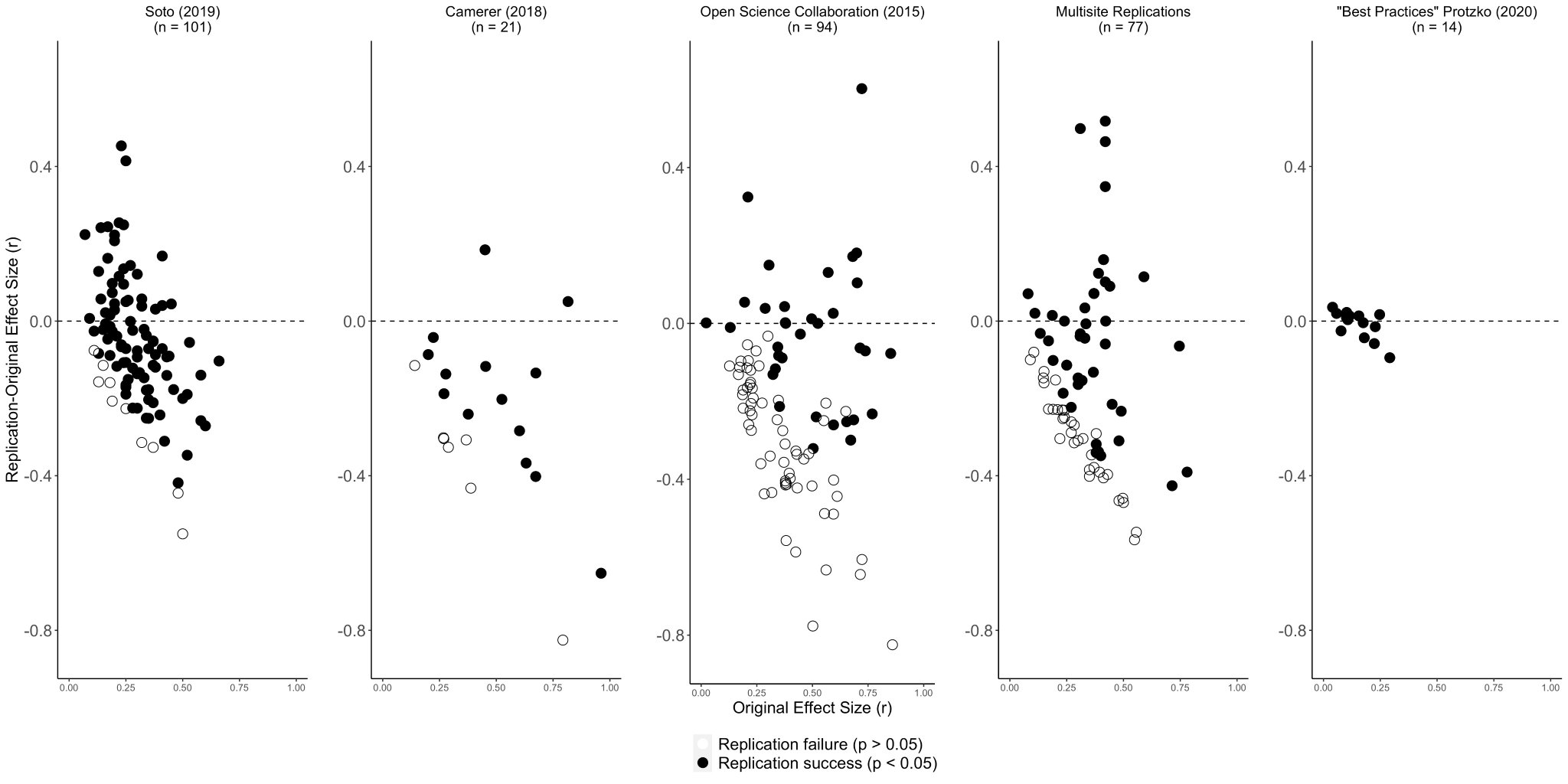
There are encouraging signs that pre-registered study designs like this are helping address the methodological problems described above. Consider the following five graphs. The graphs show the results from five major studies89, each of which attempted to replicate many experiments from the social sciences literature. Filled in circles indicate the replication found a statistically significant result, in the same direction as the original study. Open circles indicate this criterion wasn’t met. Circles above the line indicate the replication effect was larger than the original effect size, while circles below the line indicate the effect size was smaller. A high degree of replicability would mean many experiments with filled circles, clustered fairly close to the line. Here’s what these five replication studies actually found:
As you can see, the first four replication studies show many replications with questionable results – large changes in effect size, or a failure to meet statistical significance. This suggests a need for further investigation, and possibly that the initial result was faulty. The fifth study is different, with statistical significance replicating in all cases, and much smaller changes in effect sizes. This is a 2020 study by John Protzko et al90 that aims to be a “best practices” study. By this, they mean the original studies were done using pre-registered study design, as well as: large samples, and open sharing of code, data and other methodological materials, making experiments and analysis easier to replicate…In short, the replications in the fifth graph are based on studies using much higher evidentiary standards than had previously been the norm in psychology. Of course, the results don’t show that the effects are real. But they’re extremely encouraging, and suggest the spread of ideas like Registered Reports contribute to substantial progress.
The story of Brian Nosek is very interesting:
Many people have played important roles in instigating the replication crisis. But perhaps no single person has done more than Brian Nosek. Nosek is a social psychologist who until 2013 was a professor at the University of Virginia. In 2013, Nosek took leave from his tenured position to co-found the Center for Open Science (COS) as an independent not-for-profit (jointly with Jeff Spies, then a graduate student in his lab). Nosek and the COS were key co-organizers of the 2015 replication paper by the Open Science Collaboration. Nosek and the COS have also been (along with Daniël Lakens, Chris Chambers, and many others) central in developing Registered Reports. In particular, they founded and operate the OSF website, which is the key infrastructure supporting Registered Reports.
…The origin story of the COS is interesting. In 2007 and 2008, Nosek submitted several grant proposals to the NSF and NIH, suggesting many of the ideas that would eventually mature into the COS95. All these proposals were turned down. Between 2008 and 2012 he gave up applying for grants for metascience. Instead, he mostly self-funded his lab, using speaker’s fees from talks about his prior professional work. A graduate student of Nosek’s named Jeff Spies did some preliminary work developing the site that would become OSF. In 2012 this got some media attention, and as a result was noticed by several private foundations, including a foundation begun by a billionaire hedge fund operator, John Arnold, and his wife, Laura Arnold. The Arnold Foundation reached out and rapidly agreed to provide some funding, ultimately in the form of a $5.25 million grant.
To do this, Nosek had to leave the University of Virginia? Why? He was then attacked by many in the scientific community. Why? Read the whole thing for much more.
Driving Buy: Pollution, Customers and Development
The literature on air pollution continues to grow. In an impressive paper, Bassi et al. show that firms in Uganda locate on busy roads, Busy roads are more polluted but there are more customers driving and they rely on direct customer acquisition, rather than advertising or marketing, to get customers.
Location choice thus entails a trade-off between pollution exposure, which we verify to be mainly driven by road traffic, and access to customers. We also use our survey data to argue that the benefits can be explained primarily by the fact that, as it is typically the case across the developing world, firms sell locally through face-to-face interactions and do not have any other means to access customers than to be as visible as possible to them. Therefore, proximity to busy roads is essential.
Locating along busy roads increases profits per worker but reduces life expectancy of workers by about two months. A two month loss in life expectancy is substantial. Uganda is so poor (GDP per-capita ~$720), however, that the authors find that an (imaginary) policy of randomly allocating firms would not be cost-effective. Randomly allocating firms, however, is only one potential policy–others include using more buses or instituting a congestion tax. India has higher per capita GDP than Uganda so if all else were equal many such policies would pay in India. One type of “firm” that I have seen locate on congested roads in India is beggars and street sellers. It’s obvious that they go where the customers are but at the price of locating in very polluted areas.
I argued in India recently that reduced pollution could increase GDP. I continue to think that is true on the margin–there is some low-hanging fruit.
In other pollution news. It is clear that pollution papers are becoming a growth industry and thus there are bound to be green jelly bean problems. I haven’t read either closely but I did note that Roy et al. find that pollution increases mutual fund errors and Du finds that pollution increases racist tweets. Well, maybe. The new pollution literature is credible but remember to trust literatures not papers.
NASA Reduces Existential Risk!
Congratulations to NASA for a direct hit on an asteroid with the goal of shifting its orbit and proving the feasibility of protecting the planet. A great step for mankind!
Tyler and I use asteroid defense as an example of a true public good in our textbook, Modern Principles. Here’s the video from our textbook. Not quite so dramatic but funnier!
*Second City: Birmingham and the Forging of Modern Britain*
By Richard Vinen, do not forget that the Lunar Society (subject of the very first MR post!) was based there. Here is one excerpt:
What has come to be called the Birmingham or Midlands Enlightenment brought together an unusually curious and energetic group of men…Joseph Priestly and William Hutton epitomized the atmosphere of optimism, uninhibited enquiry and material prosperity some associated with Birmingham in the eighteenth century. The former was a minister of religion, though mainly known to posterity as a scientist; the latter was a well-to-do bookseller, though mainly known to posterity as a writer, particularly as the author of the first history of his adopted city. Both men, however, came ot have less happy memories of Birmingham than those implied by the quotations above because both their houses were burned down in the Church and King riots of 1791.
Strongly recommended to all those who care about such things, you can order here.
Plastic Might Be Making You Fat
WashPost: An emerging view among scientists is that one major overlooked component in obesity is almost certainly our environment — in particular, the pervasive presence within it of chemicals which, even at very low doses, act to disturb the normal functioning of human metabolism, upsetting the body’s ability to regulate its intake and expenditure of energy.
Some of these chemicals, known as “obesogens,” directly boost the production of specific cell types and fatty tissues associated with obesity. Unfortunately, these chemicals are used in many of the most basic products of modern life including plastic packaging, clothes and furniture, cosmetics, food additives, herbicides and pesticides.
Ten years ago the idea of chemically induced obesity was something of a fringe hypothesis, but not anymore.
“Obesogens are certainly a contributing factor to the obesity epidemic,” is what Bruce Blumberg, an expert on obesity and endocrine-disrupting chemicals from the University of California, Irvine, told me by email. “The difficulty is determining what fraction of obesity is related to chemical exposure.”
An important piece of evidence is something I pointed to in my post The Animals are Also Getting Fat namely, cats and dogs are getting fatter and so are rats and so (very importantly) are control mice fed a very standard diet. I hadn’t realized there is also some experimental evidence.
In particular, consequences of chemical exposure may not appear during the lifetime of an exposed organism but can be passed down through so-called epigenetic mechanisms to offspring even several generations away. A typical example is tributyltin or TBT, a chemical used in wood preservatives, among other things. In experiments exposing mice to low and supposedly safe levels of TBT, Blumberg and his colleagues found significantly increased fat accumulation in the next three generations.
Overall, I find the chemical story plausible–people in the past, even rich people, just didn’t get fat so easily–but my skepticism rises whenever I hear the word epigenetics.
An Update on Nasal Vaccines
Nasal vaccines are more likely to stop infection than vaccines injected into muscle because they stimulate mucosal immunity in the nose and respiratory system, the first line of attack, and they are likely to increase uptake especially among people with trypanophobia. Hence my longstanding call for an Operation Warp Speed for nasal vaccines. We haven’t got OWS 2.0 in the United States but nasal vaccines have recently been approved in China and India.
The Chinese vaccine is developed by CanSino and is the same as its injected vaccine but packaged in an aerosol taken with a nebulizer. It has been approved in China as a booster. Another advantage is that the Chinese nasal vaccine it’s one-fifth the dose of the injected version. India has also just approved a nasal vaccine on an emergency use basis. The Indian vaccine was developed by Bharat Biotech in a partnership with Washington University St. Louis.
Nasal vaccines as boosters seem like an especially promising approach as administration is much easier.
Mandated vaccine boosters for the AEA meetings?
Yes, the new AEA regulations will mandate vaccine boosters for attendance at the New Orleans meetings. Not just two jabs but yes boosters, at least one of them.
Like the N-95 (or stronger) mask mandate, this seems off base and possibly harmful to public health as well. Here are a few points:
1. The regulations valorize “booster with an older strain,” and count “infection with a recent strain” for nothing. In fact, the latter is considerably more valuable, most of all to estimate a person’s public safety impact on others. So the regulations simply target the wrong variable.
1b. People who are boosted might even be less likely to have caught the newer strains (presumably the boosters are at least somewhat useful). Thus they are potentially more dangerous to others, not less, being on average immunologically more naive. Ideally you want a batch of attendees who just had Covid two or three months ago.
2. More than three-quarters of Americans have not had a booster to date. Very likely the percentage of potential AEA attendees with boosters stands at a considerably higher level. Still, this is a fairly exclusionary policy, and pretty far from what most Americans consider to be an acceptable regulation.
2b. To be clear, I had my booster right away, even though I expected it would make me sick for two days (it did). I am far from being anti-booster. I am glad I had my booster, but I also understand full well the distinction between “getting a booster at the time was the right decision,” and “we should mandate booster shots today.” They are very different! Don’t just positively mood affiliate with boosters. Think through the actual policies.
3. Blacks are a relatively undervaccinated group, and probably they are less boosted as well. The same may or may not be true for black potential AEA attendees, but it is certainly possible. After all the talk of DEI, and I for one would like to see more inclusion, why are we making inclusion harder? And for no good medical reason.
3b. How about potential attendees from Africa, Latin America, and other regions where boosters are harder to come by? What are their rates of being boosted? Do they all have to fly to America a few days earlier, line up boosters, and hope the ill effects wear off by the time of the meetings? Why are we doing this to them?
3c. Will the same booster requirements be applied to hotel staff and contractors? Somehow I think not. Maybe that is a sign the boosters are not so important for conference well-being after all?
4. Many people are in a position, right now, where they should not boost. Let’s say you had Covid a few months ago, and are wondering if you should get a booster now or soon. I looked into this recently, and found the weight of opinion was that you should wait at least six months for your immune system to process the recent infection. That did not seem to be “settled science,” but rather a series of judgments, admittedly with uncertainty. So now let’s take those people who were not boosted, had a new strain of Covid recently, and want to go to the AEA meetings. (The first two of three there cover a lot of people.) They have to get boosted. And in expected value terms, boosting is bad for them. Did this argument even occur to the decision-makers at the AEA?
5. The AEA mentions nothing about religious or other exceptions to the policy. Maybe there are “under the table” exceptions, but really? Why not spell out the actual policy here, and if there are no exceptions come right out and tell us. And explain why so few other institutions have chosen the “no exceptions” path, and why the AEA should be different. (As a side note, it is not so easy to process exceptions for the subset of the 13,000 possible attendees who want them. Does the AEA have this capacity?)
Again, this is simply a poorly thought out policy, whether for N-95 masks or for boosters. I hope the AEA will discard it as soon as possible. Or how about a simple, open poll of membership, simple yes or not on the current proposal?
Hume on the Rise And Progress of the Arts And Sciences
Avarice, or the desire of gain, is an universal passion, which operates at all times, in all places, and upon all persons: But curiosity, or the love of knowledge, has a very limited influence, and requires youth, leisure, education, genius, and example, to make it govern any person. You will never want booksellers, while there are buyers of books: But there may frequently be readers where there are no authors.
David Hume explaining why it’s more difficult to explain the progress of the arts and sciences than economic progress, even if the latter may depend on the former. And here is Hume on geography and the growth of the arts and sciences:
But the divisions into small states are favourable to learning, by stopping the progress of authority as well as that of power. Reputation is often as great a fascination upon men as sovereignty, and is equally destructive to the freedom of thought and examination. But where a number of neighbouring states have a great intercourse of arts and commerce, their mutual jealousy keeps them from receiving too lightly the law from each other, in matters of taste and of reasoning, and makes them examine every work of art with the greatest care and accuracy. The contagion of popular opinion spreads not so easily from one place to another. It readily receives a check in some state or other, where it concurs not with the prevailing prejudices. And nothing but nature and reason, or, at least, what bears them a strong resemblance, can force its way through all obstacles, and unite the most rival nations into an esteem and admiration of it.
…In China, there seems to be a pretty considerable stock of politeness and science, which, in the course of so many centuries, might naturally be expected to ripen into some thing more perfect and finished, than what has yet arisen from them. But China is one vast empire, speaking one language, governed by one law, and sympathizing in the same manners. The authority of any teacher, such as Confucius, was propagated easily from one corner of the empire to the other. None had courage to resist the torrent of popular opinion. And posterity was not bold enough to dispute what had been universally received by their ancestors. This seems to be one natural reason, why the sciences have made so slow a progress in that mighty empire.
If we consider the face of the globe, Europe, of all the four parts of the world, is the most broken by seas, rivers, and mountains; and Greece of all countries of Europe. Hence these regions were naturally divided into several distinct governments. And hence the sciences arose in Greece; and Europe has been hitherto the most constant habitation of them.
See Tyler’s In Praise of Commericial Culture for more Humean themes.
Will open science matter?
Yesterday I posted this link, about how federally funded science will have to be made open access right away. I’m all for this, as it has some upside and no downside that I can see. Still, at the margin I am not sure it will make a huge difference.
Who says when the research is “ready” to be posted? No matter what you put in the fine print, de facto that is a decision made by the scientists. If scientists wish to delay open access publication, I doubt if this will stop them. “The paper simply isn’t finished yet.” The law cannot in practice dictate otherwise. Of course scientists already put plenty of works on-line and open to the public, and this private calculation will continue, but with only modest changes.
The actual main effect will be to enable scientists to resist commercial attempts to monopolize publication rights in closed access form. Presumably such contracts now will be illegal. But think about the new equilibrium: there will be a final, published, canonical version of the article published in The Journal of Botchagaloup. There will be an open access, not yet published, non-canonical (no proper pp. at the very least) version on the scientist’s home page. And very often there will be an illegal copy of the canonical version on SciHub, the pirate site for scientific papers. Plus the data copies that circulated before the commercial publisher made the authors take them down.
How is that so different from the status quo? Some scientists who didn’t get a crack at the data the first time around won’t have to wait as long to access it. And maybe scientists will make more of an effort for the open access version of their papers to be closer to the canonical versions published in commercial journals. This could prove a modest benefit, though you, as an outside scientist, wishing to cite “p.43” just won’t know how canonical the open access version will be. And presumably for-profit commercial journals will add extra stages to the final production process, if only to keep interest in the product they are selling, relative to the open access versions on-line. So I don’t think it will “do under” for-profit scientific publishing, not to mention that many articles are not federally funded by the U.S. government.
A more radical policy change would have been to require the journals to make their final versions of the papers open to the public, and in the final, canonical versions. That would create greater benefits, but also run the risk of putting those journals out of business. As I understand the new dictate, it does not do this.
The new law also will give scientists leverage against private companies that wish to buy up the research rights and not publicize the results. Probably this is a benefit, though that doesn’t hold a priori, as it does raise the cost of private sector involvement by forcing them to share the information more. And some unscrupulous scientists might try to get a better deal from the companies by releasing a different and inferior version of “the public research results” to the open access community. Still, on net I expect these are benefits.
Addendum: You may recall that Fast Grants had its own version of an open access requirement. I think this worked quite well! But it is interesting why it might have proven effective. I think we credibly signaled that people with open and early good results would be plausible candidates for additional funding, and soon, and indeed some of them were. To the extent that the federal government can signal the same, good incentives will be all the stronger. But this new OSTP order does not coordinate future funding decisions per se, and I don’t see any clauses that the NIH, NSF, and others are bound to revise their funding policies accordingly, to favor researchers who come out with speedy, open results. So the benefits here could be much greater if the entire federal science apparatus could signal its prioritization of speed and openness. We are still quite far from this. Nonetheless, this policy is a marginal improvement and a step in the right direction and its creates some preconditions for matters getting better yet.