Category: Science
Will open science matter?
Yesterday I posted this link, about how federally funded science will have to be made open access right away. I’m all for this, as it has some upside and no downside that I can see. Still, at the margin I am not sure it will make a huge difference.
Who says when the research is “ready” to be posted? No matter what you put in the fine print, de facto that is a decision made by the scientists. If scientists wish to delay open access publication, I doubt if this will stop them. “The paper simply isn’t finished yet.” The law cannot in practice dictate otherwise. Of course scientists already put plenty of works on-line and open to the public, and this private calculation will continue, but with only modest changes.
The actual main effect will be to enable scientists to resist commercial attempts to monopolize publication rights in closed access form. Presumably such contracts now will be illegal. But think about the new equilibrium: there will be a final, published, canonical version of the article published in The Journal of Botchagaloup. There will be an open access, not yet published, non-canonical (no proper pp. at the very least) version on the scientist’s home page. And very often there will be an illegal copy of the canonical version on SciHub, the pirate site for scientific papers. Plus the data copies that circulated before the commercial publisher made the authors take them down.
How is that so different from the status quo? Some scientists who didn’t get a crack at the data the first time around won’t have to wait as long to access it. And maybe scientists will make more of an effort for the open access version of their papers to be closer to the canonical versions published in commercial journals. This could prove a modest benefit, though you, as an outside scientist, wishing to cite “p.43” just won’t know how canonical the open access version will be. And presumably for-profit commercial journals will add extra stages to the final production process, if only to keep interest in the product they are selling, relative to the open access versions on-line. So I don’t think it will “do under” for-profit scientific publishing, not to mention that many articles are not federally funded by the U.S. government.
A more radical policy change would have been to require the journals to make their final versions of the papers open to the public, and in the final, canonical versions. That would create greater benefits, but also run the risk of putting those journals out of business. As I understand the new dictate, it does not do this.
The new law also will give scientists leverage against private companies that wish to buy up the research rights and not publicize the results. Probably this is a benefit, though that doesn’t hold a priori, as it does raise the cost of private sector involvement by forcing them to share the information more. And some unscrupulous scientists might try to get a better deal from the companies by releasing a different and inferior version of “the public research results” to the open access community. Still, on net I expect these are benefits.
Addendum: You may recall that Fast Grants had its own version of an open access requirement. I think this worked quite well! But it is interesting why it might have proven effective. I think we credibly signaled that people with open and early good results would be plausible candidates for additional funding, and soon, and indeed some of them were. To the extent that the federal government can signal the same, good incentives will be all the stronger. But this new OSTP order does not coordinate future funding decisions per se, and I don’t see any clauses that the NIH, NSF, and others are bound to revise their funding policies accordingly, to favor researchers who come out with speedy, open results. So the benefits here could be much greater if the entire federal science apparatus could signal its prioritization of speed and openness. We are still quite far from this. Nonetheless, this policy is a marginal improvement and a step in the right direction and its creates some preconditions for matters getting better yet.
Emergent Ventures India, fourth cohort
Here is the latest EV India cohort, and I am delighted to see more applications from young women and teenagers. I note also that a lot of the applicants for EV India are increasingly from smaller towns, or were raised in small towns before moving to larger cities for their projects.
EV India now has 75 winners! And I met most of them in Udaipur this last weekend. Here is the list of new winners:
Siddharth Kanungo is a chemical engineer by training and founder of Primer, an interactive conversational learning platform. Primer is designed for self-learners to learn subjects like mathematics, physics, computer science, that are usually offered in a university-level setting.
Keertana Subramani is a 23-year-old educator and social entrepreneur who wants to provide high-quality, accessible learning experiences. She received her EV grant to build SUVY Classes, a platform that vets and trains tutors for quality, and offers engaging, live classes for any learning need, and at twenty cents a day.
Arun Iyyanarappan is a 28-year-old electrical and software engineer passionate about creating alternate systems for electric power consumption. He received his EV grant to build a cost-effective solar powered house to show proof of concept for electrifying homes in rural areas at low-cost.
Gowtham Tummeda is a 21-year-old student interested in biology and programming and views biology as a software problem. He received his EV grant to build an end-to-end AI platform for biological data analysis. His larger ambition is to use the platform to model, design and simulate changes to strands of DNA at protein level using Deep Mind’s Alpha Fold.
Tejas Sidnal is an architect and researcher from Mumbai. He is the founder of CarbonCraft, a design and material innovation startup converting carbon emissions into building materials by fusing material knowledge of clean technologies with traditional techniques. He received an EV grant to reduce the curing process for Carbon Tiles from 28 days to under four hours for tiles that store captured carbon.
Hiya Jain is an 18-year-old interested in using EdTech to make education equitable. She received her EV grant to travel to San Francisco and better understand the EdTech space. She is currently working on UnMold, a project connecting high-school students in developing countries to PhD students running high information, low pressure, cohort-based courses to inject inspiration into a system.
Shruti Karandikar is a 16-year-old high school student from Bangalore. She has started ‘Screens for the Unscreened’ to collect phones, tablets, and laptops and donate them to underprivileged students. This is being converted into a non-governmental organization called ‘Mobilize’.
Sainadh Chityala is a 22-year-old engineering student. He received the EV grant to develop software to power self-driving cars in unpredictable and chaotic driving environments in urban India.
Samarth Bansal is a 28-year-old independent journalist and programmer in India. His reporting has appeared in Indian and foreign press like the The Atlantic, The Wall Street Journal, Hindustan Times, The Hindu, Mint, and HuffPost, etc. He writes The Interval, a fortnightly newsletter. He received his EV grant to merge his two interests – developing AI platforms for journalism and serve the news at higher speed and lower cost.
Apurwa Masook is a 23-year-old structural engineer who graduated and cofounded and spearheaded India’s first Indigenous Student Rocketry Mission. He is the founder of Space Fields, a team of hustlers, engineers and space aficionados working towards affordable access to space. He received his EV grant to support Space Fields’s efforts in developing a low-cost high-performance green compositepellant to power next generation of Launch Vehicles.
Snigdha Poonam is a 38-year-old journalist and author from Delhi. She has written about identity politics, income inequality, tech culture, and crime. Her first book, Dreamers: How Young Indians Are Changing Their World, won 2018’s Crossword Award for nonfiction. She received an EV grant to travel across India to for her investigative work on scams and fraud in the contemporary Indian political economy.
Aniruddha Kenge is a 20-year-old student of industrial design with an interest in carbon-based materials, especially graphene. He is working towards decarbonizing plastics and making their use, reuse, and production sustainable, swiftly. He received his EV grant to develop hemp fiber-based bio-composites in India that can replace multi-use plastics.
Keya Krishna is a 16-year-old high school student in Washington DC interested in the intersection of science, technology, and public policy. She received her EV grant to measure pollution exposures at a hyper-local level with a high level of spatial and temporal granularity, specifically focusing on the pollution exposure of school-going youth.
Abhilash Mishra is the Founder and Chief Science Officer of EquiTech Futures. He trained as a physicist and holds an M.Phys from the University of Oxford and a PhD in Astrophysics from Caltech. EquiTech Futures is a network of innovators from around the world using data science and AI to tackle societal challenges. Abhilash received his EV grant to develop and scale cohort-based courses, research residencies, and educational networking, through their programs EquiTech Scholars, EquiTech Residency, and EquiTech Institutes.
Reuben Abraham is the founding CEO of Artha Global, a new Mumbai and London based policy research and consulting organization that provides the scaffolding for efforts aimed at building state capacity. He was named ‘Think Tanker of the Year 2022’ by Prospect Magazine for putting together a large platform that enabled inter-disciplinary work to tackle the Covid-19 crisis in India.
Zi Cheng “Sam” Huang is a 26-year-old ethnographic researcher interested in elite spaces and cultural replication. Currently, they are assisting on a project about the beliefs of AI researchers. In their free time, they coach Peking University in competitive debating, effective altruism, and started a fellowship for talented young debaters to engage in effective altruism. With their EV grant, they seek to understand scaling education programs in India especially IITs.
Mohammad Ruhul Kader is an entrepreneur and writer from Dhaka, Bangladesh. He founded Future Startup, a digital publication covering the startup and technology scene in Dhaka with an ambition to transform Bangladesh through entrepreneurship and innovation. He writes about internet business, strategy, technology, and society. He is the author of Rethinking Failure: A short guide to living an entrepreneurial life. He received his EV grant to scale Future Startup into a leading destination to learn about entrepreneurship, tech, and business in Bangladesh.
Hemanth Bharatha Chakravarthy (21) and Benjamin Hoffner-Brodsky (22) are data scientists from Chennai and Davis with backgrounds in computational social science research and government. They founded Jhana, a Bangalore-based artificial intelligence lab, and are interested in simplifying and democratizing legal processes and information, and in building alignment and ethics tools for back-checking deployed AI systems. They are building a state-of-the-art, automatic legal search interface for lawyers and students.
Tushar Khandelwal (24), is a former investment banker turned social entrepreneur. He is the founder of Sigma91 – a career accelerator for ambitious teens, and has built a community of over 400 highly talented teenagers.
Akash Kulgod is a 22-year-old researcher, writer, and techno-optimist from Belagavi, with a degree in cognitive science from UC Berkeley. He is the founder of Dogluk — a startup-DAO aiming to augment the ability of dogs to detect disease by transforming their olfactory perceptual abilities into digital and multidimensional signatures. He is also a team member of the Rajalakshmi Children Foundation. You can follow his substack for his writing and podcasts about Dogluk, effective altruism, and the psychedelic revival.
Raghav Gupta is a 24-year-old industrial engineer and the founder of EquiDEI, a crypto-fintech startup. EquiDEI is a blockchain based protocol designed to monetize unbanked supply chain assets of small and medium sized enterprises in India, to provide low risk liquidity options. His ambition is to use his startup to generate wealth and liquidity and jobs for the SME ecosystem.
SealXX is a bioplastic solution to replace single-use plastics based on the concept of biomimicry, and it is founded and run by five teenagers across the world. At SealXX, they want to make the everyday products by mimicking protein-based natural processes by reducing the need for plastic reliance. Chandhana, Nithi, Roy, Nathan, and Elly, cofounders of SealXX were awarded an EV grant to develop and scale their biomimicry process.
- Chandhana Sathishkumar is a 17-year-old Neuroscience and BCI researcher, an author, TED-Ed Speaker, NFT artist, and Guinness world record holder. She has experience working alongside Walmart; with Brains@Play to develop Accessify (a brain-controlled browser extension); and the Indian Institute of Technology Madras to research fetal brains.
- Nithi Byreddy is a 17-year-old innovator and author researching the applications of carbon capture in climate science. She has worked on creating a blockchain-based solution to reduce people’s carbon footprint and has worked with IKEA to create sustainable innovations to reduce their carbon emissions.
- Roy Kim is a 16-year-old innovator and environmentalist interested in mimicking the mechanisms and designs of nature to create sustainable environments, mainly cities. In addition to working alongside Walmart, he is currently developing a theoretical ecological urban utopia and further exploring the applications of biomimicry in our society.
- Nathan Park is a 17-year-old entrepreneur who is interested in economics and business management. He is currently doing research on the economics of the housing market, and running a student-led, scientific publication called MIND Magazines that seeks to make science universally accessible to everyone.
Nexteen is an innovation accelerator program for 13-19 years-old students with programs aimed at exposing students to exponential tech to work on global challenges. Here are some of their ambitious students:
- Vedanth Nath,16, is is a high schooler, football enthusiast, and the creative engine at Nexteen. Prior to Nexteen, ran Media House, and has worked in in the WASH Sector. He also leads Tech and Youth at LooCafe helping them become the largest Toilet-WASH Company in the country.
- Karthik Nagapuri, 22, is an innovator, Defi developer, and student getting his completing the last year of his undergraduate degree in Artificial Intelligence. At Nexteen, he’s building the tech infrastructure that would be useful for innovators who are part of the program. He also worked on Safe Block, a crypto wallet nominee system. He is also the winner of a separate EV grant for building open API framework and tech for LooCafe.
- Ayush Srivastava,19, is a serial entrepreneur who likes to work on operations of new startups to help them grow. He has helped operationalize several startups before Nexteen.
- Anvitha Kollipara,16, is an entrepreneur. She works on scaling, bringing international accreditation, and acquiring partnerships with companies such as Adobe for the non-profits she founded. She was named one of the top three teen change-makers by Forbes for her work with CareGood Foundation.
- Harsh Vardhan Shukla,19, is a YouTuber turned entrepreneur, completing his undergraduate degree in business development while working on the side on nanotech projects. He works on content production (videos) and podcasts.
Emergent Ventures India is now large enough for top-up grants and repeat winners! Some familiar names below:
- Nilay Kulkarni, a 22-year-old software developer from Nashik, for his fintech start up.
- Swasthik Padma to scale his start-up TrashTrap to scale Plascrete – a high strength building material made by converting non-recyclable plastic waste – for commercial use.
- Chandra Bhan Prasad to continue his excellent scholarship on Dalit capitalism and Dalit dignity.
- Naman Pushp, co-founder of Airbound, for his early efforts to explore sustainable on-ground mobility.
- Onkar Singh to continue developing his open-source CubeSat.
Those unfamiliar with Emergent Ventures can learn more here and here. The EV India announcement is here. More about the winners of EV India second cohort and third cohort. To apply for EV India, use the EV application click the “Apply Now” button and select India from the “My Project Will Affect” drop-down menu.
If you are interested in supporting the India tranche of Emergent Ventures, please write to me or to Shruti at [email protected].
Gender Differences in Persistence and Publishing in Economics
We design an experiment to study gender differences in reactions to editorial decisions on submissions to top economics journals. Respondents read a hypothetical editor’s letter where the decision (e.g., revise and resubmit) is randomized across participants. Relative to an R&R, female assistant professors who receive a rejection perceive a significantly lower likelihood of subsequently publishing the paper in any leading journal than comparable male assistant professors. We do not find this gender difference among tenured professors. We consider several mechanisms, pointing to gender differences in attribution of negative feedback to ability and confidence under time constraints as likely explanations.
Here is the full paper by Gauri Kartini Shastry and Olga Shurchkov. Via the excellent Kevin Lewis.
One reason why a global carbon tax is impossible
Consequently, from a regional perspective, there are large disagreements about the welfare effects of carbon taxes: when a uniform carbon tax is imposed across all regions, with revenues redistributed locally as a lump sum so that there are no interregional transfers, some regions gain and others lose, often by large amounts that swamp the globally-averaged benefits of carbon taxes.
The microfoundations of that claim are interesting:
At the regional level, the optimal annual average temperature (at which the calibrated inverse U -shape governing how labor productivity varies with temperature reaches its peak) is approximately 12 degrees Celsius (◦C); an increase of regional temperature from 10 ◦C to 12 ◦C increases a region’s total factor productivity (TFP) by about 1%, while a further increase in annual average temperature from 12 ◦C to 14 ◦C reduces its TFP by about 2%.
Here are some bottom-line numbers on the global costs of climate change, with and without a carbon tax regime:
Without taxes global GDP reaches its nadir (relative to trend) just after 2190, when it is about 7.3% below the trend that would have obtained starting in 1990 without further global warming. With taxes, global GDP reaches its nadir just before 2190, at about 5.5% below trend.
Again, the costs of climate change are a few years of global economic growth. That is a big deal, and worth attending to, but far from an existential risk.
Here is the 160 pp. NBER working paper by Per Krusell and Anthony A. Smith Jr.
A new study of the European Research Council
I find these results not entirely surprising:
We examine whether the ERC selected researchers with a track record of conducting risky research. We proxy high-risk by a measure of novelty in the publication records of applicants both before and after the application, recognizing that it is but one dimension of risk. We control and interact the risk measure with high-gain by tracking whether the applicant has one or more top 1% highly cited papers in their field. We find that applicants with a history of risky research are less likely to be selected for funding than those without such a history, especially early career applicants. This selection penalty for high-risk also holds among those applicants with a history of high-gain publications.
And this:
To test whether receiving a long and generous prestigious ERC grant promotes risk taking, we employ a diff-in-diff approach. We find no evidence of a significant positive risk treatment effect for advanced grantees. Only for early career grantees do we find that recipients are more likely to engage in risky research, but only compared to applicants who are unsuccessful at the second stage.
You will note that the ERC was originally intended to encourage risk-taking in science. Here is the full paper by Reinhilde Veugelers, Jian Wang, and Paula Stephan. It is good to see the economics of science making so much progress as of late.
Evolution and the Poorly Designed Human Eye
The human eye is marvelous but also very poorly designed. The poor design is evidence against intelligent design and in favor of the “unguided, unplanned, messy, quirky, and historically contingent” process of evolutionary design. A short piece from 2008, Suboptimal Optics: Vision Problems as Scars of Evolutionary History, does a nice job explaining.
Most well known is that the wiring is backwards.
The most obvious design flaw of the retina is that the cellular layers are backwards. Light has to travel through multiple layers in order to get to the rods and cones that act as the photoreceptors. There is no functional reason for this arrangement—it is purely quirky and contingent.
Even in a healthy and normally functioning eye, this arrangement causes problems. Because the nerve fibers coming from the rods and cones need to come together as the optic nerve, which then has to travel back to the brain, there needs to be a hole in the retina through which the optic nerve can travel. This hole creates a blind spot in each eye. Our brains compensate for this blind spot so that we normally do not perceive it—but it is there.
From a practical point of view, this is a minor compromise to visual function, but it is completely unnecessary. If the rods and cones were simply turned around so that their cell bodies and axons were behind them (oriented to the direction of light), then there would be no need for a blind spot at all.
Cephalopod’s like octopuses took a slightly different evolutionary path and have a better design:

But the reversal of the wiring isn’t the only design flaw.
The arrangement of the extraocular muscles—the muscles that move the eyes—is also difficult to explain without appealing to evolutionary contingency. There are more muscles than are minimally necessary and yet there is no functional redundancy. In order to move a sphere in any direction, only three muscles would be necessary, evenly spaced like the legs of a tripod. The human eye has six—the superior, inferior, lateral, and medial rectus, and the superior and inferior oblique. And yet, despite the extra three muscles, the loss of function of any one muscle causes an impairment of eye movement and results in double vision or displaced vision. A more frugal design with only three muscles would be more efficient and less prone to malfunction, as there are fewer components to break down.
If the eye were to be designed with more than the minimal three muscles, then it would make sense to arrange the muscles so that the loss of one or even more would not impair eye movement.
Read the whole thing.
Hat tip: Paul Kedrosky.
Economics of Ideas, Science and Innovation Online PhD Short Course
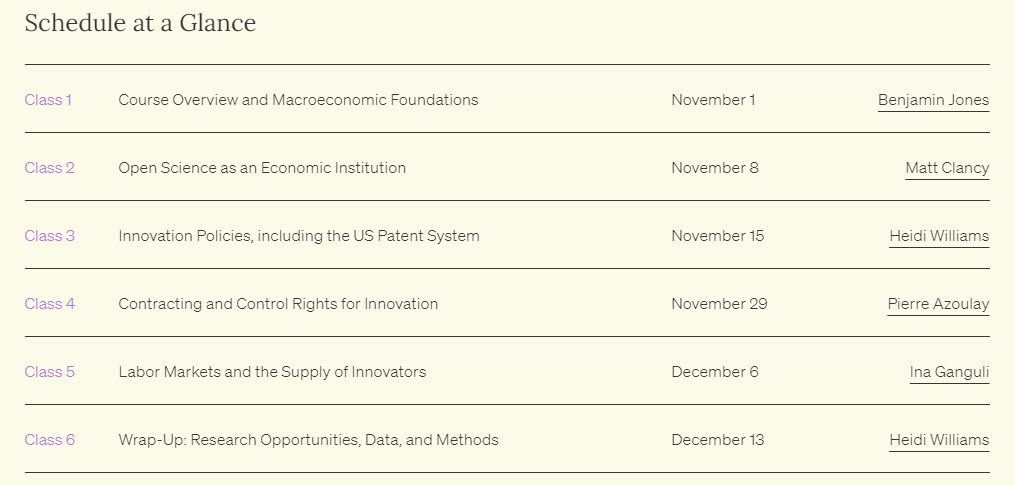
The Institute for Progress is hosting a six week course on the economics of ideas, science and innovation taught at the PhD level by Pierre Azoulay, Matt Clancy, Ina Ganguli, Benjamin Jones, and Heidi Williams. What an all star-cast! The syllabus is excellent. The course is aimed at first year or more PhD students. More details here.
The Covidization of science?
The COVID-19 pandemic saw a massive mobilization of the scientific workforce. We evaluated the citation impact of COVID-19 publications relative to all scientific work published in 2020 to 2021, finding that 20% of citations received to papers published in 2020 to 2021 were to COVID-19–related papers. Across science, 98 of the 100 most-cited papers published in 2020 to 2021 were related to COVID-19. A large number of scientists received large numbers of citations to their COVID-19 work, often exceeding the citations they had received to all their work during their entire career. We document a strong covidization of research citations across science.
Here is the full article, by John P.A. Ionnidis, et.al., via Michelle Dawson.
Peer review facts of the day
It’s estimated that, between them, researchers around the world spent a total of 100 million hours on reviewing papers in just 2020 alone. Around 10 percent of economics researchers spend at least 25 working days a year reviewing them…
Today, a scientist who submits a study to Nature or PNAS, the Proceedings of the National Academy of Sciences, can expect to be published nine months later, on average. In the top economics journals, the process takes even longer – a staggering 34 months, or almost three years. And the length has been crawling upward each year.
That is from Saloni Dattani, at Works in Progress (full issue here, recommended), and she also offers some suggestions for reform.
The Synchron brain-computer interface is implanted in a patient
So much talk about Monkey Pong, but perhaps the real action is elsewhere:
On July 6 a doctor at the Mount Sinai West medical center in New York threaded a 1.5-inch-long implant made up of wires and electrodes into a blood vessel in the brain of a patient with ALS, or amyotrophic lateral sclerosis. The hope is that the patient, who’s lost the ability to move and speak, will be able to surf the web and communicate via email and text simply by thinking—the device will translate his thoughts into commands sent to a computer.
Synchron, the startup behind the technology, has already implanted its devices in four patients in Australia, who haven’t experienced side effects and have been able to carry out such tasks as sending WhatsApp messages and making online purchases.
Here is the yummy-yum part:
A doctor makes an incision in the patient’s neck and feeds the stentrode via a catheter through the jugular vein into a blood vessel nestled within the motor cortex. As the catheter is removed, the stentrode—a cylindrical, hollow wire mesh—opens up and begins to fuse with the outer edges of the vessel. According to Majidi, the process is very similar to implanting a coronary stent and takes just a few minutes.
A second procedure then connects the stentrode via a wire to a computing device implanted in the patient’s chest. To do this, the surgeon must create a tunnel for the wire and a pocket for the device underneath the patient’s skin, much like what’s done to accommodate a pacemaker. The stentrode reads the signals when neurons fire in the brain, and the computing device amplifies those signals and sends them out to a computer or smartphone via Bluetooth.
Our regulatory state is failing us, NIH edition
…the lawmakers pressed NIH leadership for answers about the mysterious disappearance of the Scientific Management Review Board, a committee that Congress empaneled in 2006 to ensure the agency was operating efficiently…
“There wasn’t any notification that we weren’t going to meet again — it was just that the meetings stopped getting called,” Nancy Andrews, a onetime board member and the former dean of the Duke University School of Medicine, told STAT in May.
She added: “I had the sense that we were asking questions in areas that they didn’t really want to get into, and I suppose Francis [Collins] in particular didn’t really want us working on.”
Here is the full StatNews piece.
English Forests are Growing
England has doubled the amount of forestland in the past 150 years, and now has as much land dedicated to forests as the year 1350.
As I have reported before, the earth is greening–especially in China and India, in part because of rising CO2 levels and in part because of increasing urbanization and agricultural productivity.
That’s the gist, you can find a more detailed world investigation at OurWorldInData.
Hat tip: the excellent Jeremy Horpedahl.

A Radical Proposal for Funding Science
The process of competing for science funding is so onerous that much of the value is dissipated in seeking funding. Risk aversion by committee means that breakthrough science is often funded surreptiously, on the margin of funded science. These problems are serious and make alternative funding procedures worth thinking about even if radical.
To avoid rent dissipation and risk aversion, our state funding of science should be simplified and decentralized into Researcher Guided Funding. Researcher Guided Funding would take the ~$120 billion spent by the federal government on science each year and distribute it equally to the ~250,000 full-time research and teaching faculty in STEM fields at high research activity universities, who already get 90% of this money. This amounts to about $500,000 for each researcher every year. You could increase the amount allocated to some researchers while still avoiding dissipating resources on applications by allocating larger grants in a lottery that only some of them win each year. 60% of this money can be spent pursuing any project they want, with no requirements for peer consensus or approval. With no strings attached, Katalin Karikó and Charles Townes could use these funds to pursue their world-changing ideas despite doubt and disapproval from their colleagues. The other 40% would have to be spent funding projects of their peers. This allows important projects to gain a lot of extra funding if a group of researchers are excited about it. With over 5,000 authors on the paper chronicling the discovery of the Higgs Boson particle in the Hadron Supercollider, this group of physicists could muster $2.5 billion dollars a year in funding without consulting any outside sources. This system would avoid the negative effects of long and expensive review processes, because the state hands out the money with very few strings, and risk aversion among funders, because the researchers individually get to decide what to fund and pursue.
There are issues to be sure (see the paper) but experimentation in science funding is called for:
Government funding of science is a logical and well-intentioned attempt to increase the production of a positive externality. However, the institutional forms in which we have chosen to distribute these funds have created parasitic drag on the progress of science. There are many exciting proposals for new ways to fund science, but picking any one of these without rigorous experimentation would be foolish and ironic. The best proposal for science funding reform is to apply science to the problem. Rapid and large-scale experimentation is needed to continuously update and improve our science funding methods.
That is from a prize-winning essay from the CSPI by Maxwell Tabarrok.
See also Tyler’s important post, Science as a source of social alpha.
Science as a source of social alpha
How to improve society is one of the most commonly discussed questions, but it is not always approached with sufficient seriousness. We don’t think analytically enough about which variables can have maximum impact and also which are most feasible to steer.
For instance, the management of science is a radically underappreciated issue. How many managers of scientific labs receive any management training at all, even in the basics? On a scale of 1 to 10, how well are most labs or non-profit scientific ventures run? I’ve asked a number of people in the hard and biological sciences this question, and more often a laugh is the response, rather than a citation of a very specific number. I’ve never heard anyone say they are run just great.
On the other side of the market, the rest of us are failing too. In our social discourse, we have not elevated better scientific management as a social priority. This could be done in our universities, non-profits, research labs, government agencies, and of course in the private sector too. It’s not a sexy policy issue, but science is one of the most significant means for improving society. In the language of finance, you could say that science is a major source of social alpha.
Science offers the added benefit of being relatively easy to influence or control. Trying to improve the management and policy of U.S. science isn’t an easy task, but it is a relatively small part of our economy and the notion of science is relatively well-defined. Furthermore, our government has many direct policy levers such as the National Science Foundation, the National Institutes of Health, the Department of Energy, and the Department of Defense, not to mention numerous state universities. If we can’t improve the performance of our science, you have to wonder what can we do.
In contrast, some other sources of society-wide superior performance are broad and far-ranging in nature, but often too difficult to steer. I have in mind such variables as “trust,” or “having a cooperative culture.” Those are strong positives for societies, but also a little intimidating for a policy program and they can be very difficult to pin down.
Is science really a source of social alpha? Well, science gave the world mRNA vaccines, though not to all societies at the same time. The U.S. and UK cashed in early there, in large part due to their domestic scientific achievements. Science helps keep the U.S. defense establishment strong. Superior science also was essential to the building of the United States as a wealthy, developed nation. If you are hoping that we cure cancer, or limit the problems of climate change, those issues too rely on science. Most generally, science feeds into productivity growth which in turns boosts real wages and the general opportunities available in society.
Science policy could take up a much larger “mind space” in current policy debates. American science was mobilized in part due to the panic over the 1957 Sputnik scare, when the Soviet Union seemed to be ahead of the United States in a number of scientific dimensions. We don’t have a comparably focused scare today, but today’s problems are in fact no less urgent.
The institutions of the National Institutes of Health, the National Science Foundation, the Department of Defense and more all have very specific policies toward science. I do not have all or even most of the answers, but what are the chances that those institutions have the very best policies toward science? Pretty close to zero. And as time passes, those institutions seem to become more bureaucratic, more concerned with process, and less innovative, hardly a surprising evolution to anyone familiar with Washington, D.C.
I think we should experiment more with DARPA-like models, where rotating program managers, operating in relatively flat bureaucratic structures, have the autonomy to commit significant sums of money. I also think in pandemics our science institutions should have wartime-like powers to act more quickly and decisively. Whether or not those particular views are correct, a sustained national dialogue about science could yield substantial dividends.
On the research side, science policy and the study of science, should be far more prominent. In my own field, economics, economics of science is barely a subfield and it probably accounts for less than one percent of all research. In my ideal world, it would account for at least five percent of all of economic research.
Similarly, the history of science has produced thousands of wonderful books and articles, but it is hardly the highest-status or most popular subfield in history. We can appreciate what is there while wishing for much, much more, not just in terms of numerical outputs but also in terms of social status and reach to a broader set of readers.
Better science is one of the biggest “free lunches” standing before us.
The NSF Career Award
From an email from an anonymous correspondent:
Tyler, you may already know this, but I don’t think most people outside of STEM do. The NSF CAREER award (grant) is viewed as a major stepping-stone towards tenure, and there is an expectation that most people will “get one” on their way to tenure at top universities. Yet the requirements are:
1. Write 15 pages, outlining your entire ambitious research agenda for the next 5 years, generally organized as 3 major thrusts with 2-3 paper-sized ideas each.
2. Write 2-3 pages about broader impact, which generally includes broadening participation goals explaining the new undergraduate classes, graduate classes, and extensive community outreach you will engage in.
3. You have about a 20% chance of being awarded this grant, and will hear in 6-9 months (~10% of your tenure clock!)
4. It’s for only $500k, which at most top STEM programs covers about a grad-student per year by the time all the indirect costs are included.
(You may guess that I am writing one right now). The idea that we basically have “prestige” grants that everyone agrees are way too much effort for way too little money blows my mind. And everyone goes along with it!
Other unintended consequences include that you’re effectively forbidden from proposing the same ideas to other funding agencies while the grants is under review, locking you out of other funding sources!
Imagine if I pitched a VC and they said “We’ll get back to you in six months and in the mean time you can’t pitch anyone else, and we’ll only give you enough for one employee for the next five years”. How could anyone do innovation in that kind of environment?!
TC again: Of those it is #4 that I find most astonishing. That is some rate of overhead! Keep in mind that throughout world history the costs of intermediation generally have run at about two percent of wealth. And that is for intermediaries that have to assess the creditworthiness of borrowers, not just send money along.