Category: The Arts
Dav Pilkey on ADHD
Q: And you had to sit in the hall in elementary school?
A: So little was known about those conditions back in those days, and I think it was just seen as I was distracting everyone in the class with my silliness. I couldn’t stay in my chair and keep my mouth shut. So the teachers from second to fifth grade just put me in the hall. It ended up being kind of a blessing for me, too, because it gave me time to draw and to create stories and comics. I guess I made lemonade out of it…
Q: You must hear from young readers who tell you about their own difficulties and why your books help them.
A: I do. That’s actually one of the reasons I love to go out on the road and tour so much. Sometimes they’re proud in a way. There will be kids who will have posters they hold up that say that they’ve “got dyslexia like Dav,” or they’ll tell me proudly that they have ADHD. I don’t call it Attention Deficit Hyperactivity Disorder. I call it Attention Deficit Hyperactivity Delightfulness. I want kids to know that there’s nothing wrong with you. You just think differently, and that’s a good thing. It’s good to think differently. This world needs people who think differently; it’s your superpower.
What should I ask Ted Gioia?
I will be doing a Conversation with Ted, no associated public event. He is a musician and most of all a music historian, above all for jazz and blues, with numerous excellent books on those topics.
Here is his home page. Here is Ted on Twitter, one of the very best follows. Here is his latest book Music: A Subversive History, due out next week. And there is more:
Gioia was raised in a Sicilian-Mexican household in Hawthorne, California, a working class neighborhood in the South-Central area of Los Angeles. Gioia was valedictorian and a National Merit Scholar at Hawthorne High School, and attended Stanford University. There he received a degree in English (graduating with honors and distinction), served as editor of Stanford’s literary magazine, Sequoia, and wrote regularly for the Stanford Daily. He was a member of Stanford’s College Bowl team, which was featured on television, and defeated Yale in the national finals. Gioia also worked extensively as a jazz pianist during this period, and designed and taught a class on jazz at Stanford while still an undergraduate.
After graduation, Gioia received a degree in Philosophy, Politics and Economics at Oxford University, where he graduated with first class honors. He then received an MBA from Stanford University.
Gioia has enjoyed successes in the worlds of music, writing and business. In the business world, Gioia has consulted to Fortune 500
companies while working for McKinsey and the Boston Consulting Group. He helped Sola International complete an LBO and IPO on the New York Stock Exchange in the 1990s. He has undertaken business projects in 25 countries on five continents, and has managed large businesses (up to $200 million in revenues). While working amidst the venture capital community on Sand Hill Road in Silicon Valley, Gioia stood out from the crowd as the “guy with the piano in his office.”
His knowledge of varied musical genres is virtually without parallel. So what should I ask Ted?
*Sontag: Her Life and Work*
That is the new biography by Benjamin Moser, along with Ingmar Bergman bios you can call this topic my soap opera equivalent. Here are a few scattered bits:
“I’m only interested in people engaged in a project of self-transformation,” Susan wrote in 1971…she read about the University of Chicago, “which didn’t have a football team, where all people did was study, and where they talked about Plato and Aristotle and Aquinas day and night. I thought, that’s for me.”
And:
The connection between sex and pain was so natural for her — “All relationships are essentially masochistic,” she told Burch — that she could never imagine the loving partnership of equals that Freud had posited. Her “profoundest experience,” of her mother’s giving and then withdrawing her love, was perpetually renewed. Harriet dribbled out her affection by the scant thimbleful, which Susan gratefully slurped down: “I suppose, with my sore heart + unused body, it doesn’t take much to make me happy.” A couple of weeks later, she described the “total collapse” of their relationship and “blindly walking through a forest of pain.”
And:
Brodsky, after all, was the friend she dreamed of…the teacher she hoped to find in Philip Rieff; the companion she had sought all her life, an intellectual and artistic equal, and even a superior. She never found another friend as congenial, and it was in these terms that she mourned his premature death, at fifty-five. I’m all alone,” she told a friend. There’s nobody with whom I can share my ideas, my thoughts.”
Recommended, for those who care.
What should I ask Henry Farrell?
I will be doing a Conversation with him, no associated public event. As you read blogs, you might know Henry’s longstanding work over at CrookedTimber, and also his role in Monkey Cage. Henry is also professor of political science at George Washington University, has with Abraham L. Newman recently published a path-breaking book on the increasingly important concept of weaponized interdependence, is an expert on comparative labor relations, and is an all-around polymath, including on fiction, science fiction, and the politics of Ireland, his home country. Here is his home page.
So what should I ask Henry?
My favorite things Pakistan
1. Female singer: Abida Parveen, here is one early song, the later material is often more commercial. Sufi songs!
2. Qawwali performers: Nusrat Fateh Ali Khan, the Sabri Brothers, and try this French collection of Qawwali music.
3. Author/novel: Daniyal Mueenuddin, In Other Rooms, Other Wonders. I am not sure why this book isn’t better known. It is better than even the average of the better half of the Booker Prize winners. Why doesn’t he write more?
4. Dish: Haleem: “Haleem is made of wheat, barley, meat (usually minced beef or mutton (goat meat or Lamb and mutton) or chicken), lentils and spices, sometimes rice is also used. This dish is slow cooked for seven to eight hours, which results in a paste-like consistency, blending the flavors of spices, meat, barley and wheat.”
5. Movie: I don’t think I have seen a Pakistani film, and my favorite movie set in Pakistan is not so clear. Charlie Wilson’s War bored me, and Zero Dark Thirty is OK. What am I forgetting?
6. Economic reformer: Manmohan Singh.
7. Economist: Atif Mian, born in Nigeria to a Pakistani family.
8. Textiles: Wedding carpets from Sindh?

9. Visual artist: Shahzia Shikhander, images here.
I don’t follow cricket, sorry!
What should I ask Salman Rushdie?
I will be doing a Conversations with Tyler with him, no associated public event, so what should I ask him?
My Conversation with Hollis Robbins
Here is the audio and video, here is part of the CWT summary:
Now a dean at Sonoma State University, Robbins joined Tyler to discuss 19th-century life and literature and more, including why the 1840s were a turning point in US history, Harriet Beecher Stowe’s Calvinism, whether 12 Years a Slave and Django Unchained are appropriate portraits of slavery, the best argument for reparations, how prepaid postage changed America, the second best Herman Melville book, why Ayn Rand and Margaret Mitchell are ignored by English departments, growing up the daughter of a tech entrepreneur, and why teachers should be like quarterbacks.
Here is one excerpt:
COWEN: You’ve written a good deal on the history of the postal service. How did the growth of the postal service change romance in America?
ROBBINS: Well, everybody could write a letter. [laughs] In 1844 — this was the other exciting thing that happened in the 1840s. Rowland Hill in England changed the postal service by inventing the idea of prepaid postage. Anybody could buy a stamp, and then you’d put the stamp on the letter and send the letter.
Prior to that, you had to go to the post office. You had to engage with the clerk. After the 1840s and after prepaid postage, you could just get your stamps, and anybody could send a letter. In fact, Frederick Douglass loved the idea of prepaid post for the ability for the enslaved to write and send letters. After that, people wrote letters to each other, letters home, letters to their lovers, letters to —
COWEN: When should you send a sealed letter? Because it’s also drawing attention to itself, right?
ROBBINS: Well, envelopes — it’s interesting that envelopes, sealed envelopes, came about 50 years after the post office became popular, so you didn’t really have self-sealing envelopes until the end of the 19th century.
COWEN: That was technology? Or people didn’t see the need for it?
ROBBINS: Technology, the idea of folding the envelope and then having it be gummed and self-sealing. There were a number of patents, but they kept breaking down. But technology finally resolved it at the end of the 19th century.
Prior to that, you would write in code. Also, paper was expensive, so you often wrote across the page horizontally and then turned it to the side and crossed the page, writing in the other direction. If somebody was really going to snoop on your letters, they had to work for it.
COWEN: On net, what were the social effects of the postal service?
ROBBINS: Well, communication. The post office and the need for the post office is in our Constitution.
COWEN: It was egalitarian? It was winner take all? It liberated women? It helped slaves? Or what?
ROBBINS: All those things.
COWEN: All those things.
ROBBINS: But yeah, de Tocqueville mentioned this in his great book in the 1830s that anybody — some farmer in Michigan — could be as informed as somebody in New York City.
And:
COWEN: Margaret Mitchell or Ayn Rand?
ROBBINS: Well, it’s interesting that two of the best-selling novelists of the 20th-century women are both equally ignored by English departments in universities. Margaret Mitchell and Gone with the Wind is paid attention to a little bit just because, as I said, it’s something that literature and film worked against, but not Ayn Rand at all.
And:
COWEN: What’s a paradigmatic example of a movie made better by a good soundtrack?
ROBBINS: The Pink Panther — Henry Mancini’s score. The movie is ridiculous, but Henry Mancini’s score — you’re going to be humming it now the rest of the day.
And:
COWEN: What is the Straussian reading of Babar the Elephant?
ROBBINS: When’s the last time you read it?
COWEN: Not long ago.
Recommended throughout.
Disgrace insurance markets in everything
According to a Vulture article, Comenos then put together a squad of researchers in India to do the same thing: comb the trashiest ends of the web for iffy tweets, racial slurs and ill-advised sexts sent by about 27,000 prominent figures. These are then fed to a team of data specialists in Boston who crunch the numbers, based on 224 factors, and generate a “risk score” out of 100 for each person to gauge how close they are to getting permanently cancelled (shamed, rejected or boycotted for offensive behaviour or language).
Comenos’s company is called SpottedRisk: a “disgrace insurer” backed by Lloyds of London and touting for business from studios and brands badly burned by a celebrity shooting themselves in the foot – and damaging whatever project they were involved in. These losses have been substantial. Tiger Woods’ 2009 car crash, plus revelations about his infidelities, cost him $22m in brand contracts – and the shareholders of those brands up to $12bn. Meanwhile,#MeToo has escalated Hollywood blacklisting. After sexual abuse allegations against Kevin Spacey in 2017, Ridley Scott reshot the thriller All the Money in the World with Christopher Plummer in Spacey’s role – at a cost of $10m. Another Spacey movie, The Billionaire’s Boys Club, ploughed on with its planned release regardless of increasing public disgust at its star. It made £98 on its opening night.
SpottedRisk says its payout for Spacey would be about $8m – a number generated by combining his risk score with its “outcry index” to gauge public reaction. Bill Cosby and Harvey Weinstein would merit $10m payouts, while Roseanne Barr is relatively small change at $6m.
Here is the full Catherine Shoard article, via Michael, note that Donald Trump and R. Kelly are considered “uninsurable.”
My Conversation with Masha Gessen
Here is the transcript and audio, here is the summary:
Masha joined Tyler in New York City to answer his many questions about Russia: why was Soviet mathematics so good? What was it like meeting with Putin? Why are Russian friendships so intense? Are Russian women as strong as the stereotype suggests — and why do they all have the same few names? Is Russia more hostile to LGBT rights than other autocracies? Why did Garry Kasparov fail to make a dent in Russian politics? What did The Americans get right that Chernobyl missed? And what’s a good place to eat Russian food in Manhattan?
Here is excerpt:
COWEN: Why has Russia basically never been a free country?
GESSEN: Most countries have a history of never having been free countries until they become free countries.
[laughter]
COWEN: But Russia has been next to some semifree countries. It’s a European nation, right? It’s been a part of European intellectual life for many centuries, and yet, with the possible exception of parts of the ’90s, it seems it’s never come very close to being an ongoing democracy with some version of free speech. Why isn’t it like, say, Sweden?
GESSEN: [laughs] Why isn’t Russia like . . . I tend to read Russian history a little bit differently in the sense that I don’t think it’s a continuous history of unfreedom. I think that Russia was like a lot of other countries, a lot of empires, in being a tyranny up until the early 20th century. Then Russia had something that no other country has had, which is the longest totalitarian experiment in history. That’s a 20th-century phenomenon that has a very specific set of conditions.
I don’t read Russian history as this history of Russians always want a strong hand, which is a very traditional way of looking at it. I think that Russia, at breaking points when it could have developed a democracy or a semidemocracy, actually started this totalitarian experiment. And what we’re looking at now is the aftermath of the totalitarian experiment.
And:
GESSEN: …I thought Americans were absurd. They will say hello to you in the street for no reason. Yeah, I found them very unreasonably friendly.
I think that there’s a kind of grumpy and dark culture in Russia. Russians certainly have a lot of discernment in the fine shades of misery. If you ask a Russian how they are, they will not cheerfully respond by saying they’re great. If they’re miserable, they might actually share that with you in some detail.
There’s no shame in being miserable in Russia. There’s, in fact, a lot of validation. Read a Russian novel. You’ll find it all in there. We really are connoisseurs of depression.
Finally there was the segment starting with this:
COWEN: I have so many questions about Russia proper. Let me start with one. Why is it that Russians seem to purge their own friends so often? The standing joke being the Russian word for “friend” is “future enemy.” There’s a sense of loyalty cycles, where you have to reach a certain bar of being loyal or otherwise you’re purged.
Highly recommended.
Venice adopting the Renaissance
Venice’s adoption of these Renaissance styles was itself a remarkable break with the past, for the Venetians had always favored the sophisticated East when it came to artistic expression. But times were changing. The flame of Byzantium was flickering and even Venice turned its attention to the Western terra firma. Among the earliest Renaissance artists in Venice was Jacopo Bellini. The son of a Venetian tinsmith, Bellini worked under Gentile da Fabriano, who produced various now-lost works for the Great Council in 1408. Bellini accompanied his master to Florence, where he remained for some years learning the new artistic techniques pioneered there. Later, Bellini traveled to Bruges, where he was introduced to the use of oil paints on canvas — a medium that would forever change Venice.
The seat of high culture in fifteenth-century Venice was not at the governmental center, but in its outskirts at Padua. There, since 1222, a university had flourished that drew the best minds in Europe and provided an excellent education for Venice’s elite. After returning to Venice, Bellini set up shop in Padua with his two sons, Gentile and Giovanni. They were likely influenced by the arrival in 1443 of Donatello, who lived in Padua for about a decade. His masterwork during those years was the equestrian statue of the condottiere Erasmo da Narni…This magnificent life-size bronze was the first such statue produced since the days of ancient Rome.
That is from Thomas F. Madden, Venice: A New History.
My favorite things Venice
1. Favorite playwright: Carlo Goldoni, eighteenth century, best if you can see one rather than try to read it.
2. Play, set in: William Shakespeare, Merchant of Venice. Read it carefully and repeatedly, it is far subtler on issues of racism and prejudice than you might have been expecting.
3. Opera, set in: Verdi’s Otello (James Levine recording). Even as a dramatic work I (perhaps oddly) prefer this to Shakespeare’s play.
4. Memoir, set in: Casanova, though I suggest you read an abridged edition. I strongly recommend reading Marco Polo as well, though I am not sure that counts as a “memoir.”
5. Short story, set in: Thomas Mann, “Death in Venice.” But a close runner-up is Henry James, “The Aspern Papers.”
Are you getting the picture? Venice has inspired numerous major writers and artists. However I don’t love John Ruskin on Venice.
6. Painting: Ah! Where to start? I’ll opt for Giorgione’s The Tempest, or any number of late Titian works. And there are so many runners-up, starting with Veronese, Tintoretto, the Bellinis, and later Tiepolo. Even a painter as good as Sebastiano del Piombo is pretty far down the list here. Canaletto bores me, though the technique is impressive.
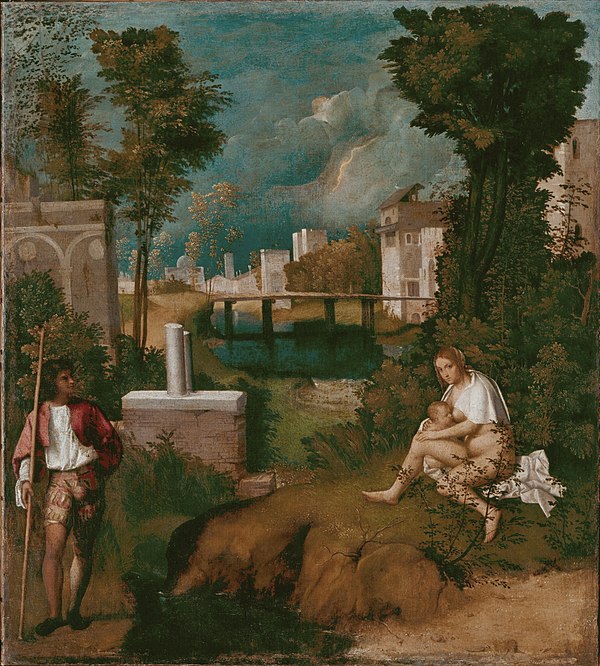
7. Sculptor: Antonio Canova was born in the Venetian Republic, and I believe he is now one of the most underrated of Western artists. His greatest work is in Vienna.
8. Composer: I can’t quite bring myself to count Monteverdi as Venetian, so that leaves me with Luigi Nono and also Gabrieli and Albioni and Vivaldi, none of whom I enjoy listening to.
9. Conductor: Giuseppe Sinopoli. I enjoy his Mahler and Strauss and Elgar, and his take on Verdi’s Aida was special as well.
10. Photographer of: Derek Parfit, here are some images.
11. Movie, set in: I can recall the fun Casino Royale James Bond scene, but surely there is a better selection attached to a better movie. What might that be?
11. Maxim about: Pope Gregory XIII: “I am pope everywhere except in Venice.”
All in all, not bad for a city that nowadays has no more than 60,000 residents and was never especially large.
I’ll be there in a few days time.
The clothing of the future
That is the topic of my latest Bloomberg column, and they chose an excellent photo to go with it. Excerpt:
A lot of current clothing innovations focus on gimmicks. There is a “Social Escape Dress,” which can “emit a cloud of fog when the wearer is feeling stressed.” Maybe that is fun, but what economic problem does it solve? And won’t it stress the wearer more? I suspect that the more durable clothing innovations will be more practical.
The first major practical problem is that clothes have to be cleaned, a time-consuming and sometimes expensive process. To remedy this problem, imagine a futuristic closet with cleaning and dry-cleaning functions (the materials of the clothes themselves could evolve to make this easier and less dangerous). A wardrobe system that cleans itself would be a big plus for many people. While I don’t see this technological advance as imminent, neither do I see it as unreachable.
A second major problem with clothes is that they have to be stored. Urban space is currently quite scarce and expensive, a reality unlikely to change anytime soon. Easily foldable and contractible clothes and shoes will therefore be at a premium, but of course the question is how to get them back into proper shape with a minimum amount of effort. That again suggests a home device — far more efficient than the iron — to get clothes into proper shape, which in turn will allow for more clothes to be rolled up and put away. Cleaning your clothes and storing your clothes are closely related problems, and in my optimistic vision they will be solved together.
Another source of big welfare gains could be quite prosaic:
At the upper end of the market, it is possible to make exclusive fashion more affordable, while still looking great. In a given fashion season the number of “in” styles could continue to expand, through the use of social media such as Instagram. That makes the market more competitive. Indeed it is already a trend that you can look “cool” and sophisticated without having to buy the most expensive dress from Milan or Paris. More market niches allow for the production of more reputation and glamour.
There is much more at the link.
My Conversation with Kwame Anthony Appiah
Here is the audio and transcript. We covered Ghana, Africa more generally, cosmopolitanism and the resurgence of nationalism, philosophy and Karl Popper, Lee Kuan Yew, the repatriation of cultural objects, Paul Simon, the smarts of Jodie Foster, sheep farming in New Jersey, and the value of giving personal advice.
Here is one excerpt:
COWEN: Take Pan-Africanism. Do you think, in the broader course of history, this will go down as merely a 20th-century idea? Or is Pan-Africanism alive and well today?
APPIAH: Pan-Africanism involves two different big strands. One is the diasporic strand. The word Pan-Africanism and the Pan-African Congresses were invented in the diaspora by people like Sylvester Williams in Jamaica and W. E. B. Du Bois from the United States and Padmore.
That idea of a diasporic African identity seems pretty lively in the world today, though it doesn’t produce much actual politics or policy, but the sense of solidarity of people of African descent, of the African diaspora seems pretty strong to me.
COWEN: But strongest outside of Africa in a way, right?
APPIAH: Yes, where it began. In Africa, I think, on the one hand, that most contemporary sub-Saharan Africans do have a sense of themselves as belonging to a kind of Black African world. But if you ask them to do something practical about it, like take down borders or do more political integration, I don’t know that that is going to go anywhere anytime soon, which I regret because I think, for lots of reasons, it would be . . .
My sister and her husband live in Lagos. If they want to go to Accra by road, they have to cross the border between Nigeria and Benin, the border between Benin and Togo, the border between Togo and Ghana. And at each of those borders, they probably have to interact with people who are going to try and extract an illegal tax on them.
COWEN: Easier to fly to London, right?
APPIAH: Much easier to fly to London and back to Accra. That’s crazy. And we’ve had these weird things. On the one hand, there’s probably a million Ghanaians in Nigeria, living Ghanaian citizens.
And:
COWEN: Is cosmopolitanism not only compatible with nationalism, but in a way quite parasitic upon it? And in a sense, the parasite is being ejected a bit? Think back to your boyhood in Kumasi. You have all these different groups, and you’re trading with them. You see them every day, and that works great, but there’s some central coherence to Ghana underlying that.
You go to Lebanon today — that central coherence seems to have been gone for some time. You could call Lebanon a cosmopolitan place, but it’s not really an advertisement for Lebanon the way it’s worked out. Are we just moving to a new equilibrium, where the parasitism of cosmopolitanism is now being recognized for what it really is?
APPIAH: I don’t like the metaphor of the parasite.
[laughter]
APPIAH: But yes, I do want to insist that cosmopolitanism . . . Look, cosmopolitanism, as I said, does not only require, or the right kind of cosmopolitan requires a kind of rootedness, but its point, precisely, is that we are celebrating connections among different places, each of which is rooted in its own something, each of which has its distinctive virtues and interest, each of which has its own history. And we’re making connections with people for whom that place is their first place, just as I am in a place which is my first place.
So yes, cosmopolitanism requires, I think, a national sense of solidarities that are not global. That’s why, as I say, you can be a cosmopolitan patriot. Now, if the nationalist says, “Okay, but why do we need anything beyond national citizenship?” The answer is, we have a world to manage. The economy works better if we integrate.
There is much, much more at the link, self-recommending…
My Conversation with Eric Kaufmann
Interesting and excellent throughout, here is the audio and transcript. Eric is political scientist at Birkbeck College in London and the author of the recent Whiteshift: Populism, Immigration, and the Future of White Majorities. Here is part of the opening summary:
Kauffman’s latest book Whiteshift, which examines how declining white ethnic majorities will respond to these changes, is on Tyler’s list as one of the best books of the year. The two discuss the book and more, including Orangeism in Northern Ireland, Switzerland’s secret for stability, what Tocqueville got most wrong about America, predictions on Brexit’s final form, why Portugal seems immune from populism, how Notre Dame should be rebuilt, whether the Amish — or Mormons — will take over the world, and much more.
Here is one excerpt:
COWEN: Do conservative Muslims also have a much higher fertility rate?
KAUFMANN: The gradient between very conservative and sort of secular and liberal is not as strong in Islam as it is in Judaism or Christianity, but it’s about a twice higher fertility for women who are most in favor of Sharia compared to those who are most opposed to Sharia, in the cities. So I do think there is also this dynamic within Islam, yes.
COWEN: If we look at a country such as Iran, which now has a very low total fertility rate, is that a sign they’re not actually very religious? Or there’s something unusual about religion in Iran? What accounts for that?
And:
COWEN: Which group of French Muslims has assimilated most successfully and why?
KAUFMANN: Well, the outmarriage rate is almost 50 percent for French Algerian men, but even across the Franco-Algerian community, I think it’s in the 40 to 50 percent outmarriage —
COWEN: And they’re marrying ethnically white French women?
KAUFMANN: Right, or men. I think part of this stems from Algeria in its history. You have a large Berber population in Algeria, many of whom are anti the regime. They’re anti the Arab-Islamist regime. So they’re actually quite secular in many ways.
That’s part of it, but even amongst the Moroccans in France, there’s quite a high outmarriage rate of like 40 percent. So yeah, the French Muslims do seem to be melting in better than Muslims even of the same ethnicity. Compared to Moroccans in the Netherlands, for example, there’s a much higher outmarriage in France.
COWEN: And that’s the Berber factor, in your view?
KAUFMANN: I think it is the Berber factor. I don’t think there’s anything magical that the French are doing that the Dutch are not in terms of integration policy. I think too much is made of that.
And:
COWEN: What’s the most plausible scenario for Irish reunification?
KAUFMANN: I think the most plausible scenario is that Northern Ireland Protestants don’t have the same hostility to the Republic that they have traditionally had, so maybe a kind of charm offensive.
In a way, the unionist population is the one they have to win over. They are kind of foursquare against reunification. Somehow, the Irish Republic has to find a way to reassure them. That’s going to be the ticket to reunification, but it’ll never really happen just through economic integration. I think there’s got to be something symbolic that will win over the unionists.
Finally:
COWEN: So there’ll be more of a turn against immigration?
KAUFMANN: Yeah.
COWEN: In Canada.
KAUFMANN: Yes, and immigration attitudes are now very different, depending if you’re a Conservative or a Liberal voter. That didn’t use to be the case even five years ago, so there is more of a politicization of that issue now.
Recommended, and I found all of Eric’s books very interesting as well.
https://medium.com/@mercatus/tyler-cowen-eric-kaufmann-population-religion-culture-6e85bf9c8c07
Taipei bleg
I haven’t been in ages, so please tell me what to do. I will be there soon. I thank you all in advance for the usual wisdom and sage counsel.