Category: Uncategorized
What I’ve been reading
1. Elizabeth A. Fenn, Pox Americana: The Great Smallpox Epidemic of 1775-82, quite a good book.
2. Louis Galambos with Jane Eliot Sewell, Networks of Innovation: Vaccine Development at Merck, Sharp and Dohme, and Mulford, 1895-1995. Imagine a book with both Vannevar Bush and Maurice Hilleman as leading and indeed intersecting characters. How is this for a sentence?: “Hilleman had spent his boyhood on a farm on which the German-American tradition was to “work like hell and live by the tenets of Martin Luther.””
3. John Duffy, The Sanitarians: A History of American Public Health. A little boring, and not conceptual enough, but is anything on this topic entirely boring at the current moment in time? Nonetheless this is a very useful overview and survey of public health issues in American history, and so I do not hesitate to recommend it.
4. Robert P. Saldin and Steven M. Teles, Never Trump: The Revolt of the Conservative Elites. Remarkably fair-minded and substantive, here is my blurb: “”Who are the Never Trumpers, what do they want, and what are their stories? Robert P. Saldin and Steven Teles have produced the go-to work on a movement that will likely prove of enduring influence in American politics.” Here is a relevant Atlantic article by Saldin and Teles. Recommended.
5. Anne Enright, Actress: A Novel. A subtle Irish story of a woman telling the tale of her now-departed famous, charismatic mother and her career in the theater. Unpeels like an onion as you read it, and reveals successively deeper layers of the story, it would make my “favorite fiction of the year” list pretty much any year. But please note it has not have the “upfront attention-grabbing style” that many of us have been trained to enjoy.
Peer Review of “COVID-19 Antibody Seroprevalence in Santa Clara County, California”
Here are 2300 words from Balaji, self-recommending. Here is the original piece. Balaji starts with:
The high reported positive rate in this serosurvey may be explained by the false positive rate of the test and/or by sample recruitment issues.
I look forward to posting more on this.
Ahem
A widely followed model for projecting Covid-19 deaths in the U.S. is producing results that have been bouncing up and down like an unpredictable fever, and now epidemiologists are criticizing it as flawed and misleading for both the public and policy makers. In particular, they warn against relying on it as the basis for government decision-making, including on “re-opening America.”
“It’s not a model that most of us in the infectious disease epidemiology field think is well suited” to projecting Covid-19 deaths, epidemiologist Marc Lipsitch of the Harvard T.H. Chan School of Public Health told reporters this week, referring to projections by the Institute for Health Metrics and Evaluation at the University of Washington.
Others experts, including some colleagues of the model-makers, are even harsher. “That the IHME model keeps changing is evidence of its lack of reliability as a predictive tool,” said epidemiologist Ruth Etzioni of the Fred Hutchinson Cancer Center, home to several of the researchers who created the model, and who has served on a search committee for IHME. “That it is being used for policy decisions and its results interpreted wrongly is a travesty unfolding before our eyes.”
…The chief reason the IHME projections worry some experts, Etzioni said, is that “the fact that they overshot” — initially projecting up to 240,000 U.S. deaths, compared with fewer than 70,000 now — “will be used to suggest that the government response prevented an even greater catastrophe, when in fact the predictions were shaky in the first place.”
Here is the full story, from StatNews, by Sharon Begley with assistance from Helen Branswell, two very good and knowledgeable sources. Via Matt Yglesias.
To be clear, I am (and always have been) fully aware that there are more nuanced epidemiological models “sitting on on the shelf,” just as is true for macroeconomics and many other areas. But I ask you, where are the numerous cases of leading epidemiologists screaming bloody murder to the press, or on their blogs, or in any other manner, that the most commonly used model for this all-important policy analysis is deeply wrong and in some regards close to a fraud? Yes I know you can point to a few tweets from the more serious people, but where has the profession as a whole been? Who organized the protest letter and petition to The Wall Street Journal?
And to be clear, I have heard this model cited and discussed in many (off the record) policy discussions, this is not just something you can pin on the Trump administration narrowly construed (though they are at fault as well).
Friday assorted links
1. Trying to re-open a restaurant in Wuhan (Bloomberg). And why is there less panic in China? And the coronavirus culture that is Maryland.
2. Covid-19 occupational risk scores (not sure how much information those are based on).
3. Patrick Wolff and Jason Tepperman on macroprudential business interruption insurance.
4. Why isn’t India doing worse?
5. The virus chasers of Massachusetts (NYT).
6. Profile of Alex Berenson, contrarian.
7. Positive Remdesivir results. And criticism of said report.
8. Is the golden age of TV over, and if so why? (FT)
9. The “implicit temporary deregulation” of OSHA — good or bad? What would gdp be if OSHA were right now exercising its intended powers?
10. How the wealthy are making do without staff, including a cameo by Martha Stewart (WSJ).
11. Some skeptical results on BCG vaccines.
12. New estimates on population prevalence, much higher than reported cases.
13. ““Just realised my soap wasn’t working because it’s literally a block of cheese,” she wrote.”
What should I ask Glen Weyl?
I will be doing a Conversation with him, mostly about his ideas on Covid-19 response and testing, though we will cover other topics as well. So what should I ask him?
“Social Distancing is Working so Well!”
How do you feel about that statement? I take this as one psychometric test.
If your reaction is: “My goodness, these are tragic times but it is splendid and noble how we all can come together and sacrifice for a common endeavor!”…well…
…you have failed my test and I will suspect a wee bit of mood affiliation. Most likely it is bad news if the relative safety (for some) of the current moment comes from social distancing. Because at some point social distancing must end, or at least be significantly curtailed, and then a higher danger level may well reemerge.
Possibly you have inside information that a cure will be ready next week, but somehow I doubt it. You are happy because you like something about the process.
Alternatively, if you hear “social distancing is working so well!” and immediately feel a deep sense of foreboding, and begin to calculate whether good short-term results are correlated with better or worse long-term results. And then you calculate how how long the distancing can last for, due to governmental budget constraints, and then try to figure out what kinds of progress we might make in the meantime while the distancing lasts, and then start worrying about how reliant on social distancing we are becoming…
…But then you undertake a second-order calculation about how the greater danger spurred by the forthcoming decline in social distancing also might spur innovation…
And then you think “would it not be better if the current progress came from a more sustainable source, what might that be, how about faster than expected herd immunity amongst a relatively small group of heterogeneous super-spreaders, now what is the chance of that?”…
…and finish your analysis confused…
Then you are my kind of weirdo.
We are living in a time of psychometric tests.
Devon Zuegel on togetherness
When we come out of this, I expect people will value in-person even more, but not in the sense that we’ll spend more time with each other in-person but rather that we put it on more of a pedestal. It’ll be treated with a lot more reverence and importance, which means it’ll be a strong signal to choose to spend time physically with someone when you could more easily spend time virtually. It’ll feel more important but also more scarce and special.
I’ve seen a preview of this with my team, which was already almost all remote before this anyways. We spend less time physically with each other since we’re all working from different cities, but when we are together we are more focused on “making the most of it”. The one week every six months we’re together, we’re very careful to use the time to get to know each other, choosing to deprioritize real work those weeks. This means that the way we relate to each other is very intentional and self-conscious, rather than more of an organic growth of the relationship that happens by just having each other ambiently in the background all the time. It works well, and over the course of working with them over time I’ve come to feel extremely close to them. But it means that everything had to be much more explicit, and that we’ve had to do extra work to develop our own new norms rather than getting to default to what’s normal. That said, this has major perks too, because we get to reinvent as we go along!
Those are two paragraph from my email.
Will the coronavirus make the digital divide worse?
That is the topic of my latest Bloomberg column, here is one excerpt:
Now consider issues beyond specific user groups. The U.S. will almost certainly need to introduce a “track and trace” system, using information technology, preferably with privacy safeguards. One version of this idea uses geolocation methods, which tracks where people are in physical space and sends individuals a text message if they come into close contact with others diagnosed with Covid-19.
That technology requires participants to have a smartphone. The federal government probably will not mandate smartphone usage, which would both be politically unpopular and difficult to enforce. Nonetheless, businesses are likely to turn to such schemes to increase workplace safety. But again, exactly who already owns or afford a smartphone? Some of the jobs with the closest physical contact, such as service jobs, employ relatively low paid workers.
Companies may well decide to help workers buy smartphones, perhaps with government subsidies too. But that would then make having a smartphone a job requirement, including in the retail and public sectors.
This would create a new and in some ways more serious digital divide. Imagine you want to visit your local shopping mall. Its owners might require that you subscribe to one of the Covid-19 tracing apps. Or imagine not being able to get your license renewed without a smartphone certifying your health status.
All of a sudden the U.S. will have a new segregation — between those who have smartphones and those who don’t. If you’re on the wrong side of that divide, many places and services will be hard if not impossible to reach.
And to close:
It is plausible that the U.S. could end up with 10% or more of the population exiled from many key institutions of American life — simply because they lack the right kind of technology.
Don’t get me wrong; the digital divide deserves the additional attention soon to come its way. The trick will be ensuring that any proposed solutions don’t just trade one kind of divide for another.
I can’t even figure out how to work those parking spots that are “app only” for the parking meter. Pity me!
Fast Grants, a project of Emergent Ventures against Covid-19, status update
As you may recall, the goal of Fast Grants is to support biomedical research to fight back Covid-19, thus restoring prosperity and liberty.
Yesterday 40 awards were made, totaling about $7 million, and money is already going out the door with ongoing transfers today. Winners are from MIT, Harvard, Stanford, Rockefeller University, UCSF, UC Berkeley, Yale, Oxford, and other locales of note. The applications are of remarkably high quality.
Nearly 4000 applications have been turned down, and many others are being put in touch with other institutions for possible funding support, with that ancillary number set to top $5 million.
The project was announced April 8, 2020, only eight days ago. And Fast Grants was conceived of only about a week before that, and with zero dedicated funding at the time.
I wish to thank everyone who has worked so hard to make this a reality, including the very generous donors to the program, those at Stripe who contributed by writing new software, the quality-conscious and conscientious referees and academic panel members (about twenty of them), and my co-workers at Mercatus at George Mason University, which is home to Emergent Ventures.
I hope soon to give you an update on some of the supported projects.
Thursday assorted links
1. Nicaragua still has a full calendar of sports (NYT).
2. An alternating lockdown strategy.
3. Vox on the Watney Stapp Mercatus mask plan.
4. Derek Lowe on vaccine prospects.
5. Will coronavirus change the proper CPI bundle?
6. “This paper argues that daily ‘universal random testing’, as recently proposed by Paul Romer, is not likely to be an effective tool for reducing the spread of Covid-19 and resuming economic activity. We find that more than 21% of the population would need to be tested every day to reduce the Covid-19 reproduction rate (R’) to 0.75, as opposed to 7% as argued by Romer. We show this using a corrected method for calculating the impact of an infectious person on others, when testing and isolation takes place. Our calculation allows for asymptomatic cases. Instead we propose ‘stratified periodic testing’ as an alternative strategy.” Link here.
7. Why is Detroit worse than Baltimore? And is there also a Brazilian heterogeneity? (limited information, however)
8. JPMorgan reopening plan, involves building herd immunity among the young. This is where the discussion will be headed soon.
9. How well did Italy do lowering R0 through lockdown? An informal estimate, but very important and underdiscussed.
11. Ongoing chart of Covid-19 deaths in Sweden, also accounting for reporting delays.
12. Who is this helping? (NYT): “Amazon said Wednesday that it would temporarily halt its operations in France after a court ruled the company had failed to adequately protect warehouse workers against the threat of the coronavirus and that it must restrict deliveries to only food, hygiene and medical products until it addressed the issue.”
13. YouTube talk by Sweden’s chief epidemiologist (have not heard it yet).
One reason why food intended for restaurants is not reallocated to supermarkets
Nutrition labeling also frequently doesn’t comply with Agriculture Department and Food and Drug Administration guidelines for consumer sales, said Geoff Freeman, president and CEO of the Consumer Brands Association, a trade organization for the consumer packaged goods industry. A company that sold hamburger buns to major fast food outlets could try to pivot to retail, but that entails changing packaging on the fly, a relaxation of labeling requirements and new distribution contracts.
Here is a longer story, about how supermarkets are changing, by Laura Reiley, interesting throughout. I’ll say it again: America’s regulatory state is failing us.
Wednesday assorted links
1. Invite a llama or goat to your next corporate Zoom meeting or video call for under $100. And new Oumuamua theory, but kind of boring.
2. Turning old shipping containers into mobile intensive care units.
3. Contemporary novels longer than 500 pages, some of them good.
5. Critique of the IHME epidemiological model, recommended. And a few more criticisms. And here is Karl T. Bergstrom, very good points. Recommended.
6. Update on French-speaking vs. German-speaking Swiss cantons. File under “heterogeneities.”
7. “But the operation can be no longer than two hours as that is how long a rhino can be safely anaesthetised.” It is hard to make a rhino.
8. Data on indoor outbreaks, striking results. Outdoors seems pretty safe.
Re-starting the economy
Will the U.S. economy re-open prematurely?:
New NBER survey of U.S. small companies nber.org/papers/w26989 Here is the percent, by industry, saying their business will still exist if the crisis lasts 6 months: All retail (except grocers): 33% Hotels: 27% Personal services: 22% Restaurants and bars: 15%
That is from Derek Thompson. Or when will the non-payment of mortgages render the banking system insolvent and beyond saving by the Fed?
At some point, irreversible, non-linear economic damage sets in, and we won’t let that happen, no matter how many times someone tells you “there is no trade-off between money and lives.”
For some time now I have thought that America will reopen prematurely, with a very partial and indeed hypocritical reopening, but a reopening nonetheless. In May, in most states but at varying speeds, including across cities.
You can see from this Chicago poll of top economists that virtually all of them oppose an early reopening. I don’t disagree with their analysis, but they are too far removed from the actual debate.
America is a democracy, and the median voter will not die of coronavirus (this sentence is not repeated enough times in most analyses). And so we will reopen pretty soon, no matter what the full calculus of lives and longer-run gdp might suggest.
Lyman Stone favors ending the lockdown. It does not matter whether you agree with him or not. Matt Parlmer predicts revolution if we don’t reopen in time. I don’t agree with that assessment, but he is thinking along the right lines by not regarding the reopening date as entirely a choice variable.
The key is to come up with a better reopening rather than a worse reopening.
Any model of optimal policy should be “what should we do now, knowing the lockdown can’t last very long?” rather than “what is the optimal length of lockdown?”
And our best hope is that the risk of an early reopening spurs America to become more innovative more quickly with masks, testing, and other methods of reducing viral and economic risk.
Why isn’t Sweden exploding?
…Swedish state epidemiologist Anders Tegnell remains calm: he is not seeing the kind of rapid increase that might threaten to overwhelm the Swedish health service, and unlike policymakers in the UK, he has been entirely consistent that that is his main objective.
That is from a new piece by Freddie Sayers, asserting that “the jury is still out” when it comes to Sweden. I cannot reproduce all of the graphs in that piece, but scroll through and please note that in terms of per capita deaths Sweden seems to be doing better than Belgium, France, or the United Kingdom, all of which have serious lockdowns (Sweden does not). If you measure extant trends, Sweden is in the middle of the pack for Europe. And here is data on new hospital admissions:
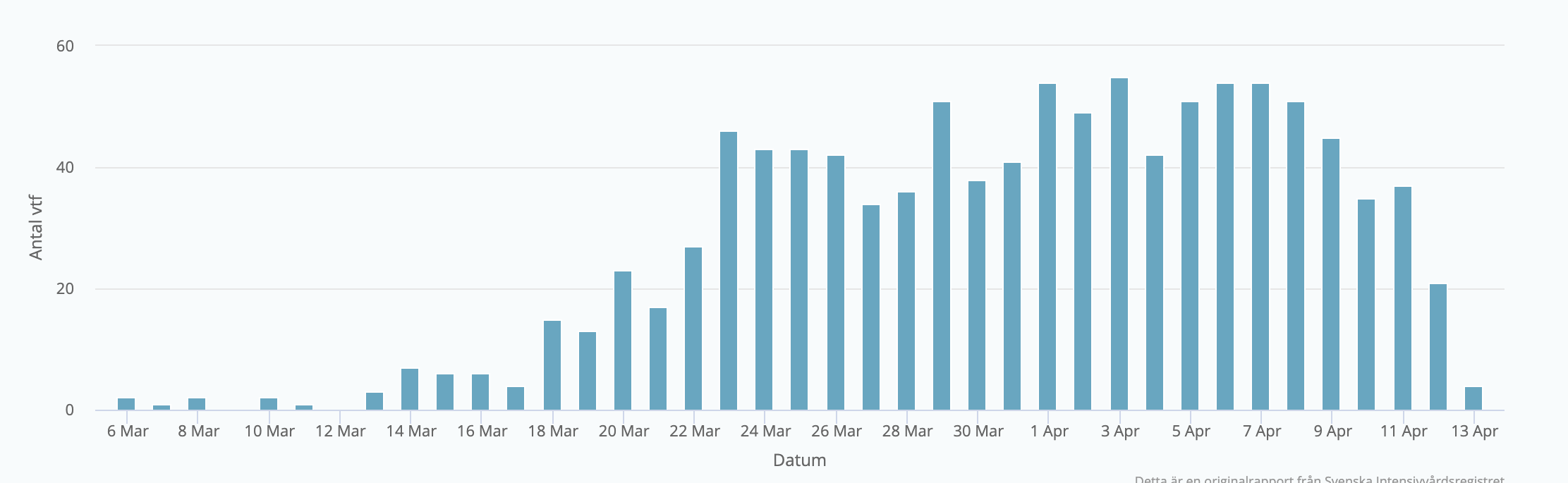
Now I understand that ideally one should compare similar “time cohorts” across countries, not absolute numbers or percentages. That point is logically impeccable, but still as the clock ticks it seems less likely to account for the Swedish anomaly.
Of course we still need more days and weeks of data.
To be clear, I am not saying the United States can or should copy Sweden. Sweden has an especially large percentage of people living alone, the Swedes are probably much better at complying with informal norms for social distancing, and obesity is much less of a problem in Sweden than America, probably hypertension too.
But I’d like to ask a simple question: who predicted this and who did not? And which of our priors should this cause us to update?
I fully recognize it is possible and maybe even likely that Sweden ends up being like Japan, in the sense of having a period when things seem (relatively) fine and then discovering they are not. (Even in Singapore the second wave has arrived, from in-migration, and may well be worse than the first.) But surely the chance of that scenario has gone down just a little?
And here is a new study on Lombardy by Daniil Gorbatenko:
The data clearly suggest that the spread had been trending down significantly even before the initial lockdown. They invalidate the fundamental assumption of the Covid-19 epidemiological models and with it, probably also the rationale for the harshest measures of suppression.
One possibility (and I stress that word possibility) is that these Lombardy data, shown at the link, are reflecting the importance of potent “early spreaders,” often family members, who give Covid-19 to their families fairly quickly, but after which the average rate of spread falls rapidly.
I’ll stand by my claim that the pieces on this one show an increasing probability of not really adding up. In the meantime, I am very happy to pull out and signal boost the best criticisms of these results.
Tuesday assorted links
2. Senators are not good at stock picking, even when related to their committee assignments.
3. Economic analysis of optimal lockdown. I definitely think this exercise is worth doing, but the researchers, as economists, ignore most of the critical public choice and sustainability issues, much as other researchers do.
4. What makes Ringo a great drummer (video). And is music getting better or worse? (data from streaming)
6. How testing works, or doesn’t work, in New Jersey.
7. An epidemiologist addresses my questions (something Twitter was unable to do), bravo to him.
8. Apichatpong Weerasethakul plum tree update. And ““This is the first transnational geopolitical Twitter war Thais have engaged in,” said Prajak Kongkirati of Bangkok’s Thammasat University.” (NYT)
9. Markets in everything: “Hamas Willing to Trade Information on Israelis Held in Gaza for Ventilators.”
10. Reopening guidelines from John Cochrane.
11. Sarah Constantin on variolation.
12. David Henderson argues for liberation from lockdown. Not my view, but I think his strongest argument is that greater freedom will induce us to rush with innovation in test and trace, masks, etc.
13. How soon does it end? Preliminary results, but very important. There is so much interesting in that link, including the possibility that California needs to worry more than does New York. Recommended. I’ll be saying more about these issues soon and of course waiting for the final results.
14. Why serology is more difficult than it looks. And look at these pictures.
16. Superspreaders (NYT): ““The MERS-CoV outbreak in South Korea was driven primarily by three infected individuals, and approximately 75 percent of cases can be traced back to three superspreaders who have each infected a disproportionately high number of contacts,” wrote George F. Gao, an immunologist and virologist at the Chinese Centers for Disease Control and Prevention in Beijing, in a recent paper.”
17. The Wolfram Physics Project, lots there.