Payola and satellite radio
In the last two weeks I’ve heard the new George Harrison box set mentioned so often on channel 26 Sirius satellite radio — accompanied by the playing of Harrison songs — that I’ve concluded some form of payola is going on. In its early days, satellite radio was critical of the mainstream radio stations for this practice, but now it’s jumped on board. And you know what — no one cares! Even on the internet, there is hardly anyone complaining. Hard to believe, I know, but that is maybe one indirect advantage of the current political polarization.
And why should you complain about satellite radio payola? Without payola, the stations choose songs (directly or indirectly, through dj instructions) to pull in the marginal subscriber. With payola, payments from IP holders become a separate influence on program content. Those payments are most likely to come from IP holders whose products show a high elasticity of demand with respect to advertising. In other words, the influence of producer surplus rises, relative to consumer surplus.
Intuitively, that seems to me “music that a lot of listeners already are familiar with, even if they don’t know that a new boxed set just has been released” is how that category translates into satellite radio circa 2017. Or, in other words, George Harrison.
Perhaps the most underrated George Harrison song is “You.”
Addendum: Interestingly, payola in earlier parts of the 20th century seemed to favor music for the young, black music, and new, previously undiscovered artists. It’s worth thinking through why this has changed. For 1950-2000, there is no “marginal subscriber to radio” the way there is for satellite radio, rather most listeners are in the relevant network. Furthermore, today’s satellite radio listeners are I believe considerably older and somewhat wealthier than the typical radio listener, either now or earlier. When more or less everyone was on the “free radio network,” the high elasticity of profits with respect to advertising was for the artists who otherwise wouldn’t get much exposure. In contrast, today it is for “golden oldies,” where the taste for the product already is there but information about availability may be lacking.
Autor, Dorn, and Hanson respond on the China trade shock
Messrs Autor, Dorn and Hanson went so far as to publish a scathing eight-page technical response to Mr. Rothwell. “The main methodological critique provided by Rothwell is unfounded,” they wrote. “The critique provided does not follow from his own logic.”
Here is the full WSJ coverage of the dispute, by Bob Davis.
Mumbai Razes Apartment Building, I Raise Questions
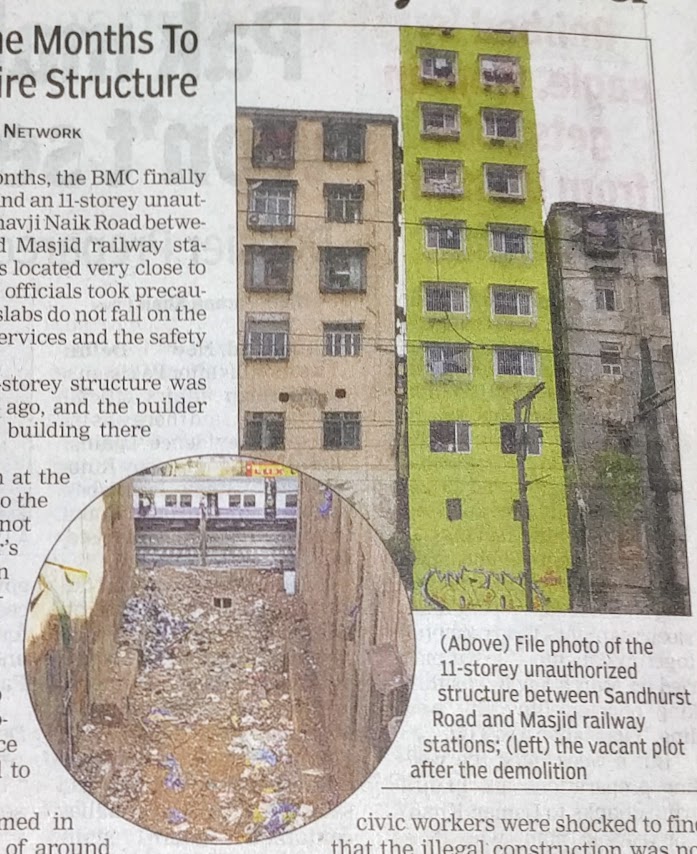 A story in The Times of India unwittingly illustrates the problems of construction in Mumbai. It is headlined, 11-storey illegal building near tracks finally razed. Many newspapers carried the story and all of the ones that I read took a righteous tone. ‘Finally this illegal monstrosity has been demolished’, they said. The authors appeared to regret only that the city had taken so long to act.
The building was not illegally constructed on public property or park land nor on a historical landmark. There were no safety claims, as far as I could find, although people worried about the safety of the demolition job given the nearness to the railroad. The photo at right shows a before and after picture. The after does not look better to me than the before.
Not everyone was pleased. The locals, presumably mostly residents (or perhaps hired thugs), tried to stop the demolition:
The BMC began demolition of the structure in June 2016, but owing to severe resistance from locals and no adequate police protection, the work had to be stopped abruptly.
The demolition resumed in August 2016 with the help of around 80 labourers. Though locals again threatened the labourers, the BMC continued the work amid police protection.
Eventually, however, the building was razed to the ground. But here is where it gets interesting. Amazingly, this is not the first time a building on this site has been demolished. According to another report this is in fact the third demolition. Now either the developer is an idiot or it must be so costly to construct a building legally that it’s worth the very real risk of demolition to construct it illegally.
I understand the frustration that people feel when the law is flouted but the real question stories like this raise is, What kind of law makes it so expensive to construct new apartment buildings in a city that by some measures is the most unaffordable in the entire world?
Saturday assorted links
1. Hamilton, Canada legalizes street hockey once again.
2. When will Amazon ship to the moon?
3. New Zealand offers free holiday to people who agree to do job interviews there.
4. $200 AI device to judge whether your tennis balls are in or out.
5. My podcast with The Art of Manliness. And my interview with Harvard Business Review.
6. Spanish Uber for priests. And John Cochrane on what economics really should be for.
The culture that is England, affirmative action edition
Oxford University has launched a summer school aimed at white British boys, in an effort to increase its intake of working class students.
It is the first time the university has ever specifically targeted this demographic, which is one of the most underrepresented groups in higher education.
Under a new partnership with the Sutton Trust, a social mobility charity, male students from rural and coastal communities will be recruited for summer schools hosted at Oxford University.
…Research by the Sutton Trust charity shows that white British boys who are eligible for free school meals – a key measure of poverty – achieve the lowest GCSE grades of any major ethnic group, with only a quarter (24%) gaining at least five C grades including English and maths.
This compares to around a third (32%) of white British girls on free school meals who achieve this benchmark, making them the lowest performing major female ethnic group.
Here is further information, via the excellent Jeff H.
Friday assorted links
1. Robert Laszlewski argues against selling health insurance across state lines. Basically new competition with narrow mandate plans can pick apart the previous pooling equilibrium.
2. My OnPoint podcast/interview. And me on YahooFinance.
3. How children are being shaped by their know-it-all voice assistants.
4. Are NFL coaches too predictable for their own good?
5. Virginia is the first state passing a law to allow robots to deliver directly to your front door.
6. Russ Roberts on what economists do and do not know.
7. The new smart condom that tracks data on your speed and velocity.
Komodo Dragon Blood!
The Economist covers some important new research out of George Mason University on the search for new antibiotics:

MYTHOLOGY is rich with tales of dragons and the magical properties their innards possess. One of the most valuable bits was their blood. Supposedly capable of curing respiratory and digestive disorders, it was widely sought. A new study has provided a factual twist on these fictional medicines. Barney Bishop and Monique van Hoek, at George Mason University in Virginia, report in The Journal of Proteome Research that the blood of the Komodo dragon, the largest living lizard on the planet, is loaded with compounds that could be used as antibiotics.
Komodo dragons, which are native to parts of Indonesia, ambush large animals like water buffalo and deer with a bite to the throat. If their prey does not fall immediately, the dragons rarely continue the fight. Instead, they back away and let the mix of mild venom and dozens of pathogenic bacteria found in their saliva finish the job. They track their prey until it succumbs, whereupon they can feast without a struggle. Intriguingly, though, Komodo dragons appear to be resistant to bites inflicted by other dragons.
Most animals—not just Komodo dragons—carry simple proteins known as antimicrobial peptides (AMPs) as general-purpose weapons against infection. But if the AMPs of Komodo dragons are potent enough to let them shrug off otherwise-fatal bites from their fellow animals, they are probably especially robust. And that could make them a promising source of chemicals upon which to base new antibiotics.
*Deep Thinking*
The author is Gary Kasparov and the subtitle is Where Machine Intelligence Ends and Human Creativity Begins. I am honored to have had the chance to write a blurb for this book. It is everything I wanted from this author and title, and it also contains the inside scoop — with some truly interesting and deep revelations — about the match with Deep Blue.
Self-recommending, and interesting throughout!
Are the madrigals the best music of Monteverdi?
But if Book IV fires a warning shot across the bow, Books V and VIII launch an all-out musical assault on convention. For the first time an instrumental basso continuo part appears, providing continuity that allows voices to falter, stop altogether or even sing alone. Suddenly, musical emotion is less a matter of symbolism than of imitation; sighs, moans and shouts of joy can all be rendered truthfully, with each voice unshackled from its fellows. Harmonically, too, things are very different. The knife-twisting dissonances that famously angered the theorist Artusi in ‘Cruda Amarilli’ (‘A tumult of sounds, a confusion of absurdities, an assemblage of imperfections’) turn the poem’s cardboard lover into something of flesh and blood, someone whose thoughts alternately gallop and linger, whose emotions ebb and flow naturally, if unpredictably.
Book VIII is the greatest and widest-ranging volume of secular music of its age — perhaps of any. Composed over a 30-year span, the madrigals tackle not only the erotic charge of love and sexuality, but also for the first time its warring conflicts — the restlessness, agitation and rage that go hand in hand with its pleasures. No single work can represent such a collection, but perhaps the ‘Lamento della Ninfa’ comes closest; if you listen to just one work, make it this one.
That is from Alexandra Coghlan, via Ted Gioia.
The bureaucratization of protest
That is the topic of my latest Bloomberg column, here is one excerpt:
Take the famed Selma civil-rights marchers of 1965, when the protesters had obtained the legal right, through petition, to conduct a 52-mile, five-day march down an interstate highway. Of course, that blocked the highway and inconvenienced many motorists and truckers. America’s NIMBY mentality would most likely prevent a comparable event today.
Starting in the 1970s, the federal courts began to assert that public spaces are not automatically fair game for marches and demonstrations, and so local governments have sought to please the users of such facilities rather than marchers and protesters. For instance, during the 2004 Democratic National Convention, numerous would-be demonstrators ended up being confined to a “demonstration zone,” which one federal judge described as analogous to Piranesi’s etchings of a prison. The zone was ringed by barricades, fences and coiled razor wire.
Here is the closer:
Could we not have kept public demonstrations and protests more alive as a vital and nonbureaucratized tradition?
For a long time, most people ignored this issue, but I wonder if it won’t start to seem urgent once again.
Do read the whole thing.
*Brown Face, Big Master*, by Joyce Gladwell
One of the most rewarding parts of preparing for my chat with Malcolm Gladwell earlier this week was discovering the autobiographical memoir of his mother, Joyce Gladwell, published in 1969. It covers growing up in Jamaica, women’s rights and recognition, a mixed-race marriage in the England of the 1960s, and a Christian journey through this world. The most striking passages are the account of a sexual assault on a ship and a stranger in the street hurling a racial epithet at her and her sons, in addition to Malcolm’s brief cameo as a very very young man on p.178. Most of all, this is a tale of a contemplative humility, and an account of how struggle and “the medicine of acceptance” can blend together into a successful and fulfilling life. It is especially valuable as a reflection of how a particular kind of quiet grace is closely tied to Jamaican heritage. Here is a short summary of the book.
What was striking on a second reading is how much this is also a memoir of how she lost her faith in adolescence, and wandered through part of her life without it, only later returning to the fold.
Here is some background information on Malcolm and his mother. Here is a 2007 radio chat with Malcolm and his mother, definitely recommended, despite her humble demeanor she has an amazing media presence and is not afraid to overrule her son. Malcolm also profiles her in Outliers, but that section makes more sense when you have read her directly.
Thursday assorted links
1. NPR Morning Edition covers Complacent Class.
2. Video of (non-complacent) hitchhikers; long, rambling, recommended. It’s called “The Greater Good: A Hitchhike Perspective.”
3. American man claims to be King of England.
4. All 17 species of penguins.
Ji Haan, Minister
One of the unfortunate legacies of British colonial rule in India is a permanent civil service that tends to subvert any change that it deems against its interests, even when such change is promoted by elected officials. This is one reason why change in India is often two steps forward, 1.9 steps back. A case in point is India’s newly passed Goods and Service Tax (GST).
The GST was supposed to solve a long-standing problem of Indian intra-national trade. Unlike say the US common market, Indian states erect tariff and non-tariff barriers against the products of other states. As a result, production is allocated inefficiently–Indian firms with high costs hide behind barriers and produce too much while Indian firms with low costs can’t expand sales to other states and so produce too little.
(Canada, by the way, also has this problem. It’s often cheaper for a Canadian firm to ship to the US than to another province in Canada. You can find similar problems in Southern Africa where it is cheaper for South Africa to import produce from South America than from Zambia, as this excellent video discusses.)
 In addition to the inefficient allocation of production, barriers to internal trade have also raised India’s transportation and logistics costs.
At the Walayar checkpoint in southern India, lines of idle trucks stretch as far as the eye can see in both directions along the tree-lined interstate highway, waiting for clearance from tax inspectors that can take days to complete.
Delays are so bad that textile entrepreneur D. Bala Sundaram has stopped sending his trucks to the international container terminal at nearby Cochin, instead diverting them hundreds of kilometres to a smaller regional port and onwards via Sri Lanka…
Two-thirds of India’s freight travels by road. But only 40% of the travel time is consumed by driving, according to the World Bank. The rest is spent on waiting at state border checkpoints, paying state government levies and dealing with regulatory bureaucracies that vary from state to state.
The sad irony is that India spends billions improving its roads only to force its trucks to stop at state border checkpoints, sometimes for days, undermining the gains from the investment in roads.
The GST was going to simplify all this with a single umbrella tax creating one-tax, one-nation. Alas, the dream is being subverted. The law created a GST council of federal and state ministers and through this council the GST is rapidly becoming more complex and convoluted. First, one-tax was changed into four and with numerous exemptions the final number may end up being more like seven or eight.
Second, as I witnessed traveling between Uttar Pradesh and Rajasthan recently, the trucks are still lining up and may continue to do so:
The revolution the proposed goods and services tax (GST) promised might not be all that rosy because it would be hobbled by the need for an e-permit to be flashed at inter-state borders as the states insisted the old analogue practises continue.
The states seem to have gotten their way and will continue with the old ‘permit raj’ system, undermining one the biggest gains of GST.
The E-permit, by the way, sounds modern but don’t be fooled. Like India’s e-visa there is really nothing e about it–it’s just modern labeling for an old system.
Eventually the GST will be beneficial to India but it’s two steps forward, 1.9 steps back.
America coefficient of the day
We find that as the county unemployment rate increases by 1 percentage point, the opioid death rate (per 100,000) rises by 0.19 (3.6%) and the ED visit rate for opioid overdoses (per 100,000) increases by 0.95 (7.0%).
That is from a new NBER working paper by Alex Hollingsworth, Christopher J. Ruhm, and Kosali Simon.
What I’ve been reading
1. Ian McEwan. The Children Act. The main story line pretends to revolve around a Jehovah’s Witness who won’t take a blood transfusion, but I think it was meant as a book about Islam and he was afraid to say so. The resulting mix doesn’t quite work.
2. Arundhati Roy and John Cusack, Things That Can and Cannot Be Said, Daniel Ellsberg and Edward Snowden are part of the book too. The two main authors conversing with Snowden is in fact the strongest argument against Snowden I’ve seen. Maybe he is just being polite, but it’s the only time I’ve heard him sound like an idiot.
3. Helen Hardacre, Shinto: A History. I’ve read only about a fifth of this 720 pp. book, but it seems to be a highly useful history on a topic hardly anyone knows anything about.
4. Daniel Ellsberg, Secrets: A Memoir of Vietnam and the Pentagon Papers. Compelling throughout, and worthwhile reading for anyone interested in media and media policy. Ellsberg, of course, was closely connected to Thomas Schelling and made significant contributions to the theory of choice under uncertainty.
There is also:
After Piketty: The Agenda for Economics and Inequality, edited by Heather Boushey, J. Bradford DeLong, and Marshall Steinbaum, is a very useful collection of writings on Piketty-related themes, including Solow and Krugman.
Nathan B. Oman, The Dignity of Commerce: Markets and the Foundations of Contract Law. An interesting blend of “moral foundations of capitalism” and analysis of Shakespeare’s Merchant of Venice.
Shahab Ahmed, Before Orthodoxy: The Satanic Verses in Early Islam, “…the early Muslim community believed almost universally that the Satanic verses incident was a true historical fact.”