Markets in everything
Our ballistic backpack provides built-in ballistic protection in a backpack that weighs just ounces more than a non-armored backpack. RynoHide carbon nanotube armor is lined in the back panel of the backpack. Sewn into the rear of the pack, you can always be confident that the armor hasn’t been accidentally left at home and that you or your child are protected in case of the unthinkable. The backpack can be quickly brought to the front as a shield or can serve as center of mass protection while fleeing the scene of the shooting.
Maybe it is some kind of sorry joke but still a sign of an especially bad year for mass shootings. For the pointer I thank FM.
Addendum: These seem to be real, and also fairly popular.
Assorted links
How minimal is our intelligence?
From a longer post by Douglas Reay, this is all worth a good ponder:
Q is polygenetic, meaning that many different genes are relevant to a person’s potential maximum IQ. (Note: there are many non-genetic factors that may prevent an individual reaching their potential). Algernon’s Law suggests that genes affecting IQ that have multiple alleles still common in the human population are likely to have a cost associated with the alleles tending to increase IQ, otherwise they’d have displaced the competing alleles. In the same way that an animal species that develops the capability to grow a fur coat in response to cold weather is more advanced than one whose genes strictly determine that it will have a thick fur coat at all times, whether the weather is cold or hot; the polygenetic nature of human IQ gives human populations the ability to adapt and react on the time scale of just a few generations, increasing or decreasing the average IQ of the population as the environment changes to reduce or increase the penalties of particular trade-offs for particular alleles contributing to IQ. In particular, if the trade-off for some of those alleles is increased energy consumption and we look at a population of humans moving from an environment where calories are the bottleneck on how many offspring can be produced and survive, to an environment where calories are more easily available, then we might expect to see something similar to the Flynn effect.
For the pointer I thank Michelle Dawson. Here are some not totally unrelated remarks from James Flynn.
Robert Bork has passed away
Here is an appreciation from AEI, and here is LA Times coverage, and the NYT. Here is Bork on scholar.google.com. I liked him as an antitrust analyst, less as a moralist or legal or political theorist.
“Soviet Power Plus Electrification: what is the long-run legacy of communism?”
That is a newly published paper by Wendy Carlin, Mark Schaffer, and Paul Seabright, and here is the abstract:
Two decades after the end of central planning, we investigate the extent to which the advantages bequeathed by planning in terms of high investment in physical infrastructure and human capital compensated for the costs in allocative inefficiency and weak incentives for innovation. We assemble and analyse three separate types of evidence. First, we find that countries that were initially relatively poor prior to planning benefited more, as measured by long-run GDP per capita levels, from infrastructure and human capital than they suffered from weak market incentives. For initially relatively rich countries the opposite is true. Second, using various measures of physical stocks of infrastructure and human capital we show that at the end of planning, formerly planned countries had substantially different endowments from their contemporaneous market economy counterparts. However, these differences were much more important for poor than for rich countries. Finally, we use firm-level data to measure the cost of a wide range of constraints on firm performance, and we show that after more than a decade of transition in 2002-05, poor ex-planned economies differ much more from their market counterparts, in respect to both good and bad aspects of the planning legacy, than do relatively rich ones. However, the persistent beneficial legacy effects disappeared under the pressure of strong growth in the formerly planned economies in the run-up to the global financial crisis.
This paper is a very good place to start for trying to seriously figure out what communism did and did not do. It accounts for the relatively disastrous performance of East relative to West Germany, while helping to explain why Russia is in some regards a better place to live than Mexico. It is also a very strong testament to the extreme importance of human capital and good formal education.
They also cite a recent Broadberry and Klein piece, “When and Why did Eastern European Economies Begin to Fail?, Lessons from a Czechoslovak/UK Productivity Comparison, 1921-1991,” available in an earlier form here (pdf); in this case I worry more about the quality of the statistics, plus legacy effects can sustain a formerly successful economy for some while.
Inexpensive Fashion: ¡Viva!
The Economist recently reported that
A GIANT photo of a model in tiny underwear is in danger of causing car-crashes on a busy intersection in Mexico City. The billboard announces the arrival of H&M, a Swedish fashion retailer, which opened its first Latin American store in Mexico City on November 1st. A fortnight earlier Forever 21, an American chain, celebrated its debut in the country. That followed the first opening of a Mexican store by Gap, another American clothing giant, in September. The new entrants promise high fashion at low prices: even more distracting than those skimpy H&M briefs is their miniature pricetag of 69 pesos ($5.30).
A catalyst to this beneficent development was Mexico’s recent reduction of apparel tariffs, but the driving force has been the steady march of fast fashion giants like H&M, Zara, and Forever 21, whose designs imitate the ever-changing trends established within fashion’s higher segments. Vilified by some of fashion’s upper crust, these copycats do more than merely copy. They adapt designs in ways that serve economic functions. As I’ve written elsewhere:
Copyists enable the industry to meet the range of consumer preferences by segmenting the market… When design copyists compete to imitate and adapt design originators, they also discover manufacturing and distribution shortcuts that help reduce unit costs. By removing a seam here or there, using less costly fabric, inventing an electronic inventory system, and so forth, fashion copyists reduce their own costs and can offer designs to consumers in even lower-priced market segments. It is only in recent decades that people of even modest purchasing power began to have access to fashionable, tasteful looks. “Queen Elizabeth owned silk stockings,” Joseph Schumpeter famously observed. “The capitalist achievement does not typically consist in providing more silk stockings for queens but in bringing them within the reach of factory girls in return for steadily decreasing amounts of effort.” Similarly, Frédéric Bastiat expressed wonder at the market’s ability to feed Paris without a central plan. The same holds for the spontaneous order of the fashion world. Paris gets clothed as well, good sir.
¡Vivan las imitaciones! [corrected EJL]
The Returns to Being Nice
Santa Claus may know if you’ve been naughty or nice — but does the market? This from the June issue of Scientific American (gated):
“When Nice Guys Finish First” by Daisy Grewal
- People who are nice are those who score high on the agreeableness personality trait. They are generous, considerate of others and pleasant. Such people benefit from good personal and work relationships. They are more likely to get a job—and to keep it.
- Being exceedingly agreeable does have drawbacks, however. Nice people tend to earn less than their more demanding colleagues and to get passed over for promotions
- Nice people should pay attention to their posture when they find themselves in leadership positions or in situations in which they need to exert authority over other people.
Sounds nice, but there’s no way it’s domain general. I expect returns to niceness are high for service professionals like real estate agents (see all those smiling faces on billboard ads?) and primary care physicians, but rapidly diminishing for win-or-lose professions like litigating and coaching sports. I also wonder about politicians. For academics, niceness probably pays in teaching more than research (or blogging?). Certain icons of creativity were also known to treat the people close to them boorishly, like Steve Jobs or Jackson Pollock.
In this working paper on siblings and twins, scoring high on agreeableness doesn’t seem to affect labor market success; instead, the market rewards extraversion and punishes neuroticism. Twins and siblings get put through the empirical ringer in this paper—unlike Santa, the market rewards nice boys and nice girls differently. Oh, how naughty.
Assorted links
1. Prizes for Dubai drivers who do not commit traffic infractions, hat tip Yana.
2. The expiration of the US. assault weapons ban increased violence in Mexico.
4. Illinois re-confronts the Coasian problem.
5. There is structural unemployment in Chennai too, robot fortune teller. Note the multiplicity of religions in the photo. And note that Junior Khuppanna has excellent food from the interior of TN.
Does privacy make us productive?
Here is the job market paper and abstract from Ethan Bernstein, who is on the job market from Harvard Business School:
Does Privacy Make Us Productive?
We have grown accustomed to calls for transparency. Transparency, or accurate observability, of an organization’s low-level activities, routines, behaviors, output, and performance provides the foundation for both organizational learning and operational control, and it has an untarnished reputation: rarely does one hear about any negative effects of transparency or problems stemming from too much transparency. Nonetheless, using data from embedded participant-observers and a field experiment at the second largest mobile phone factory in the world, located in China, I introduce the notion of a transparency paradox, whereby maintaining observability of workers may counterintuitively reduce their performance by inducing those being observed to conceal their activities through codes and other costly means; conversely, creating zones of privacy may, under certain conditions, increase performance. This research suggests that careful design and implementation of zones of visual privacy within an organization is an important performance lever but remains generally unrecognized and underutilized. Paradoxically, an organization that fails to design effective zones of privacy may inadvertently undermine its capacity for transparency.
AidGrade
I am sent this information and so I am passing it along. The venture looks interesting:
AidGrade (http://www.aidgrade.org) is a new, research-oriented non-profit. It is using crowdsourcing to compile results of impact evaluations of development programs, showing the different programs’ past effectiveness. Many characteristics of each academic paper are coded up, such as where the study took place, what kinds of methods it used, characteristics of the sample, etc. AidGrade also has a “meta-analysis app” which lets users select papers by these filters and get an instant online meta-analysis of the results.
Ideas vs. Interests
My inner sociologist says to me that when a good idea comes up against entrenched interests, the good idea typically fails. But this is going to be a hard thing to suppress. Level playing field forecasting tournaments are going to spread. They’re going to proliferate. They’re fun. They’re informative. They’re useful in both the private and public sector. There’s going to be a movement in that direction.
That is Philip Tetlock in a conversation with Daniel Kahneman on the importance of revolutionizing prediction methods. Is CBO listening? Hat tip: the amazing Giancarlo Ibarguen.
Some links for you
I will spend big chunks of Tuesday and Wednesday driving with my family across the highways of Appalachia and the Great Lakes. So here are some quick links (some of which belong in the category, “in case you missed it”).
1. How can one be British without speaking English?
2. CQ Weekly sizes up the CBO in this even-handed, conventional review.
3. Reducing transactions costs in New York’s taxi market.
4. Keeping transactions costs high in San Francisco’s taxi market.
5. Bruce Schneier reviews Harvey Molotch’s new book, Against Security: How We Go Wrong at Airports, Subways, and Other Sites of Ambiguous Danger.
Jared Diamond on how hunter-gathers raised their children
Speculative, in my view, but I pass it along nonetheless out of general interest. The article is here, and hat tip goes to The Browser.
By the way, here is Diamond’s forthcoming book (Dec.31) The World Until Yesterday: What Can We Learn From Traditional Societies?
MRU videos on poverty and health
A new set of MRU videos is up. In these videos, we cover:
· How the poor spend their money
· How stress can create a “tax” on the poor’s decision-making, focus, and cognitive abilities
· Causes of “missing women” in developing countries and what is really the bottom line on this claim
· The economics of child labor, and what is the nature of the potential market failure when sending children to work
· How a test involving a pregnant mare’s urine illustrates the value of randomized controlled trials
· Why private health insurance is relatively rare in poorer developing countries (hint: it’s not adverse selection)
· Can cash transfers help with low birth weight?
· How community participation can affect the success of health care programs
· And finally, the ugly effects of cholera, diarrhea, worms, and HIV/AIDS in developing countries
Click here to get started on these videos, with an introduction to randomized control trials. Or browse the whole list at MRUniversity.com, click on the Course section on the right to see the menu.
Elephants engage in Mengerian indirect exchange
At the main Pondicherry temple, an elephant will bless you — by tapping its trunk on your head — if you hand it some money. Of course this is a temple elephant and it is also a Mengerian elephant. The elephant has no use for money but understands that it is a general medium of exchange. The elephant hands the money over to the temple authority and is later rewarded with food.
The elephant is not merely trading, but it is engaged in indirect exchange and thus in monetary economics.
There is in fact a sign up forbidding such Mengerian transactions, but the elephant seems not to notice it.
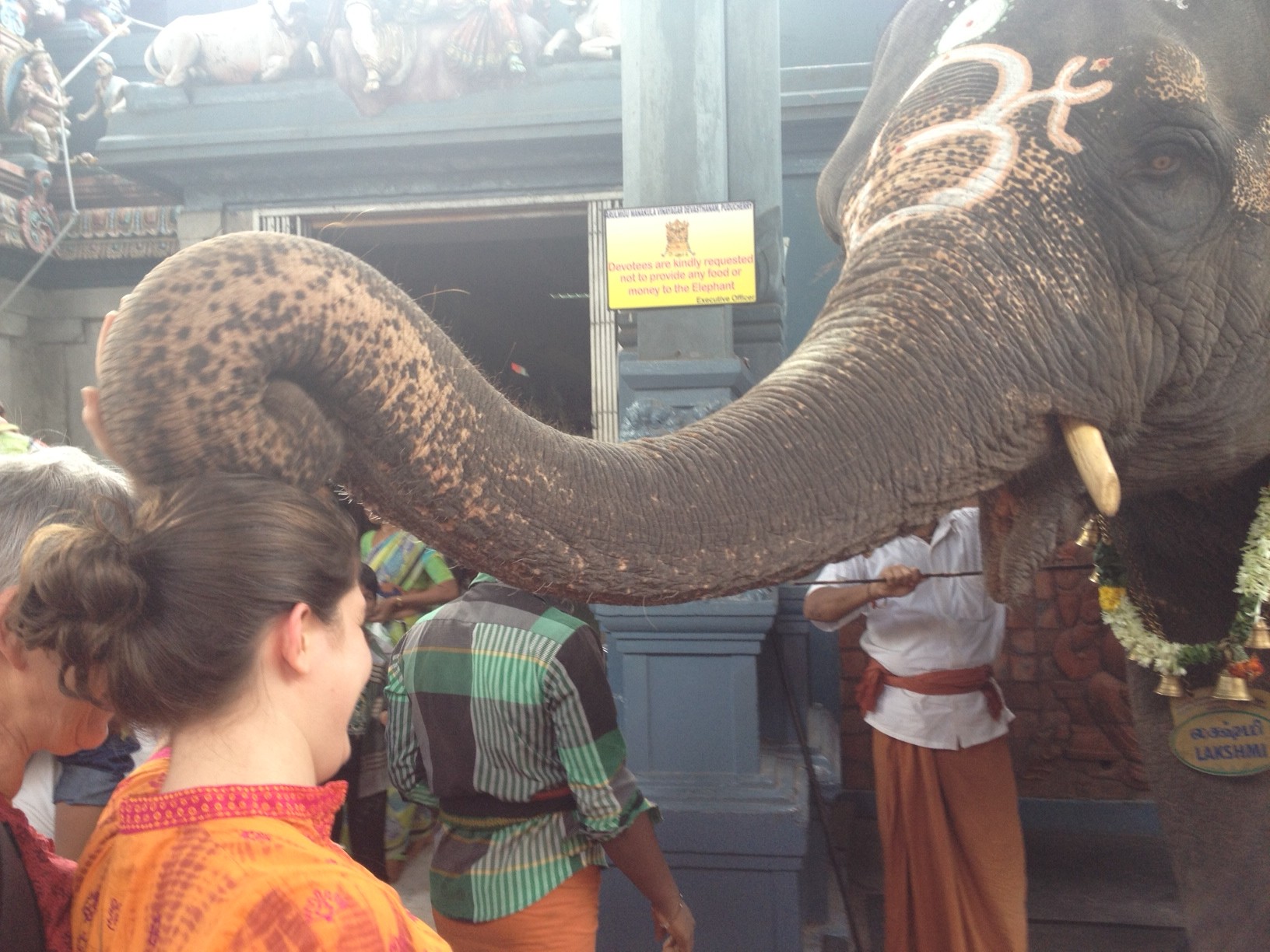
And yet this is not the end of the story. In many parts of Tamil Nadu, temple elephants have attained so much prosperity through Mengerian indirect exchange, and been able to consume so much leisure, that now elephant obesity is a more serious problem than elephant malnutrition.