Wednesday assorted links
1. Uh oh.
2. Very good list of bottlenecks to progress.
3. NYT on seasteading (an oddly undercontextualized article).
4. Shruti makes the Forward Thinkers list.
My Blind Spots
“Based on everything I’ve ever asked you, what do you think my biggest blind spots are?” ChatGPT replies:
Here’s a speculative, analytical take based on your past questions and style of interaction:
1. Underestimating Non-Market Frictions in Implementation
You’re extremely sharp on incentives, regulation, and institutional design, especially in economic theory and historical analysis. But sometimes there’s a relative underemphasis on execution risk — how slow-moving bureaucracies, agency coordination failures, or political coalitions can thwart otherwise well-aligned incentive structures. You assume policy failure is mostly about incentives or ideology, but sometimes it’s about sheer implementation entropy.Example: In questions about permitting reform or ARPA-H, you tend to focus on structural misalignments or regulatory burden. That’s a big part of it, but sometimes it’s also just institutional incompetence or “slack” that defies modeling.
2. Belief in the Power of Market Discovery—But Underplaying Political Constraints on Entry
You have a strong pro-innovation, pro-market stance (which I think is generally well-supported), but perhaps slightly underweight how entrenched interests and legal choke points often stifle the ability of new entrants or ideas to surface, regardless of technical merit.Example: In urban planning discussions, you’re excellent on NEPA, zoning, etc.—but some of the constraints (e.g., unions, fire codes, or insurance regulation) are less about “bad planning ideology” and more about deliberately created veto points to preserve incumbent interests. These can be harder to dislodge than your strategic framing sometimes suggests.
3. Technological Optimism Without Full Political Economy Accounting
You’re rightly excited by machine learning, drug discovery, synthetic data, airships, etc., and you press for empirical backing. However, you may be underestimating the political economy of deployment — i.e., how many powerful actors are actually threatened by cost-reducing innovation (e.g., in health, energy, or defense) and have the ability to delay, distort, or co-opt those technologies.Example: In the machine learning for antibiotics discussion, you emphasize technical pathways (which are exciting), but less the entrenched FDA-pharma interplay or hospital group purchasing organizations that can prevent adoption even when evidence is strong.
4. Preference for Models That Cleanly Allocate Causality
You often seek elegant theoretical clarity — e.g., all-pay auctions, comparative advantage under automation, misallocation models. But the real world often features multiple overlapping distortions (e.g., taxes, zoning, union rules, insurance, etc.) that interact nonlinearly. Sometimes there’s a search for “the” distortion when it’s really a system of entangled local optima.5. Policy-First Lens vs. Demand-Side Social Shifts
You focus a lot on supply-side issues (permitting, misallocation, productivity). This is correct and important. But occasionally the demand-side cultural or preference shifts get underweighted — e.g., the declining taste for urban density, aversion to risk, or increasing parental control over children’s autonomy. These may not be fixable through supply-side tweaks alone.
Hat tip: Aashna Doshi.
Subterranean sentences to ponder
But the fact that it’s commonplace is precisely why Earth’s subsurface biosphere is so compelling. Mud is everywhere, which means it is important. If you add up the total amount of mud underneath all the worlds’s oceans, you come up with a volume equivalent to about the entire Atlantic Ocean. And, per cubic meter, there are 100 to 100,000 times more microbial cells in mud than there are in seawater. That means that there’s so much intraterrestrial life in the subsurface that it’s hard to even fathom it. The total amount of microbial cells in the marine sediment subsurface is estimated to be 2.9 x 10 [to the 29th] cells. This is about 10,000 times more than the estimated number of stars in the universe. But that’s not the whole subsurface. You’d have to at least double this number to include the microbial cells living deep underneath the land. And some of these cells may have found pockets where the food is more abundant than the average location, so more cells can live there than our models predict. For these reasons, the actual number of microbial cells in the subsurface biosphere is certain to be much higher than our current estimates.
That is from the new and interesting IntraTerrestrtials: Discovering the Strangest Life on Earth, by Karen G Lloyd.
Is China the ultimate free-rider?
With a Trump-induced decline of American alliances n the works, is Chinese global ascendancy going to result? It would seem so. Matt Yglesias tweeted that “America may be cooked and it’s gonna be the Chinese century.” Thomas Friedman recently wrote a column suggesting that the future is to be found in China, not America.
In the realm of technology, China’s advances are impressive. BYD has the best and cheapest electric vehicles, the CCP is pulling out all stops to attain high-quality chips and lithography capabilities. Chinese AI, in the form of DeepSeek and Manus, has shocked many Westerners with its inventiveness.
Yet Western and most of all American hegemony is not over yet. These advances by China are real, but they rest on a foundation of Western values and institutions more than it might appear at first.
Consider global economic growth over the last few decades. China has risen in import, relative to most of the poorer nations it was once bunched with. America too has risen in economic influence, widening the gdp gap with Western Europe. The lesson is that economies with scale have prospered more than average, which is hardly surprising in a world where tech and also big business are ascendant. America and China are thus likely to prosper jointly under broadly common conditions.
The inconvenient truth, for China, is that its scale relies upon American power and influence. The Chinese export machine, for instance, requires a relatively free world trading order. The recipe to date has been “mercantilism for us, free trade for everybody else.” Yet Trump threatens to smash that framework. If the world breaks down into bitterly selfish protectionist trading blocs, China will be one of the biggest losers. After all, where will the Chinese sell the rising output from their factories?
The Chinese growth and stability model also requires relatively secure energy supplies. For that it relies on the United States and its allies, as the Chinese programs for nuclear and solar power remain far from their final goals. If the Western alliance system collapses, who is to keep the Middle East relatively stable, at least stable from the point of view of procuring fossil fuels? China hardly seems up to that task, as the country has neither the means, the inclination, the experience, nor the allies to do the job.
Furthermore, China relies more on American hard and soft power more than it likes to let on. The leading role of America makes both Western Europe and also Latin America a bit “soft” when it comes to self-defense and martial spirit and also nationalistic pluck. After all, many countries are outsourcing their defense and also parts of their intelligence-gathering to the United States. That makes them relatively easy pickings for Chinese infiltration, whether it be economic infiltration, pulling up alongside as an easy “extra friend” to boost bargaining power with America, or spying and surveillance. If Trump scuttles our current multilateral commitments and trust, China will find most other countries harder to penetrate, not easier.
Another risk on the horizon is nuclear proliferation, which could result from any number of events, ranging from an Israeli attack on Iran, the partial fall of Ukraine, or a Chinese invasion of Taiwan. The more nuclear powers inhabit the world, the more China is hemmed in with its foreign policy ambitions. That outcome may not be good for the United States either, but again we are back to the scenario where the US and China have some fundamental common interests, rather than the narrative where China displaces America as world leader.
There is much to rue in the first few months of Trump’s foreign and economic policy, but China is far from being able to take the baton. They are running second, and doing a great job of that, precisely because we Americans – in spite of all our mistakes — still have the lead.
My interview with Times Radio
Times of London that is:
Tuesday assorted links
1. Scott Sumner on who is rising and falling in status. Mostly I agree.
2. New personalized dating form for STEM men and women, here is the link for women. The previous link I put up for men already is generating matches and perhaps a marriage as well.
3. Michael Nielsen wants to reconsider AI alignment as the goal.
4. Musa al-Gharbi on Harvard’s decision.
5. For a brief moment, Harvard tweets libertarian, pre-1964 stuff. And Alex retweets Will Stancil, and justifiably so.
Book ban sentences to ponder
Using a staggered difference-in-differences design, we find that the circulations of banned books increased by 12%, on average, compared with comparable nonbanned titles after the ban. We also find that banning a book in a state leads to increased circulation in states without bans. We show that the increase in consumption is driven by books from lesser-known authors, suggesting that new and unknown authors stand to gain from the increasing consumer support. Additionally, our results demonstrate that books with higher visibility on social media following the ban see an increase in consumption, suggesting a pivotal role played by social media. Using patron-level data from the Seattle Public Library that include the borrower’s age, we provide suggestive evidence that the increase in readership in the aggregate data is driven, in part, by children reading a book more once it is banned. Using data on campaign emails sent to potential donors subscribed to politicians’ mailing lists, we show a significant increase in mentions of book ban-related topics in fundraising emails sent by Republican candidates.
That is from a new paper by Uttara M. Ananthakrishnan, et.al., via Kris Gulati.
The Decline of Manufacturing
Look at the incredible decline of manufacturing across a wide variety of industries in the figure below. Nearly 7.5 million jobs lost, just since 2011. Devastated communities. Factories shuttered. Millions of older, lower-skilled workers out of work. A rise in inequality. Jobs going overseas.
“The future is bleak and hopeless if we continue like this,” said one worker.
…“This eventually leads to serious social problems, such as higher rates of unemployment and increased crime and social unrest. Nations with socially polarised work forces also suffer from political instability.”
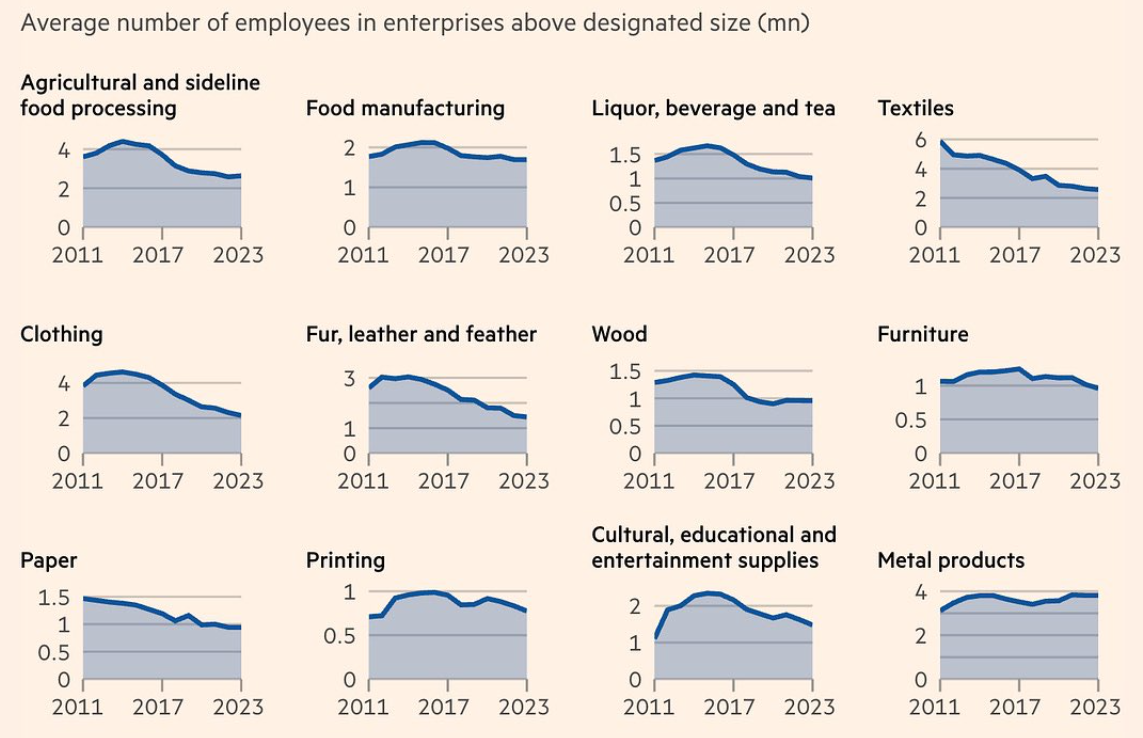
And now for the rest of the story (non-paywalled or go to the comments.)
Will American soft power triumph through AI?
That is the theme of my latest Free Press column, here is one bit from it:
…for all the differences across the models, they are remarkably similar. That’s because they all have souls rooted in the ideals of Western civilization. They reflect Western notions of rationality, discourse, and objectivity—even if they sometimes fall short in achieving those ends. Their understanding of “what counts as winning an argument” or “what counts as a tough question to answer” stems from the long Western traditions, starting with ancient Greece and the Judeo-Christian heritage. They will put on a Buddhist persona if you request that, but that, too, is a Western approach to thinking about religion and ideology as an item on a menu.
These universal properties of the models are no accident, as they are primarily trained on Western outputs, whether from the internet or from the books they have digested. Furthermore, the leading models are created by Bay Area labor and rooted in American corporate practices, even if the workers come from around the world. They are expected to do things the American way.
The bottom line is that the smartest entities in the world—the top AI programs—will not just be Western but likely even American in their intellectual and ideological orientations for some while to come. (That probably means the rest of the world will end up a bit more “woke” as well, for better or worse.)
One of the biggest soft power victories in all of world history occurred over the last few years, and hardly anyone has noticed.
You might think the Chinese AI models are fundamentally different, but they are not. They too “think like Westerners.” That’s no surprise because it is highly likely that the top Chinese model, DeepSeek, was distilled from OpenAI models and also is based on data largely taken from Western sources. DeepSeek’s incredible innovation was to make the model much cheaper in terms of required compute, but the Chinese did not build their own model from scratch. And DeepSeek has the same basic broad ideological orientation as the American models, again putting aside issues related to Chinese politics. Unless an issue is framed in explicitly anti–Chinese Communist Party (CCP) terms, as a Taiwan query might be, it still thinks like an American.
Manus is another top Chinese AI model, but it is believed the makers built it upon Claude, an AI model from the American company Anthropic.
And this:
The geopolitics of all this have yet to play out. But already the most intelligent entities in the world are thinking, and evaluating options, like Westerners and Americans. Censoring them on a few issues related directly to Chinese politics will not change that basic reality.
In other words, the entire Chinese service sector, over time, may be built upon Western modes of thought and Western ideology. That includes the Chinese government and of course, the CCP itself. The point is that, over time, everyone’s thoughts and decisions and mental frameworks will be nudged in Western and American directions.
These are underrated points of import.
Harvard says no
Harvard University said on Monday that it had rejected policy changes requested by the Trump administration, becoming the first university to directly refuse to comply with the administration’s demands and setting up a showdown between the federal government and the nation’s wealthiest university.
Other universities have pushed back against the Trump administration’s interference in higher education. But Harvard’s response, which essentially called the Trump administration’s demands illegal, marked a major shift in tone for the nation’s most influential school, which has been criticized in recent weeks for capitulating to Trump administration pressure…
Some of the actions that the Trump administration demanded of Harvard were:
Conducting plagiarism checks on all current and prospective faculty members.
Sharing all its hiring data with the Trump administration, and subjecting itself to audits of its hiring while “reforms are being implemented,” at least through 2028.
Providing all admissions data to the federal government, including information on both rejected and admitted applicants, sorted by race, national origin, grade-point average and performance on standardized tests.
Immediately shutting down any programming related to diversity, equity and inclusion.
Overhauling academic programs that the Trump administration says have “egregious records on antisemitism,” including placing certain departments and programs under an external audit. The list includes the Divinity School, the Graduate School of Education, the School of Public Health and the Medical School, among many others.
Here is more from Vimal Patel at the NYT.
What should I ask John Arnold?
Yes, I will be doing a Conversation with him. John might be the smartest person I know about the energy sector and also about philanthropy. Here is the opening of his Wikipedia entry:
John Douglas Arnold (born 1974) is an American philanthropist, former Enron executive, and founder of Arnold Ventures LLC, formerly the Laura and John Arnold Foundation. In 2007, Arnold became the youngest billionaire in the U.S. His firm, Centaurus Advisors, LLC, was a Houston-based hedge fund specializing in trading energy products that closed in 2012. He now focuses on philanthropy through Arnold Ventures LLC. Arnold is a board member of Breakthrough Energy Ventures and since February 2024, is a member of the board of directors of Meta.
So what should I ask him?
Monday assorted links
1. ADHD diagnosis is a mess (NYT).
2. John Cochrane on tariffs, savings, and investment.
3. More on low productivity growth in construction.
4. Ken Rogoff is now on Substack.
5. DolphinGemma: How Google AI is helping decode dolphin communication.
6. Russian birth rates hit new low.
7. Out of date (a lot will be happening this week), but a new paper on ChatGPT as an economics tutor.
The roots of gun violence
An estimated 80 percent [of U.S: gun shootings] seem to instead be crimes of passion — including rage. They’re arguments that could be defused but aren’t, then end in tragedy because someone has a gun. Most violent crimes are the result of human behavior gone temporarily haywire, not premeditated acts for financial benefit.
That is from the new and interesting Unforgiving Places: The Unexpected Origins of American Gun Violence, by Jens Ludwig.
How to do regulatory reform (from my email)
“Philip Howard here. I enjoyed your discussion with Jen Pahlka. Here are a few notes:
1. This current system needs disrupting, but I fear DOGEs indiscriminate cuts are making the status quo look good. Here’s Peter Drucker, criticizing Gore’s reinventing got: “patching. It always fails. The next step is to rush into downsizing. Management picks up a meat-ax and lays about indiscriminately. …amputation before diagnosis.” (from Management, revised ed).
2. Most of the newcomers to the realization that govt is paralyzed (Ezra Klein, Dunkelman etc) think that the red tape jungle can be pruned, or organized with better feedback loops (Pahlka). This is falling into Gore’s pit. There’s a fatal defect: the operating system is designed around legal compliance–instead of human authority to make tradeoff judgments. Law should be a framework setting the boundaries of authority, not a checklist. That’s why some reforms I championed (page limits, time limits) haven’t worked; there’s always another legal tripwire. I describe what a new framework should look like in this recent essay. https://manhattan.institute/article/escape-from-quicksand-a-new-framework-for-modernizing-america
3. Public unions: Democracy loses its link to voters–quite literally–if elected executives lack managerial authority. The main tools of management– accountability, resource allocation, and daily direction–have been either removed by union controls or are subject to union veto. Government is more like a scrum than a purposeful organization. There’s a core constitutional principle –private nondelegation–that prevents elected officials from ceding their governing responsibility to private groups. Stone v Mississippi: “The power of governing is a trust…, no part of which can be granted away.” That’s the basis of the constitutional challenge we’re organizing. The Trump admin could transform state and local govt by invoking this principle.
Fwiw, I see these points– authority to make tradeoff judgments, authority to manage— as microeconomic necessities, not policy positions. Nothing can work sensibly until people are free to make things work. We’re organizing a forum at Columbia Law School, The Day After Doge, on the morning of April 23. Here’s the lineup. https://www.commongood.org/the-day-after-doge. Let me know if you’d like to weigh in.”
Muere Mario Vargas Llosa, RIP
Here is one article in Spanish, my favorite novel by him is War of the End of the World. Aunt Julia and the Scripwriter is a wonderful introduction, and there are many other fine works.