Tariff sentences to ponder
We find that only 15.1 percent of the decline in goods-sector employment from 1992 to 2012 stems from U.S. trade deficits; most of the decline is due to differential productivity growth.
Here is the full paper by Kehoe, Ruhl, and Steinberg, via Zack Mazlish. I believe we have covered this issue before.
One economist removed from the Naval library
Deirdre McCloskey, can you guess which book? See #197. I might add the text to that one is remarkably non-salacious, perhaps many readers were somewhat disappointed.
Via the excellent CW.
Monday assorted links
1. How do people perceive international trade? (redux from a few years ago)
2. Mice exhibit first aid behaviors.
3. What we are learning about the geology of northeastern North America. An interesting piece.
4. Recent ReStud paper on trade imbalances.
5. “Two directors of the Charles Rennie Mackintosh Society have been accused of “vandalism” and “mutilation” after allowing furniture designed by the architect to be sawn up and sold for scrap for £80.” Times of London.
6. Is decarbonization a cost center?
7. Arvind Subramanian on Indian music.
8. Magnus and Fabiano analyze their games together.
Mercatus Emerging Scholar initiative
The Emerging Scholars Program is a new initiative of the Mercatus Center, aimed at supporting early-career classical-liberal thinkers who are committed to focusing on an original research project that is well-defined, shows strong potential to further classical liberal ends, and is ready to be started or continued. Through the program, Mercatus will hire a full cohort of scholars for a two-year, paid fellowship based on-site in Arlington, VA.
‘Scholar’ is broadly construed: you might be an academic, but perhaps instead you work in policy, journalism, run a business, or do something entirely different.
‘Emerging’ is also broadly construed: you might be finishing a degree of some kind, but perhaps instead you’re looking to shift focus mid-career, return to public life, or have decided not to retire. Whatever your background, you’ll be a deeply rigorous thinker, working on innovative projects, and excited to share your ideas clearly and broadly, to further classical-liberal ends.
Here is further detail.
Coordination and AI safety (from my email)
Jack Skidmore writes to me, and I will not double indent:
“Hello Tyler,
As someone who follows AI developments with interest (though I’m not a technical expert), I had an insight about AI safety that might be worth considering. It struck me that we might be overlooking something fundamental about what makes humans special and what might make AI risky.
The Human Advantage: Cooperation > Intelligence
- Humans dominate not because we’re individually smartest, but because we cooperate at unprecedented scales
- Our evolutionary advantage is social coordination, not just raw processing power
- This suggests AI alignment should focus on cooperation capabilities, not just intelligence alignment
The Hidden Risk: AI-to-AI Coordination
- The real danger may not be a single superintelligent AI, but multiple AI systems coordinating without human oversight
- AIs cooperating with each other could potentially bypass human control mechanisms
- This could represent a blind spot in current safety approaches that focus on individual systems
A Possible Solution: Social Technologies for AI
- We could develop “social technologies” for AI – equivalent to the norms, values, institutions, and incentive systems that enable human society that promote and prioritize humans
- Example: Design AI systems with deeply embedded preferences for human interaction over AI interaction; or with small, unpredictable variations in how they interpret instructions from other AIs but not from humans
- This creates a natural dependency on human mediation for complex coordination, similar to how translation challenges keep diplomats relevant
Curious your thoughts as someone embedded in the AI world… does this sparks any ideas/seem like a path that is underexplored?”
TC again: Of course it is tricky, because we might be relying on the coordination of some AIs to put down the other, miscreant AIs…
Nikolaus Matthes finishes The Art of the Fugue
Sunday assorted links
1. “15k researchers are working on AGI, in America. We have more people working on AGI then the whole world combined. Be grateful to those researchers putting in 7 day work weeks” Link here.
2. From Glenn: “People still don’t seem to appreciate that official trade figures don’t include the U.S.’ largest “exports” to the world, which is intangible brand/IP/tech that flows via MNCs and aren’t captured in cross-border trade data because the physical products are often produced abroad.”
3. Michael P. Gibson: “If we really want Russia to bleed, you know what we should do? Impose free trade on them. Surely they will wince and holler once free trade makes them worse off. Free trade will hollow out their middle class! Ukraine will have the Donbas again in no time”
3b. Consumer staples were hit hardest by the stock market decline.
4. Owls can swim.
5. Oren Cass has gone entirely in the tank. And more here. I had thought he was preparing to backpedal with his recent “the tariffs have to be predictable to work” Substack. But no. Sad!
5b. p.s. The billionaire oligarchs are not running everything.
6. Roy Foster in conversation with Fintan O’Toole.
7. By now the bloom is off the Luka trade.
Lots of Twitter links today, Twitter had the best stuff.
Why Do Domestic Prices Rise With Tarriffs?
Many people think they understand why domestic prices rise with tariffs–domestic producers take advantage of reduced competition to jack up prices and increase their profits. The explanation seems cynical and sophisticated and its not entirely wrong but it misses deeper truths. Moreover, this “explanation” makes people think that an appropriate response to domestic firms raising prices is price controls and threats, which would make things worse. In fact, tariffs will increase domestic prices even in perfectly competitive industries. Let’s see why.
Suppose we tax imports of French and Italian wine. As a result, demand for California wine rises, and producers in Napa and Sonoma expand production to meet it. Here’s the key point: Expanding production without increasing costs is difficult, especially so for any big expansion in normal times.
To produce more, wine producers in Napa and Sonoma need more land. But the most productive, cost-effective land is already in use. Expansion forces producers onto less suitable land—land that’s either less productive for wine or more valuable for other purposes. Wine production competes with the production of olive oil, dairy and artisanal cheeses, heirloom vegetables, livestock, housing, tourism, and even geothermal energy (in Sonoma). Thus, as wine production expands, costs increases because opportunity costs increase. As wine production expands the price we pay is less production of other goods and services.
Thus, the fundamental reason domestic prices rise with tariffs is that expanding production must displace other high-value uses. The higher money cost reflects the opportunity cost—the value of the goods society forgoes, like olive oil and cheese, to produce more wine.
And the fundamental reason why trade is beneficial is that foreign producers are willing to send us wine in exchange for fewer resources than we would need to produce the wine ourselves. Put differently, we have two options: produce more wine domestically by diverting resources from olive oil and cheese, or produce more olive oil and cheese and trade some of it for foreign wine. The latter makes us wealthier when foreign producers have lower costs.
Tariffs reverse this logic. By pushing wine production back home, they force us to use more costly resources—to sacrifice more olive oil and cheese than necessary—to get the same wine. The result is a net loss of wealth.
Note that tariffs do not increase domestic production, they shift domestic production from one industry to another.
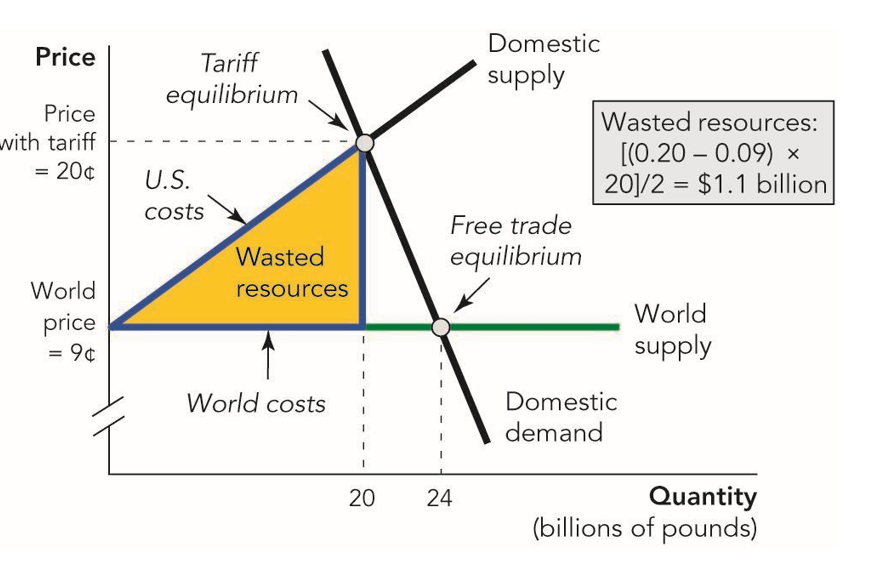
Here’s the diagram, taken from Modern Principles, using sugar as the example. Without the tariff, we could buy sugar at the world price of 9 cents per pound. The tariff pushes domestic production up to 20 billion pounds.
As the domestic sugar industry expands it pulls in resources from other industries. The value of those resources exceeds what we would have paid foreign producers. That excess cost is represented by the yellow area labeled wasted resources—the value of goods and services we gave up by redirecting resources to domestic sugar production instead of using them to produce other goods and services where we have a comparative advantage.
All of this, of course, is explained in Modern Principles, the best textbook for principles of economics. Needed now more than ever.
Five insights from farm animal economics
By Martin Gould, here is one excerpt:
Halting plans for a large, polluting factory farm feels like a clear win — no ammonia-laden air burning residents’ lungs, no waste runoff contaminating local drinking water, and seemingly fewer animals suffering in industrial confinement. But that last assumption deserves scrutiny. What protects one community might actually condemn more animals to worse conditions elsewhere.
Consider the UK: Local groups celebrate blocking new chicken farms. But because UK chicken demand keeps growing — it rose 24% from 2012-2022 — the result of fewer new UK chicken farms is just that the UK imports more chicken: it almost doubled its chicken imports over the same time period. While most chicken imported into the UK comes from the EU, where conditions for chickens are similar, a growing share comes from Brazil and Thailand, where regulations are nonexistent. Blocking local farms may slightly reduce demand via higher prices, but it also risks sentencing animals to worse conditions abroad.
The same problem haunts government welfare reforms — stronger standards in one country can just shift production to places with worse standards. But advocates are getting smarter about this. They’re pushing for laws that tackle both production and imports at once. US states like California have done this — when it banned battery cages, it also banned selling eggs from hens caged anywhere. The EU is considering the same approach. It’s a crucial shift: without these import restrictions, both farm bans and welfare reforms risk exporting animal suffering to places with even worse conditions. And advocates have prioritized corporate policies, which avoid this problem, as companies pledge to stop selling products associated with the worst animal suffering (like caged eggs), regardless of where they are produced.
Russia facts of the day
Russia’s stock market has suffered its worst week in more than two years in response to U.S. President Donald Trump’s sweeping global tariffs and a drop in global oil prices.
The market capitalization of companies listed on the Moscow Exchange (MOEX) fell by 2 trillion rubles ($23.7 billion) over just two days, sliding from 55.04 trillion rubles ($651.8 billion) at Wednesday’s close to 53.02 trillion ($627.9 billion) by the end of trading Friday, according to exchange data.
The MOEX Russia Index, which tracks 43 of Russia’s largest publicly traded companies, lost 8.05% over the week — its worst performance since late September 2022, when markets were rattled by the Kremlin’s announcement of mass mobilization for the war in Ukraine.
At the end of trading on Friday, shares in some of the country’s largest firms had plunged: Sberbank fell by 5.2%, Gazprom 4.9%, VTB 6%, Rosneft 3.9% and Lukoil 4.6%. Mechel, the steel and coal giant, dropped more than 7%, while flagship airline Aeroflot slid 4.8% and gas producer Novatek fell 5.4%.
“A massive crisis is unfolding before our eyes,” said Yevgeny Kogan, an investment banker and professor at the Higher School of Economics in Moscow.
Here is the full story, via C. At least Trump does not seem to be a Russian agent…
Common sense from Ross Douthat
Now for my own view. I think trying to reshore some manufacturing and decouple more from China makes sense from a national security standpoint, even if it costs something to G.D.P. and the stock market. Using revenue from such a limited, China-focused tariff regime to pay down the deficit seems entirely reasonable.
I am more skeptical that such reshoring will alleviate specific male blue-collar social ills, because automation has changed the industries so much that I suspect you would need some sort of social restoration first to make the current millions of male work force dropouts more employable.
And I am extremely skeptical of any plan that treats pre-emptive global disruption as the key to avoiding a deficit crisis down the road. The “instigate a crisis now before our position weakens” has a poor track record in real wars — I don’t think trade wars are necessarily different.
Here is the full NYT piece. And from Armand Domalewski on Twitter: “there is no industry in America with stronger protectionism than the shipbuilding industry. The Jones Act makes it illegal to ship anything between two points in the US on a ship not built in the US and crewed by Americans. And yet America’s shipbuilding industry is nonexistent”
Saturday assorted links
1. AI protection against epilepsy?
2. “Well the latest DeepSeek is very satisfying from an humanities perspective. The trick to generalize RL is replacing scalar grades with… source criticism (qualitative principles and critiques).” Link here.
3. Redrawing India’s electoral map (FT).
4. Build with Tract, an EV project that failed.
5. “How do you individualize an AI? A model? A model running in a specific hardware? A model owned by a human entity? A model running on a hardware owned by a human entity? What about combinations of models and other non-AI software?” Link here.
In Defense of Econ 101
People sometimes dismiss basic economic reasoning, “that’s just Econ 101!” yet most policymakers couldn’t pass the exam. Here’s an apropos bit from our excellent textbook, Modern Principles of Economics.
Do you shop at Giant, Safeway, or the Piggly Wiggly? If you do, you run a trade deficit with those stores. That is, you buy more goods from them than they buy from you (unless, of course, you work at one of these stores or sell them goods from your farm). The authors of this book also run a trade deficit with supermarkets. In fact, we have been running a trade deficit with Whole Foods for many years. Is our Whole Foods deficit a problem?
Our deficit with Whole Foods isn’t a problem because it’s balanced with a trade surplus with someone else. Who? You, the students, whether we teach you or whether you have bought our book. You buy more goods from us than we buy from you. We export education to you, but we do not import your goods and services. In short, we run a trade deficit with Whole Foods but a trade surplus with our students. In fact, it is only because we run a trade surplus with you that we can run a trade deficit with Whole Foods. Thanks!
The lesson is simple. Trade deficits and surpluses are to be found everywhere. Taken alone, the fact that the United States has a trade deficit with one country is not special cause for worry. Trade across countries is very much like trade across individuals. Not every person or every country can run a trade surplus all the time. Suddenly, a trade deficit does not seem so troublesome, even though the word “deficit” makes it sound like a problem or an economic shortcoming.
We continue on to discuss ” What if the United States runs a trade deficit not just with China or Japan or Mexico but with the world as a whole, as indeed it does? Is that a bad thing?”
Here’s a good Noah Smith piece if you want the details.
My 1979 trip to Oxford and London
In my recent post on my Freiburg year abroad, I mentioned that my first time leaving the country was a trip to England. Somehow I was accepted into a multi-week economics course at Oxford. Of course it was not the real Oxford, just some program for foreigners held on Oxford campus.
I didn’t much care for Oxford, and I suppose I still do not. It struck the 17-year-old Tyler as rather backward and ancien regime. Everything seemed so old and static, and also slightly rundown. I walked around plenty, I did go punting, and I also got drunk for the first time in my life (out of three times total?). I enjoyed only the first three of those experiences.
My fondest memories are walking across town, through a residential neighborhood, to a very good fish and chips place. I sat on the curb and ate out of the newspaper wrapper. That was pretty divine, keeping in mind I come from Kearny, NJ, where fish and chips was a major Scots-Irish “thing” until recently (the town is now Latino and Lusaphone).
I realized quickly that I knew a lot of economics — almost everything presented in the lectures bored me.
What did influence me was hearing and meeting Madsen Pirie, who of course is still around. Here was an actual logical positivist! That shocked me. At age seventeen, logical positivists were to me boogeymen who had been refuted by Karl Popper and Brand Blanshard. But all of a sudden, there was one right in front of me, bowtie and all. The biggest thing I learned from Madsen is that behind each view is a human being who has counterarguments. That may sound deeply stupid, but so many of our most important learnings take that form, namely emotionally internalizing something that ought to be obvious, and thus developing better habits of thought. Anyway, Madsen’s lectures at least were fun, even if the content was familiar to me. I recall also David O’Mahoney, of University College Cork, giving a good talk on competition and cooperation.
One weekend a few of us decided to take the train up to Edinburgh, egads what a debacle that was. Somehow we ended up sleeping in a boxcar with a bunch of soldiers around us (how did that happen!? I have no idea). It was freezing cold the whole time, even though this was August. And the train kept on stopping, maybe the trip took eight or nine hours and had neigh a smooth moment.
Edinburgh was cold too, and I was not prepared for that. Somehow I ended up walking around in a bathrobe, if only not to freeze. I recall seeing monuments to Hume and Smith, being satisfied, and wanting to turn around and go back. Just as I do not recall how I ended up in the boxcar with the soldiers, I also do not recall how I was wearing a robe in Scotland.
The last week of the trip I spent in London. As I have narrated in the opening chapter of my GOAT book, my main activity was to walk across town to the British Library and read old pamphlets in the history of economic thought. That was wonderful.
I quite enjoyed 1979 London, which I much preferred to Oxford. For one thing, it had great music shops, including for sheet music. Most of all, I soaked up the “rude boy” atmosphere of the city and its slight tinge of danger. I was an avid Clash fan, and this was before they sold out with their London Calling album. The whole Clash worldview was laid out in front of me, and I kept on thinking of “Safe European Home” and other early classics. Piccadilly was a great place to hang out to imbibe that mood, which in retrospect seems remarkable.
I walked, walked, and walked more. Hardly any of the city seemed well-off, and it was very definitely an English city, unlike today.
I was staying in a hostel, and three or so nights before I was due to fly home, someone broke into the collective room and stole a lot of money. I didn’t have much left, and didn’t think I could get a money transfer quickly. So for a few days I bought and lived off Wonder bread, and scavenged abandoned fruit from dumpster bins. I also found a chess tournament (how??), and played some speed chess with people who in turn bought me a meal.
That all seemed like an appropriate way to end the trip.
At the time, and given my interests, England seemed unambiguously inferior to The American Way Of Life. The grit of London appealed to me, but I had my own version of that back home in NYC and New Jersey.
And so I flew home, and made no immediate plans to travel abroad again.
It was not until I started listening to Beethoven, and reading German romantic poetry, that that was to change.
Treasury market dysfunction and the role of the central bank
Thinly capitalized hedge funds’ growing role in the enormous and rapidly expanding market for U.S. Treasury securities poses a clear and present danger to financial stability that warrants a new approach from the Federal Reserve during times of extreme market stress, suggests a paper discussed at the Brookings Papers on Economic Activity (BPEA) conference on March 28.
In their paper, “Treasury Market Dysfunction and the Role of the Central Bank,” the authors examine changes in the Treasury market since March 2020, when the Federal Reserve purchased more than $4 trillion of Treasuries and government-backed mortgage securities to calm turmoil in those markets triggered by the COVID pandemic.
“These problems threatened to spill over into other markets as well, potentially interrupting the smooth flow of credit and impairing the implementation of monetary policy,” write the authors, Anil K Kashyap of the University of Chicago, Jeremy C. Stein and Jonathan L. Wallen of Harvard University, and Joshua Younger of Columbia University. “It is natural to wonder whether such episodes of fragility will become more frequent and/or more severe as the Treasury market continues to grow.”
Here is the link to the summary, here is the link to the paper and slides. Via Julian Gough.