Deviations from Benford’s Law over time, in U.S. accounting data
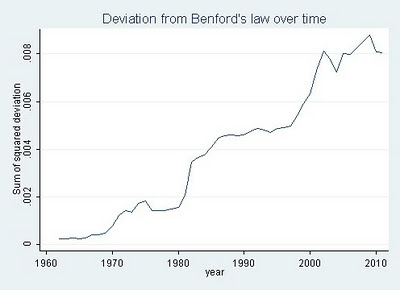
Jialan Wang writes:
So according to Benford’s law, accounting statements are getting less and less representative of what’s really going on inside of companies. The major reform that was passed after Enron and other major accounting standards barely made a dent.
There is much more at the link. If you are new to the party, Benford’s Law is that:
…in lists of numbers from many (but not all) real-life sources of data, the leading digit is distributed in a specific, non-uniform way. According to this law, the first digit is 1 about 30% of the time, and larger digits occur as the leading digit with lower and lower frequency, to the point where 9 as a first digit occurs less than 5% of the time. This distribution of first digits is the same as the widths of gridlines on the logarithmic scale.
There is more at the link or more here. Here are two previous MR posts on Benford’s Law.
Slovakia rejects EU bailout
Yup, the story is here. Nie pozwalam!
The culture that is California
Nice:
The University of California last week tentatively agreed to a deal with UC-AFT that included a new provision barring the system and its campuses from creating online courses or programs that would result in “a change to a term or condition of employment” of any lecturer without first dealing with the union.
Bob Samuels, the president of the union, says this effectively gives the union veto power over any online initiative that might endangers the jobs or work lives of its members. “We feel that we could stop almost any online program through this contract,” Samuels told Inside Higher Ed.
Bone Marrow Bounty Hunters
Amit Gupta has leukemia and needs to find a bone-marrow transplant. Gupta is the founder of the do-it-yourself photography site Photojojo and the collaborative-working community Jelly and many of his high-tech friends have jumped to his aid including Seth Godin. Here’s Virginia Postrel:
[Godin offered] to pay $10,000 to anyone who became a match for Gupta and made the stem-cell donation, or to give the money to that person’s favorite charity. The offer, he says, was “a chance to say to my readers, ‘Hey, I care about this. A lot. Money where my mouth is.’”
He picked $10,000 because, he says, it’s “enough money to matter to both the giver and the recipient, without being enough money to sue over, cheat over or corrupt.”
Gupta’s friend Michael Galpert, one of the co-founders of the photo-editing site Aviary.com, quickly matched Godin’s offer. “I would do anything that could contribute to helping save his life,” he says.
With $20,000 at stake, the cause did indeed take on new urgency….There was only one problem. The offer was illegal.
Paying a marrow donor is currently illegal under the same law that makes paying organ donors illegal, despite the fact that marrow donation (technically blood stem cells from marrow) is much more like blood donation or egg donation than donating a kidney. (To avoid the law Godin has modified his offer.) Fortunately, the law might be overturned.
In February, the 9th U.S. Circuit Court of Appeals heard arguments in a lawsuit challenging the constitutionality of the ban on valuable consideration for bone-marrow donations. The suit was brought by the Institute for Justice, a libertarian public-interest law firm, on behalf of plaintiffs who include patients, parents of sick children, a doctor who does bone- marrow transplants and a charity that would like to offer incentives, such as scholarships, to encourage more donations.
The lawsuit argues that since marrow cell transplants aren’t significantly different from blood transfusions, the federal government has no “rational basis” for outlawing the kind of compensation that is perfectly legal not only for blood but also for other regenerating tissues, such as hair and sperm, not to mention eggs, which don’t regenerate. This disparate treatment of essentially similar processes, it maintains, violates the Constitution’s guarantee of equal protection. A decision could come down any day.
Assorted links
1. Economic analysis of where the NBA stands.
2. How NYU lured Thomas Sargent, who by the way seems to like Borges, and Henderson on Sargent, and a rude guy in Italian.
3. Via Cafe Hayek, Henry Simons reviews Keynes.
4. Bernanke and Sims on the price of oil and recessions.
5. Complaints Choir of Tokyo, hat tip Yana.
Steven Pinker on violence
It is an important and thoughtful book, and I can recommend it to all readers of intelligent non-fiction, reviews are here But I’m not convinced by the main thesis.
Might we run an econometrics test on regime changes? The 17th century was much more violent than the preceding times, as was the early 19th century, albeit to a lesser extent. Perhaps the distribution is well-described by “long periods of increasing peace, punctuated by large upward leaps of violence”, as was suggested by Lewis Richardson in his 1960 book on the statistics of violent conflict? Imagine a warfare correlate to the Minsky Moment. In the meantime, there will be evidence of various “great moderations,” though each ends with a bang.
Pinker does discuss these ideas in detail in chapter five, but at the end of that section I am not sure why I should embrace his account rather than that of Richardson. I am reminded of the literature on the peso problem in finance.
Another hypothesis is to see modern violence as lower, especially in the private sphere, because the state is much more powerful. Could this book have been titled The Nationalization of Violence? But nationalization does not mean that violence goes away, especially at the most macro levels. In a variant on my point above, one way of describing the observed trend is “less frequent violent outbursts, but more deadlier outbursts when they come.” Both greater wealth (weapons are more destructive, and thus used less often, and there is a desire to preserve wealth) and the nationalization of violence point toward that pattern. That would help explain why the two World Wars, Stalin, Chairman Mao, and the Holocaust, all came not so long ago, despite a (supposed) trend toward greater peacefulness. Those are hard data points for Pinker to get around, no matter how he tries.
We now have a long period between major violent outbursts, but perhaps the next one will be a doozy.
How would this book sound if it were written in 1944? Maybe there is a regime break at 1945 or so, with nuclear weapons deserving the credit for a relative extreme of postwar peace. Pinker’s discussion of the nuclear question starts at p.268, but he underrates the power of nuclear weapons to reach the enemy leaders themselves and thus he does not convince me to dismiss the nuclear issue as central to the observed improvement, throw in Pax Americana if you like.
In one of the most original sections of the book (e.g., p.656), Pinker postulates the greater reach of reason, and the Flynn effect, working together, as moving people toward more peaceful attitudes. He postulates a kind of moral Flynn effect, whereby our increasing ability to abstract ourselves from particulars, and think scientifically, helps us increasingly identify with the point of view of others, leading to a boost in applied empathy. On p.661 there is an excellent mention of the wisdom of Garett Jones. Pinker’s thesis implies the novel conclusion that those skilled on the Ravens test have an especially easy time thinking about ethics in the properly cosmopolitan terms; I toy with such an idea in my own Create Your Own Economy.
What is the alternative hypothesis to this moral Flynn Effect? Given that the private returns to supporting violence are rare — most of the time — and violence has been nationalized, people will have incentives to invest in greater empathy and to build their self-images around such empathy. This empathy will be real rather than feigned, but it also will be fragile rather than based in a real shift in cognitive and emotive faculties; see 1990s Mostar and Sarajevo or for that matter Nagasaki or British or Belgian colonialism.
When doing the statistics, one key issue is how to measure violence. Pinker often favors “per capita” measures, but I am not so sure. I might prefer a weighted average of per capita and “absolute quantity of violence” measures. Killing six million Jews in the Holocaust is not, in my view, “half as violent” if global population is twice as high. Once you toss in the absolute measures with the per capita measures, the long-term trends are not nearly as favorable as Pinker suggests.
Here is John Gray’s (excessively hostile) review of Pinker. In my view this is very much a book worth reading and thinking about. And I very much hope Pinker is right. He has done everything possible to set my doubts to rest, but he has not (yet?) succeeded. I find it easiest to think that the changes of the last sixty years are real when I ponder nuclear weapons.
Claims about Kyrgyzstan, bridenapping edition
In Kyrgyzstan – one of the few places to collect data – the practice has been on the increase since the fall of communism. Some believe this violent subversion of a tradition (which was historically for show and done with the consent of the wife) has become popular to avoid the embarrassment of being unable to afford a dowry.
Up to a third of all ethnic Kyrgyz women in Kyrgyzstan are kidnapped brides, and some studies suggest that, in certain regions, the rates of bride kidnapping account for up to 80 per cent of marriages.
In six villages scrutinised for a recent survey, almost half of the 1322 marriages registered were from bride kidnapping, and up to two-thirds were non-consensual.
…”Once bride kidnapping was characteristic mostly in rural areas, but it has become widespread everywhere, including the capital, Bishkek,” says Gazbubu Babayarova, founder of the Kyz Korgon Institute, an organisation that campaigns to eliminate bridenapping in Kyrgyzstan.Most people in Kyrgyzstan view the practice as a tradition rather than a crime. There is such a thing as “consensual” bridenapping, where the bride agrees to be taken as part of a custom, but a more violent version of this “tradition” has grown in the 21st century.
Russell Kleinbach, a professor at Philadelphia University who is an expert on the issue, believes it is only since the 1950s that this tradition has morphed into something that is widespread, brutal and non-consensual.
Ms Babayarova is herself an example of how this custom has spread to urban, educated Kyrgyz communities.
Seven years ago, she was kidnapped by one of her closest friends, who was a medical student. He did not accept her protestations that she did not want anything more than friendship and entered into an arrangement with both their parents to kidnap her.
The rest of the story is here.
Question from Slovakia
Today is vote day on the EFSF, here is the question:
Today, Slovakia has the lowest average salaries in the euro zone. How am I supposed to explain to people that they are going to have to pay a higher value-added tax (VAT) so that Greeks can get pensions three times as high as the ones in Slovakia?
Here is more.
Assorted links
1. Karl Smith on Russ Roberts on TGS. Karl also has had some excellent posts on IS-LM and related matters, start here but scroll backwards through the blog.
2. When was the phrase “Great Depression” first used? More from the extraordinary Barry Popik.
3. 1982 interview with Thomas Sargent. And the Thomas Sargent academic family tree. And Sargent’s (very short, and very good) graduation speech at Berkeley. An excellent short overview of what economics has to contribute to human understanding. Here is his Dad’s speech, from his Dad’s 90th birthday.
4. Carolyn Sargent’s guide to the art of Florence; she is related to Thomas.
We are not as wealthy as we thought we were, installment #1637
In dollar terms, median household income is now $49,909, down $3,609 — or 6.7% — in the two years since the recession ended.
That is from Felix Salmon, read the rest of the post and see the graph. Further comment here.
Christopher Sims, Nobel Laureate
Here is Sim’s home page, lots of content. Here is his Wikipedia page. Here is Sims on scholar.google.com. Here is a video of Sims speaking. Sims is currently at Princeton but most closely associated with the University of Minnesota. Basically this is a prize in praise of Minnesota macro, fresh water macro of course, and lots of econometrics. Think of Sims as an economist who found the traditional Keynesian methods “just not good enough” and who worked hard to improve them. He brought a lot more rigor into empirical macro and he helped define a school of thought at the University of Minnesota. His influence will endure. Some of his results raised the status of the “real shocks” approach to business cycles, although I think of Sims’s work as more defined by a method than by any set of conclusions.
I think of Sims as having three major contributions: vector autoregression as a macroeconomic method, impulse response functions, and deep examinations of money-income causality. Via Tim Harford, here are powerpoint slides on the first two, first rate presentation. If you know some math, this is the place to go on Sims.
Here are Jim Hamilton’s mathematical notes on impulse response functions. It has helped economists sort out the differences between expected and unexpected shocks and it has become a regular part of the macroeconomic toolkit. The Swedes give a simple — perhaps too simple — exposition of impulse response functions. Wikipedia has a simple introduction:
In signal processing, the impulse response, or impulse response function (IRF), of a dynamic system is its output when presented with a brief input signal, called an impulse. More generally, an impulse response refers to the reaction of any dynamic system in response to some external change. In both cases, the impulse response describes the reaction of the system as a function of time (or possibly as a function of some other independent variable that parameterizes the dynamic behavior of the system).
Here is one good brief survey of VAR techniques. Here is another: tough stuff! Here is one of Sim’s seminal papers related to VAR techniques. Basically this stuff is saying we don’t know as much as we might like to think we do, most of all about macroeconomics. It is suggested that empirical work proceed with extreme caution and that we should see what we can scoop out of the data in a robust fashion.
He has done serious work on extending concepts of Granger causality; in this context the question is whether money causes output or is it output causing money? Sims’s empirical techniques helped bring people to the conclusion that it was often output causing money and in the 1980s this was a revelation of sorts (though not a new idea to economics).
Here are his files on the topic of rational inattention, coming out of Shannon’s communications theory, not what he is best known for but he has made contributions in that area as well. In this paper he tries to show how rational inattention can give rise to partially Keynesian results. With Sargent, he also has contributions to the fiscal theory of the price level.
Here is a 2007 interview with Sims, quite accessible. He says that monetary policy doesn’t matter as much as you think. He does favor explicit monetary targets, and he worries about the fiscal foundations of the euro. Here is a more technical interview, on statistics, Bayesian reasoning, and GMM, it’s Sims putting some of the math into words, sort of.
Overall: Sims is one of the most important figures in macro econometrics in the last thirty years, if not the most important. He clearly deserves a Nobel Prize.
From the comments, on Sims and IS-LM
This is from E. Barandiaran and it relates to recent controversies in the blogosphere:
This is the last section of a Sims’s paper on the ISLM model (1998):
4. Conclusion
• Keynesian reasoning ought to be essentially forward looking and to emphasize expectational factors in savings and investment decisions. Traditional ISLM hides and inhibits development of this aspect of Keynesian modeling.
• ISLM ignores connections between monetary and fiscal policy that are enforced by the government budget constraint. In many policy contexts, this is a major gap.
• It remains to be seen whether there is a way to capture these aspects of Keynesian modeling in a package as neat and non-technical as ISLM, but that should not be an excuse for continuing to make ISLM the core of our teaching and informal policy discussion.
and this is the abstract
Abstract. ISLM inhibits attention to expectations in macroeconomics, going against the spirit of Keynes’s own approach. This can lead to mistaken policy conclusions and to unnecessarily weak responses to classical critiques of Keynesian modeling. A coherent Keynesian approach, accounting for endogenous expectations, implies very strong effects of monetary and fiscal policy and leads to greater attention to the role of the government budget constraint in making the effects of monetary policy conditional on prevailing fiscal responses, and vice versa.
Nobel for Sargent and Sims
The Nobel in Economics goes to Thomas Sargent and Christopher Sims, for empirical macroeconomics.
Let’s go back to the Lucas Critique of 1976. Lucas looked at the large econometric models of the 1970s, models that contained hundreds of variables relating economic aggregates like income, consumption, unemployment and so forth. Lucas then asked whether these models could be used to predict the impact of new policies. One could certainly take the regression coefficients from these models and forecast but Lucas argued that such a method was invalid because the regression coefficients themselves would change with new policies.
If you wanted to understand the effects of a new policy you had to go deeper, you had to model the decision rules of individuals based on deep, invariant or “structural” factors, factors such as how people value labor and leisure, that would not change as policy changed and you had to include in your macro model another deep factor, expectations.
The Nobel for Christopher Sims and Thomas Sargent is for work each did in their quite different ways to develop ideas and techniques to address the Lucas Critique. Sargent’s (1973, 1976) early work showed how models incorporating rational expectations could be tested empirically. In many of these early models, Sargent showed that including rational expectations in a model could lead to invariance results, nominal shocks caused by changes in the money supply, for example, wouldn’t matter.
Sargent’s name thus became connected with rational expectations and new-classical invariance results. Sargent himself, however, has long moved past rational expectations models towards models that incorporate learning. What will people do when they don’t know the true model of the economy? How will they update their model of the economy based on observations? In these learning models the goal is to look for a self-confirming equilibrium. The interesting thing about a self-confirming equilibrium is that people’s expectations and learning can converge on a false model of the economy! Sargent has thus evolved in a very different direction than one might have imagined in 1976.
Sargent is also a very good economic historian, having written important pieces on monetary history (and also here on America) that combine history with theory.
Sims was also unsatisfied with the standard econometric models of the 1970s. In response, he developed vector auto regressions. In its simplest form a VAR is just a regression of a variable on its past values and the past values of other related variables. It’s easy to run a VAR on unemployment, inflation and output, for example. Such a VAR doesn’t tell you much about structural parameters but surprisingly even very simple VARs have quite good forecasting ability relative to the macro models of the 1970s, this was another reason why those models declined in importance.
Sims, however, took the models a step further by showing that you could identify fundamental shocks in these models by making assumptions about the dynamics or ordering of the shocks. Interest rates respond to government spending, for example, before government spending responds to interest rates. Note that these ordering assumptions tend to be quite neutral with respect to different economic models so VARs could be used to test different theories and could also be used by practioniers of many different stripes. Thus VAR models caught on very quickly and have come to dominate macro-economic modelling.
VAR models can also be identified in different ways, instead of identifying based on ordering, for example, one can identify based on what economic theory predicts about long-run relationships. For example, a monetary shock should affect the price level but not the output level in the long-run. More generally, modern macro models are dynamic models–they make predictions about how variables evolve over time–so relating a VAR to a model thus creating a structural or identified VAR has been the natural way to examine the data and to test modern models.
With identification in hand one can then use these models to plot impulse response functions. How does a shock to oil prices work its way through the economy? When does GDP begin to fall and by how much? How long does it take the economy to recover? What about a shock to monetary policy? Sims (1992), for example, looks at monetary shocks in five modern economies. Understanding these dynamics has played an important role in recent debates over the importance of money, government spending and real shocks.
Thomas Sargent, Nobel Laureate
Most of all, this is a prize about expectations, macroeconomics, and the theory and empirics of policy. Let’s start with Sargent, noting that I will be updating throughout.
Sargent has made major contributions to macroeconomics, the theory of expectations, fiscal policy, economic history, and dynamic learning, among other areas. He is a very worthy Laureate and an extraordinarily deep and productive scholar. Here is Wikipedia on Sargent. Here is his home page, rich with information. Here is Sargent on scholar.google.com. Here is the explanation for both laureates from Sweden. Here is a Thomas Sargent lecture on YouTube.
He now teaches at NYU, and is a fellow at Hoover, though much of his career he spent at the University of Minnesota. Sargent is one of the fathers of “fresh water” macro, though his actual views are far more sophisticated than the critics of his approach might let on. He has done significant work on learning and bounded rationality, for instance. This is very much a “non Keynesian” prize.
I think of Sargent as a “foundationalist” economist who always insists on a model and who takes the results of that model seriously. In general he would be placed in the “market-oriented” camp, though it is a mistake to view his work through the lens of politics.
Sargent was first known for his work on rational expectations in the 1970s. He wrote a seminal paper, with Neil Wallace, on when rational expectations will mean that monetary policy does not matter. You will find that article explained here, and the paper here. Expected monetary growth will not do much for output because it does not fool people and thus its nominal effects wash away.
One of his most important (and depressing) papers is Sargent, Thomas J. and Neil Wallace (1981). “Some Unpleasant Monetarist Arithmetic“. Federal Reserve Bank of Minneapolis Quarterly Review 5 (3): 1–17. The main idea of this paper is that good monetary policy requires good fiscal policy. Otherwise the fight against inflation will not be credible. This is probably his most important paper.
He followed up this paper with Sargent, Thomas J. (1983). “The Ends of Four Big Inflations” in: Inflation: Causes and Effects, ed. by Robert E. Hall, University of Chicago Press, for the NBER, 1983, p. 41–97. This is a masterful work of economic history, showing that monetary stabilizations, from hyperinflation, first required some fiscal policy successes. I view this as his second most important paper, following up on and illustrating “unpleasant monetarist arithmetic.”
These two papers inspired work from other researchers on a “fiscal theory of the price level,” integrating monetary and fiscal theories. In Sargent’s view the quantity theory is a special case of a more general theory of asset-backed monies, and for fiat monies the relevant backing cannot be determined without referring to the fiscal stance of the money-issuing government.
His Dynamic Macroeconomic Theory has been an important Ph.d. text for macro.
Sargent also has important work on computational learning, such as Sargent, Thomas J. and Albert Marcet (1989). “Convergence of Least Squares Learning in Environments with Hidden State Variables and Private Information”. Journal of Political Economy 97 (6): 251. doi:10.1086/261603. A short summary of his work on learning can be found here; I will admit I have never grasped the intuitive kernel behind this work. I have not read Sargent’s work on neutral networks, you will find some of it here. It may someday be seen as path breaking, but so far it has influenced only specialists in that particular area. It is considered to be of high quality technically. Here is his piece, with Marimon and McGrattan, on how “artificially intelligent” traders might converge upon a monetary medium of exchange; think of this as a modern and more technical extension of Carl Menger.
Here is an old paper with Sims, co-laureate, on how to do macro econometrics with a minimum of theoretical assumptions; this reflected a broad move away from structural models and toward “theory-less” approaches such as Vector Auto Regression. Here is his introductory paper on how to understand the VAR method. Sargent’s worry had been that structural models estimate parameters, but then those parameters will vary with policy choices and in essence the economist will be using an “out of date” model. VAR models are an attempt to do without structural estimation as much as possible, though critics might suggest this enterprise was not entirely successful.
Here is Sargent’s take on the history of the Fed; basically the Fed first had an OK model, then forgot it for a while (the 1970s), then relearned it again. In July 2010 he penned a defense of the Greenspan-era FOMC, based on the view that they were tackling worst case scenarios. Here is Sargent’s paper, with Tim Cogley, on what the Fed should do when it does not know the true model.
Circa 2010, in an interview, Sargent defends the relevant of freshwater macro during the recent financial crisis. While my view is not exactly his, it is a good corrective to a lot of what you read in the economics blogosphere. This is the single most readable link in this entire post and the best introduction to Sargent on policy and method for non-economists. The last few pages of the interview have a good discussion of how the euro was an “artificial gold standard,” how it was based on an understanding of the “unpleasant monetarist arithmetic point, and how breaking the fiscal rules has led to the possible collapse of the euro. Recommended.
He has a very interesting 1973 paper on when the price level path will be determinate, again with Neil Wallace. Here is his old paper on whether Keynesian economics is a dead end. Here is his appreciation of Milton Friedman’s macroeconomics. Here is his recent paper on whether financial regulation is needed, in a context of efficiency vs. stability. Sargent has toyed with free banking ideas over the decades, casting them in the context of “the real bills doctrine.” Here is a recent paper on determinants of the debt-gdp ratio.
He is not primarily known for his work on unemployment, but he has a lot of good papers in the area, many of them are listed here. Here he uses layoff taxes and unemployment compensation to explain the behavior of unemployment in Europe over the decades.
His work on “catastrophe,” with Cogley and others, suggests that the equity premium changes with historical memory.
With Velde, Sargent wrote a detailed and excellent book on the history of small change; why was small change scarce for so many centuries? Hint: the answer involves Gresham’s Law. There is an MR discussion of this book here. This book illustrates just how deep Sargent’s learning and erudition runs.
Here are his new papers, Sargent remains very active.
Overall: Sargent really is one of the smartest, deepest, and most scholarly of all contemporary economists. The word “impressive” resonates. He has enough contributions for 1.6 Nobel Prizes, maybe more. He has influenced the thought of all good macroeconomists. The economic history is dedicated and path breaking. If I had to come up with a criticism, I find that some of his papers have an excess of rigor and don’t leave the reader with a clear intuitive result. I am not as enamored of foundations as he is. Still, that is being picky and this is a very very good choice for the prize. I would have considered a co-award with Neil Wallace, however, since two of Sargent’s most important papers (JPE 1975) and “unpleasant monetarist arithmetic” were written with Wallace.
Probably I won’t be updating this post any more!
Nobel Prize in economics goes to Thomas Sargent and Christopher Sims
I’ll be updating this morning’s posts for a while, so visit the site, don’t rely on your RSS feed. Great choices!