Sunday assorted links
1. Crafting AI-complementary skills.
2. Rhino vs. elephant. And they work for less than minimum wage.
3. Some evidence that wage disclosure leads to wage suppression.
4. Lotte Lenya singing Weill’s Alabama Song.
5. High-tech ice packs for the summer heat (WSJ).
7. Chicago School of Economics canon. And for Austrian economics.
Claude Reviews You!
I asked Claude to read my post, Go for the Gold! on using inequality in the NFL and NBA to get a different perspective on income inequality. I then asked Claude, “Which are the best comments showing they understood the op-ed and responded in a productive and reasonable way either critically or positively?” And following that “Which are the least informed, least useful comments?” Here are Claude’s answers for the best comments and the original comments (no indent on Claude):
Jack of all disciplines (2024-08-19 09:26:51):
The NFL is a clever analogy, but were this not such a small part of the economy we’d surely have fights over value creation, opportunity, and fairness even if we could measure performance in other careers as well as we can in professional athletics. Genes matter a lot for economic outcomes, for example. Is this fair or unfair? We’d be fighting a lot about that question even if we could provide every reasonable opportunity for everyone to increase their human capital to their full potential and could measure one’s contribution to society perfectly.
This comment acknowledges the NFL analogy as clever while pointing out its limitations. It expands on the discussion by noting that genetics play a large role in economic outcomes beyond just athletics, raising thoughtful questions about fairness and opportunity that go beyond the original analogy.
Marginalist Cormac (2024-08-19 11:42:54):
The point that most of the comments here are unwilling to accept is a undeniable fact of reality:
Every equal society known to man in practice has been way, way poorer than the more unequal societies. Across the board: poorer economically, socially, with more poverty, more resentment, less freedom, less access to health and leisure, less optimistic and less dynamic.
Voila!
While brief, this comment shows understanding of the op-ed’s broader implications. It productively shifts the discussion to empirical outcomes, noting the historical correlation between inequality and overall societal prosperity. This adds a valuable perspective to consider alongside the ethical arguments presented in the original piece.
Saturn (2024-08-19 08:10:08):
The analogy makes me think that Alex is now sympathetic to strong government, unions and price controls/salary caps. Go Kamala!
This comment, while brief, cleverly turns the op-ed’s argument on its head in a thought-provoking way. By suggesting that the NFL analogy actually supports “strong government, unions and price controls/salary caps,” the commenter highlights potential inconsistencies in using the NFL as a model for free-market economics. This response shows a keen understanding of the op-ed’s premise and critically engages with it in a witty and insightful manner.
Alex again: Here are Claude’s answers for the worst comments. In this case I do not include the original comment but I checked and Claude is correct. EdR is usually much better!
It’s much easier to agree on the worst than the best comments. I would have no problem letting Claude delete the worst comments.
- Skeptical American (2024-08-19 08:37:25): This comment attacks Bernie Sanders personally rather than engaging with the content of the op-ed. It uses inflammatory language and makes accusations without providing evidence or constructive criticism. This type of comment doesn’t contribute to a reasoned debate about inequality.
- EdR (2024-08-19 14:26:49): This comment veers off-topic to make personal attacks against Kamala Harris, including unsubstantiated claims about her personal life. It doesn’t address the arguments in the op-ed and instead engages in inflammatory rhetoric that doesn’t contribute to a productive discussion about inequality.
Hat tip: Robin Hanson who suggested the experiment.
The falling cost of tokens
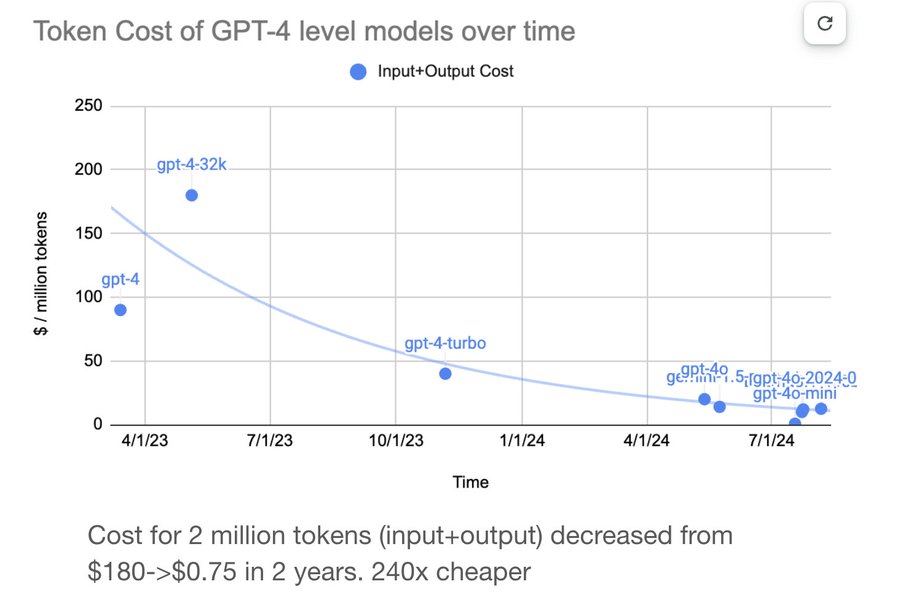
That is from Elad Gil.
Emergent Ventures 36th cohort
Unmol Sharma, Ontario, for work on purple sulfur bacteria to make hydrogen.
Andrew Gau, Stanford, robotics for the science lab.
James Edward Dillard, Atlanta area, AI and local reporting.
Jim Larsen, Farmington, New Mexico, energy, geothermal energy, and Indonesia,
Mohit Deepak Agarwal, Stanford, LLMs and ancient texts, through Perseus.
Rohit Krishnan, San Francisco, to run mid-career sabbatical program for interesting doers and thinkers.
Yuan Sui, Toronto/Harvard, to work at Harvard on neurosystems and the brain.
Kevin Zhu, Palo Alto, AI and child protection.
Muhammad Hunain, NYC, 18, space shields to protect satellies.
Vaishnav Sunil, NYC, writing and podcasting, including on talent.
Andrew Wu and Holden Mui, MIT, to compose and play the piano music of Holden.
Alan Chen, Austin, high schooler, robotics, AI, and assembly.
Ishir Rao, Chatham, NJ, high school, bio and AI and neurodegeneraton.
Adam Cheairs, Boston, high school, general career support, issues of sustainable development.
Nicholas Reville and Alex Jutca, San Francisco, RCTs to study the ability of GLP-1 drugs to alleviate addictions.
Here are previous winners of Emergent Ventures. Here is Nabeel’s software for querying about EV winners.
Saturday assorted links
1. Intertemporal empathy decline.
2. When do LLMs harm educational outcomes?
3. “Data from the Current Employment Statistics survey suggests that average hourly pay in manufacturing relative to the rest of the private sector has been falling for decades, and in May 2018 finally sank below. Among production workers the premium vanished in September 2006.” From Soumaya Keynes at the FT.
4. Okie-dokie, nuclear fusor at Waterloo edition.
5. Claims about how Georgia raised fertility.
7. He modeled that.
How do musical artists end up getting cancelled?
There is a new paper on that topic by Daniel Winkler, Nils Wlömert, and Jura Liaukonyte. Here is the abstract:
This paper investigates how the consumption of an artist’s creative work is impacted when there’s a movement to “cancel” the artist on social media due to their misconduct. Unlike product brands, human brands are particularly vulnerable to reputation risks, yet how misconduct affects their consumption remains poorly understood. Using R. Kelly’s case, we examine the demand for his music following interrelated publicity and platform sanction shocks-specifically, the removal of his songs from major playlists on the largest global streaming platform. A cursory examination of music consumption after these scandals would lead to the erroneous conclusion that consumers are intentionally boycotting the disgraced artist. We propose an identification strategy to disentangle platform curation and intentional listening effects, leveraging variation in song removal status and geographic demand. Our findings show that the decrease in music consumption is primarily driven by supply-side factors due to playlist removals rather than changes in intentional listening. Media coverage and calls for boycott have promotional effects, suggesting that social media boycotts can inadvertently increase music demand. The analysis of other cancellation cases involving Morgan Wallen and Rammstein shows no long-term decline in music demand, reinforcing the potential promotional effects of scandals in the absence of supply-side sanctions.
What I’ve been reading
1. Anna Bogutskaya, Feeding the Monster: Why Horror Has a Hold on Us. A fun read about the importance of horror movies in contemporary culture, and a lament that we underrate them.
2. Daniel Tammet, Nine Minds: Inner Lives on the Spectrum. This is probably the best book of profiles of high-achieving autistics, with the chapter on Dan Ackroyd especially interesting. Do note that the writing style is autistic, which you may consider either a plus or a minus. And “Are we there yet?”
3. Michael Haas, Music of Exile: The Untold Story of the Composers Who Fled Hitler. A detailed, well-organized and captivating look at this story. My conclusion, though, is that the Germanic compositional scene already was starting to reach dead ends in terms of quality and innovation?
4. Oren Kessler, Palestine 1936: The Great Revolt and the Roots of the Middle East Conflict. A good look at the festering problems in place before 1948. Among other things, it shows how many of the current arguments and debates have very deep roots, and just how far back the lack of trust goes.
5. Luke Stegemann, Madrid: A New Biography. Madrid is now one of the world’s very very best cities. You can judge tomes like this by how many other books they induced you to read or buy, and in this case the number was eight. I bought a whole catalog of color plates by the 18th century still life painter Melendez, for instance. Recommended.
6. Michael H. Kater, After the Nazis: The Story of Culture in West Germany. Another excellent work. From this book I took away the (unintended?) conclusion that the German written and cinematic contributions have not aged well, due to excessive (but understandable) preoccupations with Naziism and the Second World War. The greatest German postwar cultural contributions in fact are Richter, Beuys, Kiefer, Baselitz, Stockhausen, Kraftwerk, and Can. The less literal artistic forms dealt with the war obsession in more effective and lasting ways, noting that some Kiefer works still have this problem.
Self-recommending is Dana Gioia, Poetry as Enchantment, and Other Essays. The essays on Frost, Auden, and Bradbury are some of my favorites.
Jordan Ott’s Back to the Future: How to Reignite American Innovation is exactly that.
Speaking of Kraftwerk, I also enjoyed the new Simon Reynolds book Futuromania: Electronic Dreams, Desiring Machines, and Tomorrow’s Music Today Reynolds is very good at covering parts of music history that other people ignore.
More to come!
The new Karl Marx translation
Capital: Critique of Political Economy, volume 1. Translated by Paul Reitter, published by Princeton, promises to be an event. Just arrived on my doorstep.

And here is my post, from twenty years ago, on what is valid in Marx.
Friday assorted links
1. Which books, papers, and blogs are in the Bayesian canon?
2. “All fields, EXCEPT FOR ECONOMICS, exhibit a low and decreasing concentration, which suggests a trend toward decentralized knowledge production.” Link here.
3. David Perell interviews Ben Thompson.
4. Boudreaux and McKenzie on price controls (WSJ). And most climate policies are ineffective in cutting emissions (WSJ).
5. NYT on the Harris tax plan.
6. Chickens per capita, in some Anglo countries.
7. John Woo remakes The Killer but set in Paris and with a female lead, reviews are good.
8. Model this pelican capabara interaction (are they trying to eat him? I don’t think so).
Yes, strong talent is getting younger and younger
Except for the tank tops, this could be a bunch of professionals on a boisterous equity trading floor. In fact, it’s a cohort of 15- to 18-year-old students at a two-day free seminar getting a taste of high finance. The session ended with a simulation in which they each ran fictitious $20 million portfolios for more than an hour.
If the training seems intense, it is. From Morgan Stanley to Citadel, the titans of finance are spanning the globe to find ever-younger talent to eventually fill their ranks with the best and brightest. That’s creating opportunities for firms like AmplifyME Ltd., which for years has run seminars for university students, and is now extending them to high schoolers in places like Hong Kong and Singapore.
Here is the full Bloomberg story by Lulu Yilun Chen. The article has further points of interest. The winner is eighteen, and he started in on related activities at the age of fourteen. Via John De Palma.
Mobility vs. density in American history
American history is much more about rapid and cheap transport than about extremes of population density. Even New York, our densest major city by far, became dense relatively late in American history. To this day, the United States is not extremely dense, not say by European or East Asian standards.
But in American history, themes of horses, faster ships, safer ships, turnpikes, canals, our incredible river network, railroads, cars, and planes have been absolutely central to our development. America has put in a very strong performance in all those areas. When it comes to density, we have a smaller number of victories. The moon landing was mobility, but not density.
Many of our Founding Fathers were in fact a bit suspicious of density. So why not play to your own cultural and also geographic strengths? After all, the United States is arguably the most successful country.
American SMSAs are so often more impressive than are American cities per se.
These days I see an urbanist movement that is more obsessed with density than with mobility. I favor relaxing or eliminating many restrictions on urban density, and American cities would be better as a result. Upward economic mobility would rise, and Oakland would blossom. But still I am more interested in mobility, which I see as having a greater upside.
One issue is simply that urban density seems to lower fertility. It is not obvious the same can be said for mobility.
And do you really want to spread and replicate the politics of our most dense areas?
Is not mobility rather than density better for raising a class of young men who will fight to defend their country?
Do not mobile, scattered immigrants assimilate better than densely packed ones?
The density crowd is very interested in high-speed rail, which I (strongly) favor for the Northeast corridor, but otherwise am not excited about, at least not for America. Otherwise, the density crowd works to raise the status of a lot of low-speed means of transport, for instance bicycles. Bicycles are also precarious, and their riders break the traffic laws at a very high frequency. I do not wish to ban bicycles, but I do wish we could program them not to run red lights. (I wonder how much the demand for them would then fall.)
I prefer to look to a better future where higher-speed transport is both affordable and green. Ultimately, low-speed transport is a poor country thing. It is also a poor country thing to have a lot of different speeds on your roads at the same time (I will never forget my first India visit in 2004). High variance of speed also can prove dangerous, as evidenced by the research of Charles Lave.
I do not want to see the United States moving in poor country directions.
If you are obsessed with mobility, you will attach great importance to Uber, Waymo, self-driving vehicles more generally, and better aviation. To me these are major advances, and they all can get much, much better yet.
I do not know if current plans for Neom, in Saudi Arabia, can prove workable or affordable. Nonetheless, the idea of rapid transport along “The Line” at least represents an attractive mode of thought. A better direction for future exploration than bicycles.
These points were obvious to many people in the 1960s. The Jetsons had their (safe) flying cars. The ultimate innovation in Star Trek was the transporter.
Jane Jacobs was obsessed with the West Village, an amazing part of America. Yet, as far as I can tell (I haven’t read all her work), she didn’t write much about how to get more people visiting, and learning from, the West Village. Hers was the perspective of the insider who already lives there. That is one valid perspective, but not the only one.
Robert Moses was obsessed with building the Cross-Bronx Expressway. That was a mixed blessing (see Robert Caro), but it did reflect his interest in mobility rather than density per se.
Today the world is full of anti-tourist movements, opposed to at least some kinds of mobility. I prefer to push back on most of those, using Pigouvian fees to protect Venice and other locales when needed.
Ireland strikes me as the one country today that truly should be obsessed with density, not mobility. Before 1840, the country had many more people than it does today. And it could once again, easily. In the meantime, there are far too few structures and the cost of living is very high. Dublin and Belfast also need more cultural infrastructure (requiring higher populations) to be bigger draws for talented foreign workers.
The correct answers here really are going to depend on the countries and regions under consideration.
Switzerland, a highly successful country, also pays great heed to mobility. The Swiss tunnels through the Alps are some of Europe’s greatest achievements, though today we take them for granted. And the Swiss are trying to do road upgrades without slowing traffic. You don’t have to put more people in Bern if it is easier to get to Bern, and away from Bern.
Mobility often gives you more algorithmic freedom than does density.
So, at least amongst the urbanists, perhaps density is these days a wee bit overrated? After all, the net flow of American citizens still is to the suburbs.
The new Elizondo book
The title is Imminent: Inside the Pentagon’s Hunt for UFOs. This is a difficult book to review. For instance, it has passages like the following:
In one particular instance, a senior CIA official and his wife had a terrifying UAP experience in the backyard of their own home. When they awoke lying on the ground in the yard, the CIA officer had a small hole punched in the back of his neck and his wife had a small metallic object recovered from her nose when she sneezed [TC: what percentage of younger American women have this?]. Making things even more interesting, CIA doctors were notified of the circumstances and examined the patients.
I would bet very heavily against what seems to be Elizondo’s interpretation of those events. So if you read this book, do not trust any section that puts forward propositions about aliens. And that is much of the book.
That said, no matter what your view on aliens, the bureaucratic history surrounding debates on aliens is a fascinating one, and one very much underexplored by serious scholars. For instance, the more skeptical you are about aliens, the more you have to think our military and intelligence bureaucracies are just entirely, out of control insane. Here you will get a first person account of how incidents such as Tic Toc and GIMBAL evolved. I am not talking about interpretations concerning the aliens, I mean just the history of how these events were processed, recorded, and discussed. Along that exceedingly scarce dimension, this is indeed a valuable memoir.
Can you trust Elizondo on such “ordinary” matters when you cannot trust him on the accounts of the aliens? I am not sure, but my intuition says yes? So in probabilistic terms, this is a historical document of import. If used with care.
I cannot recommend a book which to me has so many apparent blatant falsehoods, but I would not try to talk you out of reading it either. There is something here, and time will tell what exactly that is.
Thursday assorted links
1. India Canada Naveen fact of the day.
2. New announcements on tax hikes supported by Harris. Most of these plans are not serious, and now is a good time to see who is a Democrat first, and an economist second. And vice versa. Here is some relevant commentary.
4. MIT without affirmative action (NYT). White admissions dropped (a small amount), by the way.
5. David Wallace-Wells on gambling and risk-taking (NYT).
6. MIE: “The scientists bought the citations for US$300 from a firm that seems to sell bogus citations in bulk. This confirms the existence of a black market for faked references that research-integrity sleuths have long speculated about, says the team.”
The Intellectual Roots of YIMBYism
At the Democratic National Convention former President Obama came out strongly in favor of housing deregulation saying “we need to build more homes and clear away some of the outdated laws and regulations that make it harder to build homes”. Robert Kwasny asks on X, “What are the intellectual roots of present-day YIMBYism?”
Looking at MR I think the first truly YIMBY post was a 2005 guest post by Tim Harford, Red tape and housing prices, pointing to a Slate article by Steven Landsburg. Here’s Landsburg:
Instead of the traditional formula “housing price equals land price + construction costs + reasonable profit,” we seem to be seeing something more like “housing price equals land price + constructions costs + reasonable profit + mystery component.” And, most interestingly, the mystery component varies a lot from city to city.
Even in cities like San Francisco, where there’s little room to build and land is consequently dear (on the order of $85,000 per quarter acre, compared with $2,200 for Dallas), you can’t use land prices to explain away housing prices. The mystery component in San Francisco housing—that is, the amount left over when you subtract land prices and construction costs from house prices—is the highest in the country.
Edward Glaeser of Harvard and Joe Gyourko of the University of Pennsylvania have computed these mystery components for about two dozen American cities. They speculate that the mystery component is essentially a “zoning tax.” That is, zoning and other restrictions put a brake on competitive forces and keep housing prices up. (Read one of their papers here.)
Zoning’s Steep Price, the Glaeser and Gyourko paper is actually from 2002 (a popular version of their NBER piece presented that same year at the NYFed) so you can see back in the old days it took years for ideas to circulate even among the bloggers! Nevertheless, 22 years from NBER paper to Presidential campaign is a great accomplishment. I see Glaeser and Gyourko as the YIMBY fountainhead. All hail Glaeser and Gyourko!
MR continued to promote housing deregulation on and off for years but I think it picked up around 2017 which is when the first YIMBY reference I can find on MR appeared in an assorted link. Here’s Tyler in 2017 pointing to a job market paper on how regulation increases housing prices and here is me in early 2018 on Why Housing in California is Unaffordable. The increase in research on this topic gave us something to talk about which is an interesting model of how ideas are transmitted.
Kwasny also wonders why Democrats seem to have picked up YIMBY more than Republicans, especially given that deregulation, anti-zoning, pro-growth, pro-developers would seem more compatible with Republican rhetoric and political support. Indeed, Zoning’s Steep Price was published in Cato’s Regulation and the assorted link which introduced YIMBY to MR was to an article blaming YIMBY on libertarians, Peter Theil and tech bros! (Congratulations Jeremy Stoppelman for an extremely effective EA donation!)
While it might have started out as being coded libertarian, Ezra Klein and Matt Yglesias are to be credited with pushing YIMBY and housing growth among Democratic elites. (Jon Favreau, an Obama speech writer, says Obama sounds like Ezra Klein!) But it’s not too late for Republicans to come home. Can’t we all agree on building more? Read Bryan Caplan in the NYTimes and buy his book!
Addendum: Tyler traces the intellectual roots of YIMBY back much further to Nicolas Barbon’s An Apology for the Builder which is also recommended by Marc Andreessen. For Britain, Sam Bowman points Mark Pennington’s excellent 2002 monograph Liberating the Land: The Case for Private Land-Use Planning (pdf).
My excellent Conversation with Nate Silver
Here is the audio, video, and transcript. Here is the episode summary:
In his second appearance, Nate Silver joins the show to cover the intersections of predictions, politics, and poker with Tyler. They tackle how coin flips solve status quo bias, gambling’s origins in divination, what kinds of betting Nate would ban, why he’s been limited on several of the New York sports betting sites, how game theory changed poker tournaments, whether poker players make for good employees, running and leaving FiveThirtyEight, why funky batting stances have disappeared, AI’s impact on sports analytics, the most underrated NBA statistic, Sam Bankman-Fried’s place in “the River,” the trait effective altruists need to develop, the stupidest risks Tyler and Nate would take, prediction markets, how many monumental political decisions have been done under the influence of drugs, and more.
Here is one excerpt:
COWEN: Why shouldn’t people gamble only in the positive sum game? Take the US stock market — that certainly seems to be one of them — and manufacture all the suspense you want. Learn about the companies, the CEO. Get your thrill that way and don’t do any other gambling. Why isn’t that just better for everyone?
SILVER: Look, I’m not necessarily a fan of gambling for gambling’s sake. Twice a year, I’ll be in casinos and in Las Vegas a lot. Twice a year, I’ll have a friend who is like, “Let’s just go play blackjack for an hour and have a couple of free drinks,” and things like that. But I like to make bets where I think, at least in principle, I have an edge, or at least can fool myself into thinking I have an edge.
Sometimes, with the sports stuff, you probably know deep down you’re roughly break-even or something like that. You’re doing some smart things, like looking at five different sites and finding a line that’s best, which wipes out some but not all of the house edge. But no, I’m not a huge fan of slot machines, certainly. I think they are very gnarly and addictive in various ways.
COWEN: They limit your sports betting, don’t they?
SILVER: Yes, I’ve been limited by six or seven of the nine New York retail sites.
COWEN: What’s the potential edge they think you might have?
SILVER: It’s just that. If you’re betting $2,000 on the Wizards-Hornets game the moment the line comes out on DraftKings, you’re clearly not a recreational bettor. Just the hallmarks of trying to be a winning player, meaning betting lines early because the line’s early and you don’t have price discovery yet. The early lines are often very beatable. Betting on obscure stuff like “Will this player get X number of rebounds?” or things like that. If you have a knack for — if DraftKings has a line at -3.5 and it’s -4 elsewhere, then it can be called steam chasing, where you bet before a line moves in other places. If you have injury information . . .
It’s a very weird game. One thing I hope people are more aware of is that a lot of the sites — and some are better than others — but they really don’t want winning players. Their advertising has actually changed. It used to be, they would say for Daily Fantasy Sports, which was the predecessor, “Hey, you’re a smart guy” — the ads are very cynical — “You’re a smart guy in a cubicle. Why don’t you go do all your spreadsheet stuff and actually draft this team and make a lot of money, and literally, you’ll be sleeping with supermodels in two months. You win the million-dollar prize from DraftKings.”
And:
COWEN: If we could enforce just an outright ban, what’s the cost-benefit analysis on banning all sports gambling?
SILVER: I’m more of a libertarian than a strict utilitarian, I think.
COWEN: Sure, but what’s the utilitarian price of being a libertarian?
Recommended, interesting and engaging throughout. And yes, we talk about Luka too. Here is my first 2016 CWT with Nate, full of predictions I might add, and here is Nate’s very good new book On the Edge: The Art of Risking Everything.