Germany chart of the day

Here is the link.
Thursday assorted links
1. The Grand Mosque in Abu Dhabi has a Cinnabon on its ground floor.
4. Can architecture reveal the spread of purdah?
5. Drones to map and follow buses?
6. How much should we trust developing country gdp?
7. David Wallace-Wells on the Covid contrarians (NYT). And from Zeynep (NYT).
8. “Large language models surpass human experts in predicting neuroscience results.”
9. The drone intrusions are probably Russia?
10. Hurdles to DOGE (NYT).
Thanksgiving and the Lessons of Political Economy
It’s been a while so time to re-up my 2004 post on thanksgiving and the lessons of political economy. Here it is with no indent:
It’s one of the ironies of American history that when the Pilgrims first arrived at Plymouth rock they promptly set about creating a communist society. Of course, they were soon starving to death.
Fortunately, “after much debate of things,” Governor William Bradford ended corn collectivism, decreeing that each family should keep the corn that it produced. In one of the most insightful statements of political economy ever penned, Bradford described the results of the new and old systems.
[Ending corn collectivism] had very good success, for it made all hands very industrious, so as much more corn was planted than otherwise would have been by any means the Governor or any other could use, and saved him a great deal of trouble, and gave far better content. The women now went willingly into the field, and took their little ones with them to set corn; which before would allege weakness and inability; whom to have compelled would have been thought great tyranny and oppression.
The experience that was had in this common course and condition, tried sundry years and that amongst godly and sober men, may well evince the vanity of that conceit of Plato’s and other ancients applauded by some of later times; that the taking away of property and bringing in community into a commonwealth would make them happy and flourishing; as if they were wiser than God. For this community (so far as it was) was found to breed much confusion and discontent and retard much employment that would have been to their benefit and comfort. For the young men, that were most able and fit for labour and service, did repine that they should spend their time and strength to work for other men’s wives and children without any recompense. The strong, or man of parts, had no more in division of victuals and clothes than he that was weak and not able to do a quarter the other could; this was thought injustice. The aged and graver men to be ranked and equalized in labours and victuals, clothes, etc., with the meaner and younger sort, thought it some indignity and disrespect unto them. And for men’s wives to be commanded to do service for other men, as dressing their meat, washing their clothes, etc., they deemed it a kind of slavery, neither could many husbands well brook it. Upon the point all being to have alike, and all to do alike, they thought themselves in the like condition, and one as good as another; and so, if it did not cut off those relations that God hath set amongst men, yet it did at least much diminish and take off the mutual respects that should be preserved amongst them. And would have been worse if they had been men of another condition. Let none object this is men’s corruption, and nothing to the course itself. I answer, seeing all men have this corruption in them, God in His wisdom saw another course fitter for them.
Among Bradford’s many insights it’s amazing that he saw so clearly how collectivism failed not only as an economic system but that even among godly men “it did at least much diminish and take off the mutual respects that should be preserved amongst them.” And it shocks me to my core when he writes that to make the collectivist system work would have required “great tyranny and oppression.” Can you imagine how much pain the twentieth century could have avoided if Bradford’s insights been more widely recognized?
*Blind Spots: When Medicine Gets It Wrong, and What It Means for Our Health*
That is the new book by Marty Makary. Since Makary has been nominated to head the FDA, I am surprised this work is not receiving more attention.
In the book, Makary is sympathetic to HRT, skeptical about a lot of antibiotic use (microbiome issues), says it is fine to ingest the cholesterol in eggs, and he is critical of earlier attempts to separate mothers and their babies. He believes silicone breast implants got a bum rap, and thinks we have screwed up the treatment of peanut allergies. A common theme is that there is too much groupthink in modern medicine and medical research. He wonders if we should be suspicious of fluoride, in part because of microbiome issues. He briefly worries about the ingestion of microplastics. I would not say I have concrete views on these questions, but overall I came away from this book comfortable with him running the FDA, at least relative to past candidates. I am skeptical of his views on fluoride, however, as the recent flurry of debate seems to have settled on a “fluoride is a net benefit” side. I also worry a bit he is picking on some easy cases (e.g., separating mothers from their babies), and not going hard enough on the incentive problems in U.S. health care and its research communities.
Makary is not obviously an accelerationist. Most of all, he likes to avoid groupthink and give matters a further look. While such a view is hard to disagree with, it makes me nervous in a bureaucratic context. In reality, “groupthink” is how many things get approved as quickly as they do. Just how many public health debates are we supposed to be reopening here? Should that be the priority of the FDA? Or should speeding up clinical trials and lowering their cost be the emphasis?
When he thinks about FDA matters, is he willing to have questions of incentives arise first in his thoughts? If so, that would be a break from his writing career so far.
I also would be curious to know why he thinks “his sides of these debates” will, on the whole, avoid groupthink more than the status quo has done. Lemon-picking from the status quo, even if we agree with him on every point, does not clarify this all-important question. Groupthink stems from incentives, and what kind of better incentives will he build into the U.S. health care system? He does write about “common sense,” and making things “physician-centered,” both fine and well, but I don’t see either of those as answering my questions in a scalable manner.
Makary wanted to approve and accelerate the Johnson and Johnson vaccine, a good sign in my view. Still, on some issues he will, for my tastes, be insufficiently consequentialist (“go ahead and let them try!”) and too worried about “getting the science right” and “sampling more data.”
Marty has strong academic and research credentials, here is his Wikipedia page. Here is more on what he has done, all positives in my view:
Makary is a director on the board at Harrow, an ophthalmic pharmaceuticals company, and an adviser to Sidecar Health, an insurance provider that aims to lower customer costs by eliminating provider networks and drug formularies.
He’s also chief medical adviser to Nava, a benefits brokerage, and chief medical officer at Sesame, a cash-pay health service market that offers compounded semaglutide, Stat reported over the weekend, raising questions about how Makary will approach the GLP-1 shortage brouhaha should he be confirmed.
Sesame’s founder, David Goldhill, wrote a well-known piece in The Atlantic about his father’s death from a hospital-acquired infection that references a surgery checklist Makary helped develop to reduce errors and adverse events.
During the pandemic he called for universal masking and opposed vaccine mandates. He supported national lockdowns and called for “first doses first.” He also raised doubts about children needing two doses of the Covid vaccine. Rather than relitigate whether those are all the correct views or not, I will simply note he is not a deregulator per se. He donated to Obama in 2008.
Here is a recent Russ Roberts podcast with Makary.
Overall, I see only upsides from this pick. Nonetheless I also see a good chance he focuses on reform directions where I think the expected benefits are small. So I am not excited by this pick, at least not yet.
Wednesday assorted links
Environmental “Justice” Recreates Redlining
It’s been said that the radical left often ends up duplicating the policies of the radical right, just under different names and justifications, e.g. separate but equal, scientific thinking is “white” thinking and so forth. Here’s another example from Salim Furth: the re-creation of redlining. Redlining was the practice of making it more difficult to access financial products such as mortgages by grading some neighborhoods as “hazardous” for investment. Either by design or result, redlining was often associated with minority populations.
Salim shows that Massachusetts has created a modern redlining system.
In Massachusetts, the context is that MEPA (its mini-NEPA) requires projects of a certain size to go through either a moderately-expensive or a quite-expensive process. Some types of projects automatically [require] the quite-expensive Environmental Impact Review process. The #maleg passed a 2021 “Environmental Justice” law, which defined certain people – oh euphemism treadmill! – as “Environmental Justice populations.”…So any housing (or other) project that requires a permit from a state agency and is within 1 mile of a “Environmental Justice population” now automatically triggers the expensive EIR process….How expensive? I was told it can run from $150k to $1m, and take 6 to 12 months. That’s a lot of additional delay in a state where delays are already extreme.
If there’s a, uh, silver lining here, it’s that “EJ Population” is defined so capaciously that it includes super-rich areas of Lexington (32% Asian, $206k median hh income), because all “minorities” are automatically disadvantaged. So it’s much less targeted to disinvested places than the original redlining. But the downside is that it’s *extremely well targeted* to discourage investment anywhere near transit or jobs. The non-EJ places are the sprawly exurbs. So maybe they *tried* to reinvent redlining, but all they really accomplished was reinventing subsidies for sprawl and raising housing costs along the way!
…This is a good, sobering reminder that for every 1 step forward by pro-housing advocacy, the blue states can manage 2 steps backward via wokery, proceduralism and anti-market ideas…
Jay Bhattacharya at the NIH
Trump has announced the appointment, so it is worth thinking through a few matters. While much of the chatter is about the Great Barrington Declaration, I would note that Bhattacharya has a history of focusing on the costs of obesity. So perhaps we can expect more research funding for better weight loss drugs, in addition to other relevant public health measures.
Bhattacharya also has researched the NIH itself (with Packalen), and here is one bit from that paper: “NIH’s propensity to fund projects that build on the most recent advances has declined over the last several decades. Thus, in this regard NIH funding has become more conservative despite initiatives to increase funding for innovative projects.”
I would expect it is a priority of his to switch more NIH funding into riskier bets, and that is all to the good. More broadly, his appointment can be seen as a slap in the face of the Fauci smug, satisfied, “do what I tell you” approach. That will delight many, myself included, but still the question remains of how to turn that into concrete advances in public health policy. Putting aside the possibility of another major pandemic coming around, that is not so easy to do.
My main worry is simply that NIH staff will not trust their new director. The problem is not so much GBD, which can be compartmentalized as a “political” stance, but rather the earlier claims that many more people had Covid early than we had thought, and that expected fatalities were going to be quite low, with a maximum of 40,000. We all make mistakes, the question is how those mistakes get processed. If you interrogate Perplexity it will report “Bhattacharya has not publicly acknowledged or confessed to these mistakes in his early predictions.” You don’t have to agree with Perplexity (though contrary cites are welcome!), rather it suffices to say that reflects a common perception of the scientific community. He also seemed to be pushing those low fatality estimates for longer than might have been considered appropriate. And that is indeed a problem for his tenure at the NIH.
The danger is simply that NIH staff will double down on risk aversion, and they may not so readily support any attempt to make the grants themselves riskier, or rooted in the greater discretion of program directors, a’la DARPA and the like. They will fear that their director will not sufficiently follow the evidence, or admit when mistakes are being made and reverse course. Even if you fully agree with GBD and the like, I hope you are able to see this as a relevant problem. Every institutional revolution requires supportive troops on the inside, even if they are only a minority.
I very much hope this works out well, but in the meantime that is my reservation.
Who Americans spend their time with, by age
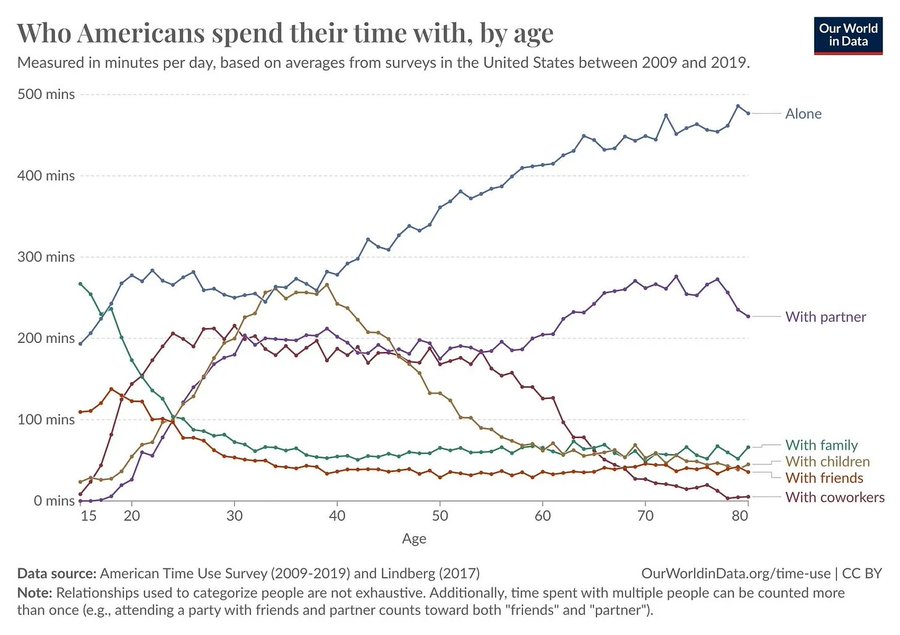
Via the excellent Bryan Caplan.
The Consequences of Limiting the Tax Deductibility of R&D
We study the tax payment and innovation consequences of limiting the tax deductibility of research and development (“R&D”) expenditures. Beginning in 2022, U.S. companies are required to capitalize and amortize R&D rather than immediately deduct these expenditures. We utilize variation in U.S. firms’ fiscal year ends to test the effects of the R&D tax change in a difference-indifferences framework. We first document that affected U.S. firms’ cash effective tax rates increase by 11.9 percentage points (62%), on average. We then test and find decreases in R&D investment among domestic-only, research-intensive, and constrained firms. In aggregate, these estimates translate to a reduction in R&D of $12.2 billion in the first year among the most research-intensive firms. Further, we observe decreased capital expenditures and share repurchases among affected companies, suggesting that firms also reduced other types of investment and shareholder payout to meet the increased cash tax liability. The paper provides policy-relevant evidence about the significant real effects of limiting innovation tax incentives.
That is from a new paper by Mary Cowx, Rebecca Lester, and Michelle L. Nessa. Via the excellent Kevin Lewis.
Kevin Hassett to lead the NEC?
Bloomberg says so, a very good pick.
Can we expect large federal workforce cuts?
Wow, our government employees market is now projecting a new low of just 60k cuts For context, there are a record 23.4 million government employees When Elon Musk took over Twitter, he reduced the workforce by more than 80%
That is from Kalshi. Here is the market.
Tuesday assorted links
More Randian villains
Gavin Newsom, California’s Democratic governor, announced on Monday that he would reinstate a tax credit for electric vehicle purchases if the incoming Trump Administration removes federal EV tax credits. But the state may not extend the credits to Tesla because of the company’s large market share. Tesla’s stock price fell 4% on Monday.
Here is more from The Information (gated). GPT comments.
Birth Dearth and Local Population Decline
Local population decline has spread rapidly since 1970, with half of counties losing population between 2010 and 2020. The workhorse economic models point to net out-migration, likely driven by changing local economies and amenities, as the cause of this trend. However, we show that the share of counties with high net out-migration has not increased. Instead, falling fertility has caused migration rates that used to generate growth to instead result in decline. When we simulate county populations from 1970 to the present holding fertility at its initial level, only 10 percent of counties decline during the 2010s.
That is from a new paper by Brian Asquith and Evan Mast. Via the excellent Kevin Lewis.
My Conversation with Russ Roberts on Vasily Grossman’s *Life and Fate*
Here is the audio, video, and transcript. Russ and I agreed to read the book in its entirety and then discuss it. Here is part of the episode summary:
Russ and Tyler cover Grossman’s life and the historical context of Life and Fate, its themes of war, totalitarianism, freedom, and fate, the novel’s polyphonic structure and large cast of characters, the parallels between fascism and communism, the idea of “senseless kindness” as a counter to systemic evil, the symbolic importance of motherhood, the psychology of confession and loyalty under totalitarian systems, Grossman’s literary influences including Chekhov, Tolstoy, Dante, and Stendhal, individual resilience and moral compromises, the survival of the novel despite Soviet censorship, artificial intelligence and the dehumanization of systems, the portrayal of scientific discovery and its moral dilemmas, the ethical and emotional tensions in the novel, the anti-fanatical tone and universal humanism of the book, Grossman’s personal life and connections to its themes, and the novel’s enduring relevance and complexity.
Here is one bit from me:
COWEN: Amongst Soviet authors, he is the GOAT, one could say, to refer to our earlier episode. But this, to me, is one of the very few truly universal novels. The title itself, Life and Fate — it is about life and fate, but the novel is about so much more. It’s about war. It’s about slavery. It’s about love, motherhood, fatherhood, childbirth, rape, friendship, science, politics. How many novels, if any, can you think of that have all of those worlds in them in an interesting and insightful manner? Very few.
The one that comes closest to it is, in fact, his model. That’s Tolstoy’s War and Peace, a three-word title with an and in the middle and two important concepts. They’re both about war. They’re both about the invasions of Russia or the USSR. There’s a central family in both stories. The notion of what is fate or destiny is highly important to Tolstoy, as it is to Grossman, though they have different points of view.
Napoleon plays a significant role in War and Peace. In Life and Fate, Hitler and Stalin make actual appearances in the novel, which I find shocking when I read it, like, here they are on the page, and it’s actually somewhat plausible. So, he’s modeling this, I think, after War and Peace. He actually pulls it off, which is a miracle. I think it is a novel comparable in quality and scope and import to Tolstoy’s War and Peace, which is sometimes called the greatest novel ever. So that is a pretty amazing achievement.
And on some non-book issues:
COWEN: I think I should have said it’s a bimodal distribution, that you go one way or another. Look at it this way: In the simplest Bayesian model, your views should be a random walk, that the recent evolution of your views shouldn’t predict where you’ll end up tomorrow. But that’s not the case, really, with anyone that I’ve ever met. There’s some kind of trend in your views. You’re either getting more fanatical, getting more moderate, getting more religious, more or less something.
And that, to me, is one of the most interesting facts about human belief, is how hard it is to find belief as a random walk. So, what’s wrong with all of us? If you’re getting more moderate all the time, that’s wrong too. That’s a funny kind of, you could say, almost fanaticism, where you ought to say, “Well, I see the trend so I’m just going to leap to where I ought to be.” Then the next day, maybe 50 percent chance I’ll take a step back toward being more dogmatic or less moderate. But again, that’s not what we see from the moderates either.
ROBERTS: I wonder how much of it is the fact that it’s really convenient to have a system, gives you something to shove into the box. You’ve got this black box that you take the world’s events and you’ve decided how they should be processed. Then something new comes along, and you know how to deal with that because you’ve got this box; you’ve got all these great examples from the past.
At some point for me, I just started thinking that maybe the box doesn’t work all the time. I think a lot of people love the box. It’s a great source of comfort, whether it’s religion or ideology or other things. Maybe there’s just something peculiar about me. When you’re younger, certainty is deeply comforting because the world’s a bit too complicated to deal with. It still is, but I’m just less certain.
COWEN: There’s also a more charitable interpretation of what you’re describing. Think of yourself as working through problems, which is fine. Working through problems takes some time. You can’t every day pick up a new problem. The problems you’re working through as you — I wouldn’t say solve them, but as you somewhat make progress on them — that’s going to give you some persistence in the deltas of how your beliefs change.
I’m not sure — the pure Bayesian model might just be wrong. It’s so far from actual human practice. Maybe we shouldn’t just damn humans for not meeting it, but realize there are structures to how you work through things, and they are going to imply certain trends that go on for periods of time.
Recommended, obviously.