The Fast, the Slow, and the Congested
That is a new NBER working paper by Protty A. Akbar, Victor Couture, Gilles Duranton, and Adam Storeygard. Here is the abstract:
We assemble a new global database on motor vehicle travel speed in over 1,200 large cities in 152 countries. We then estimate comparable city-level indices of travel speed and congestion. Most of the variation in urban travel speed is across countries, not within. National income per capita explains most of this cross-country variation in speed. In rich countries, urban travel is roughly 50% faster than in poor countries. To investigate the link between economic development and mobility, we develop an urban model with endogenous travel, road infrastructure, and land area. The model provides an exact decomposition of how city size, infrastructure, and topography contribute to explaining why urban travel is faster in richer countries. We find that richer countries are faster, mainly because their cities have more major roads and wider land areas. These effects operate by increasing uncongested speed, not by reducing congestion.
In general, I am much more skeptical about slower modes of transportation than are many other MR readers, most of all those on the Left.
If you look on p.36, “major road length” is the variable most predictive of speed if you ask why rich countries are faster than are poor countries — please do not forget the Lucas Critique however! After all, they do measure Flint, Michigan as the fastest city [sic] in the world.
Here is a good paragraph (p.37):
Compared to other cities in the oecd, us cities are (exp(−0.27) − 1 =) 24% less populous, cover 72% more area, have 67% more major roads, and have 30% more roads that conform to the road network’s main grid orientation. Panel A of figure 5 reports the corresponding decomposition result. The low density of us cities explains most of why they are faster. Major roads matter too, as do griddier road networks. City size variables account for 47% of the speed difference between the us and other oecd countries, infrastructure accounts for 35%, and the share accounted for by topography is negligible.
If you are wondering, by their measures Dhaka is the slowest city in the world.
An excellent paper, recommended.
The impacts of Covid-19 absences on workers
In the Journal of Public Economics, by Gopi Shah Goda and Evan J. Soltas:
We show that Covid-19 illnesses and related work absences persistently reduce labor supply. Using an event study, we estimate that workers with week-long Covid-19 absences are 7 percentage points less likely to be in the labor force one year later compared to otherwise-similar workers who do not miss a week of work for health reasons. Our estimates suggest Covid-19 absences have reduced the U.S. labor force by approximately 500,000 people (0.2 percent of adults) and imply an average labor supply loss per Covid-19 absence equivalent to $9,000 in forgone earnings, about 90 percent of which reflects losses beyond the initial absence week.
Here is the full article.
Claims about Italy, Tiebout edition
Using census data, we study false birth-date registrations in Italy, a phenomenon well known to demographers, in a setting that allows us to separate honesty from the benefits of cheating and deterrence. By comparing migrants leaving a locality with those who remain in it, we illustrate the tendency of Italians to sort themselves across geographic areas according to their honesty levels. Over time, this tendency has modified the average honesty level in each locality, with relevant consequences for the distribution across geographic areas of outcomes like human capital, productivity, earnings growth, and the quality of local politicians and government.
That is from a new paper by Massimo Anelli, Tommaso Colussi, and Andrea Ichino, via the excellent Kevin Lewis. How many people recall that Tiebout’s initial work was drawn from New Jersey data?
What should I ask Rebecca F. Kuang?
I am a big fan of her latest book Yellowface, which I read straight through (and it’s much more double-edged and subversive than you might be expecting). Here is a partial bio:
Rebecca F. Kuang is the award-winning, #1 New York Times bestselling author of the Poppy War trilogy and Babel: An Arcane History, as well as the forthcoming Yellowface. [TC: no longer forthcoming] She has an MPhil in Chinese Studies from Cambridge and an MSc in Contemporary Chinese Studies from Oxford; she is now pursuing a PhD in East Asian Languages and Literatures at Yale.
Here is her Twitter. Here is her full of facts, but somehow a bit convoluted Wikipedia page. So what should I ask her?
Law-Abiding Immigrants
The subtitle is The Incarceration Gap Between Immigrants and the U.S.-Born, 1850–2020, and the authors are Ran Abramitzky, Leah Boustan, Elisa Jácome, Santiago Pérez, and Juan David Torres. Here is the to-the-point abstract:
Combining full-count Census data with Census/ACS samples, the researchers provide the first nationally representative long-run series (1870–2020) of incarceration rates for immigrants and the U.S.-born. As a group, immigrants had lower incarceration rates than the US-born for the last 150 years. Moreover, relative to the U.S.-born, immigrants’ incarceration rates have declined since 1960: Immigrants today are 60% less likely to be incarcerated (30% relative to U.S.-born whites). This relative decline occurred among immigrants from all regions and cannot be explained by changes in immigrants’ observable characteristics or immigration policy. Instead, the decline likely reflects immigrants’ resilience to economic shocks.
Here is the full paper, via Anecdotal.
Why do immigrants oppose immigration?
This question does not receive enough discussion, but there is a new paper of note, by Aflatun Kaeser and Massimiliano Tani:
…successful immigrants in the United States (i.e., those who are in the top quintile of the socioeconomic classification), who may benefit the most from being perceived as unrelated to unskilled undocumented immigrants, have negative views about immigration, especially with respect to its contribution to unemployment, crime, and the risk of a terrorist attack. This effect does not arise in the case of countries that apply stricter controls than the United States on immigration, like Australia, Canada, and New Zealand, or do not attract as large a number of undocumented immigrants. We interpret these results as evidence that immigrants’ attitudes toward other immigrants respond to the lack of a selective immigration policy: namely, if successful immigrants run the risk of being perceived as related to undocumented or uncontrolled immigration, they respond by embracing an immigrants’ anti-immigration view.
Via the excellent Kevin Lewis.
Wednesday assorted links
My Conversation with the excellent Jerusalem Demsas
Here is the audio, video, and transcript. Here is the episode summary:
In this special episode, Tyler sat down with Jerusalem Demsas, staff writer at The Atlantic, to discuss three books: The Dispossessed by Ursula K. Le Guin, Gulliver’s Travels by Jonathan Swift, and Of Boys and Men by Richard V. Reeves.
Spanning centuries and genres and yet provoking similar questions, these books prompted Tyler and Jerusalem to wrestle with enduring questions about human nature, gender dynamics, the purpose of travel, and moral progress, including debating whether Le Guin prefers the anarchist utopia she depicts, dissecting Swift’s stance on science and slavery, questioning if travel makes us happier or helps us understand ourselves, comparing Gulliver and Shevek’s alienation and restlessness, considering Swift’s views on the difficulty of moral progress, reflecting on how feminism links to moral progress and gender equality, contemplating whether imaginative fiction or policy analysis is more likely to spur social change, and more.
An actual conversation! This one is difficult to excerpt, and unlike many I suspect it is better to listen than to read the transcript. Nonetheless here is one short excerpt:
DEMSAS: Yes. The only walls on the anarchist planet [in The Dispossessed] are the ones that surround the space travel, the launching pad or whatever it is. That’s something that’s said very early on, but then you discover throughout the book how much there are all of these other “invisible walls” that he’s discovering. That’s made very explicit at times, sometimes maybe too explicit. [laughs] But I think it’s also a lesson in how much you have to have an other to compare yourself to in order to even understand yourself.
He’s alone for a really long time, and when he’s doing his studies at the beginning or in the middle of the book, and he can’t get these scientific breakthroughs that he inevitably does get to — it’s when he starts interacting with other people and rebuilding those bonds with other humans that you do actually get these breakthroughs. I think that’s also another point in favor of Le Guin pointing out that communitarianism is important.
Recommended.
Misandry
John Tierney lets loose in a well-researched piece:
Scholars, journalists, politicians, and activists will lavish attention on a small, badly flawed study if it purports to find bias against women, but they’ll ignore—or work to suppress—the wealth of solid research showing the opposite. Three decades ago, psychologists identified the “women-are-wonderful effect,” based on research showing that both sexes tended to rate women more positively than men. This effect has been confirmed repeatedly—women get higher ratings than men for intelligence as well as competence—and it’s obvious in popular culture.
“Toxic masculinity” and “testosterone poisoning” are widely blamed for many problems, but you don’t hear much about “toxic femininity” or “estrogen poisoning.” Who criticizes “femsplaining” or pretends to “believe all men”? If the patriarchy really did rule our society, the stock father character in television sitcoms would not be a “doofus dad” like Homer Simpson, and commercials wouldn’t keep showing wives outsmarting their husbands. (When’s the last time you saw a TV husband get something right?) Smug misandry has been box-office gold for Barbie, which delights in writing off men as hapless romantic partners, leering jerks, violent buffoons, and dimwitted tyrants who ought to let women run the world.
Numerous studies have shown that both sexes care more about harms to women than to men. Men get punished more severely than women for the same crime, and crimes against women are punished more severely than crimes against men. Institutions openly discriminate against men in hiring and promotion policies—and a majority of men as well as women favor affirmative-action programs for women.
The education establishment has obsessed for decades about the shortage of women in some science and tech disciplines, but few worry about males badly trailing by just about every other academic measure from kindergarten through graduate school. By the time boys finish high school (if they do), they’re so far behind that many colleges lower admissions standards for males—a rare instance of pro-male discrimination, though it’s not motivated by a desire to help men. Admissions directors do it because many women are loath to attend a college if the gender ratio is too skewed.
Gender disparities generally matter only if they work against women. In computing its Global Gender Gap, the much-quoted annual report, the World Economic Forum has explicitly ignored male disadvantages: if men fare worse on a particular dimension, a country still gets a perfect score for equality on that measure. Prodded by the federal Title IX law banning sexual discrimination in schools, educators have concentrated on eliminating disparities in athletics but not in other extracurricular programs, which mostly skew female. The fact that there are now three female college students for every two males is of no concern to the White House Gender Policy Council. Its “National Strategy on Gender Equity and Equality” doesn’t even mention boys’ struggles in school, instead focusing exclusively on new ways to help female students get further ahead.
Read the whole thing.
America is asleep on its AI boom
That is the topic of my latest Bloomberg column, here is one observational part:
Not long ago I walked through Tysons Corner Center in northern Virginia, one of America’s largest malls, serving a prosperous and well-educated community. I didn’t see a single sign or marker referring to AI. No posters announcing the coming new AI-powered toys for Christmas. No AI-enhanced shopping app. No AI-assisted beauty salons. There were, however, a lot more stores selling high-end clothing.
Progress is nonetheless continuing at a rapid pace, as much of the rest of the column discusses. Maybe good if the general population is not paying entirely full attention!
Mimetic desire and India’s IT growth
We study how US immigration policy and the Internet boom affected not just the US, but also led to a tech boom in India. Students and workers in India acquired computer science skills to join the rapidly growing US IT industry. As the number of US visas was capped, many remained in India, enabling the growth of an Indian IT sector that eventually surpassed the US in IT exports. We leverage variation in immigration quotas and US demand across occupations to show that India experienced a ‘brain gain’ when the probability of migrating to the US was higher. Changes in the US H-1B cap induced changes in fields of study, and occupation choice in India. We then build and estimate a quantitative model incorporating trade, innovation, and dynamic occupation choice in both countries. We find that high-skill migration raised the average welfare of workers in each country, but had distributional consequences. The H-1B program induced Indians to switch to computer science occupations, and helped drive the shift in IT production from the US to India. We show that accounting for endogenous skill acquisition is key for quantifying the gains from migration.
That is from a new paper by Gaurav Khanna and Nicolas Morales. One implication is that for many countries brain drain is not a problem, rather many people train to go abroad but end up staying home, to the benefit of the home country.
Tuesday assorted links
1. Can we talk to whales? (New Yorker)
2. Roland Fryer podcast with Russ Roberts.
3. Why has per capita Medicare spending slowed down? (NYT) And the changing economics of higher education (NYT).
4. How much are male-female partners alike?
5. Flying puffin.
Rewatching *Close Encounters of the Third Kind* (with a few spoilers)
I hadn’t seen it in many years, and this time around I know more about demonology. Much more. If there were a Second Coming, how would we distinguish it from the Antichrist? How would we distinguish aliens from either? The movie explores these questions in considerable depth, so no it’s not Spielberg happy and shiny aliens movie. I was reminded of Shyamalan’s (excellent) Signs throughout. There is even a background scene where The Ten Commandments is playing on a TV. In this movie, who are the Apostles? Is the notion of “The Chosen” being redefined? Doesn’t the final scene, where the big ship comes through the clouds, remind you of The Book of Revelation? And if “the aliens” are so benevolent, why do they kidnap people and return so many of them as frozen zombies? Or are those the demons? Or the saved? Or whatever.
Oh, and from Wikipedia there is this: “The name “Devil’s Tower” originated in 1875 during an expedition led by Colonel Richard Irving Dodge, when his interpreter reportedly misinterpreted a native name to mean “Bad God’s Tower”.”
By the way, did you notice the role of the “Deep State” in this movie? You don’t see the President, members of Congress, or even generals greeting the aliens. There is instead some weird French guy who barely speaks English, surrounded by a bunch of bureaucrats.
A Diamond Pricing Puzzle
In our textbook, Modern Principles of Economics, Tyler and I predicted that lab grown diamonds would break the DeBeers cartel. Well, it’s finally happening.
Bloomberg: One of the world’s most popular types of rough diamonds has plunged into a pricing free fall, as an increasing number of Americans choose engagement rings made from lab-grown stones instead.
…the scale and speed of the pricing collapse of one of the diamond industry’s most important products has left the market reeling.
…De Beers has cut prices in the category by more than 40% in the past year…The impact on De Beers was clear…first half profits plunged more than 60% to just $347 million, with its average selling price falling from $213 per carat to $163 per carat.
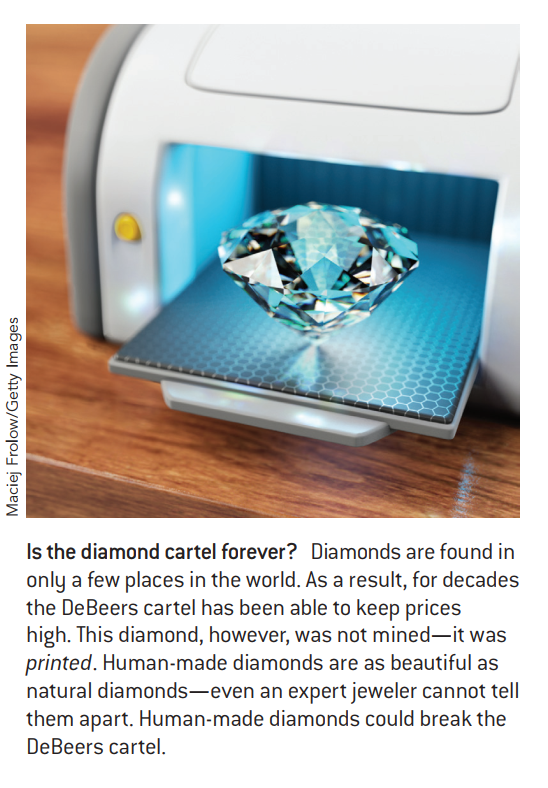
The puzzle, however, is why has it taken so long? The diamond market does have some peculiar features. Buyers of engagement rings don’t necessarily benefit from lower-prices per se as a diamond ring is a signal. If the cost of the signal goes down, people need to spend more to send the same message. An inexpensive engagement ring is thus something of a contradiction in terms, so price shopping is less intense. Nevertheless, the early buyers of lab-grown diamond rings should still benefit because the rings can’t be distinguished by the naked eye. Neither the bride, nor her friends, have to know the $10,000 ring only cost $5,000, right? Right?
Well maybe not right. DeBeers also produces lab-grown diamonds and they have a very strange pricing strategy:
De Beers started selling its own lab-grown diamonds in 2018 at a steep discount to the going price, in an attempt to differentiate between the two categories. The company expects lab-grown prices to continue to tumble, in what it sees as a tsunami of more supply coming on to the market, Rowley said. That should create an even bigger delta in prices between natural diamonds and lab grown, helping differentiate the two products, he said.
What? Ordinarily, the bigger the price between a competitor and its substitute the greater pressure on the competitor to lower prices! Yet DeBeers is gambling that the bigger the difference in price between natural and lab grown diamonds the bigger the demand for natural diamonds! Strange. The only way I see this working is if the fiancée knows the price of the ring, which maybe they do! In that case, the buyer still has to spend 10k and doesn’t care whether it’s 10k on synthetic diamonds or 10k on natural grown diamonds. But 10k on synthetic diamonds will get you more carats so we need an equilibrium in which a smaller diamond signals more expensive. But that runs against hundreds of years of expectations! And remember natural and lab grown diamonds are indistinguishable by the naked eye. It’s one thing for the fiancée to know the price of the diamond but surely her friends judge by what they can see, namely the size of the ring. Which signal is the most important to send?
All of this goes to show how peculiar the signaling model can be. Keep diamonds in mind when thinking about the the market for higher-education. Harvard is never going to lower prices and might they even raise prices as state schools lower their price?
Podcast with Pradumnya Prasad
my most anticipated podcast of the year is out! I talked to @tylercowen about a variety of topics
– How Singapore can get weirder
– What happens to kids and public intellectuals in a post-GPT world
– Why he's optimistic on Kenyan economic growthAnd more!https://t.co/ZZ6z52hqKD
— Pradyumna (@PradyuPrasad) September 4, 2023