Perhaps intergenerational mobility has not declined in the United States after all
From the latest American Economic Review:
A large body of evidence finds that relative mobility in the US has declined over the past 150 years. However, long-run mobility estimates are usually based on White samples and therefore do not account for the limited opportunities available for nonwhite families. Moreover, historical data measure the father’s status with error, which biases estimates toward greater mobility. Using linked census data from 1850 to 1940, I show that accounting for race and measurement error can double estimates of intergenerational persistence. Updated estimates imply that there is greater equality of opportunity today than in the past, mostly because opportunity was never that equal. (JEL J15, J62, N31, N32)
That is from Zachary Ward of Baylor University. If that is true, and it may be, how many popular economics books from the last twenty years need to be tossed out? How many “intergenerational mobility is declining” newspaper columns and magazine articles? Ouch. No single article settles a question, but for now this seems to be the best, most up to date word on the matter.
Wednesday assorted links
1. Anti-Piketty on r > g, once you put entrepreneurs into the model.
2. From Loyal, potential gains in canine life extension. And more from the NYT.
3. The economics of globalized fashion. And Emily Oster moonlights as fashion model.
4. Please donate to Conversations with Tyler.
5. Joe Walker podcasts with Shruti Rajagopalan on India and also talent. With transcript, there is also quite a bit of discussion of me in there.
6. Scott Alexander on Effective Altruism.
7. Niskanen symposium on Milton Friedman and the negative income tax.
Why Housing is Unaffordable: The Elasticity of Supply
We have a great new MRU video on housing and why it’s so expensive in many dynamic cities. The video is a good introduction to the economics and also to the politics of housing supply. A highlight is a wonderful animation illustrating how increasing demand coupled with inelastic supply leads to competitive bidding among buyers, driving up prices. Anyone teaching economics should take a look.
Of course, the video pairs perfectly with our textbook, Modern Principles. Indeed, this is the initial video in a two-part series exploring the elasticity of supply, transforming a traditionally mundane topic into a relevant and fun discussion. Check it out!
Africa fact of the day
Map of successful military coups in Africa since 2020. And there appears to be an attempted one underway in Sierra Leone.
– Bloomberg pic.twitter.com/CBaGOtHikl
— Nick Hedley (@nickhedley) November 28, 2023
Why Argentina’s dollarization is likely to come in sudden, messy ways
Yes, I do still favor it, but here is part of the problem, as I explain in my latest Bloomberg column:
The simplest way for Argentina to dollarize would be to inflate the peso even more. For purposes of argument, imagine a peso inflation rate of one billion percent a year. Pesos would be worthless, and transactions would be consummated with US dollars (or in some cases in crypto, which also is popular in Argentina). The problem is that current peso holders would be left with nothing. That would be unfair, and it also might torpedo support for other parts of Milei’s agenda.
To put it in more general terms: The question is not how to adopt a new currency, it is how to adopt a new currency and retain a reasonable value for the old one. Argentina, according to some estimates, would need about $30 billion to back the retired pesos.
And now here is the key practical issue:
Another question is how to choose a rate of conversion for pesos to dollars. The government might look to current black market rates as a rough guide — but the correct rate, post-policy shift, would not be the same as the market rate right now. If the government were to peg the peso too high, in the short run prices in Argentina would have to adjust downward, if only because the demand for pesos would be rising (let’s generously assume the peg is credible). That would lead to deflationary pressures, which would likely harm the economy.
Alternatively, if the government pegged the peso too low to the dollar, there would be even more inflation in the short run, as people would be all the more inclined to unload their pesos.
The government is more likely to overshoot, pegging the peso too low in order to avoid a deflationary recession and because it would require raising fewer dollars. In this case, the peso would lose even more value right now, and the rate of inflation would accelerate. In fact, this is the most likely scenario for the early months of the Milei administration.
It would be a version of the first plan mentioned above — namely, dollarization through the outright destruction of the peso, whether intentional or not. Either the value of the peso would collapse, or the higher inflation rate would induce Milei to advance dollarization as quickly as possible, even if it is done at quite unfair rates.
Worth a ponder, roller coaster ahead. One way to put it is that an unexpected dollarization and an expected dollarization have somewhat different properties, with the latter in some ways being more difficult. Here is the Spanish language version of the column.
Charlie Munger, RIP
Age 99, the reissue of his Poor Charlie’s Almanack: The Essential Wit and Wisdom of Charles T. Munger is due out December 5 from Stripe Press. And my planned CWT with him will have to be rescheduled…
Depolarizing GPT
David Rozado has now created a service that enables left-wing GPT, right-wing GPT, and what he calls depolarizing GPT. Enjoy!
Reassessing China’s Rural Reforms: The View from Outer Space
We study one of the central reforms in China’s economic miracle, the Household Responsibility System (HRS), which decollectivized agriculture starting in 1978. The HRS is commonly seen as having significantly boosted agricultural productivity—but this conclusion rests on unreliable official data. We use historical satellite imagery to generate new measurements of grain yield, independent of official Chinese statistics. Using two separate empirical designs that exploit the staggered rollout of the HRS across provinces and counties, we find no causal evidence that areas that adopted the HRS sooner experienced faster grain yield growth. These results challenge our conventional understanding of decollectivization, land reform, and the origins of the Chinese miracle.
That is a new paper by Joel Ferguson and Oliver Kim, with Kim being on the job market from Berkeley this year. Here is Kim’s thread on Twitter. Intriguing results, which have won praise from Pseudoerasmus…
Tuesday assorted links
2. Vitalik on techno-optimism, recommended.
3. Time inconsistent Korean canine threats.
4. Profile of Jensen Huang of Nvidia (New Yorker).
5. Samo Burla reports from Bismarck Brief.
7. How the NYT picks its “Best Books” list (NYT). This account is from the Times itself, and it illustrates so many nightmarish features of our contemporary world. And I’m not even talking about “Woke” issues here, just the procedure of how they do it.
The Big Fail
The Big Fail, Joe Nocera and Bethany McLean’s new book about the pandemic, is an angry book. Rightly so. It decries the way the bien pensant, the self-righteously conventional,  were able to sideline, suppress and belittle other voices as unscientific, fraudulent purveyors of misinformation. The Big Fail gives the other voices their hearing— Martin Kulldorff, Sunetra Gupta, Jay Bhattacharya and Emily Oster are recast not as villains but as heroes; as is Ron DeSantis who is given credit for bucking the conventional during the pandemic (Nocera and McLean wonder what happened to the data-driven DeSantis, as do I.)
Amazingly, even as highly-qualified epidemiologists and economists were labelled “anti-science” for not following the party line, the biggest policy of them all, lockdowns, had little to no scientific backing:
…[lockdowns] became the default strategy for most of the rest of the world. Even though they had never been used before to fight a pandemic, even though their effectiveness had never been studied, and even though they were criticized as authoritarian overreach—despite all that, the entire world, with a few notable exceptions, was soon locking down its citizens with varying degrees of severity.
In the United States, lockdowns became equated with “following the science.” It was anything but. Yes, there were computer models suggesting lockdowns would be effective, but there were never any actual scientific studies supporting the strategy. It was a giant experiment, one that would bring devastating social and economic consequences.
The narrative lined up “scientific experts” against “deniers, fauxers, and herders” with the scientific experts united on the pro-lockdown side (the following has no indent but draws from an earlier post). But let’s consider. In Europe one country above all others followed the “ideal” of an expert-led pandemic response. A country where the public health authority was free from interference from politicians. A country where the public had tremendous trust in the state. A country where the public were committed to collective solidarity and public welfare. That country, of course, was Sweden. Yet in Sweden the highly regarded Public Health Agency, led by state epidemiologist Anders Tegnell, an expert in infectious diseases, opposed lockdowns, travel restrictions, and the general use of masks.
It’s important to understand that Tegnell wasn’t an outsider marching to his own drummer, anti-lockdown was probably the dominant expert opinion prior to COVID. In a 2006 review of pandemic policy, for example, four highly-regarded experts argued:
It is difficult to identify circumstances in the past half-century when large-scale quarantine has been effectively used in the control of any disease. The negative consequences of large-scale quarantine are so extreme (forced confinement of sick people with the well; complete restriction of movement of large populations; difficulty in getting critical supplies, medicines, and food to people inside the quarantine zone) that this mitigation measure should be eliminated from serious consideration.
Travel restrictions, such as closing airports and screening travelers at borders, have historically been ineffective.
….a policy calling for communitywide cancellation of public events seems inadvisable.
The authors included Thomas V. Inglesby, the Director of the Johns Hopkins Center for Health Security, one of the most highly respected centers for infectious diseases in the world, and D.A. Henderson, the legendary epidemiologist widely credited with eliminating smallpox from the planet.
Nocera and McLean also remind us of the insanity of the mask debate, especially in the later years of the pandemic.
But by the spring of 2022, the CDC had dropped its mask recommendations–except, incredibly, for children five and under, who again, were the least likely to be infected.
…Once again it was Brown University economist Emily Oster who pointed out how foolish this policy was…The headline was blunt: Masking Policy is Incredibly Irrational Right Now. In this article she noted that even as the CDC had dropped its indoor mask requirements for kids six and older, it continued to maintain the policy for younger children. “Some parents of young kids have been driven insane by this policy,” Oster wrote, “I sympathize–because the policy is completely insane…”
As usual, her critics jumped all over her. As usual, she was right.
Naturally, I don’t agree with everything in the Big Fail. Nocera and McLean, for example, are very negative on the role of private equity in hospitals and nursing homes. My view is that any theory of what is wrong with American health care is true because American health care is wrong in every possible way. Still, I don’t see private equity as a driving force. It’s easy to find examples where private equity owned nursing homes performed poorly but so did many other nursing homes. More systematic analyses find that PE owned nursing homes performed about the same, worse or better than other nursing homes. Personally, I’d bet on about the same overall. Covid in the Nursing Homes: The US Experience (open), my paper with Markus Bjoerkheim, shows that what mattered more than anything else was simply community spread (see also this paper for the ways in which I disagreed with the GBD approach). More generally, my paper with Robert Omberg, Is it possible to prepare for a pandemic? (open) finds that nations with universal health care, for example, didn’t have fewer excess deaths.
The bottom line is that vaccines worked and everything else was a sideshow. Had we approved the vaccines even 5 weeks earlier and delivered them to the nursing homes, we could have saved 14,000 lives and had we vaccinated nursing home residents just 10 weeks earlier, before the vaccine was approved, as Deborah Birx had proposed, we might have saved 40,000 lives. Nevertheless, Operation Warp Speed was the shining jewel of the pandemic. The lesson is that we should fund further vaccine R&D, create a library of prototype vaccines against potential pandemic threats, streamline our regulatory systems for rapid response, agree now on protocols for human challenge trials and keep warm rapid development systems so that we can produce vaccines not in 11 months but in 100 days.
The Big Fail does a great service in critiquing those who stifled debate and in demanding a full public accounting of what happened–an accounting that has yet to take place.
Addendum 1: I have reviewed most of the big books on the pandemic including the National Covid Commission’s Lessons from the COVID WAR, Scott Gottlieb’s Uncontrolled Spread, Michael Lewis’s The Premonition, Andy Slavitt’s Preventable and Abutaleb and Paletta’s Nightmare Scenario.
Addendum 2: I also liked Nocera and McLean’s All the Devils are Here on the financial crisis. Sad to say that the titles could be swapped without loss of validity.
Can ChatGPT assist in picking stocks?
I don’t believe this result will hold up, but I am happy to present the opposing point of view:
This paper studies whether ChatGPT-4 with access to the internet is able to provide valuable investment advice and evaluate financial information in a timely manner. Using a live experiment, we find a positive correlation between ChatGPT-4 ratings and future earnings announcements and stock returns. We find evidence that ChatGPT-4 adjusts ratings in response to earnings surprises and news events information in a timely manner. An investment strategy based on “attractiveness ratings” by ChatGPT-4 yields positive returns.
That is from a new paper by Matthias Pelster and Joel Val.
Same-sex marriage and priestly employment
We study the effect of legalization of same-sex marriage on coming out in the United States. We overcome data limitations by inferring coming out decisions through a revealed preference mechanism. We exploit data on enrollment in seminary studies for the Catholic priesthood, hypothesizing that Catholic priests’ vow of celibacy may lead gay men to self-select as a way to avoid a heterosexual lifestyle. Using a differences-in-differences design that exploits variation in the timing of legalization across states, we find that city-level enrollment in priestly studies fell by about 15% exclusively in states adopting the reform. The celibacy norm appears to be driving our results, since we find no effect on enrollment in deacon or lay ministry studies that do not require celibacy. We also find that coming out decisions, as inferred through enrollment in priestly studies, are primarily affected by the presence of gay communities and by prevailing social attitudes toward gays. We explain our findings with a stylized model of lifestyle choice.
That is from a new working paper by Avner Seror and Tohit Ticku.
Monday assorted links
1. Big changes in energy and climate policy over the last five years, a list.
2. My 2014 post on immigration, and cosmopolitanism at the margin. And my 2005 post “Tyler Cowen pretends he is a Democrat.”
3. Dustin Sebell reviews the BAP dissertation (persist and you can get to the actual review).
4. WaPo runs a front page story about the first freed American hostage, so I am linking to it.
In which I talk *GOAT* with Russ Roberts on EconTalk
My 18th EconTalk episode with @tylercowen and I think the best of the bunch. Thank you, Tyler. https://t.co/RMriSq2h3f
— Russ Roberts (@EconTalker) November 27, 2023
The book of course is here.
Bona Vacantia
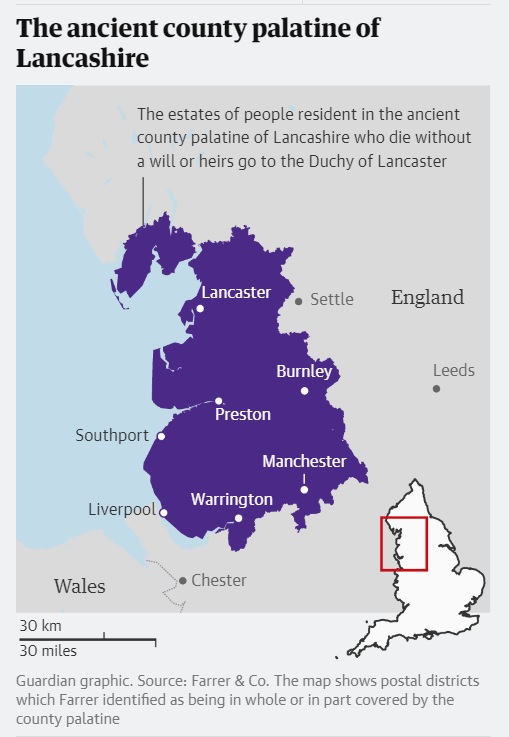 Bona vacantia are unowned assets–primarily the assets of people who die without a will and without heirs. In Britain, as in the United States, unowned assets generally pass to the government but Britain is full of ancient and strange traditions and one of them is that the estates of people resident in the “ancient county palatine of Lancashire” who die without a will or heirs go to the Duchy of Lancaster.
The Duchy of Lancaster is “a portfolio of lands, properties, and assets held in trust for the sovereign.” The Duchy dates back to 1265 but in 1461 Edward IV made it a distinct and private inheritance of the reigning monarch. As such the reigning monarch is not allowed to sell the Duchy but is due any returns. To be clear, this is all different from the Crown Estate which are a bunch of land and property nominally owned by the monarch and dedicated to funding the monarchy but yet not owned by the monarch privately. Having fun yet?
Periodically someone discovers the duchies and kicks up a fuss and there is a debate about making the revenues public and giving the monarch a stipend instead. The latest fuss was kicked up by the Guardian with an article that describes the whole thing in accurate but lurid terms:
The king is profiting from the deaths of thousands of people in the north-west of England whose assets are secretly being used to upgrade a commercial property empire managed by his hereditary estate, the Guardian can reveal.
Great stuff! It could only have been improved by adding “the king and his son” are profiting from the deaths of thousands of people because there is another Duchy in Cornwall which is owned by the eldest son of the reigning monarch, in this case Prince William, where the same rules apply. Prince William also has the rights to all the royal fish caught off the shores of the Duchy—namely to whales, porpoises, and sturgeon (obviously).
Despite having once read a book on the subject, I am obviously not an expert in the intricacies of British inheritance law. Who is? But I found the back story very amusing.