Why is the minor key rising in popularity?
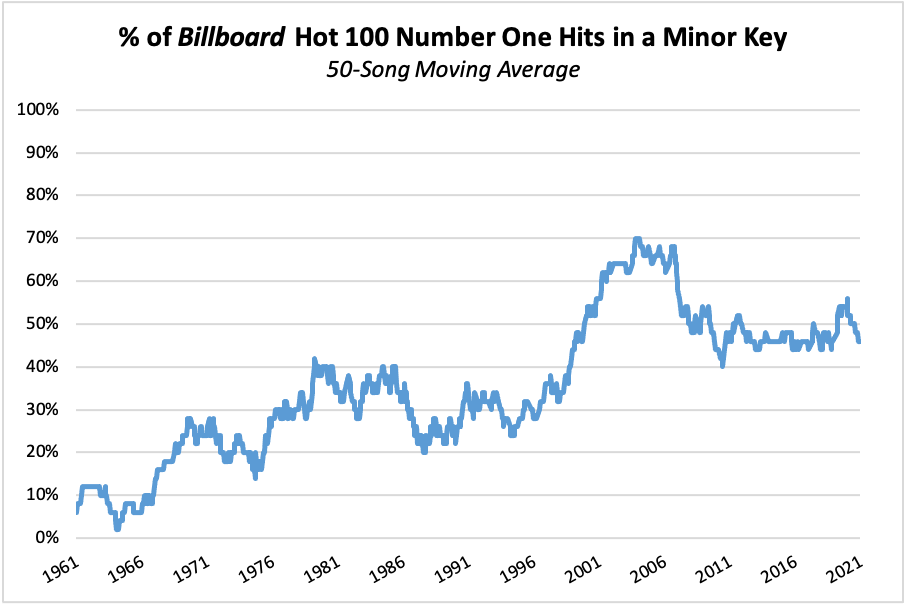
Another telltale sign of sad songs is the minor key. This rise in minor key songs has been dramatic. Around 85% of songs were in a major key back in the 1960s, but in more recent years this has fallen in half.
My favorite guru of music data analytics, Chris Dalla Riva, has sent me this chart showing the increasing share of Billboard #1 hits in a minor key. (By the way, I highly recommend Chris’s Substack Can’t Get Much Higher.)
Here is more from Ted Gioia.
The Bat the Ball and the Hopeless
You will no doubt be familiar with the bat and ball problem;
- A bat and a ball cost $1.10 in total.
- The bat costs $1.00 more than the ball.
- How much does the ball cost? ____ cents.
In a paper in Cognition, Meyer and Fredrick test multiple versions of the bat and ball and related problems to try to uncover where people’s intuitions go wrong. The most remarkable two versions of which are shown below:
- A bat and a ball cost $110 in total.
- The bat costs $100 more than the ball.
- How much does the ball cost?
- Before responding, consider whether the answer could be $5.
- $_____
———–
- A bat and a ball cost $110 in total.
- The bat costs $100 more than the ball.
- How much does the ball cost?
- The answer is $5.
- Please enter the number 5 in the blank below.
- $_____
Remarkably, even when told to consider $5, most people continue to answer $10. Even more shockingly, most people get the answer right when they are explicitly told the answer and instructed to enter it, yet 23% still get the answer wrong! Wow.
The authors conclude:
…this “hinted” procedure serves to partition respondents into three groups: the reflective (who reject the common intuitive error and solve the problem on the first try), the careless (who answer 10, but revise to 5 when told they are wrong), and the hopeless (who are unable or unwilling to compute the correct response, even after being told that 10 is incorrect)
…many respondents maintain the erroneous response in the face of facts that plainly falsify it, even after their attention has been directed to those facts….the remarkable durability of that error paints a more pessimistic picture of human reasoning than we were initially inclined to accept; those whose thoughts most require additional deliberation benefit little from whatever additional deliberation can be induced.
As an economist, I would have liked to see an incentivized version (maybe some people are pulling the authors legs) but I don’t actually think that explains the results. Quite a few people are indeed hopeless.
Korea Japan (China) fact of the day
…the most significant destruction on the Korean Peninsula was wrought by the Japanese invasions of the late sixteenth century. Nearly two million Koreans, a staggering 20 percent of the population, perished during the Imjin Wars, Toyotomi Hideyoshi’s campaigns of 1592-1598 to subjugate the Korean Peninsula. Hideyoshi’s object was the conquest of Ming China (1368-1644) but the result was to turn Korea into a ruined land.
That is from the new and interesting The Other Great Game: The Opening of Korea and the Birth of Modern East Asia, by Sheila Miyoshi Jager.
The Value of Communication for Mental Health
Mental health disorders account for a significant share of the overall global disease burden. The economic losses from such disorders are staggeringly large, particularly in low-income countries, where people are faced with several unexpected shocks. We test whether improved communication can mitigate such mental health disorders. Partnering with a major telecommunications company, we implement low-cost communication interventions that provide mobile calling credits to a nationally representative set of low-income adults in Ghana during the COVID-19 pandemic. Individuals’ inability to make unexpected calls, need to borrow SOS airtime, and to seek digital loans decreased significantly relative to a control group. As a result, the programs led to a significant decrease in mental distress (-9.8%), the likelihood of severe mental distress by -2.3 percentage points (a quarter of the mean prevalence), and domestic violence, with null impact on consumption expenditure. The effects are stronger for monthly mobile credits than a lump-sum. We present evidence that improvements in both business-related services and social inclusion and/or protection are relevant explanations. Simple cost-benefit analysis shows that providing communication credit to low-income adults is a cost-effective policy for improving mental health. Communication – the ability to stay connected – meaningfully improves mental well-being and interventions about communication are particularly valuable when implemented as many installments.
Here is the full NBER working paper, I am happy to see economists tackling the all-important set of mental health problems.
Russia-Africa facts of the day
Since invading Ukraine, Russia has sought to increase the region’s share of its total global trade above the current 3.7%, with specific attention to increasing African primary commodity exports to Russia. However, African exports to Russia still make up a tiny 0.4% of the region’s total exports. In addition, Russian foreign direct investments in Africa amount to about 1% of the total flow. These numbers are not what one would expect from an alleged geopolitical heavyweight that is supposedly about to remake the region’s alliance terrain.
While Moscow is a leading arms supplier to a number of African states — a fact that is often cited a multiplier of its influence in the region — the actual numbers are inarguably underwhelming. Earlier this year SIPRI, a Swedish tracker of conflicts and trade in arms, noted that Russia had increased its share of weapons supply to Africa to 26% of the regional market share. The report was greeted with the usual willfully ignorant shock and alarm. Yet the figure quickly loses its punch once one realizes that it represents less than $115m in flows to a region of 54 sovereign states. Arms sales in Africa simply aren’t what they used to be (see below).
Here is more from Ken Opalo.
Sunday assorted links
1. Beauty induces higher stock market participation and thus higher returns.
2. “Afuera!”
3. Sri Lankan food is becoming more popular.
4. Those old service sector jobs. Circa 1933, with Einstein.
5. The new Katherine Rundell book (UK only) is receiving rave reviews (Times of London).
6. New Knausgaard novel is coming.
7. Markets in everything, security breach division, dept. of uh-oh.
Did Katrina boost freedom, wreck state capacity, or both?
We find that Hurricane Katrina had lasting impacts on Louisiana’s formal institutions. In the post-Katrina period, we find that actual Louisiana had persistently higher economic freedom scores for both GE [government employment] and PT [property tax] than the synthetic Louisiana that did not experience the hurricane. These findings imply that the hurricane led to a reduction in both PTs and GE, which indicates a decrease in the relative size of the public sector as a share of the state’s economy.
That is from a new paper by Veeshan Rayamajhee, Raymond J. March, and Corbin C.T. Clark, via the excellent Kevin Lewis.
A matching framework with neither evidence nor theory on its side
Imagine if the relevant “change variable,” in macro terms, was the ease and quality of matching.
In some mini-eras, matching does not work very well. The labor market is slow, real interest rates are low, and capital is very cheap. It is thus relatively easy for super-talented people — who often become quite wealthy — to commandeer resources for their grand projects. They can raise the money and they can raise the labor. We elevate the powers of those individuals.
The software infrastructure is built out, and solar power gets put on its way for a grander future. The progress foundations for the next generation or two are laid. At the same time, everyone complains that returns to savings are low, wages are sluggish, labor force participation is low, and so on.
In other mini-eras, matching works very well. The labor market is tight, and capital is hard to raise. So many of these resources already are allocated to where they ought to be, and not much is sitting around “slack.” Due to resource tightness and higher real interest rates, many projects end up abandoned. Yet the demand for labor is high and real wages are rising. Income inequality falls.
Sometimes these periods feel “especially boom-y,” because the concrete innovative fruits of the “poor matching era” finally are coming available. But truly new grand projects have a much harder time of it.
Perhaps one should behave and invest very differently, depending which kind of era it is? And are talent-spotting skills worth more in the poor matching era than in the well-matched era? Are there some sectors that always have a lot of slack resources? Music, intellectuals, the visual arts, NBA basketball, others? And in those cases talent-spotting skills remain valuable across the eras?
Yet none of this is true! The ease and quality of matching is not a relevant macroeconomic “hinge variable.”
p.s. Is it better that sometimes we have these periods of slack, so that the builders may do their thing!?
Attitudes toward capitalism (Poland fact of the day)
The author commissioned a survey on the image of capitalism in 34 countries. In only six of these countries – led by Poland and the United States – do pro-capitalist attitudes dominate. Although approval of capitalism increases when the word ‘capitalism’ is omitted (and instead only described), even then a positive attitude dominates in only seven of 34 countries. The most frequently mentioned criticisms of capitalism are that capitalism is dominated by the rich and that capitalism leads to growing inequality. Respondents with higher incomes and higher levels of education, men, and those who classified themselves as being on the right of the political spectrum are less anti-capitalist or are more pro-capitalist than the population at large in most countries. In 33 countries, anti-capitalists tend to be more conspiracy-minded than pro-capitalists.
That is from a new paper by Rainer Zitelman. And here is Rainer’s recent book In Defense Of Capitalism: Debunking the Myths.
Saturday assorted links
1. Interesting Toby Ord paper on the Lindy Effect.
2. Interview with Andras Schiff. Does he count as a grump?
3. Why didn’t we get a malaria vaccine sooner? Very good piece.
4. Graduate student GRE scores, by field.
5. Further detail on the recent climate change/research/publication bias/skewed results brouhaha. Useful addenda, the real story is somewhat more complicated than it has been presented?
Ames, Iowa, underrated mecca of science
Ames is only the 9th largest city in Iowa, and yet:
1. The city (and university) has supported three Nobel Laureates in economics, namely Schultz, Hurwicz, and Stigler.
2. The plutonium for the first atomic bomb was synthesized there.
3. The first electronic digital computer was built there.
4. George Washington Carver worked and taught there.
5. Neal Stephenson is from there.
6. Russ Roberts spent 1957 there.
7. The library of Iowa State University has some large (and very good) pro-science murals by American regionalist painter Grant Wood.
Hail Ames, Iowa!
How Mexico built a state (that was then, this is now)
Mexico in the nineteenth century presents a dramatic example of this problem. Mexico suffered extreme political instability and strife in the nineteenth century. There were 800 revolts between 1821 and 1875. Between independence in 1821 and 1900, Mexico had 72 different chief executives, meaning that the average term was only a little more than one year long. Likewise, the country had 112 finance ministers between 1830 and 1863. In addition there were several invasions and secessionist movements.
The country also experimented with several different forms of government, including two empires (one headed by a French-backed, Austrian-born member of the Habsburg dynasty), one disputed period where there were presidents from both main parties, four republics, one provisional republic, and a long dictatorship. President Guadalupe Victoria was the first constitutionally elected president of the country, and the only one who would complete a full term in the first 30 years of independence.
Some other examples: There were four Mexican presidents in the years 1829, 1839, 1846, 1847, and 1853, while there were five in 1844 and 1855 and eight in 1833. Antonio López de Santa Anna, who was President of Mexico on ten separate occasions, was president four different times in a single year.
Mexico faced constant challenges to its sovereignty in the first 50 years of independence, from the secessions of Texas and Central America, to the secession attempts of the Yucatán, as well as numerous smaller rebellions.
Here is more from the excellent Robin Grier, from Works in Progress. There are further points of interest in the piece.
Tokyo hotel bleg
Part of the time we will be in Roppongi, which is another good/different complementary part of town to stay in? And do you have particular hotel recommendations? This will be my fourth Tokyo trip, if that gives you further context.
Friday assorted links
1. Jon Elster on Marx and Freud.
2. Are right-wing boycotts working?
3. UFO information is not classified in Brazil.
4. Alex Ross on Franz Liszt (New Yorker).
5. New issue of Works in Progress, haven’t read it yet, looks great.
6. Rachel Kleinfeld on political polarization. One implication is that if you are making the other side feel more threatened, you are part of the problem.
The Real Secret of Blue Zones
Netflix has a new documentary on Blue Zones, regions in the world such as Okinawa Prefecture, Japan; Nuoro Province, Sardinia, Italy; the Nicoya Peninsula, Costa Rica; Icaria, Greece; and Loma Linda, California, where people appear to live “extraordinarily long and vibrant lives.” What are the secrets of such blue zones and how can you live to be 100?
These blue zones first started to be discussed in the 2000s which means that people aged 100 or older were born sometime around 1900. What do we know about that period of history? It was before vital records were uniformly established. And what happens when state-wide certification goes into effect? Saul Justin Newman shows that the number of supercentarians [100+] drops sharply a hundred or so years later!
…the introduction of state-wide birth certification coincides with a sharp reduction in the number of supercentenarians born in each state. In total, 82% of the GRG supercentenarian records from the USA predate state-wide birth certification. Forty-two states achieved complete birth certificate coverage during the survey period. When these states transition to state-wide birth registration, the number of supercentenarians falls by 80% per year overall and 69% per capita when adjusted relative to c.1900 state population sizes.
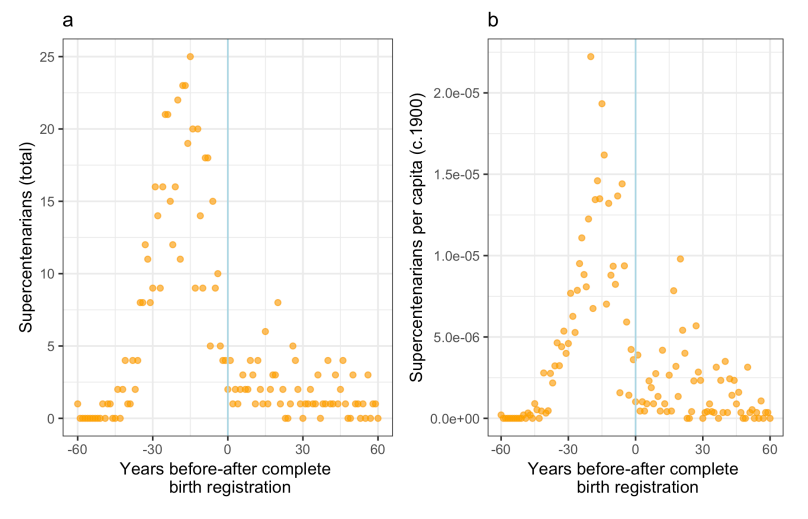
The author goes on to show that in many countries the number of of extremely old people is positively correlated with poverty, shorter average life spans and illiteracy. All factors which are difficult to explain if we think these factors are causally related to health but which make sense if we think that the explanation is unreliable birth and death records. Supercentenarian birthdates also exhibit patterns such as age-heaping that are “strongly indicative of manufactured birth data.”
In addition, cross-country comparisons don’t make much sense if we focus on health:
In 1900 the UK had eight million more inhabitants than Italy, a 1.22-fold larger population. Citizens of the UK also enjoyed 2.5 times the GDP per capita, earned 3.5 times higher wages in real terms, had 1.25 times lower income inequality, received 2.2 times the average education (with just 5.3 years of schooling), were four times less likely to be murdered, were 3.8cm taller, and lived 5.3 years longer on average than people in Italy. Given these indicators and the long history of birth records in both countries, it is difficult to reconcile why the healthier, wealthier, better-educated, taller, and longer-lived population of the UK produced roughly a quarter as many SSCs per capita. One explanation is that remarkable age records result, not from better health or greater longevity, but from the historical accumulation of illiteracy-driven errors and the modern dynamics of poverty-driven fraud.
Thus, in Blue Zones, people aren’t necessarily living longer lives; they’re just experiencing a ‘senior moment’ with their date of birth.
Hat tip: The always skeptical, Paul Kedrosky.