Should child influencers have stronger rights to the income they generate?
That is the topic of my latest Bloomberg column. You can think of this as a government regulation issue, but alternatively you could frame it as the government enforcing individual property rights that currently are absent. Here is one excerpt:
More and more children, by which I mean minors below legal working age, are producing content as online influencers. A lot of Instagram or YouTube or TikTok accounts feature such children, and they can be cute, endearing or (depending on your mood) annoying — as well as profitable. By one estimate, the most successful children working in this area — called “kidfluencers” — can generate more than $20 million a year in revenue…
Legally, these children have no claim to the income their sites generate. Thankfully, many parents are loving and generous. But not all. There is no data on how social media earnings are distributed within the family, but the long history of child movie and TV stars indicates that many receive little or nothing.
But change is afoot, and this is mostly a good thing:
Enter the state of Illinois, where a recently passed law gives successful child social media stars a right to some percentage of the earnings they generate, to be held in a trust in their name until they turn 18. Such legislation has precedent. In the early days of Hollywood, California passed the Coogan Law, which gives child actors a right to a certain percentage of earnings, which employers have to place in trust accounts. New York has passed similar legislation.
The social media case is tougher to enforce, because often the parents themselves are the de facto employer and there is no contract specifying terms. And how is the relative contribution of the child to the family income to be assessed? (Time spent onscreen? Cuteness? What if the social media presence leads to a book contract or podcast?) Nonetheless, the law sends a clear signal that the children do have some rights to the generated income, and grown children can sue their parents if the money is not passed along.
Note however that: “It is neither practical nor desirable for the state to insert itself into family decision-making on a regular basis.” So we should expect only limited gains from such legislation. Furthermore, unlike with child stars in the movies and on TV, there is no real paper trail of contracts and transactions. On the upside, those superior property rights for “kidfluencer” income might get some kids to want to work more, rather than less.
Not everyone will like that outcome of course.
I thank Anecdotal, and also A., for pointers on this issue.
Model this, NBA rebounding edition
There has staggeringly been only one U.S. representative among the league’s top 10 rebounders for each of the past three seasons.
That is from Marc Stein. How did that happen? Where is the current-day Charles Oakley? Moses Malone, our nation turns it lonely eyes to you! Dennis Rodman would do as well. Yet here is the list of the top rebounders from last year in the NBA, and yes Rudy Gobert is French.
Of course, you all know that in the key FIBA games the U.S. squad was badly rebounded by a number of nations, including the tiny Lithuania (their population is tiny, not their size per person). And Bam Adebayo was tired from the Finals and was not available.
Why has the balance of rebounding power turned so seriously against U.S. basketball players? Is it that all the tall ones are nowadays being hired by Goldman Sachs or Open AI? Somehow that doesn’t seem right to me.
One hypothesis is that today the game demands a broader set of skills, and more teamwork, than in earlier times. Charles Oakley still would make the NBA today, but perhaps as an 11th man, rather than as a regular player who could hone his skills and become a leading figure. In other words, the return to training big men has (maybe) gone up a lot. Simply being big and strong yields a smaller return than before, because on offense they are counting on you to hit that open three-point shot. On defense, they are counting on you to rotate on perimeter defense in a manner that Oakley did not have to worry about so much. And so on.
And maybe the European and other teams do a better job training their big men at younger ages. The European big guys do in fact have excellent long-distance shooting and often higher quality passing skills. The U.S. players (mostly) leaving college after their first year does not help with this.
And thus, in that equilibrium, the better shooting makes the teams as a whole, better rebounders as well. That is a modestly counterintuitive conclusion.
Or is there some other, better model for why U.S. rebounding prowess has declined in recent years?
Wednesday assorted links
1. “Today, we launched the John Stuart Mill Fellowship, a one-year program that allows entrepreneurs to study the philosophical underpinnings of major ideas related to markets, politics, and society.” Mercatus.
2. “Curiously, the wild boars remained radioactive.”
3. The lost lifting stones of Ireland.
4. Are we living through a new scientific revolution, with side observations on Robert Boyle?
5. Use AI to live translate and synch your lips. App here. And claims about AI girlfriends.
7. Blog prize for how to get Britain moving again.
8. “The ball will always find you.” (NYT, Ross D.)
What I think
From an email I sent to a well-known public intellectual:
I think the chance that the bodies turn out to be real aliens is quite low.
But the footage seems pretty convincing, a way for other people to see what…sources have been telling me for years. [Everyone needs to stop complaining that there are no photos!]
And to think it is a) the Chinese, b) USG secret project, or…whatever…*in Mexico* strains the imagination.
It is interesting of course how the media is not so keen to report on this. They don’t have to talk about the aliens, they could just run a story “The Mexican government has gone insane.” But they won’t do that, and so you should update your mental model of the media a bit in the “they are actually pretty conservative, in the literal sense of that term, and quite readily can act like a deer frozen in the headlights, though at some point they may lurch forward with something ill-conceived.”
Many of you readers are from Christian societies, or you are Christian. But please do not focus on the bodies! I know you are from your early upbringing “trained” to do so, even if you are a non-believer. Wait until that evidence is truly verified (and I suspect it will not be). Focus on the video footage.
In any case, the Mexican revelations [sic] mean this issue is not going away, and perhaps this will force the hand of the USG to say more than they otherwise would have.
They Got the Lead Out of Turmeric!
Last year in Get the Lead Out of Turmeric! I reported that adulteration of turmeric was a major source of lead exposure among residents of rural Bangladesh. Well there is good news: the lead is gone!  Wudan Yan at UnDark reports the remarkable story of academic research quickly being translated into political action that improves lives.
The story begins (more or less) with PhD student Jenna Forsyth:
Jenna Forsyth knew nothing about the practice of adding lead chromate to turmeric in 2014, when she started her Ph.D. in environment and resources at Stanford University. Excited to continue her masters research on water and sanitation, she sought out working with Stephen Luby, a world expert on the subject. When she arrived, Luby instead pointed Forsyth to a conundrum he was encountering in his work in Bangladesh: In a rural part of the country, pregnant women and children had high levels of lead in their blood. There were none of the usual suspects of lead exposure. There were no nearby battery recycling plants and families didn’t paint their homes. How could this be?
After eliminating dozens of explanations, Forsyth eventually hit on turmeric contamination. But Forsyth and the team didn’t just analyze turmeric in the lab, they hit the ground in Bangladesh:
They visited mills, and sometimes found sacks of the pigment on-site. They sampled dust from the polishing machine and from the floors of the mill. If there was about one part of lead to chromium, it was a dead giveaway that the adulterant was being used. From interviews, they also understood the motive: Brighter roots led to more profit, and adulterating with a consistently bright paint agent could disguise poorer-quality roots. The findings from this study were published in 2019.
Then they took their results to the Bangladesh Food Safety Authority:
The team held a meeting with the Bangladesh Food Safety Authority. The agency’s chairman at the time, Syeda Sarwar Jahan, was immediately concerned. She decided to spearhead a massive public information campaign.
…Local and international news outlets disseminated the findings from Forsyth’s new studies to create public awareness. The researchers met with businesses to make them aware of the risks of lead in turmeric. BFSA posted notices in the nation’s largest wholesale spice market, Shyambazar. The flyers warned people of the dangers of lead and that anyone caught selling turmeric adulterated with lead would be subject to legal action.
Authorities also raided Shyambazar using a machine called an X-ray fluorescence analyzer which can quickly detect lead in spices. Nearly 2,000 pounds of turmeric was seized in the raid and two wholesalers were fined 800,000 taka, more than $9,000 USD.
…In late 2019, as part of the intervention against lead chromate use in turmeric, the Bangladesh Food Safety Authority printed and distributed an estimated 50,000 copies of green flyers, that they shared with traders and plastered around the market. Be skeptical of fingers that appear too bright and yellow, it advised, and if the yellow dusting from turmeric doesn’t come off easily, it’s likely you’ve been played.
Getting rid of the lead isn’t just a cosmetic change. Lead can be so bad, especially for children, that removing it from spices improves lives at very low cost. Kate Porterfield writing at the EA Forum reports:
Despite being a preliminary assessment, this cost-effectiveness analysis (CEA) of this intervention in Bangladesh presents an exceptionally encouraging outlook, with a cost per DALY-equivalent averted estimated at just under US$1. It is crucial not to overlook the profound significance of this outcome: US$1 represents a small investment for the equivalent of an additional year of life in optimal health.
Early results from Pure Earth’s Rapid Market Assessment project find that between 6 and 12 countries may have similar problems with contaminated spices. Large parts of northern India (also highly populated) are similarly affected. Other lead salts are also highly colored, in reds and oranges, and found in other products. Programs to halt intentional contamination of spices and other foodstuffs are enormously impactful, and ought to be a first response in the fight against lead poisoning globally.
Finally, other significant sources of lead exposure (including leaded pottery and aluminum cookware, paint, medicines etc) require a similar regulatory response, and are likely to show cost benefit ratios that are also very strong.
Bangladesh has done it. It is time for Northern India to also eliminate lead from spices.
Big congratulations to Forsyth and the other Stanford researchers who documented the problem and who cared enough to follow up with a plan to work with charities and governments in Bangladesh to solve the problem. Big congratulations also to Givewell who supported the project.
U.S.A. fact of the day
After the Supreme Court struck down Roe v. Wade last year, it looked like the number of abortions would soon plummet across the country. But new estimates suggest that has not happened. The number of legal abortions has held steady, if not increased, nationwide since 2020, our colleagues Amy Schoenfeld Walker and Allison McCann reported today.
How is that possible? New data from the Guttmacher Institute, a nonprofit specializing in reproductive health, implies that more people are traveling across state lines or using telemedicine to get abortions, including through the use of abortion pills. The increase in use of those options has offset the decrease in abortions resulting from new state bans, Amy and Allison found.
Here is more from The New York Times.
Do not underrate the elasticity of supply
When I first read about the discovery of a vast new deposit of lithium in a volcanic crater along the Nevada-Oregon border, I can’t say that I was surprised. Not because I know anything about geology — but because, as an economist, I am a strong believer in the concept of elasticity of supply…
Now about elasticity of supply, in which we economists tend to have more faith than do most people. Time and again over the centuries, economists have observed that resource shortages are often remedied by discovery, innovation and conservation — all induced by market prices. To put it simply: If a resource is scarce, and there is upward pressure on its price, new supplies will usually be found.
Not surprisingly, the Lithium Americas Corporation put in a lot of the work behind the discovery. Searching for new lithium deposits has been on the rise worldwide, as large parts of the world remain understudied and, for the purposes of lithium, undersampled. Just as Adam Smith’s invisible hand metaphor would lead one to expect, that set off many new lithium-hunting investigations.
Sometimes the new supplies will be for lithium substitutes rather than for lithium itself. In the case of batteries, relevant potential substitutes include aqueous magnesium batteries, solid-state batteries, sodium-based batteries, sodium antimony telluride intermetallic anodes, sodium-sulfur batteries, seawater batteries, graphene batteries, and manganese hydrogen batteries. I’m not passing judgment on any of these particular approaches — I am just noting that there are many possible margins for innovation to succeed.
Here is the rest of my Bloomberg column.
Ho hum model this
The Mexican government releases some of its footage. And more. Here is 4.5 hours, I have not watched it. Here is lots of Twitter commentary. And one snatch of detail on the corpse.
Is this just the Virgen of Guadalupe all over again? But with photos and sensor readings? Por favor, explica’ me a mi!
Tuesday assorted links
The shaming of one-parent families
Matt Yglesias writes:
…(continue to be confused by the widespread claim that the elites won’t tell you about this idea)
Matt is referring to the two-parent family and the notion that elites will (after some point) lead fairly culturally conservative lives, but preach a more outgoing, tolerant, liberal morality at the social level, a morality which “the lower classes” perhaps cannot handle. But do the elites in fact do that? Do the elites fail to tell the “lower classes” about the virtues of their (eventual) culturally conservative lifestyles?
I view the issue in terms of shame. In an earlier America, and indeed in many other societies in world history, there has been a certain amount of shame surrounding single parent families. I don’t view the Left as very willing to shame along this dimension. It does not fit their basic worldview, and furthermore single-parent women are such loyal Democratic voters it would be electorally counterproductive. So the net influence of the Left is to limit the amount of shame surrounding single-parent families.
Now to be fair, I think the Right wing shames on this issue much less than it used to. Some of that may be the Trump thing, some may be the rise of the “post-religious Right,” and some may be a simple recognition that such shaming has become counterproductive. It does not have a critical mass of social support behind it, not any more. But some significant segment of the Right wishes we once again could have a world where such shaming had real effect.
This point is perhaps easiest to see with suicide. Does the Left “refuse to tell people that suicide is bad”? Of course not. But does the Left shame those who commit suicide? If they do, I never see that on Twitter. Instead I see lots of sympathy and sorrow. But in traditional Christianity suicide is seen as a sin. Is that latter approach better? I don’t know! But I see people choosing their stances on this issue using mood affiliation, rather than obsessing over the data. I would in fact like to know whether shaming suicide (or how about bringing the shame upon the entire family?) limits the number of suicides.
The “elite Democrats” of course will shame on a large number of other issues, just not on those ones.
If you ever want to know what is going on with a particular issue, start by looking at who is willing to shame what, or not.
China fact of the day
China is set to become the world’s biggest car exporter this year, overtaking Japan. The watershed moment will mark the end of decades of dominance by European, American, Japanese and South Korean groups.
Here is more from the FT. Note that as recently as three years ago, China for car exports was not in the top fifteen.
How Credible is the Credibility Revolution?
When economists analyze a well-conducted RCT or natural experiment and find a statistically significant effect, they conclude the null of no effect is unlikely to be true. But how frequently is this conclusion warranted? The answer depends on the proportion of tested nulls that are true and the power of the tests. I model the distribution of t-statistics in leading economics journals. Using my preferred model, 65% of narrowly rejected null hypotheses and 41% of all rejected null hypotheses with |t|<10 are likely to be false rejections. For the null to have only a .05 probability of being true requires a t of 5.48.
That is from a new NBER working paper by Kevin Lang.
U.S. immigration policy is slightly better than you think
Keep in mind that Canadian immigration policy also is U.S. immigration policy. Currently Canada is taking in about 400,000 people a year, with plans to raise that to 500,000. At the same time, the U.S. is doing little to boost high-skilled immigration. But Canada is serving as a kind of farm system for the U.S. The very best Canadian arrivals — or their children — have the best chance of getting into the United States, if only through O-1 visas.
So if the quantity of Canadian immigration is going up, the quality of U.S. immigration is going up too, through Canada in this case. Call it cherry-picking if you like.
Not surprisingly, neither side in the immigration debate wants to scream this loudly from the rooftops. The pro-immigration side wants to present the status quo as dire. The immigration-skeptical side does not want to stress that there are perfectly good ways of screening for immigrant quality, some of which already are in place.
Monday assorted links
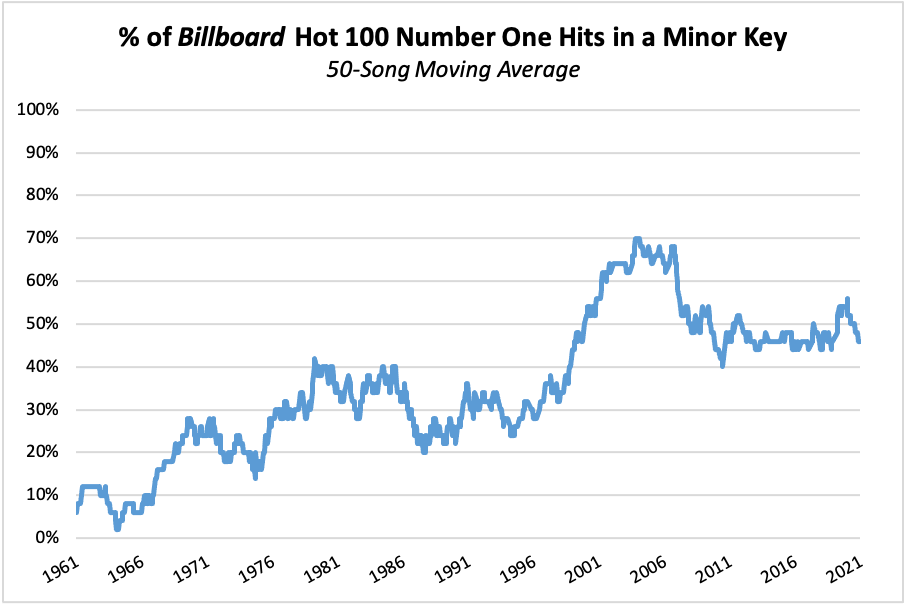
Why is the minor key rising in popularity?
Another telltale sign of sad songs is the minor key. This rise in minor key songs has been dramatic. Around 85% of songs were in a major key back in the 1960s, but in more recent years this has fallen in half.
My favorite guru of music data analytics, Chris Dalla Riva, has sent me this chart showing the increasing share of Billboard #1 hits in a minor key. (By the way, I highly recommend Chris’s Substack Can’t Get Much Higher.)
Here is more from Ted Gioia.