The Age of Unpredictability
It is much harder to predict foreign policy outcomes, especially in times of turmoil when there is no “nothing happens” default path, than it is to predict the results of economic policies. There is no coherent model, no causal identification in the data, and the data are not very good or well-partitioned to begin with.
Currently it is very hard to predict an endgame for the Russia-Ukraine war. It is also very hard to predict the longer-run consequences of a Putin escalation, including but not restricted to the use of tactical nuclear weapons.
It is very hard to predict the outcome of China-Taiwan, and possible American responses, and this will hang over our heads for some while even if an invasion comes very soon.
With the recent Biden chip sanctions, I don’t think it is ridiculous to assert that the United States is very close to being informally at war with the two other most destructive nations in the world.
Iran-Israel is a neglected wild card in all of this. In many scenarios a superpower war spreads to parts of the Middle East.
You don’t have to fear “Skynet goes live” to recognize that the total net effects of forthcoming AI will be very hard to predict.
Whatever you think of UAPs, the reports are not going away and the observers are not being discredited. The sensor readings are not “mere flocks of geese.” The most likely non-alien drone probe scenario is a U.S. military innovation, but that too would be big news and a major increase in global uncertainty. Imagine the shock when the U.S. first deployed the atomic bomb.
By the way, it seems we are getting pretty effective vaccines for Covid, malaria, dengue, and some forms of cancer? That too was hard to predict until recently.
So we are entering a new time, The Age of Unpredictability. I am not sure what it means to be “ready” for this. But again, cheap hobbies are always underrated.
Emergent Ventures Africa and African diaspora, first cohort
Saron Berhane, Australian-Ethiopian living in Ghana, for research in synthetic biology (bio-leather produced using microbes). Previously she was the co-founder of an agriculture technology startup that specializes in real-time airborne disease detection.
Emmanuel Nnadi, Nigerian microbiologist and lecturer at Plateau State University in Bokkos, for research on phage therapies and the development of a phage bank in Nigeria.
Dithapelo Medupe, Botswana medical doctor and Anthropology PhD candidate at UPenn, to support her research on statistical approaches to multilinear evolution in African development and for general career development.
Mercy Muwanguzi, Ugandan high school senior, to support her research on robotics design and development for medical purposes in Kampala. She was jointly awarded the President’s Innovation Award for Science and Innovation.
Nseabasi Akpan, a professional photographer from Ibadan, for promoting photography education to young people in Nigeria.
Colin Clarke, an Astrophysics undergrad in Ireland, for travel to Nairobi to assist in providing astronomy education to rural schools in Kenya with a non-profit called the Travelling Telescope.
Geraud Neema, Congolese policy analyst living in Mauritius, for in-depth research on the domestic policy impact of Africans educated in China and for general career development.
I thank Rasheed Griffith for leading the selection process behind our new branch of Emergent Ventures Africa and African diaspora.
Saturday assorted links
Moon in June is these days a poltroon
Since the early 1990s, pop song lyrics have become significantly more negative (ht @mattyglesias)https://t.co/tcmOeEWBll
"We conclude that the proliferation of negative song lyrics may be explained partly by content bias … negative lyrics do better in the charts" pic.twitter.com/FTt7ZAIKQp
— Derek Thompson (@DKThomp) October 22, 2022
China, Coppola
Democracy and the Democrats
It is not sufficiently remarked upon that many Democrats have an increasingly difficult time believing in democracy (you can level criticisms at Republicans here too, but those already get far more play, and please anyone who invokes the concept of equivalence here is just a mood-affiliating, internet knee-jerk dummy). To put it bluntly, many Democrats have arrived at the position that democracy works satisfactorily only when it delivers sufficiently low gas prices!
See my previous post, and also the new column by Krugman.”Will Gas Prices Doom Democracy?”. All rhetorical contortions notwithstanding, I don’t see how many current Democrats avoid an implicit or maybe even explicit super-charged skepticism about, yes, democracy.
And it is increasingly hard to blame either “Big Tech” (largely run by Democrats), or campaign finance reform, which now on net is the friend of the Democrats, not the Republicans, at least at the national level.
Matters are easier for the classical liberal. Classical liberals are used to the idea of very bad politicians being elected. If some of those politicians become worse yet, that is highly unfortunate but it does not shake the underlying worldview to its core. Classical liberals also view government as pretty inefficient, often craven, inconsistent, and in many key matters unmanageable. That isn’t always so great! But it does provide some layers of protection against the very worst actors and their possible intentions.
I believe that in October 2022 the classical liberal case for democracy rests on firmer foundations than does the Democratic case for democracy.
Is it worthwhile to teach self-regulation?
Children’s self-regulation abilities are key predictors of educational success and other life outcomes such as income and health. However, self-regulation is not a school subject, and knowledge about how to generate lasting improvements in self-regulation and academic achievements with easily scalable, low-cost interventions is still limited. Here we report the results of a randomized controlled field study that integrates a short self-regulation teaching unit based on the concept of mental contrasting with implementation intentions into the school curriculum of first graders. We demonstrate that the treatment increases children’s skills in terms of impulse control and self-regulation while also generating lasting improvements in academic skills such as reading and monitoring careless mistakes. Moreover, it has a substantial effect on children’s long-term school career by increasing the likelihood of enrolling in an advanced secondary school track three years later. Thus, self-regulation teaching can be integrated into the regular school curriculum at low cost, is easily scalable, and can substantially improve important abilities and children’s educational career path.
That is from a new Nature Human Behavior paper by Daniel Schunk, Eva M. Berger, Henning Hermes, Kirsten Winkel, and Ernst Fehr. There should be more good papers on this topic…
On the five-year breakeven rate (from the comments)
Friday assorted links
1. Why did wind power take so long?, part III.
2. The importance of permitting reform for the environment.
4. Redux of my 2016 post on what is neo-reaction.
5. There has been catch-up at the bottom end of the U.S. wage distribution.
6. Negativity bias in the media is increasing over time, most of all it is pronounced for the Right.
7. Elad on how well will the new AI companies capture value.
OTC Prescriptions Save on Medical Costs
The excellent Joel Selanikio writes on medical disruption from the rise of self-care:
I’ve been asked many times whether I think that AI will replace doctors. Never once have I been asked if I thought that OTC drugs could replace doctors. But that’s exactly what they have done: every time a drug switches from prescription to OTC, the total number of doctor visits drops.
In fact, a 2012 study by Booz concluded that
“if OTC medicines did not exist, an additional 56,000 medical practitioners would need to work full-time to accommodate the increase in office visits by consumers seeking prescriptions for self-treatable conditions.”
Fifty-six thousand doctors that we don’t need because of OTC drugs; that’s almost 6% of the practicing doctors in America. Think of the effect on healthcare costs.
Selanikio gives more examples of how AI plus super-computers, i.e. cell phones, can lead to better, at-home diagnosis and fewer physician hours (and more here). More generally, due to the Baumol effect the only way to save on medical care costs is by using less labor and more capital–this is rarely recognized.
What should Latin America learn from India?
That is another MR reader request. Here are a few possible answers:
1. You could word this question the other way around, noting that Bolivia — one of the poorer Latin American economies — is richer than India per capita.
2. At least partial integration with the Anglo world — and through the English language rather than the drug trade — is worth a great deal.
3. Learn more good English. It can become a meaningfully useful second or third language for your country, you need only to will it so.
4. Encourage your smartest young kids to be obsessed with the internet.
5. Create top institutions of elite education in your country. Most (all?) of Latin America has nothing comparable to the Indian IIT system.
6. In India it used to be super-high status for your kid to attend Oxford and Cambridge, now American universities have stepped into these spots as well. I don’t see a similar phenomenon in Latin America, not on a widespread basis.
7. Single parent families can be disastrous. In Colombia the current rate of that is 84 (!) percent, in Argentina, Mexico, and Chile it is more than half. For India I see estimates ranging from 4.5 percent to 7.5 percent for single parent families. Hail the disapproving Indian auntie! Hail the “difficult” Indian mother who insists on a proper wedding and marriage for the family’s children. etc.
8. More generally, one might praise the general notion of “families that bust your balls.”
What else?
San Francisco fact of the day
…the city of San Francisco is upping its toilet game and is prepared to spend up to $1.7 million to build a single commode in one neighborhood plaza.
City leaders are slated to gather Wednesday afternoon at the Noe Valley Town Square to officially announce a “$1.7 Million state budget win” to build a toilet there, according to an online event schedule. The proposed facility would include just one toilet in a 150-foot space, according to a new report by San Francisco Chronicle columnist Heather Knight.
The city’s Recreation and Parks Department and the Department of Public Works, which will work together to build the pricey potty, expect it will take three years to complete.
Here is the full story, via Fernand.
Thursday assorted links
1. Why Vienna is so livable, the theory may help explain Ljubljana as well.
2. Devon Zuegel and Russ Roberts on hyperinflation in Argentina.
3. Woman releases bees during eviction.
4. NFTs and the economics of royalties.
5. Brian Chau on me on the New Right, etc.
6. Out of the Blue Liz Truss about to be cancelled markets in everything?
A Vision of Metascience
Lots to praise and to ponder in this excellent piece by Michael Nielsen and Kanjun Qiu on improving the discovery ecosystem with metascience. The piece contains some pop-ideas to stimulate thinking such as:
- Fund-by-variance: Instead of funding grants that get the highest average score from reviewers, a funder should use the variance (or kurtosis or some similar measurement of disagreement5) in reviewer scores as a primary signal: only fund things that are highly polarizing (some people love it, some people hate it). One thesis to support such a program is that you may prefer to fund projects with a modest chance of outlier success over projects with a high chance of modest success. An alternate thesis is that you should aspire to fund things only you would fund, and so should look for signal to that end: projects everyone agrees are good will certainly get funded elsewhere. And if you merely fund what everyone else is funding, then you have little marginal impact6,7.
But it’s really not about one one idea but about understanding why scientific tools are rarely applied to science itself and what can we do to improve metascience. Lots of bad news but there are some positive examples. Thereplication revolution (no longer a crisis!) appears to be working:
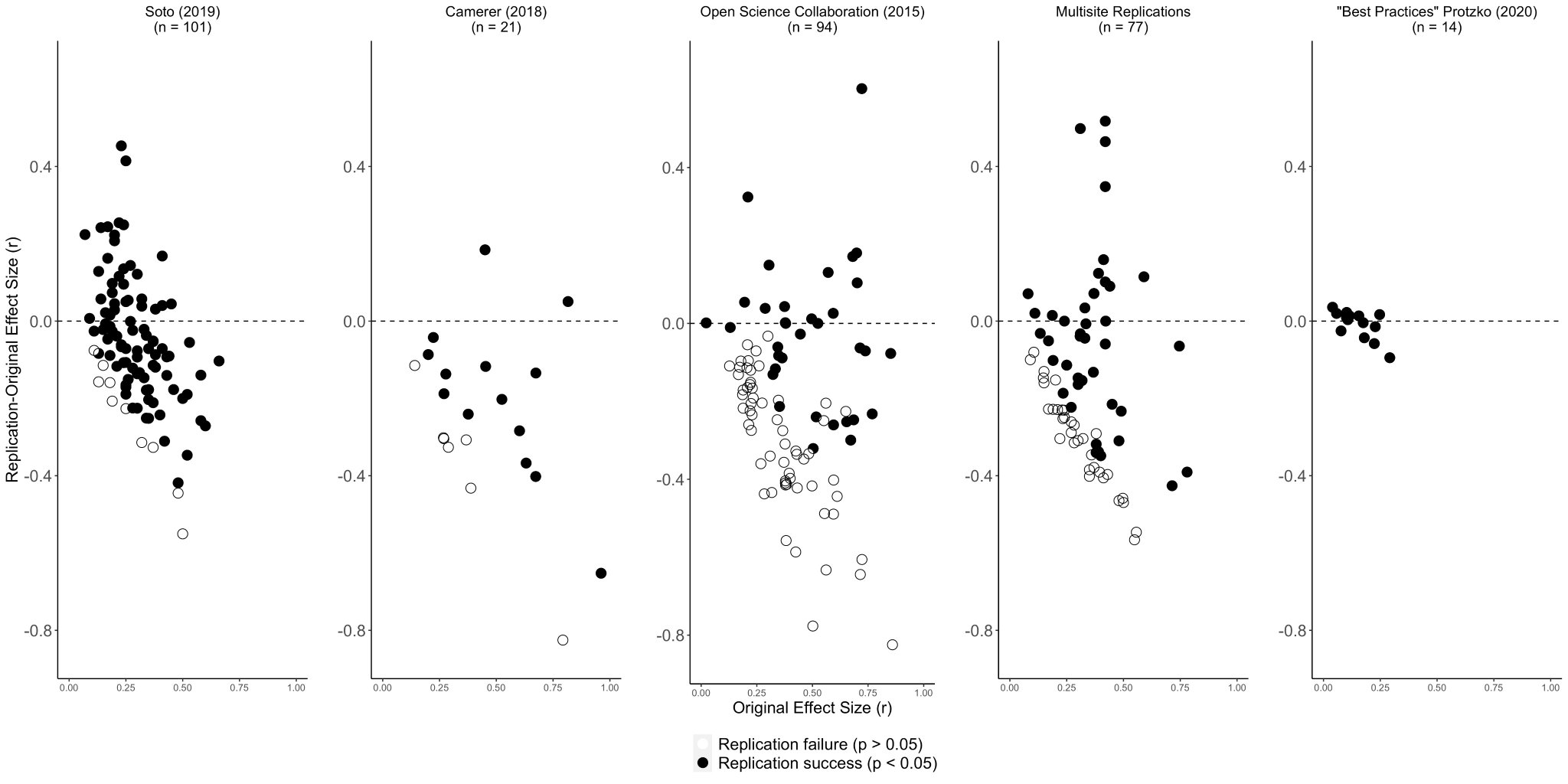
There are encouraging signs that pre-registered study designs like this are helping address the methodological problems described above. Consider the following five graphs. The graphs show the results from five major studies89, each of which attempted to replicate many experiments from the social sciences literature. Filled in circles indicate the replication found a statistically significant result, in the same direction as the original study. Open circles indicate this criterion wasn’t met. Circles above the line indicate the replication effect was larger than the original effect size, while circles below the line indicate the effect size was smaller. A high degree of replicability would mean many experiments with filled circles, clustered fairly close to the line. Here’s what these five replication studies actually found:
As you can see, the first four replication studies show many replications with questionable results – large changes in effect size, or a failure to meet statistical significance. This suggests a need for further investigation, and possibly that the initial result was faulty. The fifth study is different, with statistical significance replicating in all cases, and much smaller changes in effect sizes. This is a 2020 study by John Protzko et al90 that aims to be a “best practices” study. By this, they mean the original studies were done using pre-registered study design, as well as: large samples, and open sharing of code, data and other methodological materials, making experiments and analysis easier to replicate…In short, the replications in the fifth graph are based on studies using much higher evidentiary standards than had previously been the norm in psychology. Of course, the results don’t show that the effects are real. But they’re extremely encouraging, and suggest the spread of ideas like Registered Reports contribute to substantial progress.
The story of Brian Nosek is very interesting:
Many people have played important roles in instigating the replication crisis. But perhaps no single person has done more than Brian Nosek. Nosek is a social psychologist who until 2013 was a professor at the University of Virginia. In 2013, Nosek took leave from his tenured position to co-found the Center for Open Science (COS) as an independent not-for-profit (jointly with Jeff Spies, then a graduate student in his lab). Nosek and the COS were key co-organizers of the 2015 replication paper by the Open Science Collaboration. Nosek and the COS have also been (along with Daniël Lakens, Chris Chambers, and many others) central in developing Registered Reports. In particular, they founded and operate the OSF website, which is the key infrastructure supporting Registered Reports.
…The origin story of the COS is interesting. In 2007 and 2008, Nosek submitted several grant proposals to the NSF and NIH, suggesting many of the ideas that would eventually mature into the COS95. All these proposals were turned down. Between 2008 and 2012 he gave up applying for grants for metascience. Instead, he mostly self-funded his lab, using speaker’s fees from talks about his prior professional work. A graduate student of Nosek’s named Jeff Spies did some preliminary work developing the site that would become OSF. In 2012 this got some media attention, and as a result was noticed by several private foundations, including a foundation begun by a billionaire hedge fund operator, John Arnold, and his wife, Laura Arnold. The Arnold Foundation reached out and rapidly agreed to provide some funding, ultimately in the form of a $5.25 million grant.
To do this, Nosek had to leave the University of Virginia? Why? He was then attacked by many in the scientific community. Why? Read the whole thing for much more.
My Conversation with Reza Aslan
On a bunch of normal issues, I disagree with him rather vehemently, but overall I thought this Conversation worked out quite well. Here is the audio and video and transcript. Here is part of the episode summary:
He joined Tyler to discuss Shi’a and Christian notions of martyrdom, the heroism of Howard Baskerville, the differences between Sunni and Shi’a Islam, esoteric vs. exoteric expressions of religion, how mystical movements arise more organically than religion, the conflicts over Imams in the Islamic world, how his upbringing as an Iranian immigrant shaped his view of religion, his roundabout spiritual journey, the synthesis of Spinoza and Sufism, the origins of Wahhabism, the relationship (or lackthereof) between religion and political philosophy, the sad repetition of history in Iran, his favorite Iranian movie, and more.
Here is one excerpt:
COWEN: In your understanding, can Sufism stand alongside the prophetic structure of Islam as something separate? Or is it synthesized with it into one consistent picture?
ASLAN: That’s a hardcore, brilliant theological question because it’s been debated for generations. What I will say is this: that Sufism is, like all mystical traditions, incredibly eclectic. It comes in thousands of different forms.
There are some Sufis that are very traditionalist, very hard to even, sometimes, tell the difference between them and your basic Sunni. And there are some Sufis that take part in the spectacular displays, sometimes displays that involve putting swords through their bodies, taking part in painful acts, ways of trying to deny the self and the body in a way that most Muslims would look at and say, “That looks nothing like Islam.” Sufism is what a Sufi says it is, basically.
COWEN: If I go to Albania and I chat with the Bektashi, how is their version of Sufism different?
ASLAN: Then say the Naqshbandi? Absolutely. What’s great about Sufism — and again, this is a standard description of all mystical movements — is that they absorb themselves into local cultures and local practices. When you have these kinds of deeply spiritual, mystical movements, they most often arise from the culture. They’re not so often brought in from the outside.
Religion, in its most orthodox sense, is usually introduced to a culture or to a people. Somebody shows up and says, “This is Islam, this is Christianity, this is Buddhism.” Sufism, like much of mystical movements, is something that comes out of the ground itself and then starts to marry itself to that dominant religion.
We see Christian mysticism all around the world that in some places looks like paganism, and in some places looks like traditional nature worship. It uses some of the symbols and metaphors of Christianity, and it becomes an indigenous version of Christianity. That’s exactly the same thing with Sufism and Islam. It depends on where you go —
Interesting throughout.
That is from an Alex in the comments.