Somehow missed this the first time I looked, but GPT-4 got *significantly worse* at microeconomics after it was trained to tell you what you want to hear. pic.twitter.com/8tDtTwf1II
Fifty years ago today, on March 23, 1973, Alexander P. Butterfield, the Administrator of the Federal Aviation Administration, issued a rule that remains one of the most destructive acts of industrial vandalism in history.
“No person may operate a civil aircraft at a true flight mach number greater than 1 except in compliance with conditions and limitations in an authorization to exceed mach 1 issued to the operator under Appendix B of this part.”
This text was slightly modified in 1989 and again in 2021, but the upshot remains the same. The rule imposed a speed limit on US airspace. Not a noise standard, which would make sense. A speed limit.
This speed limit has naturally distorted the development of civil aircraft. For fifty years, the aviation industry has worked to improve subsonic aviation. Commercial passenger aircraft are safer and more economical today than they were in 1973, but they are no faster.
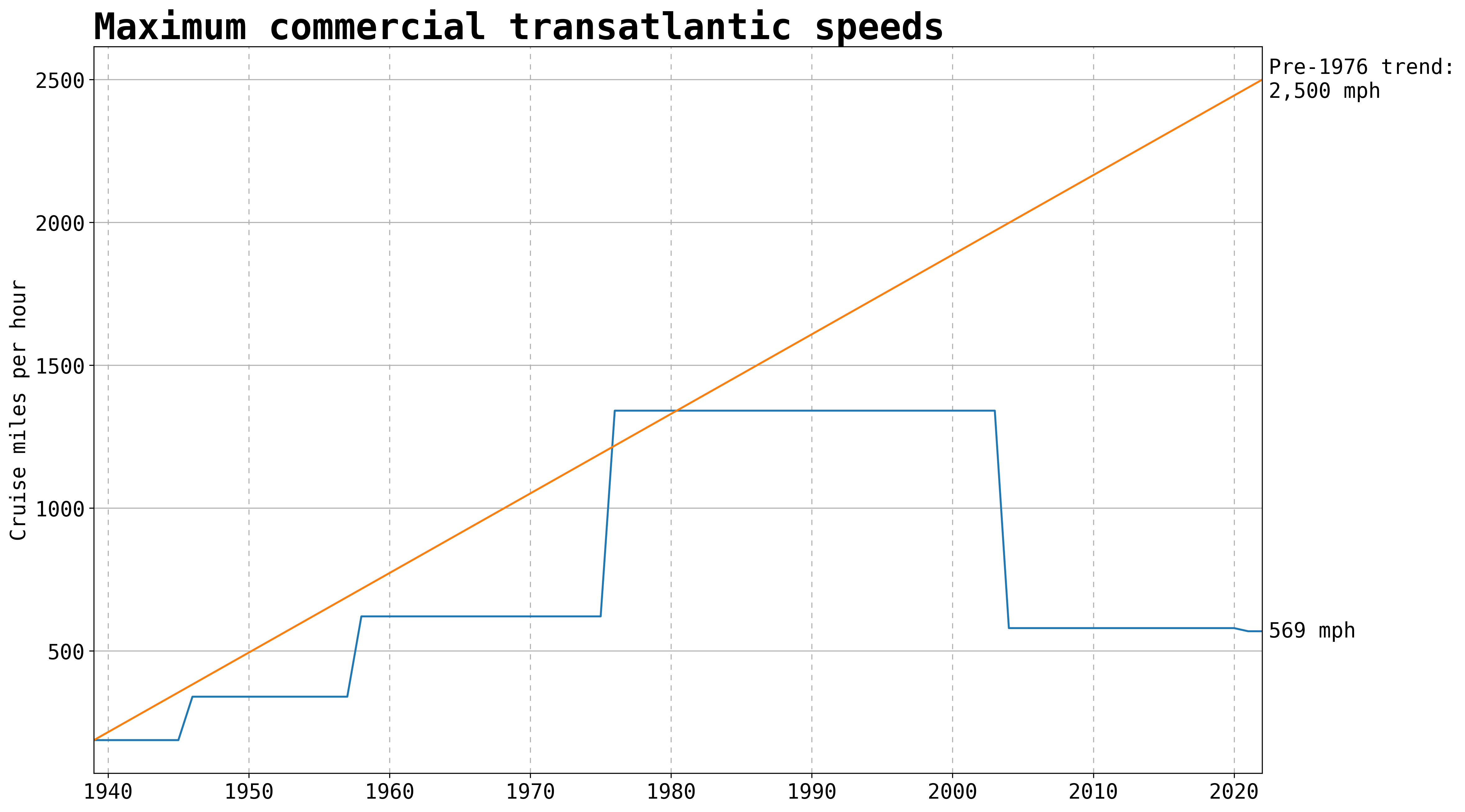
If we had propagated the rate of growth in commercial transatlantic aircraft speeds that existed from 1939 to the mid-1970s, we would have Mach-4 airliners by now. But the overland ban put an end to all that. It made small supersonic aircraft, which need to fly shorter overland routes, essentially illegal, closing off the iteration cycle that could drive progress in the industry.
That’s Eli Dourado who notes that modern designs greatly reduce sonic boom. I would also add the following. In 2019 there were 811 million passengers on US domestic flights and 241 million passengers on US international flights. The average duration of a domestic flight is about 2.5 hours and an international fight about 7.3 hours so Americans spend about 3.7 billion hours every year on airplanes. If we could cut even 20% of that time that’s a saving of 757 million hours which has to be weighed against a few people experiencing sonic booms near airports. Indeed, since the people on the airplane are subjected to a lot of the noise the total amount of noise experienced could easily go down with faster aircraft!
The central claim of our work is that GPT-4 attains a form of general intelligence, indeed showing sparks of artificial general intelligence. This is demonstrated by its core mental capabilities (such as reasoning, creativity, and deduction), its range of topics on which it has gained expertise (such as literature, medicine, and coding), and the variety of tasks it is able to perform (e.g., playing games, using tools, explaining itself…). A lot remains to be done to create a system that could qualify as a complete AGI.
A Washington Post poll finds that 41 percent of Americans support a federal ban of the popular short-videoapp, while 25 percent say they oppose it. And 71 percent are concerned that TikTok’s parent company is based in China, including 36 percent who say they are “very concerned.”
Here is the WaPo article. A single poll on this issue is not dispositive, but still it suggests to me that if our politicians force the sale of TikTok to an American company that would not be an electorally unpopular move.
You can see the broader pattern here:
1. Change starts with the states, many of which have been restricting the use of TikTok on government phones. Then the momentum spreads to the federal government.
2. American companies end up heavily favored (yes the competitors gain, as a side issue who will Elizabeth Warren allow to buy TikTok? Certainly not Meta.) Market concentration rises.
3. National security considerations, or ostensible national security considerations, win out.
4. For all the talk of polarization and gridlock, both parties get on board.
5. TikTok is the Girardian sacrifice to the American national vision, which in any case proceeds with rampant surveillance.
The SEC allowed Coinbase to go public in 2021, he [Brian Armstrong] wrote, including after reviewing its disclosures that “clearly explained our asset listing process and included 57 references to staking.”
Here is the full WSJ article. Rule of law people, or “rule of men” (and women)? Which is it?
In The New Madness of Crowds I argued that SVB failed because “Greater transparency and lower transaction costs have intensified the madness of the masses and expanded their reach.” A piece by Miao, Zuckerman and Eisen in the WSJ now adds to to the other side of the problem. Depositors were working on twitter time, the regulatory apparatus was not.
Depositors were draining their accounts via smartphone apps and telling their startup networks to do the same. But inside Silicon Valley Bank, executives were trying to navigate the U.S. banking system’s creaky apparatus for emergency lending and to persuade its custodian bank to stay open late to handle a multibillion-dollar transfer.
Instead of hearing a rumor at the coffee shop and running down to the bank branch to wait on line to withdraw your money, now you can hear a rumor on Twitter or the group chat and use an app to withdraw money instantly. A tech-friendly bank with a highly digitally connected set of depositors can lose 25% of its deposits in hours, which did not seem conceivable in previous eras of bank runs.
But the other part of the problem is that, while depositors can panic faster and banks can give them their money faster, the lender-of-last-resort system on which all of this relies is still stuck in a slower, more leisurely era. “When the user interface improves faster than the core system, it means customers can act faster than the bank can react,” wrote Byrne Hobart. You can panic in an instant and withdraw your money with an app, but the bank can’t get more money without a series of phone calls and test trades that can only happen during regular business hours.
It’s not obvious whether the right thing to do is slow down depositors, at least in some circumstances, or speed up regulators but the two systems can’t work well at different speeds.
Historian Tom Holland joined Tyler to discuss in what ways his Christianity is influenced by Lord Byron, how the Book of Revelation precipitated a revolutionary tradition, which book of the Bible is most foundational for Western liberalism, the political differences between Paul and Jesus, why America is more pro-technology than Europe, why Herodotus is his favorite writer, why the Greeks and Persians didn’t industrialize despite having advanced technology, how he feels about devolution in the United Kingdom and the potential of Irish unification, what existential problem the Church of England faces, how the music of Ennio Morricone helps him write for a popular audience, why Jurassic Park is his favorite movie, and more.
Here is one excerpt:
COWEN: Which Gospel do you view as most foundational for Western liberalism and why?
HOLLAND: I think that that is a treacherous question to ask because it implies that there would be a coherent line of descent from any one text that can be traced like that. I think that the line of descent that leads from the Gospels and from the New Testament and from the Bible and, indeed, from the entire corpus of early Christian texts to modern liberalism is too confused, too much of a swirl of influences for us to trace it back to a particular text.
If I had to choose any one book from the Bible, it wouldn’t be a Gospel. It would probably be Paul’s Letter to the Galatians because Paul’s Letter to the Galatians contains the famous verse that there is no Jew or Greek, there is no slave or free, there is no man or woman in Christ. In a way, that text — even if you bracket out and remove the “in Christ” from it — that idea that, properly, there should be no discrimination between people of different cultural and ethnic backgrounds, based on gender, based on class, remains pretty foundational for liberalism to this day.
I think that liberalism, in so many ways, is a secularized rendering of that extraordinary verse. But I think it’s almost impossible to avoid metaphor when thinking about what the relationship is of these biblical texts, these biblical verses to the present day. I variously compared Paul, in particular in his letters and his writings, rather unoriginally, to an acorn from which a mighty oak grows.
But I think actually, more appropriately, of a depth charge released beneath the vast fabric of classical civilization. And the ripples, the reverberations of it are faint to begin with, and they become louder and louder and more and more disruptive. Those echoes from that depth charge continue to reverberate to this day.
And:
COWEN: In Genesis and Exodus, why does the older son so frequently catch it hard?
HOLLAND: Well, I’m an elder son.
COWEN: I know. Your brother’s younger, and he’s a historian.
HOLLAND: My brother is younger. It’s a question on which I’ve often pondered, because I was going to church.
COWEN: What do you expect from your brother?
HOLLAND: The truth is, I have no idea. I don’t know. I’ve often worried about it.
Large language models (LLMs) have demonstrated remarkable capabilities in natural language understanding and generation across various domains, including medicine. We present a comprehensive evaluation of GPT-4, a state-of-the-art LLM, on medical competency examinations and benchmark datasets. GPT-4 is a general-purpose model that is not specialized for medical problems through training or engineered to solve clinical tasks. Our analysis covers two sets of official practice materials for the United States Medical Licensing Examination (USMLE), a three-step examination program used to assess clinical competency and grant licensure in the United States. We also evaluate performance on the MultiMedQA suite of benchmark datasets. Beyond measuring model performance, experiments were conducted to investigate the influence of test questions containing both text and images on model performance, probe for memorization of content during training, and study calibration of the probabilities, which is of critical importance in high-stakes applications like medicine. Our results show that GPT-4, without any specialized prompt crafting, exceeds the passing score on USMLE by over 20 points and outperforms earlier general-purpose models (GPT-3.5) as well as models specifically fine-tuned on medical knowledge (Med-PaLM, a prompt-tuned version of Flan-PaLM 540B). In addition, GPT-4 is significantly better calibrated than GPT-3.5, demonstrating a much-improved ability to predict the likelihood that its answers are correct. We also explore the behavior of the model qualitatively by presenting a case study that shows the ability of GPT-4 to explain medical reasoning, personalize explanations to students, and interactively craft new counterfactual scenarios around a medical case. Implications of the findings are discussed for potential uses of GPT-4 in medical education, assessment, and clinical practice, with appropriate attention to challenges of accuracy and safety.
Here is the full paper by Harsha Nori, Nicholas King, Scott Mayer McKinney, Dean Carignan, and Eric Horvita. Ho hum, people, ho hum!
Many people are upset at my rather anodyne remarks from earlier in the week. Thus I have a simple question: what are the best cost-benefit studies of urban investments in bicycle lanes and other bicycle-friendly policies? They have to take into account the opportunity cost of the land for bike lanes, the cost of cycling deaths and injuries, and the costs of slower vehicular traffic. Counting those variables in addition to the rather considerable benefits of cycling is hardly a genius-level move, right?
Funny that, I can’t seem to find such a study! But I am not an expert. I am sure there are many such studies, so I am opening comments to all of you, so that I may pull in the appropriate references. I will then read the best study or studies, and report back.
And if by some freak chance of nature no such studies can be found, what should we infer from that?
Addendum: And people (commentators), I don’t need the blah blah blah. Don’t need the mood affiliation. Don’t need the abstract citation of individual gross benefits. Just the cost-benefit studies, please. I am sure you will oblige.
When interest rates go up, the price of bonds goes down. As Tyler and I discuss in Modern Principles, the inverse relationship between interest rates and prices holds for any asset that pays out over time. In particular, as Patrick McKenzie points out, when interest rates go up, the value of a loan goes down. McKenzie suggests that you can use this fact to buy back your mortgage from a bank when interest rates rise.
For example, suppose you get a 500k 30-year fixed rate mortgage when interest rates are 3%–that loan obligates you to pay $2108 per month for 30 years. Now suppose that interest rates go to 6%, now that same stream of payments is only worth, in present value, about $358k. Thus, the bank should be willing to let you buy your mortgage for $358k–that is, after all, what the market would pay for such a stream of payments if your mortgage was securitized.
I am skeptical that I could find the right person at the right bank to actually authorize a deal like this but it turns out that the Danish mortgage system is built to allow this relatively easily. The Danish mortgage system is built on the match principle:
JYSKE Bank: The match-funding principle entails that for every loan made by the mortgage bank, a new bond is issued with matching cash-flow properties. This eliminates mismatches in cash-flows and refinancing risk for the mortgage bank, which also secures payments for the bondholder. In the Danish mortgage system the mortgage bank functions as an intermediary between the investor and borrower. Mortgage banks fund loans on a current basis, meaning that the bond must be sold before the loan can be given. This also entails that the market price of the bond determines the loan rate. The loan is therefore equal to the investment, which passes through the mortgage bank.
In essence, in the Danish system, mortgage banks are more like a futures clearinghouse or a platform (ala Airbnb) than a lender–they take on some credit risk but not interest rate risk.
Thus, if a Danish borrower takes out a 500k mortgage at 3% interest and then rates rise to 6%, the value of that mortgage falls to $358k and the borrower could go to the market, buy their own mortgage, deliver it to the bank, and, in this way, extinguish the loan. Since the value of homes also falls as interest rates rise this is also a neat bit of insurance. Remarkable!
The Danish mortgage market appears to be very successful and so may be a model for American reform:
JYSKE Bank: The Danish Mortgage Bond Market is one of the oldest and most stable in the world, tracing its roots all the way back to 1797 with no records of defaults since inception. Furthermore, the market value of the Danish Mortgage Bond Market is approx. EUR 402bn, making it the largest mortgage bond market in Europe.
Good Morning from Germany, where China is losing importance as export destination. In Feb, exports to China slumped by 12.4%, while exports to US rose 19%. This means that US is by far the most important export market, France is also establishing itself as #2, far ahead of China. pic.twitter.com/S2pSqeRTO9