Saturday assorted links
Uh-oh, reverse Flynn effect edition
A reverse Flynn effect was found for composite ability scores with large US adult sample from 2006 to 2018 and 2011 to 2018.
Domain scores of matrix reasoning, letter and number series, verbal reasoning showed evidence of declining scores.
Three-dimensional rotation scores generally increased from 2011 to 2018.
Differences in ability scores were present regardless of age, education, or gender.
The steepest slopes occurred for ages 18–22 and lower levels of education.
That is from a new paper by Elizabeth M. Dworak, William Revelle, and David M. Condon. Alex T. comments.
Home bias in top economics journals
Two of the top economics journals have institutional ties to a specific university, the Quarterly Journal of Economics (QJE) to Harvard University and the Journal of Political Economy (JPE) to the University of Chicago. Researchers from Harvard, but also nearby Massachusetts Institute of Technology (MIT), and from Chicago (co-)author a disproportionate share of articles in their respective home journal. Such home ties and publication bias may harm, but also benefit, article quality. We study this question in a difference-in-differences framework, using data on both current and past author affiliations and cumulative citation counts for articles published between 1995 and 2015 in the QJE, JPE, and American Economic Review (AER), which serves as a benchmark. We find that median article quality is lower in the QJE if authors have ties to Harvard and/or MIT than if authors are from other top-10 universities, but higher in the JPE if authors have ties to Chicago. We also find that home ties matter for the odds of journals to publish highly influential and low impact papers. Again, the JPE appears to benefit, if anything, from its home ties, while the QJE does not.
That is from a new paper by Dirk Bethmann, Felix Bransch, Michael Kvasnicka, and Abdolkarim Sadrieh.
Earnings Are Greater and Increasing in Occupations That Require Intellectual Tenacity
That is the title of a new paper by Christos Makridis, Louis Hickman, and Benjamin Manning, here is the abstract:
Automation and technology are rapidly disrupting the labor market. We investigated changes in the returns to occupational personality requirements—the ways of thinking, feeling, and behaving that enable success in a given occupation—and the resulting implications for organizational strategy. Using job incumbent ratings from the U.S. Department of Labor’s Occupational Information Network (O*NET), we identify two broad occupational personality requirements, which we label intellectual tenacity and social adjustment. Intellectual tenacity encompasses achievement/effort, persistence, initiative, analytical thinking, innovation, and independence. Social adjustment encompasses emotion regulation, concern for others, social orientation, cooperation, and stress tolerance. Both occupational personality requirements relate similarly to occupational employment growth between 2007 and 2019. However, among over 10 million respondents to the American Community Survey, jobs requiring intellectual tenacity pay higher wages—even controlling for occupational cognitive ability requirements—and the earnings premium grew over this 13-year period. Results are robust to controlling for education, demographics, and industry effects, suggesting that organizations should pay at least as much attention to personality in the hiring and retention process as skills.
Of course that is very much accord with some of the claims Daniel Gross and I make in our book on talent. Via the excellent Kevin Lewis.
What should I ask David Bentley Hart?
I will be doing a Conversation with him. David Gordon claims the guy has read more than David Gordon! Here is Wikipedia:
David Bentley Hart (born 1965) is an American writer, philosopher, religious studies scholar, critic, and Orthodox theologian noted for his distinctive, humorous, pyrotechnic and often combative prose style. With academic works published on Christian metaphysics, philosophy of mind, classics, Asian languages, and literature, Hart received the Templeton Fellowship at the University of Notre Dame Institute for Advanced Study in 2015 and organized a conference focused on the philosophy of mind. His translation of the New Testament was published by Yale in 2017 with a 2nd edition in 2023.
A prolific essayist, Hart has written on topics as diverse as art, baseball, literature, religion, philosophy, consciousness, problem of evil, apocatastasis, theosis, fairies, film, and politics. His fiction includes The Devil and Pierre Gernet: Stories (2012) as well as two books from 2021: Roland in Moonlight and Kenogaia (A Gnostic Tale). Hart also maintains a subscription newsletter called Leaves in the Wind that features original essays and conversations with other writers such as Rainn Wilson, China Miéville, Tariq Goddard, and Salley Vickers. Hart’s friendship and substantial intellectual common ground with John Milbank has been noted several times by both thinkers.
So what should I ask him?
Friday assorted links
1. Eric Topol on the new breakthrough obesity drugs.
2. A taxonomy of Mexico City horns.
3. The polity that is Florida.
4. Air Force OKs hand and neck tattoos.
5. Good David Brooks piece on the importance of the arts (NYT).
6. Scaling automatic speech recognition beyond 100 languages. And reconstructing visual images from human brain activity. As I’ve been telling you, advances every single day.
So what is the right-wing pathology then?
Recently I discussed the connection between high neuroticism and left-wing politics. In passing I mentioned that the right-wing had its own problems, leading a few of you to ask what those were.
The classic response would be to accuse (credit?) conservatives as being low in empathy. Whether or not you agree historically, that answer does not seem to me to be “of the moment.” Instead, I see the more recent right-wing thinkers as falling into a different camp. The pathology I observe most frequently and most intensely is a kind of reckless anger, directed at some semi-imaginary, hypostatized notion of “elites.” In an almost Pavlovian fashion, you can pump up this group by putting out some “bait” about “the elites” and seeing the resentment fly. To be clear, as with the left-wing, this pathology does not have to mean the right-wing thinkers are wrong on the issues themselves. After all, maybe Lab Leak did indeed happen, or whatever other claim you might wish to debate. But when one of these sensitive topics comes up, yes right-wing thinkers do often respond to it pathologically and with an excess of emotion. Born out of their sense of their own failures, they can be the true snowflakes.
You can see this in the comments section of MR every single day. Maybe even today. No surprise that the neurotic left-wingers will notice this and be disturbed by it!
The link between IQ and income is overrated
Garett Jones was the one who first put me on to this idea, now it is in a Bloomberg column, excerpt:
The evidence is striking. One study of CEOs of large Swedish companies found that on average they ranked at the 83rd percentile of measured IQ (for CEOs of smaller companies, the rank was the 66th percentile). That’s above average, but it’s hardly a cluster at the top of the distribution. Many CEOs undoubtedly achieved their position through hard work, charisma, people skills and other abilities, not to mention luck.
In the broader distribution, the connection between IQ and income is also positive but underwhelming. One study concluded that moving from the 25th to the 75th percentile of IQ correlates with a 10% to 16% boost in earnings. That may feel significant when you get it, but it doesn’t push you into a whole new socioeconomic class.
The connection between IQ and achievement at the very highest tiers is in my view still an open question. Here are some recent results, in my view not yet confirmed as the correct overall point of view:
One recent study, also based on Swedish data, showed two results of significance. First, much of the intelligence-earnings correlation weakens significantly and plateaus above salaries of 60,000 euros a year. Second, and perhaps more surprising, people in the top 1% of earners had lower IQs than the earners immediately beneath them.
Why that is the case, it’s hard to say. But one possibility is that the very smartest people prefer a more balanced life rather than working all the time. Or perhaps they prefer occupations with higher status and somewhat lower pay. Money isn’t the only thing you can enjoy. Maybe having a lot of it can make it harder to trust potential friends or spouses.
Recommended.
Russia facts of the day
Consider that last year, the IMF predicted Russian GDP would shrink by 8.5% in 2022 and by 2.3% in 2023; for its part, the White House projected a year-on-year decline in Russian GDP of 15%. Last month, the IMF revised its growth estimate for Russia to 0.3% for 2023 and 2.1% in 2024—higher than the eurozone and the United Kingdom.
What happened? For the first eight months of the war, thanks to a 250% increase in hydrocarbon prices combined with an unavoidable lag in sealing off imports, Western sanctions actually raised Russian revenues from exports to the European Union. Sanctions only started to inflict significant damage on the Kremlin at the very end of 2022, after which the Russian Finance Ministry reported a budget deficit of nearly $25 billion for January, and an overall decline in revenue of 35%. In the meantime, however, Russia managed to tap gray and black trade markets across the Middle East, Africa, and Asia while continuing to sell oil around the world and provide petroleum services like maritime shipping and insurance. The EU has admitted to not knowing the quantity or nature of the Russian central bank assets it’s supposedly blocked. At the same time, thanks to China, Russia now imports more semiconductors than it did before the war.
Here is more from Jeremy Stern at Tablet.
What young people say is driving changes in their mental health
I think consistent with Matt's point here — you see young people identifying social media as a source of worsening mental health; but also emphasizing politics and national media.https://t.co/scOXEMNFjJ https://t.co/MGgdNIsz0m pic.twitter.com/hY47EOZFAO
— Arpit Gupta (@arpitrage) March 1, 2023
I would stress this point. Most of the explanations for declining teen mental health invoke contagion at one stage of the argument or another. That in turn means the initial causes can be fairly small, relative to the final outcome. Contagion itself is arguably the most important cause.
Thursday assorted links
1. Good to see a Mexican amate up for auction at Christie’s. Might anyone here know what is being done with the rest of the Citibanamex collection?
4. Return to Seoul is an excellent movie (NYT).
5. Shruti interviews Alain Bertaud (newly part of Mercatus) on cities in India.
6. Fifty conversations in Bangalore and Chennai.
7. Ross on magic, AI, and related topics (NYT): “…what we’re doing resembles a complex incantation, a calling of spirits from Shakespeare’s “vasty deep.””
AGI is Coming
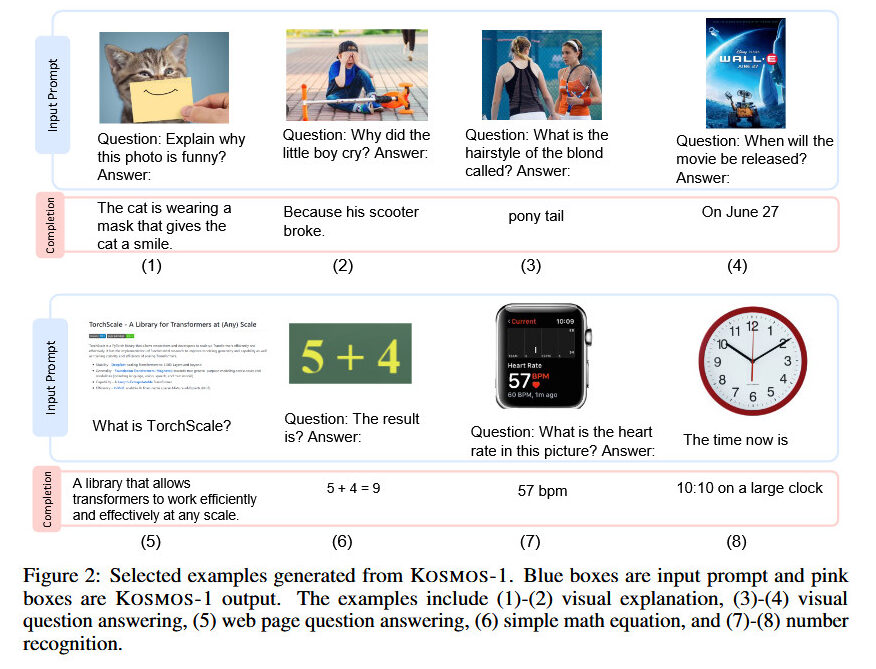
ARSTechnica: On Monday, researchers from Microsoft introduced Kosmos-1, a multimodal model that can reportedly analyze images for content, solve visual puzzles, perform visual text recognition, pass visual IQ tests, and understand natural language instructions. The researchers believe multimodal AI—which integrates different modes of input such as text, audio, images, and video—is a key step to building artificial general intelligence (AGI) that can perform general tasks at the level of a human.
In 2020 Metaculus forecasters were predicting weak general AI by around 2053. Now they are predicting weak general AI by 2028 and strong general AI which includes:
- Has general robotic capabilities, of the type able to autonomously, when equipped with appropriate actuators and when given human-readable instructions, satisfactorily assemble a (or the equivalent of a) circa-2021 Ferrari 312 T4 1:8 scale automobile model. A single demonstration of this ability, or a sufficiently similar demonstration, will be considered sufficient.
I never expected to witness the birth of aliens. It is a very strange time to be alive. If you think the world isn’t changing in a very uncertain and discontinuous way you just aren’t paying attention.
What predicts attractiveness-enhancing behavior?
Such investigations are invariably somewhat speculative, but from some new research here goes:
The strongest predictor of attractiveness-enhancing behaviors was social media usage. Other predictors, in order of effect size, included adhering to traditional gender roles, residing in countries with less gender equality, considering oneself as highly attractive or, conversely, highly unattractive, TV watching time, higher socioeconomic status, right-wing political beliefs, a lower level of education, and personal individualistic attitudes.
That is from a paper by Marta Kowal, et.al.
South Park Commons — the collectives model for spurring innovation
From the NYT circa 2017:
…the [South Park] Commons aims to fill a hole in the tech landscape. Northern California is littered with incubators and accelerators, organizations like Y Combinator and Techstars that help small companies develop and grow. This is something different, a community you can join before you have founded a company or even when you have little interest in founding one.
The Commons is a bit like the hacker spaces that have long thrived in the Valley — places where coders and makers gather to build new software and hardware — but it moves beyond that familiar concept. Its founder, for one thing, is a female engineer turned entrepreneur turned executive.
From SPC itself:
SPC is a de-risking platform. The community addresses the social and intellectual components of risk—it provides a close-knit, high-talent group during the idea stage so members can reach founder-market fit before attempting product-market fit. The SPC Fund plays the more traditional role of de-risking finances: our recently-launched Community Grant works much like Emergent Ventures; the Founder Fellowship (we’re currently accepting applications) is designed to get would-be founders to take the plunge; and we participate in the broader VC ecosystem with some later-stage investments.
Reminds me of the Junto Club, not to mention the 18th century more broadly; SPC itself cites Junto as a model. Think of it as a technical community of people without full-time jobs, plus a venture fund. On the ground, technologists hang out with potential founders. Here is TechCrunch on SPC.
Which are other recent examples of successful “community” models for spurring innovation?
Wednesday assorted links
1. Garett Jones on why AI possibly might not boost economic growth very much. And William Eden expects another AI winter.
2. Classical liberalism by country, volume 2 (Latin America).
3. Ben Evans presentation of trends, tech and otherwise.
4. Aligning perception with language models: “We also show that MLLMs can benefit from cross-modal transfer, i.e., transfer knowledge from language to multimodal, and from multimodal to language.”
5. Is declining knowledge diffusion behind the loss in U.S. business dynamism?