Matt Yglesias on depression and political ideology
The connection between Left thinking and high neuroticism (as a formal personality trait) is one of the most underdiscussed yet important themes in American politics (to be clear, the Right has its own pathologies as well). Here is one excerpt from Matt’s latest Substack (gated):
But I want to talk about something Goldberg mentions but doesn’t focus on: a 2021 paper by Catherine Gimbrone, Lisa Bates, Seth Prins, and Katherine Keyes titled “The politics of depression: Diverging trends in internalizing symptoms among US adolescents by political beliefs.” The CDC survey doesn’t ask teens about their political beliefs, but Gimbrone et. al. find not only divergence by gender, but divergence by political ideology. Breaking things down by gender and ideology, they find that liberal girls have the highest increase in depressive affect and conservative boys have the least. But liberal boys are more depressed than conservative girls, suggesting an important independent role for political ideology.
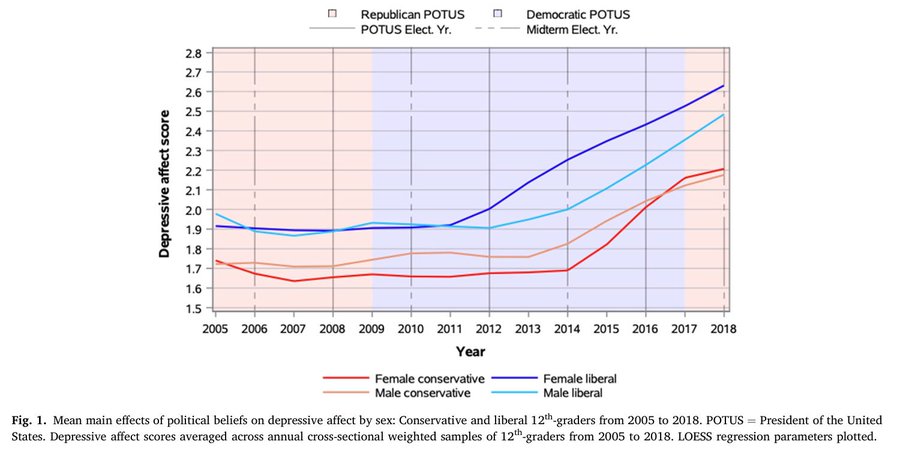
And:
Some of it might be selection effect, with progressive politics becoming a more congenial home for people who are miserable. But I think some of it is poor behavior by adult progressives, many of whom now valorize depressive affect as a sign of political commitment. The thing about depression, though, is that it’s bad.
And:
…progressive institutional leaders have specifically taught young progressives that catastrophizing is a good way to get what they want…
One of the best and most important pieces you will read this year. I would go as far to say that you cannot understand the American public intellectual sphere without a grasp of the close connection between Left thinking and high neuroticism. I would add that incorporating gender expectations into Matt’s analysis would give it yet more explanatory power. Once you see all this, you can never look away again and forget it…
A view that hardly anyone embraces
It is not an airtight view, but it is also not the least plausible view. Imagine a “basic needs” argument that suggests, a’ la David Braybrooke, that individuals truly have positive rights to a certain degree of sustenance, health care, shelter, and so on. Yet above that basic needs level, individuals don’t have positive rights to much of anything at all. They are left to fend for themselves, though of course they will benefit from social cooperation. After all, positive rights have to stop somewhere if only because of the scarcity constraint. Furthermore, perhaps what society owes a person is “enough to construct a meaningful life,” but not so much more.
You may or may not agree, but as a view it is not crazy.
To make this more specific, imagine a health care policy that stated individuals have a true right to access any health care technology invented up through say…2004 or so. Individuals would be guaranteed “2004 value health care lives.” (In 2004 that certainly seemed pretty good.) But for subsequent health care developments, a free market will reign. Is not guaranteeing basic needs an essential part of the egalitarian argument? Surely not everything needs to be equalized? Anyway, no one believes in guaranteeing individuals protection against all the rare diseases out there, as that would cost too much. So a line will be drawn somewhere.
The very title of this post suggested these views are extremely unpopular. One reason might be their theoretical inadequacy. But surely another reason is that, at the margin, they suggest you just don’t have too much complaining you can do. You don’t have too much to say about social arrangements. You don’t have too many opportunities to express purely negative emotions about how things are.
And perhaps that is a big part of what people find intolerable.
What does that tell you about political views more generally?
Is business doing our saving for us?
That is the theme of my latest Bloomberg column, as U.S. household savings rates often fall between three and five percent. From the column here is one bit:
Are such low savings rates unsustainable for an advanced economy? Not in view of America’s business saving. Looking at the US Federal Reserve’s series on undistributed business profits, it starts to rise significantly in the 1970s, and takes off around 2000 (with a dip for the financial crisis), and currently stands a bit above $1.2 trillion. There are other ways to measure business savings rates, but generally they show a significant upward move over the last few decades.
On net, gross US savings rates are hovering between 17% and 18% of GDP. Again, there are different ways to measure the relevant variables. But under any plausible approach the US is not having to survive on saving only a few percent of personal income.
This is related to those stories about some of the most successful US corporations sitting on billions of dollars. Maybe you view that as wasteful or extravagant. But a more helpful response might be: “Better them than me!”
Data on personal savings typically neglect pension plans and realized capitals gain on financial assets and homes. In that sense the personal saving rate also is higher than is typically measured. Yet here, too, much of the credit goes to business. If equities are high in value in the aggregate, that is a tribute to corporate productivity more than to brilliant investing.
But do recall the Garett Jones strictures that if you don’t save enough you may not enjoy compounding returns over time.
C’mon people…
CHIPs details to raise costs:
1) Mandated daycare
2) Davis Bacon pay regulations
3) Buy American
4) Consult, engage, coordinate with unions
5) NEPA compliance
6) Source materials from small, minority, and women owned business https://t.co/2TLrdbrBmP— Adam Ozimek (@ModeledBehavior) February 28, 2023
Tuesday assorted links
1. Does male physical labor boost sperm count and thus fertility?
2. Nathan Labenz on many things GPT. And new Windows update will bring AI-powered Bing to the taskbar.
3. Those new service sector jobs: Prompt engineer.
4. Further Austin Vernon defense of aircraft carriers.
5. Chotiner interviews Jeffrey Sachs, do read it (New Yorker). And on the China-Russia relationship.
Britain’s Long Timeline of Housing Decline
In 1947 the British Town and Country Planning Act made planning permission a requirement for land development; ownership alone no longer conferred the right to develop the land. A decline in construction was predictable but housing is a durable good. Even today more than a third of the British housing stock dates to before 1947. So it has taken time but, according to a new study, the act has had a slow but long-run depressing effect on construction with the result that today the average house in England costs more than ten times the average salary.
Britain has a severe housing crisis, especially in the most prosperous places in the Greater South East. Across England, the average house costs more than ten times the average salary, vacancy rates are below 1 per cent, and space per person for private renters has dropped substantially in recent decades.
This report explores the root cause of the UK’s housing problem, how policy in this area has developed over the last 75 years, and what action policymakers need to take to deliver enough homes in the UK.
…This report uses this new data and other sources to compare British housebuilding and outcomes to that in Ireland, France, Belgium, the Netherlands, (West) Germany, Austria, Switzerland, Denmark, Sweden, Norway, and Finland from 1955 to 2015. It finds that Britain’s housing shortage began at the beginning of the post-war period…
Housebuilding rates in England and Wales have dropped by more than a third after the introduction of the Town and Country Planning Act 1947, from 2 per cent growth per year between 1856 and 1939 to 1.2 per cent between 1947 and 2019.
This has been a key factor behind the UK’s long-standing housing crisis, which has led to inflated property prices and soaring rents in recent decades.
*The Soviet Century*
The author is Karl Schlögel, and the subtitle is Archaeology of a Lost World. Who else could have a whole chapter on Soviet-era doorknobs? This is a fascinating book about the material loose ends, the pamphlets, the clothes, the non-existent phone books, the shop signs, the chest medals, and the bric-a-brac — among many other items — of the Soviet Union. Excerpt:
…the centre of this city consisted of the largest steelworks in the world, the Magnitogorsk Iron and Steel Plant.
Who would be able to describe the sight of it? There is no vantage point and no camera lens that would encompass the panorama that we know otherwise only from the sight of the forces of nature at work…
The conglomerate has an area of around twenty by ten kilometres. The Magnitogorsk combine is roughly the size of a region from Manchester to Sheffield, compressed into a single point, a Pittsburgh beyond the Urals. As Stephen Kotkin observed at the end of the 1980s, the Magnitogorsk engineering complex was far more than just a ‘steel factory’. It consisted of dozens of plants, ten mighty blast furnaces, thirty-four open hearth furnaces, rolling mills and finishing mills that produced more steel annually than Canada or Czechoslovakia and almost as much as the whole of Great Britain.
Over 800 pp. of text, this is in my view one of the better books for understanding the Soviet Union.
Hungary incentives of the day
Hungary passed a law in 2019 exempting women with four children from income taxes, for life. This is the first effort that at least sounds somewhat like actually trying.
Yet when considered in detail, this was a rather terrible implementation. There is a mismatch here between what women and families want and what this is pushing them towards.
Even with a large income tax break, asking women to have four children is rather ambitious. The one-time payments for the first three children are not that different from zero, the main effect only kicks in if you have four. Then there is no substantial further benefit to having five.
The benefit then comes in the form of not paying income tax rather than a direct payment. That means that to get the benefit, the mother of four has to be working.
There are exceptions, but presumably if you choose to have four children in order to get financial benefits, what you want to do with that funding is stay home with your children. That’s not allowed here. The income tax benefits don’t even seem to pass to the father or husband, so they can support a family on their own. I do get it, given how easy that would be to game, but it doesn’t seem great. It also creates a very strange and huge incentive to have stay-at-home fathers, and to encourage various forms of tax fraud, I am sad I have not yet watched any movies about this.
All the incentives here are twisted and highly inefficient. Another problem is that most of the benefits paid are going, for a while, to go to women whose children were already born under the old regime.
Then early this year they extended the policy to all mothers under 30. If you have one child by 30, you are exempt from income taxes for life.
This essentially wipes out the four-child policy, other than retroactively. The number of women who are going to have zero children before 30, then have four or more later, is very small.
The new rule seems much more interesting. Hungary’s tax rate on personal income is 15%. So this is a permanent 17% boost in take-home pay if you have your first child before 30. That seems like a very strong incentive to have your first child before 30, even if you weren’t sure if you wanted one or not. Not as strong as a similar-expected-value one-time payment or guaranteed income steam. Still warping the tax incentives in very strange ways. Still pretty great.
Long term I am very curious to see what this does to tax rates. If the majority of Hungarian women do not pay income tax, that is going to require a substantial tax hike. It also will be very interesting to see the impact on earnings, and on the gender pay gap, and on norms of child care. If a couple gets married in their 20s, and knows that the women is permanently immune from income taxes and the man is not, so the women’s pay is worth at least 17% more, what happens?
Here is more from Zvi Mowshowitz, most of it about fertility-boosting attempts in other nations.
*The Individualists*
The authors are Matt Zwolinski and John Tomasi, and the subtitle is Radicals, Reactionaries, and the Struggle for the Soul of Libertarianism. Due out April 4, pre-order now, here is my blurb:
“Zwolinski and Tomasi have written the definitive book about libertarian ideas reaching up to the present day. They show that libertarianism remains a vital and fascinating source of ideological energy and influence.”
Recommended.
Monday assorted links
1. Is the former colonizer now popular in the colonies?
2. Progress on small modular nuclear reactors?
3. Who is a liberal? LiberalismUnrelinquished.
4. Those new service sector jobs: “I’m a pastor living in rural Arkansas, and I make up to $3,000 a week with my side hustle using ChatGPT to make pitch decks for startups.” And California man goes to Disney every day for eight straight years.
5. MIE: remote kissing device.
6. Data on pharmaceutical blockbusters. Very good post.
7. Scott Aaronson on ChatGPT, an extreme view much but not all of it correct. And ChatGPT and robotics. And Snap to incorporate a persona-based version of ChatGPT.
The Impacts of Same and Opposite Gender Alumni Speakers on Interest in Economics
What is the impact of male and female alumni speaker interventions in introductory microeconomics courses on student interest in economics? Using student-level transcript data, we estimate the effect of speakers on future course-taking in models which use untreated lectures as control groups, including professor and semester fixed effects and student-level covariates. Alumni speakers increase intermediate economics course take-up by 2.1 percentage points (11%). Students are more responsive to same-gender speakers, with male speakers increasing men’s course take-up by 36% and female speakers increasing women’s course take-up by 40%, implying that the effect of alumni speakers is strongly gendered.
That is from a new NBER working paper by Arpita Patnaik, Gwyn C. Pauley, Joanna Venator, and Matthew J. Wiswall.
Willingness to pay for upper-caste status
How much are individuals willing to pay for privileged status in a society with systemic discrimination? Utilizing unique data on indentured Indians in Fiji paying to return to India, I calculate how much upper-caste individuals were willing to pay historically for their status. I show the lower bound of the value of the uppermost castes in north India equaled almost 2.5 years’ gross wages. The ordering follows hypothesized inter-caste hierarchies and shows diminishing effects as caste status falls. Men entirely drive the effects. My results show some of the first evidence quantifying caste status values and speak to caste’s persistence.
Here is the paper by Alexander Persaud, with data from the turn of the 20th century, via the excellent Kevin Lewis.
ChatGPT vs. the experts (Department of Uh-Oh)
ChatGPT’s answers are generally considered to be more helpful than humans’ in more than half of questions, especially for finance and psychology areas.
Most of all, ChatGPT does better in terms of concreteness. Note also that ChatGPT uses more nouns and deploys a more neutral tone than do the human experts. ChatGPT fares worst in the medical domain, but its biggest problem (from the point of view of the human evaluators) is giving too much information and not enough simple instructions. Hmm… In any case, here is the link.
I wonder how well the upgrades are going to do.
What should I ask Simon Johnson?
Other than “why don’t you have a better Wikipedia page?” Here is one excerpt:
Simon H. Johnson…is the Ronald A. Kurtz Professor of Entrepreneurship at the MIT Sloan School of Management… From March 2007 through the end of August 2008, he was Chief Economist of the International Monetary Fund. He is the author of the 2010 book 13 Bankers: The Wall Street Takeover and the Next Financial Meltdown along with James Kwak, with whom he has also co-founded and regularly contributes to the economics blog The Baseline Scenario.
He has an extensive publication record, including in political economy, economic history, and economic growth, he studied earlier Russian reforms, and he has books on science policy (with Jonathan Gruber) and the national debt (with Kwak). Most notably his forthcoming book is with Daron Acemoglu and is titled Power and Progress: Our Thousand-Year Struggle Over Technology and Prosperity, due out in May. He is a Brit of course.
So what should I ask him?
Sunday assorted links
1. Ask questions of a research paper, using GPT.
2. Reupping Katja Grace on AGI risk.
3. The early decline of fertility in France.
4. The demand for opioids, over time.
5. Fascinating thread on jailbreaking, ethics, and the future of LLMs.
6. Germany’s very ambitious plan to move toward green energy (Bloomberg).
7. Niall Ferguson on mental health issues and drug abuse problems (Bloomberg).